
Meal-benefit plans that even small offices of 10 or fewer people can start

"We're still a startup with fewer than 10 people—can we even start a meal benefit?"—a question we often hear from HR and executives in the founding phase. The short answer: there are plenty of meal benefits that actually suit companies with fewer than 10 people. Plans you can start for under 10,000 yen a month, space-saving stocked services, meal subsidies that make use of tax advantages—all of them can be run with a small company's resources. And by presenting meal benefits as "recruiting branding," you can differentiate from competitors even on a limited hiring budget. This article covers how to choose the best meal benefit for offices of fewer than 10 people, specific plans you can start for under 10,000 yen a month, cases where startups boosted their hiring power, and options for small offices like the one run by Kai Group × Agriture Office Yaoya (office greengrocer).
- How to choose the best meal benefit for offices of fewer than 10 people
- Specific plans you can start for under 10,000 yen a month
- How to create a space-saving meal environment
- Cases where startups boosted hiring power with meal benefits
- Information on subsidies and tax advantages you can use at introduction
"Meal benefits are a big-company thing, right?"
There are actually quite a few executives who think this way. Building a company cafeteria takes an initial investment of several million yen, and boxed-lunch delivery has minimum orders starting from 20 meals. It's true that conventional meal benefits weren't suited to small offices.
But over the past few years, the situation has changed dramatically.
Services you can start from 500 yen per person a month have emerged, and there are more setups you can introduce with just the space of a single refrigerator. Precisely because you have fewer than 10 people, there's the merit of being able to create a meal environment tailored to each individual.
This article is for executives of small offices, laying out concretely the meal-benefit plans you can achieve on a low budget and in a small space.
TOC
Three challenges small offices face with their meal environment
Lunches reliant on convenience stores and eating out
At a small office, lunch usually means a convenience store or a nearby restaurant, right?
But convenience-store bentos every day skew the nutritional balance, and eating out runs up expenses at 800-1,200 yen a time. Converted to a month, that's 16,000-24,000 yen per person. Annually, it works out to roughly 200,000-300,000 yen spent on lunch alone.
For employees too, the monotony of "the same menu at the same shop every day" is quietly stressful.
The limits of a small pantry or kitchen space
A common issue at small offices is that the pantry is extremely cramped, or there simply isn't one.
You can fit a microwave and an electric kettle, but there's no cooking space beyond that. And just one small refrigerator. In an environment like this, even bringing a bento is a struggle for storage space.
The "minimum order" wall of having few people
Many meal-benefit services set their minimum order at 20-30 meals. An office of fewer than 10 people doesn't reach this minimum line.
"We found a great service, but our size means we can't use it." This is the biggest wall blocking meal benefits at small offices.
Five meal-benefit plans you can start for under 10,000 yen a month
Plan 1: Keeping dried vegetables and freeze-dried foods on hand (3,000-8,000 yen a month)
The lowest hurdle is keeping healthy food on hand in the office.
Keep dried-vegetable soups, miso soup, zosui, and other just-add-hot-water items in the break area. That alone changes the meal environment dramatically.
| Benefits | Details |
|---|---|
| Zero initial cost | No capital investment needed; an electric kettle is enough |
| Minimal storage space | Room-temperature storage, one shelf's worth |
| Long best-before date | Dried vegetables keep about 6 months to a year |
| Little food waste | Use only what you need, when you need it |
| Nutritional supplementation | Boost nutrition with a convenience-store bento plus vegetable soup |
We at Agriture manufacture dried vegetables in Kyoto, and we also handle small packs (from 10 servings) for keeping on hand in the office. Soups made with quintessentially Kyoto ingredients like Kujo green onion and Shogoin daikon are well received as "the perfect companion to a convenience-store bento."
For an office of 10, you can offer one cup of soup a day for about 3,000-8,000 yen a month.
Plan 2: Meal-subsidy vouchers or e-money (5,000-10,000 yen a month)
A method of providing a meal subsidy usable at convenience stores or nearby restaurants.
If it's up to 3,500 yen per person a month and the employee pays an equal or greater amount themselves, it becomes tax-free as a welfare expense. In other words, the company can record it as an expense and the employee owes no income tax—a win-win setup.
| Item | Details |
|---|---|
| Company-cost ceiling (tax-free) | 3,500 yen per person a month |
| Employee's self-payment condition | 50% or more of the meal cost |
| Monthly cost for 10 people | 35,000 yen |
| Annual cost | 420,000 yen |
| Tax treatment | Welfare expense (tax-free) |
Lately there are more meal-subsidy services usable through a dedicated app. You just show the app when paying at a convenience store or restaurant, so it takes almost no operational effort.
Plan 3: Catering or boxed-lunch delivery 1-2 times a week (5,000-10,000 yen a month)
Even if every day is hard, there's the option of delivering boxed lunches just 1-2 times a week.
Making it a rule that "every Wednesday is the day the company provides lunch" also helps energize team communication.
For a group of 10, it's 800 yen/meal × 10 people × 4 times a month = 32,000 yen a month. That's 3,200 yen per person a month.
Catering services that take orders from small numbers are also increasing, so the "minimum order wall" is easier to clear.
Plan 4: Office convenience store / stocked services (0-5,000 yen a month)
A service where you set up one refrigerator and keep salads, sandwiches, yogurt, and the like on hand.
If it's the type where employees pay for the products themselves and the company covers only the refrigerator's floor space and electricity, the company's cost is nearly zero. Even if you provide a partial subsidy, it comes to just a few thousand yen a month.
However, note that at an office of fewer than 10 people, usage frequency tends to be low and food waste easily occurs. Check the product-turnover frequency and the number of office users carefully before introducing it.
Plan 5: A combined plan (5,000-10,000 yen a month)
Personally, what I recommend most is combining multiple measures.
| Measure | Frequency | Monthly guide (10 people) |
|---|---|---|
| Keeping dried-vegetable soup on hand | Every day | 5,000 yen |
| Lunch delivery once a week | 4 times a month | 32,000 yen |
| Total | 37,000 yen (3,700 yen per person) |
On weekdays, supplement convenience-store bentos with dried-vegetable soup; once a week, everyone eats the same bento together. This way you achieve both "everyday health support" and "team building."
If you have budget to spare, adding a monthly lunch seminar by a nutritionist is also effective.
Learn about Office Yaoya
We have prepared materials
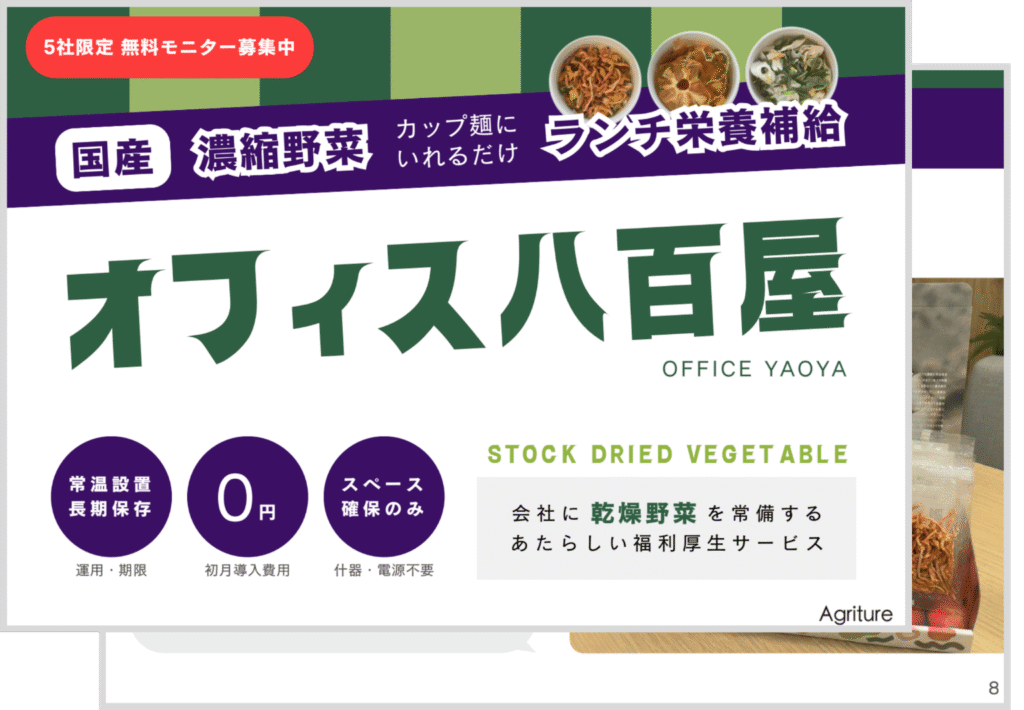
- Service details and vegetable lineup
- Pricing and plans
- How adoption and operation work
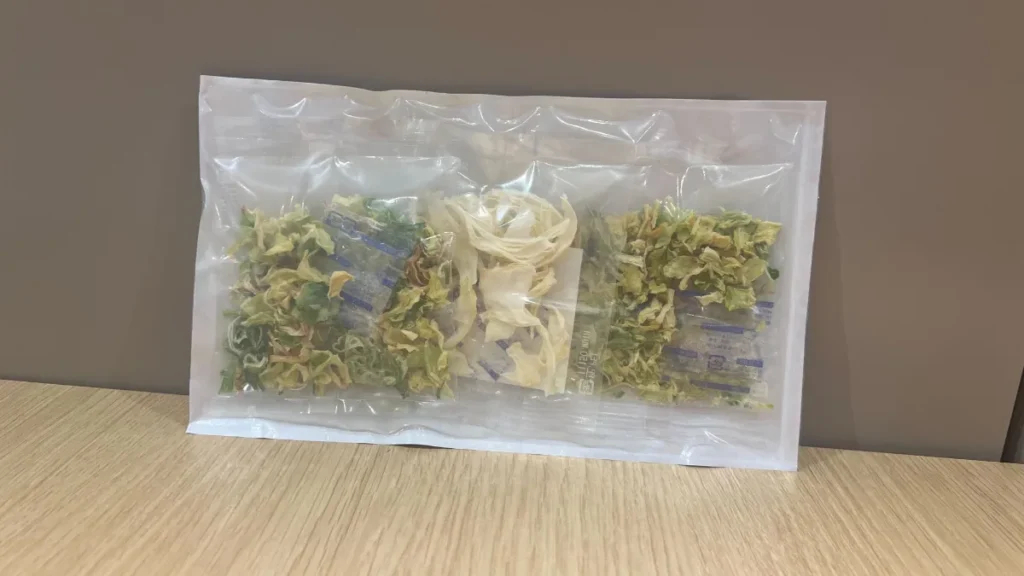
Sample sets are also available. Download the materials for details!
We offer sample sets so you can try Office Yaoya in small quantities. See the materials for details.
Creating a meal environment in a small space
Necessary equipment and cost
You don't need large-scale equipment to set up a meal environment at a small office.
| Equipment | Cost guide | Space needed |
|---|---|---|
| Electric kettle | ¥3,000–5,000 | 20 cm square |
| Small refrigerator (around 46 L) | 15,000-20,000 yen | 45 cm wide × 50 cm deep |
| Microwave | 8,000–15,000 yen | 50 cm wide × 40 cm deep |
| Food storage shelf | ¥3,000–5,000 | 60 cm wide × 30 cm deep |
| Total | 29,000-45,000 yen | About 1 m² |
With just one square meter of space, you can set up a basic meal environment. The initial investment comes to only about 30,000-50,000 yen, too.
Layout ideas
Here are three points for making the most of a limited space.
Use the walls: Wall-mounted shelves and magnetic storage let you keep food and cutlery without taking up floor space.
Create a dual-purpose desk space: Set up a counter table as a shared space for both work and meals. For an office of fewer than 10 people, 3-4 seats is plenty.
Be mindful of zoning: Separating the food-storage area, prep area, and dining area keeps the flow smooth even in a small space.
Hygiene-management points
Since you're handling food, hygiene management is essential. Set at least the minimum rules to keep even at a small office.
- Refrigerator temperature check (once a week)
- Checking best-before dates and managing stock rotation
- Cleaning rules for the shared space (a rotation system is recommended)
- Sharing food-allergy information
Especially with food allergies, being small means you should find it easier to grasp everyone's information. Be sure to check when selecting the food you'll keep on hand.
Cases where small companies boosted hiring power with meal benefits
The case of web design firm D (8 people)
Company D had the problem that "people don't come because we have no benefits."
Even when asked "what benefits do you have?" in a hiring interview, all they could answer was "nothing in particular." They say candidates declined over this many times.
What they introduced was a combination of keeping dried-vegetable soup and drip coffee on hand, plus lunch delivery once a week. The investment was about 40,000 yen a month.
As a result, they were able to post "meal benefits available" on their recruiting site, and applications rose 30% year on year. The offer-acceptance rate improved, too.
The executive said, "If 40,000 yen a month changes our hiring power this much, I wish we'd done it sooner."
The case of tax-accountant firm E (5 people)
Company E had the problem that overtime continued during the busy tax-filing season and staff meals went off-track.
What they introduced was keeping dried vegetables, instant miso soup, and rice balls on hand. About 15,000 yen a month.
The reassurance of "being able to have a warm soup even when working late" contributed greatly to maintaining motivation in the busy season. They also saw the result of their turnover rate dropping to zero.
The case of startup F (10 people)
Company F was right after fundraising and urgently needed to hire talented engineers.
But at a stage where revenue wasn't yet stable, there was no room to introduce expensive benefits. So what they chose was a plan combining meal-subsidy vouchers (3,500 yen/person a month) with keeping health foods on hand in the office.
The company's monthly cost was just under 50,000 yen. Even so, being able to present "meal subsidy available" and "office stocked with health foods" reportedly became a point of differentiation from larger companies.
Subsidies and tax advantages worth knowing
Making use of the meal-subsidy tax-free allowance
As touched on earlier, a meal subsidy becomes tax-free if it meets certain conditions.
| Condition | Details |
|---|---|
| Company-cost ceiling | Within 3,500 yen a month |
| Employee's self-payment | 50% or more of the meal cost |
| For in-kind provision | Provide the meal itself (cash provision is not allowed) |
By making use of this tax-free allowance, the company can record it as a welfare expense and the employee owes no income tax. Small companies find it especially easy to feel the tax-saving effect.
Subsidies related to health management
Depending on the municipality, some offer subsidies for small and mid-size companies working on health management.
Try searching for "health management subsidy [your city]" (your location). Meal measures are sometimes eligible.
In Tokyo, for example, you may be able to get part of the cost of setting up a meal environment covered under the "Workplace Environment Improvement Subsidy."
Tips for expensing welfare costs
For small companies, simplicity in expense processing also matters.
The cost of keeping dried vegetables and soup on hand can be processed as a "welfare expense." However, if only specific employees use it, it may be treated as "salary," so the point is to keep it in a form all employees can use.
A dried-vegetable meal benefit that fits offices of fewer than 10 people
What suits small offices especially well is Office Yaoya (office greengrocer) which Kai Group × Agriture began offering in earnest in April 2026. Individually packaged dried vegetables—100% domestic vegetables, no sugar or additives, low-temperature dried—designed so you can supplement vegetables just by adding them to cup noodles or miso soup. From a few thousand yen a month, no initial cost, and shelf-stable for 3 months or more so no refrigerator is needed—even an office of fewer than 10 people can start with minimal initial investment and operational burden. Because you can appeal to food-loss reduction through upcycling off-spec vegetables at the same time, it also works for startups' recruiting branding.
Learn about Office Yaoya
We have prepared materials
- Service details and vegetable lineup
- Pricing and plans
- How adoption and operation work
Sample sets are also available. Download the materials for details!
We offer sample sets so you can try Office Yaoya in small quantities. See the materials for details.
Summary
Even a small office of fewer than 10 people can absolutely introduce meal benefits.
If anything, being small is a strength—you can respond flexibly, tailored to each person's needs.
The most recommended first step is keeping dried-vegetable soup or miso soup on hand in the office. Zero initial investment, startable from a few thousand yen a month, and the storage space fits on a single shelf.
We at Agriture handle office packs made with Kyoto-grown dried vegetables. Soups you can enjoy just by adding hot water—the aroma of Kujo green onion, the sweetness of Shogoin daikon—make each day's lunch just a little special.
Questions like "can even a small office like ours use it?" are very welcome. Feel free to reach out.
FAQ
Recommended reading
Sustainable initiatives / Commercial dried vegetables / Product lineup / How to Choose a Dried Fruit Assortment: 10 Points to Avoid Regret / How many apples a day is too many? A thorough look at the right amount and health effects
Download the office dried vegetable materials
We will send the materials to your email address based on the information you provide.
- Five tips for getting a health-management meal measure approved | Data and cost-effectiveness
- Health management and recruitment branding | Toward being a company chosen for its meal-related employee benefits
Author of this article
Related articles
-
 [2026 edition] What is a meal subsidy as an employee benefit? A guide to adoption steps and a comparison of popular services
 -
[2026 edition] Meal-subsidy benefits usable at convenience stores | 3 ways to adopt them tax-free
-
[2026 edition] 6 disadvantages of placed staff meals and how to avoid them | An adoption checklist to avoid failure
-
 A Must-See for HR: 12 Measures to Raise Employee Satisfaction Through Benefits
 -
 Food Questions in the Health and Productivity Management Survey: What to Write to Score Points
 -
Summary of tax benefits for dining subsidies | Tax-exemption requirements and expense booking
-
Food Programs for Health and Productivity Management: How Much Will It Actually Cost for a Company Our Size?
-
 Solving the office vegetable shortfall | How to choose a placed dried-vegetable service