
[2026 edition] 6 disadvantages of placed staff meals and how to avoid them | An adoption checklist to avoid failure

“An office snack service sounds convenient, but aren’t there problems in actual operation?”—what HR and general affairs staff considering adoption first want to know is not the merits but the demerits. Precisely because it’s a measure with a fixed monthly cost of tens of thousands of yen, understanding the failure patterns first can serve both as persuasive material for internal approval and as a filter for selecting a service. In this article, for the 2026 edition, we have organized the six representative demerits of office snack services, workarounds for each, a comparison of weak points by service type, a pre-adoption checklist, and alternatives—such as the one operated by the Kai Group × Agriture—that minimize the operational burden. Office Yaoya (office greengrocer)—like this, which minimizes the operational burden.
TOC
What is an office snack service | The market expanding in 2026 and its background
An office snack service is the general term for a service that installs a dedicated refrigerator or rack in the office and delivers salads, prepared dishes, boxed lunches, dried vegetables, and the like on a regular basis. Because it can be started from tens of thousands of yen a month—compared with the initial investment of building a new staff cafeteria (from 10 million yen)—the number of adopting companies is spreading in 2025–2026 as the number of companies certified as Health & Productivity Management Outstanding Organizations grows. On the other hand, there are cases where, once operation begins, people say “it wasn’t what I expected,” so it’s important to choose with an understanding of both the merits and the demerits.
Main types of office snack services
Even though we say “office snack service” in one breath, the provision format splits into four types. Because how the demerits show up also changes with the provision format, let’s organize this first.
- Refrigerated type (salads and prepared dishes): OFFICE DE YASAI, Office Okan, etc.
- Frozen type (boxed lunches): Pan for You Office, Minna no Shokudo, etc.
- Room-temperature type (snacks and dried vegetables): Office Glico, snaq.me, Office Yaoya, etc.
- Meal ticket type: Ticket Restaurant, etc. (dining subsidy type)
Six representative demerits of office snack services
Summarizing the operational feel of adopting companies, the demerits come down to roughly six. If you grasp each together with “why it happens” and “how to avoid it,” you can also be ready for questions in the approval process.
Demerit 1: A fixed monthly cost arises (making it hard to zero out)
Refrigerated and frozen office snack services typically cost 30,000–100,000 yen a month, and the cost rises in proportion as the number of people increases. Because product cost, restocking fees, and refrigerator lease fees are included, it’s hard to break even simply by collecting from employees, and it takes the form of the company bearing the cost continuously.
| Employee headcount | Monthly guide | Annual burden |
|---|---|---|
| 30 people | 30,000–50,000 yen | 360,000–600,000 yen |
| 50 people | Around 50,000 yen | Around 600,000 yen |
| 100 people | Around 100,000 yen | Around 1,200,000 yen |
| 200 people or more | From 200,000 yen | From 2,400,000 yen |
Demerit 2: High risk of food loss and disposal (especially the refrigerated type)
Refrigerated salads and prepared dishes have a short best-before date of 2–3 days, and in the early adoption period when the usage rate is hard to read, the disposal rate tends to be high. There are three structural factors that create disposal risk.
- Best-before date of 2–3 days: if you can’t accurately predict consumption speed, surplus stock arises
- Unstable usage rate in the early adoption period: a disposal rate of around 10–20% is reported as a guide
- Bearing the disposal cost: depending on the contract, it is passed on to the company and added to the fixed monthly cost
Note also that the more a company champions the SDGs and food-loss reduction, the more likely it is to feel uncomfortable with operations premised on disposal.
Demerit 3: You need to secure a refrigerator, power supply, and installation space
The refrigerated and frozen types require refrigerator installation space and a power supply. Because they occupy a corner of the kitchenette or break room, the adoption hurdle is higher for companies with cramped offices or small single-floor offices. Since refrigerators also create a further cost difference between leasing and purchase, always confirm before adoption “whether it can physically be placed” and “who bears the electricity cost.”
Demerit 4: Employee usage rate doesn’t grow / it’s used only by some people
“We installed it, but no one picks it up” is a common failure with office snack services. The causes of a usage rate that doesn’t grow can be classified mainly into three.
- Placement problem: in a tucked-away space that doesn’t stand out / off the traffic line
- Product lineup mismatch: doesn’t match employees’ tastes, health orientation, or eating patterns
- Insufficient internal announcement: it simply isn’t known / how to use it isn’t communicated
When the usage rate stays low (e.g., under 20%) at the three-month mark after adoption, many companies consider reviewing the contract.
Demerit 5: Operation stalls at handover of the person in charge
An office snack service requires continuing “restock ordering, inventory management, usage records, and responding to inquiries from employees.” There are failure examples where the work stalled at the transfer or resignation of the general affairs person in charge, and six months later they noticed products with expired best-before dates lined up. The workaround is to build a manual and a multi-person responsibility structure from the start.
Demerit 6: Cancellation and service changes incur costs
Many office snack services set a minimum usage period of 3–6 months, and mid-term cancellation may incur a penalty. If the company is leasing the refrigerator, a return procedure is also needed. Because “it didn’t suit us, so switch to another service” can’t be done instantly, always confirm the cancellation terms before contracting.
Learn about Office Yaoya
We have prepared materials
- Service details and vegetable lineup
- Pricing and plans
- How adoption and operation work
Sample sets are also available. Download the materials for details!
We offer sample sets so you can try Office Yaoya in small quantities. See the materials for details.
Comparison of demerits by service type
How the demerits show up differs by provision type. Please compare with a view to choosing the type that suits your company’s resources and work style.
| Type | Main demerits | Mitigation measures |
|---|---|---|
| Refrigerated type (salads, prepared dishes) | Disposal loss, refrigerator space, short best-before date | Install in a high-usage location, use a reservation system in combination |
| Frozen type (boxed lunches) | Needs a freezer, thawing time, weak sense of freshly cooked | Install a large freezer, secure a microwave |
| Room-temperature type (snacks) | Nutritional imbalance, weak healthy impression | Combine nuts, dried fruit, and dried-vegetable items |
| Room-temperature type (dried vegetables) | It takes time for the “add-a-little” habit to take hold | Hold a tasting event and announce recipes at adoption |
| Meal ticket type | Limited partner stores, out-of-pocket cost on site required | Select partner stores, distribute a usage guide |
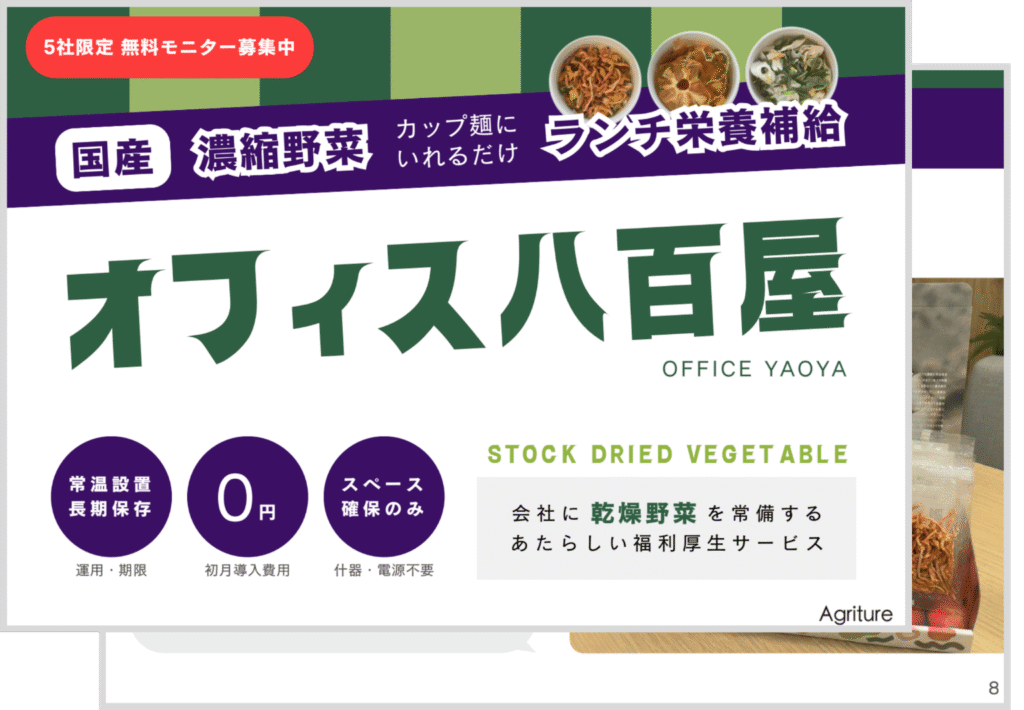
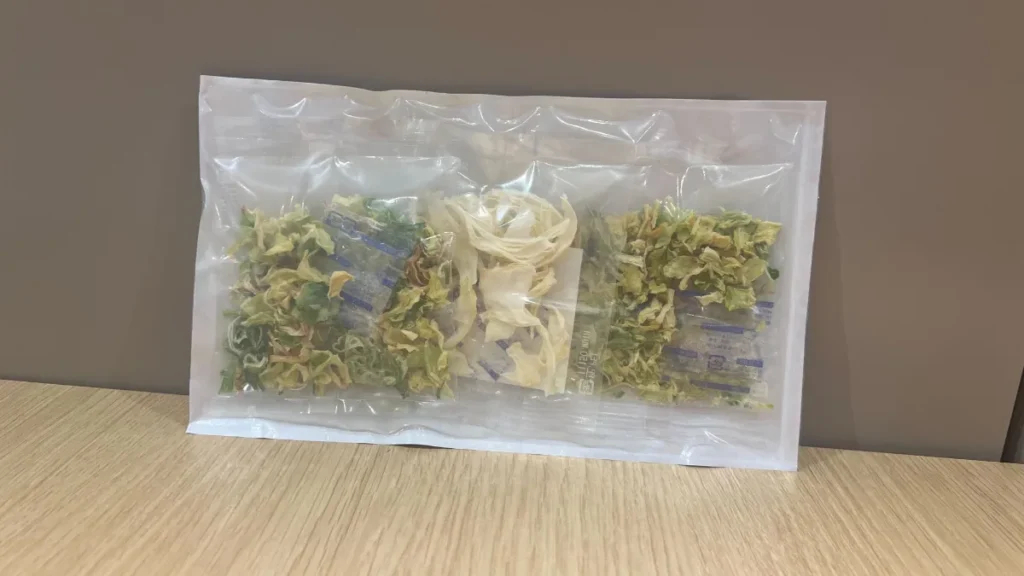
The room-temperature type has the lowest disposal loss and installation hurdle. For example, the service that Agriture Inc. of the Kai Group began fully providing in April 2026, Office Yaoya (office greengrocer) is designed so you can replenish vegetables simply by adding individually wrapped dried vegetables—100% domestic vegetables, no added sugar or additives, low-temperature dried—straight into cup noodles or miso soup. With room-temperature storage of 3 months or more, it needs no refrigerator, has almost zero disposal loss, and no initial cost, drawing attention as an option that avoids the three big demerits of the refrigerated type. Another point is that it can simultaneously appeal to food-loss reduction through the upcycling of off-spec vegetables.
Five checkpoints to avoid the demerits
If you confirm the following five before adoption, you can greatly reduce post-operation trouble. These are viewpoints you can use as-is in internal approval documents.
- Employee needs survey: use a questionnaire to grasp “the desired form of dining subsidy” and “current dining issues.” Makes the usage rate easier to read
- Compare quotes from three or more companies: always compare fee structures, cancellation terms, minimum usage periods, and who bears disposal costs
- Make use of a trial period: run a 1–3 month test adoption to gather usage rates and employee feedback before the main contract
- Turn operations into a manual: document restocking, inventory, and inquiry handling so it doesn’t stall even when the person in charge changes
- Confirm the tax-exemption requirements: employees bear half or more of the meal cost, and it stays within the monthly cap
Alternatives to office snack services | Options with a smaller operational burden
As alternatives for cases of “the refrigerated type has too heavy an operational burden” or “we don’t want to generate disposal loss,” we introduce three options in which the operational burden is minimized.
Alternative 1: room-temperature-storage office snack service
The room-temperature type—centered on dried vegetables, freeze-dried soups, and healthy snacks—can be operated with no refrigerator and almost zero disposal loss. A small-scale start from a few thousand yen a month is possible, fitting even offices of 10 or fewer people. With individually wrapped dried vegetables that keep at room temperature for 3 months or more, the burden of managing best-before dates is also minimized.
Alternative 2: meal ticket type (using external partner stores)
A meal ticket system such as Ticket Restaurant requires no installation space or power supply, since there is no physical installation inside the office. It also fits companies that combine telework and sales roles that are often out on the road. If the company’s burden is up to 3,750 yen a month, it can be operated within the tax-exempt bracket.
Alternative 3: dining subsidy via a benefits platform
Benefits platforms such as Benefit Station and Reloclub include dining-related menus. For 500–1,500 yen per person a month, you can contract multiple benefits together, with almost zero operational burden. It is a format that is easy to adopt at medium-sized or larger companies.
FAQ | Office snack service demerits Q&A
Learn about Office Yaoya
We have prepared materials
- Service details and vegetable lineup
- Pricing and plans
- How adoption and operation work
Sample sets are also available. Download the materials for details!
We offer sample sets so you can try Office Yaoya in small quantities. See the materials for details.
Summary | Understand the demerits, then choose “the type that suits your company”
The demerits of office snack services come down to six: “fixed monthly cost,” “disposal loss,” “refrigerator space,” “unstable usage rate,” “handover of the person in charge,” and “cancellation cost.” These can be addressed in advance with five checkpoints (needs survey, comparison of three companies, trial, manualization, tax-exemption requirements).
If you want to minimize the operational burden, it’s realistic to start with room-temperature dried vegetables and healthy snacks. Office Yaoya (office greengrocer) A service with no initial cost and almost zero disposal loss, like this, can greatly avoid the demerits of office snack services. Placed staff meals, chilled vs. room-temperature | 5 differences and how to choose and Office snack adoption guide | A comparison of pricing and selection across 8 stocking-service providers Checking this as well brings into view the option that fits your company.
Related article:
- Placed staff meals, chilled vs. room-temperature | 5 differences and how to choose
- Office snack adoption guide | A comparison of pricing and selection across 8 stocking-service providers
- What is a dining subsidy as a benefit? An adoption-procedure and popular-service comparison guide
- A thorough comparison of office snack services! 10 points for how to choose
- Office Yaoya | Just-place-it dried vegetables for disaster preparedness × health management

Download the office dried vegetable materials
We will send the materials to your email address based on the information you provide.
- [2026 edition] What is a meal subsidy as an employee benefit? A guide to adoption steps and a comparison of popular services
- [2026 edition] Meal-subsidy benefits usable at convenience stores | 3 ways to adopt them tax-free
Author of this article
Related articles
-
 [2026 edition] What is a meal subsidy as an employee benefit? A guide to adoption steps and a comparison of popular services
 -
[2026 edition] Meal-subsidy benefits usable at convenience stores | 3 ways to adopt them tax-free
-
 A Must-See for HR: 12 Measures to Raise Employee Satisfaction Through Benefits
 -
 Food Questions in the Health and Productivity Management Survey: What to Write to Score Points
 -
Summary of tax benefits for dining subsidies | Tax-exemption requirements and expense booking
-
Food Programs for Health and Productivity Management: How Much Will It Actually Cost for a Company Our Size?
-
Meal-benefit plans that even small offices of 10 or fewer people can start
-
 Solving the office vegetable shortfall | How to choose a placed dried-vegetable service