
Summary of tax benefits for dining subsidies | Tax-exemption requirements and expense booking

"I've heard meal subsidies can be tax-exempt, but what are the conditions?" "Can we book them as welfare expenses?" These are the first questions HR and accounting staff run into when designing a meal subsidy program. The Income Tax Act sets tax-exemption requirements such as "employees pay at least half the value of the meals" and "the company's share is no more than 7,500 yen per month" (under the FY2026 tax reform, this was raised to 7,500 yen from 3,500 yen per month, where it had stayed for 42 years). If you understand the requirements correctly, you can implement a meal subsidy without reducing employees' take-home pay. This article covers the tax-exemption requirements for meal subsidies, 3 practical patterns, how to book the expenses, and the service run by the Kai Group × Agriture Office Yaoya (office greengrocer) which we cover here.
- Tax-exemption requirements for meal subsidies and the latest on the FY2026 reform
- Three ways to provide meal subsidies tax-free
- How to handle the expense booking in concrete terms
- Practical examples of meal subsidies using dried vegetables
TOC
Why the tax advantages of meal subsidies are drawing attention
"We want to provide employees a meal subsidy, but what happens with taxes?"—this is one of the most common questions from general affairs and HR staff.
Get meal subsidies wrong, and they become the employee's subject to payroll taxation. But design the program correctly and you can provide them tax-free, while the company can also book them as welfare expenses.
What's more, the FY2026 tax reform The tax-exempt allowance has been greatly expanded. For meals provided on or after April 1, 2026, the tax-exempt limit is 7,500 yen per month. If you're considering introducing or reviewing a meal subsidy program, now is the ideal time.
Key points of the FY2026 tax reform | The first major revision in 42 years
The FY2026 (Reiwa 8) tax reform made a major change to meal subsidies. The new limit applies to meals provided on or after April 1, 2026.
Overview of the revision
| Item | Before the revision | After the revision |
|---|---|---|
| Tax-free ceiling | 3,500 yen per month | 7,500 yen per month |
| Late-night meal allowance for night-shift workers (cash payment) | 300 yen or less per meal | 650 yen or less per meal |
| Frozen period | 42 years since 1984 | Revised from FY2026 |
This is, the first increase in 42 years. The background is the rise in prices in 2025–2026, and the government positions meal subsidies as "a means of effectively raising wages."
It applies to meals provided on or after April 1, 2026. It is already in effect, and the current tax-exempt limit is 7,500 yen per month.
Concrete benefits for companies
Let's look at what changes with the expanded exemption cap, in concrete figures.
| Case | Before the revision | After the revision |
|---|---|---|
| Company-borne cap / person / month | 3,500 yen | 7,500 yen |
| Annual welfare-expense cap for a 50-person company | 2.1 million yen | 4.5 million yen |
In other words, the company can cover up to 7,500 yen per person per month without it being taxed as salary (this assumes employees pay at least half the value of the meals, so in this case the meal value would be 15,000 yen or more per month). This makes it easier to book the cost of office snack boxes or dried vegetable installations as welfare expenses.
Three requirements for providing meal subsidies tax-free
To make meal subsidies tax-exempt, you must meet the requirements set out in the Income Tax Act directives.
Requirement 1: The employee bears at least half of the meal's value
Rather than the company covering the full amount, the employee must bear 50% or more of the meal's value themselves. The value is judged, as a rule, by "market price, not raw-material cost." For example, if you provide a dried-vegetable set worth 200 yen per meal, the company's share becomes tax-exempt as long as the employee bears 100 yen or more. Conversely, if the company hands out meals for free, the full amount is treated as salary and becomes taxable—so be careful.
| What is provided | Meal value | Employee's share | Company's share | Verdict |
|---|---|---|---|---|
| Dried-vegetable set | 200 yen | 100 yen | 100 yen | Tax-exempt ✅ |
| Catered bento | 500 yen | 250 yen | 250 yen | Tax-exempt ✅ |
| Company-cafeteria lunch | 700 yen | 200 yen | 500 yen | Taxable ❌ (employee share under half) |
Requirement 2: The company's share is within 7,500 yen per month
(Value of the meals) − (employee's contribution) must be no more than 7,500 yen per month (excluding consumption tax and local consumption tax). If this requirement isn't met, not just the excess but the company's entire contribution is taxed as salary. For example, if the company pays 8,000 yen per month, the full 8,000 yen, not 500 yen, is treated as salary. When combining several meal subsidies, such as a staff cafeteria, office snack boxes, a dried vegetable service and meal tickets, design them so the total stays within 7,500 yen.
Requirement 3: It must be an in-kind provision
As a rule, in-kind provision of meals is required. If you pay a meal allowance in cash, the full amount is treated as taxable salary regardless of the amount, so be careful. For example, "adding a 3,000 yen monthly lunch allowance to salary" is not recognized as a meal subsidy, because the employee can spend it freely. The only exception is when cash of no more than 650 yen per meal is paid to night-shift workers because late-night meals can't be provided in kind.
On the other hand, meals provided via meal tickets or electronic money are recognized as in-kind provision if they meet certain requirements (usable only at specific stores, usable only for meals, non-resalable, personal use only). Edenred's "Ticket Restaurant" and RELO Club's meal-subsidy electronic money are representative examples.
| Method | Whether tax-free | Notes |
|---|---|---|
| Company cafeteria / catered bento | ○ | The most common method |
| Placed-cafeteria service | ○ | Qualifies as in-kind provision |
| Stocking dried vegetables / health foods | ○ | Qualifies as in-kind provision |
| Meal tickets (paper / electronic) | △ | Allowed if requirements are met |
| Cash meal allowance | × | Fully taxable |
Learn about Office Yaoya
We have prepared materials
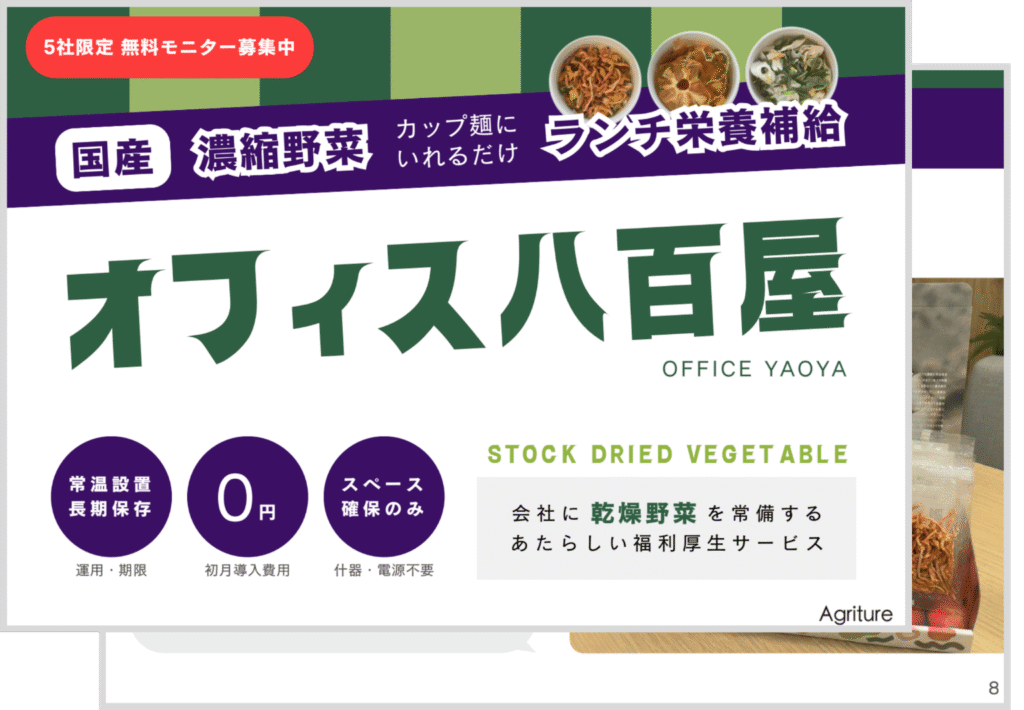
- Service details and vegetable lineup
- Pricing and plans
- How adoption and operation work
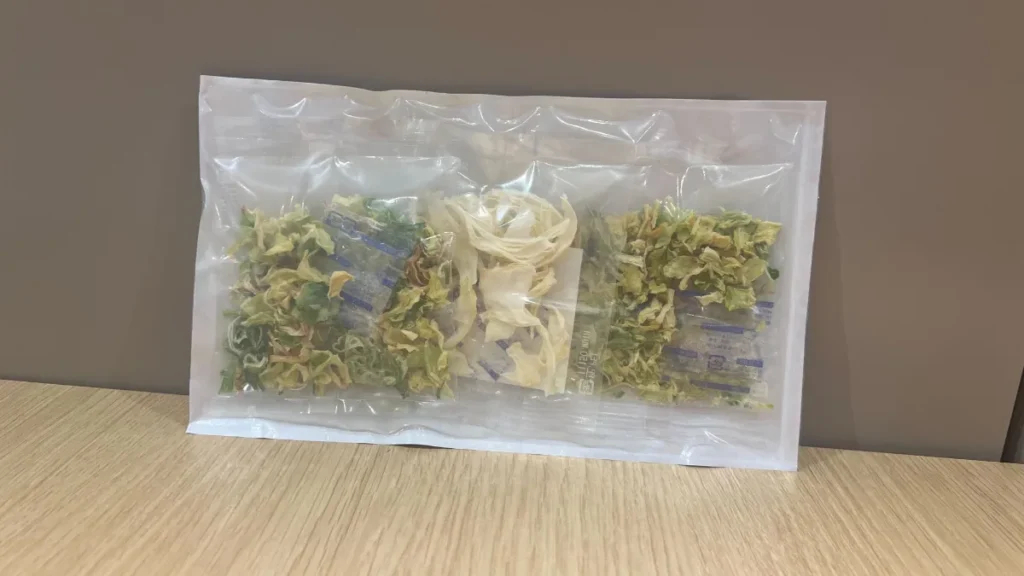
Sample sets are also available. Download the materials for details!
We offer sample sets so you can try Office Yaoya in small quantities. See the materials for details.
How to book meal subsidies as expenses
Here are the key points for booking them as welfare expenses.
Conditions for handling it as welfare expenses
- It must be a program all employees can use (executives only is not allowed)
- It must be stated in internal rules (welfare rules)
- Records of usage must be kept
Journal-entry example
When purchasing 30,000 yen of dried vegetables per month and employees buy at 50 yen per item:
| Account | Debit | Credit |
|---|---|---|
| Welfare expenses | 15,000 yen | — |
| Cash | — | 15,000 yen |
| Purchases (food) | 30,000 yen | — |
| Accounts payable | — | 30,000 yen |
* The employee's share (15,000 yen) is booked as miscellaneous income
Points to note
Honestly, the tax treatment of meal subsidies has many fine-grained rules, so it's safest to consult a tax accountant when first designing the program. Because judging the tax-exemption requirements in particular depends on individual circumstances, proceeding on your own judgment alone carries risk.
Practical patterns for meal subsidies using dried vegetables
Here we introduce patterns for providing meal subsidies at low cost while meeting the tax-exemption requirements.
Pattern A: Stocked dried vegetables (lowest cost, fastest to launch)
A simple approach of placing a shelf or rack in the office and displaying dried vegetables, freeze-dried soups, and health snacks. Employees buy at 50–100 yen per item, and the company books the difference from the purchase cost as welfare expenses. You can start from 10,000–30,000 yen a month (for around 50 people), and with no initial fee, no refrigerator, and no electricity cost, it's the pattern with the lowest barrier to entry.
| Item | Details |
|---|---|
| Initial cost | Free (depending on plan) |
| Monthly guide | 10,000–30,000 yen / around 50 people |
| Company's share per meal | 50 to 150 yen |
| Employee's share | 50–100 yen / item |
| Tax-exemption requirements | Easy to meet (half-share + in-kind provision) |
| Operational effort | Restocking just 1–2 times a month |
The Kai Group × Agriture's Office Yaoya (office greengrocer) is a representative example of this pattern. Individually wrapped dried vegetables—100% domestic vegetables, no added sugar or additives, low-temperature dried—are designed to be added straight to cup noodles or miso soup, resolving vegetable shortfalls without changing employees' eating habits.
Pattern B: Meal-subsidy tickets (for external lunch demand)
An approach of distributing meal tickets or electronic money (Ticket Restaurant, etc.) with a monthly cap. Employees can use them at nearby partner restaurants or for delivered bento, so it suits companies with a culture of eating lunch out or those combining remote work.
| Item | Details |
|---|---|
| Initial cost | Depends on the adopting company (generally 50,000–300,000 yen) |
| Monthly guide | 7,500 yen per person (maximum within the tax-exempt limit) |
| Applicable scenarios | Dining-out lunch, delivered bento, convenience stores |
| Tax-exemption requirements | Meeting the meal-ticket requirements (specific stores, non-resalable, etc.) |
| Operational effort | Managing ticket issuance and usage records |
Pattern C: Combined type (stocking + tickets)
An approach of keeping dried vegetables and health snacks on hand in the office while also using meal tickets for lunch. It easily accommodates diverse working styles (in-office, remote, sales roles that are often out), and has the strength of letting you write "multiple meal initiatives implemented" on a health-management application.
| Item | Details |
|---|---|
| Estimated total per month | 5,000–7,500 yen per person |
| Tax-exemption cap | Within 7,500 yen combined |
| Health-management application | Can be listed as multiple initiatives (raises the score) |
| Applicable company size | Suits companies of 30 or more |
Combining "baseline nutrition via stocking" with "supporting individual meal choices via tickets" works for both health management and improving employee satisfaction.
Learn about Office Yaoya
We have prepared materials
- Service details and vegetable lineup
- Pricing and plans
- How adoption and operation work
Sample sets are also available. Download the materials for details!
We offer sample sets so you can try Office Yaoya in small quantities. See the materials for details.
FAQ
Recommended reading
Sustainable initiatives / Commercial dried vegetables / Product lineup / The appeal of heirloom vegetables in Hokuriku! Regional brands such as Kaga vegetables thoroughly explained / Solve the Vegetable Shortage of Living Alone with Dried Vegetables | A New, Effortless Habit
Download the office dried vegetable materials
We will send the materials to your email address based on the information you provide.
- Food Programs for Health and Productivity Management: How Much Will It Actually Cost for a Company Our Size?
- Food Questions in the Health and Productivity Management Survey: What to Write to Score Points
Author of this article
Related articles
-
 [2026 edition] What is a meal subsidy as an employee benefit? A guide to adoption steps and a comparison of popular services
 -
[2026 edition] Meal-subsidy benefits usable at convenience stores | 3 ways to adopt them tax-free
-
[2026 edition] 6 disadvantages of placed staff meals and how to avoid them | An adoption checklist to avoid failure
-
 A Must-See for HR: 12 Measures to Raise Employee Satisfaction Through Benefits
 -
 Food Questions in the Health and Productivity Management Survey: What to Write to Score Points
 -
Food Programs for Health and Productivity Management: How Much Will It Actually Cost for a Company Our Size?
-
Meal-benefit plans that even small offices of 10 or fewer people can start
-
 Solving the office vegetable shortfall | How to choose a placed dried-vegetable service