
[2026 edition] Meal-subsidy benefits usable at convenience stores | 3 ways to adopt them tax-free

“We want to introduce a dining subsidy system usable at convenience stores” “We want to deliver convenience-store-based benefits to telework employees too”—these are consultations increasing from HR and general affairs staff. A convenience-store dining subsidy is a new form of benefit that requires no physical installation space inside the company and can be delivered fairly to members who telework, travel, or work in sales. It splits into three patterns—the convenience-store e-money type, the meal-ticket type, and the placed-convenience-store type—and any of them can be implemented tax-free up to 7,500 yen a month (applicable from April 1, 2026; before the revision it was 3,500 yen) if the income-tax-law tax-exemption requirements are met. In this article, for the 2026 edition, we have organized the mechanism of convenience-store dining subsidies, the three adoption methods, service comparisons, adoption procedures, failure examples, and even combinations with dried-vegetable services—like the one operated by the Kai Group × Agriture. Office Yaoya (office greengrocer) we have organized even dried-vegetable-type combinations like this.
TOC
What is a convenience-store dining subsidy | A work-style-friendly benefit drawing attention in 2026
A convenience-store dining subsidy is a benefit system in which a company partners with major convenience-store chains such as Seven-Eleven, FamilyMart, and Lawson, or via a meal-ticket service, subsidizing part of employees’ convenience-store spending. The point that it requires no physical installation—unlike a staff cafeteria or catered boxed lunches—and can be delivered fairly to employees with diverse work styles such as telework, sales, and store work is the factor behind the spreading number of adopting companies in 2025–2026.
Merits of a convenience-store dining subsidy
- Independent of work style: supports all of office attendance, telework, sales on the road, and store work
- No installation space needed: no refrigerator, power supply, or fixtures needed, so the adoption hurdle is low
- High freedom of product choice: employees can choose meals by their own preference
- Can be operated tax-free: if the requirements are met, tax-free up to 3,500 yen a month (7,500 yen after the revision)
- Directly tied to recruitment branding: you can appeal “convenience-store dining subsidy available” on job postings
Three requirements to make it tax-free at convenience stores
Based on Basic Income Tax Directive 36-38, to make a convenience-store dining subsidy tax-free, the following three requirements must be met.
- Employees bear 50% or more of the meal cost themselves: for example, for a 500-yen boxed lunch per meal, they bear 250 yen or more themselves
- The company’s burden is within the monthly cap: the upper limit is 7,500 yen a month per person (applicable from April 1, 2026; before the revision it was 3,500 yen)
- In-kind provision or an equivalent method: cash provision is not allowed. Meal tickets and e-money (limited to specific stores, non-resellable, personal-use-only) are conditions
Cash provision like “adding 3,000 yen to salary as lunch money” is fully taxable even if it can be used at convenience stores. For detailed tax requirements, see Summary of tax benefits for dining subsidies.
Three adoption methods for convenience-store dining subsidies
Organizing “a dining subsidy usable at convenience stores” and “supplementing the dining environment by bringing a convenience store into the company” as separate things keeps the tax discussion and adoption decision from getting confused. The representatives of the former are the “meal-ticket type” and “benefit-platform type,” and of the latter, the “placed-convenience-store type.” Choose by how well they fit your company’s work style, scale, and tax requirements.
Method 1: meal-ticket and e-money type (the most widespread)
Edenred’s “Ticket Restaurant” is the representative example. You charge the monthly subsidy amount onto a dedicated IC card / smartphone app, and it can be used as meals at partner stores (restaurants and convenience stores nationwide, including the three major convenience-store chains; Edenred official information cites over 250,000 member stores). Employees pay at purchase with the dedicated card / app, and a mechanism records the usage log on the company side. Because it structurally meets the tax-exemption requirements (limited to specific stores, non-resellable, personal-use-only), the tax processing is stable.
- Suitability: 50 or more employees, telework combined, many sales staff
- Monthly guide: 3,500–7,500 yen per person (within the tax-free bracket)
- Adoption effort: 2–4 weeks from contract to operation start
Supplementary measure: placed-convenience-store type (dining-environment development on a separate axis from dining subsidy)
Convenience-store-type services installed in the office, such as “Seven Vending Machine” and “TUKTUK,” are strictly not a dining subsidy system but a “measure to supplement the in-company dining environment.” It is common for employees to purchase the products by cashless payment, with the company operating it by only providing installation space and bearing part of the electricity cost. It creates a state of “there’s a convenience store inside the company” at zero company cost, with the effect of eliminating the time lost on round trips to the convenience store. The tax point of dining subsidies doesn’t arise, but on job postings you can appeal it as “in-office convenience store fully equipped.”
- Suitability: 30 or more employees, mainly office attendance, a location with no nearby convenience store
- Monthly guide: zero company cost (employee-purchase type) is common
- Adoption effort: 1–2 weeks from installation to operation start
Method 2: convenience-store-partner platform type
A method of contracting a convenience-store-partner dining subsidy menu via a benefit platform such as Benefit Station or Reloclub. Because you can contract multiple benefit measures together, it suits mid-sized and large companies that want to minimize the operational burden. Its strength is that you can operate not only the convenience-store subsidy but also staff cafeteria, health checkups, and gym subsidies all together.
- Suitability: 200 or more employees, already contracting a benefit platform
- Monthly guide: 500–1,500 yen per person (set fee for multiple benefits)
- Adoption effort: a few days if added to an existing contract
Learn about Office Yaoya
We have prepared materials
- Service details and vegetable lineup
- Pricing and plans
- How adoption and operation work
Sample sets are also available. Download the materials for details!
We offer sample sets so you can try Office Yaoya in small quantities. See the materials for details.
Convenience-store dining subsidy service comparison
We compared the main convenience-store-type dining subsidy services. Choosing by your company’s scale and work style is the basic principle.
| Service name | Category | Nature of company burden | Employee self-burden | Tax point |
|---|---|---|---|---|
| Ticket Restaurant | Dining subsidy (ticket type) | From several thousand yen a month as subsidy (designable within the tax-free bracket) | 50% or more of the meal cost | Easy to meet the tax-exemption requirements |
| Benefit Station | Dining subsidy (platform type) | Service usage fee 500–1,500 yen/person + subsidy amount | Self-burden at each menu use | Tax-free treatment depending on the operating method |
| Reloclub | Dining subsidy (platform type) | Service usage fee 500–1,500 yen/person + subsidy amount | Self-burden at each menu use | Tax-free treatment depending on the operating method |
| Seven Vending Machine | Dining-environment supplement (placed convenience store) | Zero yen (only providing installation space) | 100% self-burden of the product cost | No tax point arises |
| TUKTUK | Dining-environment supplement (placed convenience store) | Zero yen (only providing installation space) | 100% self-burden of the product cost | No tax point arises |
As you can see in the “classification” column of the table, Ticket Restaurant and benefit platforms are “dining subsidies,” while the placed convenience store differs in nature as a “dining-environment supplement measure.” For the former, conformity with the tax-exemption requirements is the operational point; for the latter, no company burden arises, so no tax point comes up. For job-posting appeal too, it is accurate to use separate wording: “dining subsidy tax-free up to XX yen a month” and “office convenience store fully equipped.”
Combining a convenience-store dining subsidy with placed dried vegetables
The weak point of a convenience-store dining subsidy is that “it becomes convenience-store-product-centered, and nutrition tends to be imbalanced.” It is pointed out that convenience-store lunches tend to be biased toward carbohydrates and fats from a nutritional-balance perspective (even in data from the Ministry of Health, Labour and Welfare’s “National Health and Nutrition Survey,” the tendency for the busy working-age group’s vegetable intake to fall below the target continues). As an operation to supplement this, the pattern of combining a convenience-store dining subsidy with an office dried-vegetable service is increasing in 2026.
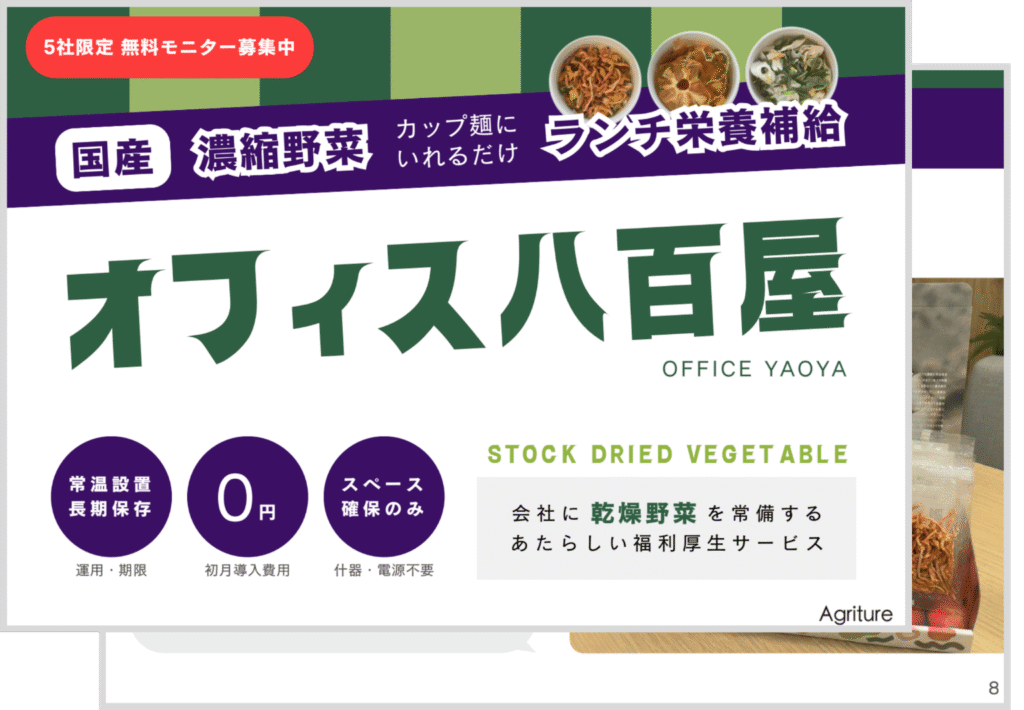
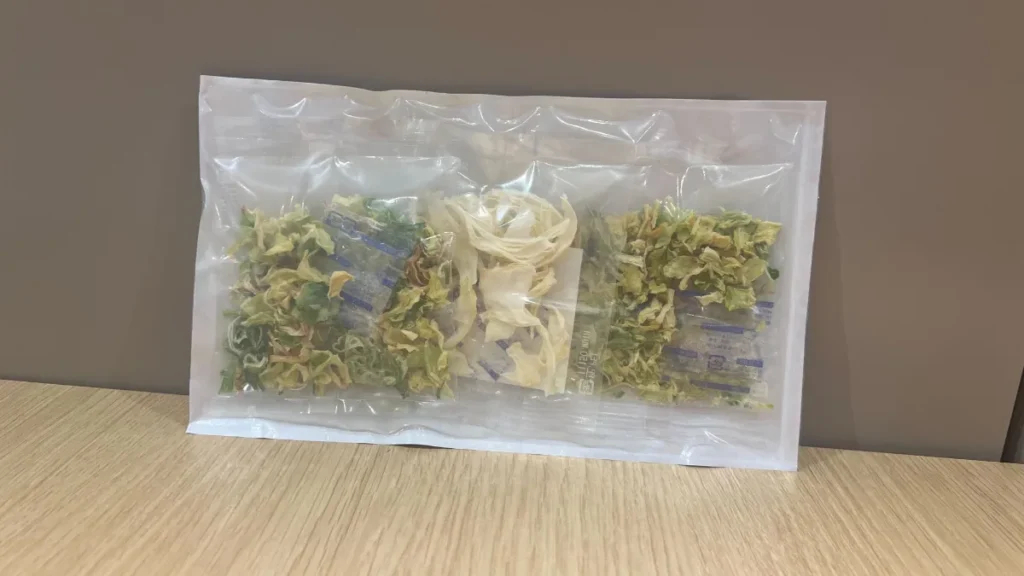
For example, the service that Agriture Inc. of the Kai Group began fully providing in April 2026, Office Yaoya (office greengrocer) is designed so you can replenish vegetables simply by adding individually wrapped dried vegetables—100% domestic vegetables, no added sugar or additives, low-temperature dried—straight into cup noodles or miso soup bought at a convenience store. The “vitamins, dietary fiber, and minerals” that a convenience-store subsidy can’t satisfy can be naturally replenished with the placed service. Because it upcycles off-spec vegetables that can’t reach the market due to poor shape by buying them from producers at a fair price, the point that it achieves both health management and food-loss reduction in a single mechanism is the reason it pairs well with a convenience-store dining subsidy.
Example combination patterns
- Office of about 50 people: Ticket Restaurant 3,500 yen/person + Office Yaoya (dried vegetables always in stock) = monthly budget about 200,000 yen
- Telework-combined company: Ticket Restaurant (usable at convenience stores on home days too) + add-a-little at Office Yaoya on attendance days
- Recruitment-branding-focused: state “convenience-store dining subsidy + health-management dried-vegetable service” clearly on job postings
Adoption procedure for a convenience-store dining subsidy
While a convenience-store dining subsidy has a smaller adoption effort compared with other benefits, developing the tax requirements and internal regulations is important. Proceeding in 4 steps is standard.
Step 1: organize your company’s needs and budget (1–2 weeks)
Use an employee survey to grasp “current lunch consumption patterns,” “convenience-store usage frequency,” and “desired form of dining subsidy.” Fix the monthly budget cap (the tax-free bracket of 7,500 yen is the benchmark) and the number of eligible people.
Step 2: select the method that fits your company from the three types (2–3 weeks)
From the three—meal-ticket type, placed-convenience-store type, and platform type—compare the one that suits your company’s scale and work style with quotes from 2–3 companies. Services that offer a trial period have high usage value.
Step 3: develop internal regulations and confirm taxation (2 weeks)
State “the eligible people, provision method, and usage rules of the dining subsidy” clearly in the benefit regulations, and ask a tax accountant / labor and social security attorney for a final check. Covering the following items gives peace of mind even in a tax audit.
- Regulation-entry items: scope of eligible people, provided amount, provision method, usable stores, usage rules
- Perspective of the tax accountant’s check: conformity with tax-exemption requirements, expense-booking method, management of the annual cap
- Perspective of the labor attorney’s check: whether there is a labor-management agreement, ensuring fairness, developing regulations
- Operational preparation: employee explanation materials, usage guide, inquiry desk
This is a step to fix before the internal announcement.
Step 4: full operation and effect measurement (ongoing)
Measure the effect at 3 months, 6 months, and 1 year after adoption. Track the five indicators—“usage rate,” “employee satisfaction,” “health-checkup data,” “turnover rate,” and “number of recruitment applications”—at fixed points, and use them as application documents for Health & Productivity Management Outstanding Organization certification and as recruitment-page content.
Common failures with convenience-store dining subsidies
Failure 1: cash provision makes it fully taxable
The judgment of cash provision versus in-kind provision splits as follows.
| Operating method | Whether tax-free | Reason for judgment |
|---|---|---|
| Adding a lunch allowance to salary | Fully taxable ❌ | Use can’t be restricted, treated as cash |
| Providing settlement money by convenience-store receipt reimbursement | Fully taxable ❌ | Same as above, treated as cash |
| Dedicated IC card (Ticket Restaurant, etc.) | Tax-free OK ✅ | Specific stores, non-resellable, personal-use-only |
| Meal-ticket booklet | Tax-free OK ✅ | Same as above |
Using a dedicated IC card, e-money, or ticket type is the golden rule.
Failure 2: a design where employees bear less than half of the meal cost
An operation like “the company bears the full cost and distributes 3,500 yen worth of tickets a month” has a self-burden of 0%, so it doesn’t meet the tax-exemption requirements. Always build “employee self-burden of 50% or more” into the system design.
Failure 3: no measures against nutritional imbalance
Convenience-store food has the following tendencies from a nutritional-balance perspective.
- Carbohydrate-centered: rice balls, bread, and noodles are easy to choose
- Excess fat: high intake rate of fried foods, snacks, and sweet breads
- Dietary fiber shortage: low intake of vegetable-type menu items
- Vitamin and mineral shortage: processed-food-centered, so micronutrients tend to be depleted
Combining a dried-vegetable service or placed healthy snacks greatly improves the nutritional balance.
FAQ | Convenience-store dining subsidy Q&A
Learn about Office Yaoya
We have prepared materials
- Service details and vegetable lineup
- Pricing and plans
- How adoption and operation work
Sample sets are also available. Download the materials for details!
We offer sample sets so you can try Office Yaoya in small quantities. See the materials for details.
Summary | Choose from the three types to match your work style
A convenience-store dining subsidy splits into three types—“meal-ticket type,” “placed-convenience-store type,” and “platform type”—and you choose by your company’s scale, work style, and budget. Ticket Restaurant for telework combined, a placed convenience store for attendance-centered, and a benefit platform for composite operation at mid-sized and above—the scenes that fit each are clear.
If you meet the tax-exemption requirements (half self-burden + monthly cap + in-kind provision), it can be operated tax-free up to 7,500 yen a month (applicable from April 1, 2026; before the revision it was 3,500 yen). If nutritional imbalance concerns you, combining it with a dried-vegetable service like the Kai Group × Agriture’s Office Yaoya (office greengrocer) lets you realize both health management and the convenience-store subsidy.
Related article:
- What is a dining subsidy as a benefit? An adoption-procedure and popular-service comparison guide
- Summary of tax benefits for dining subsidies | Tax-exemption requirements and expense booking
- 5 benefits to resolve the vegetable shortage of telework employees
- Office snack adoption guide | A comparison of pricing and selection across 8 stocking-service providers
- Office Yaoya | Just-place-it dried vegetables for disaster preparedness × health management

Download the office dried vegetable materials
We will send the materials to your email address based on the information you provide.
Author of this article
Related articles
-
 [2026 edition] What is a meal subsidy as an employee benefit? A guide to adoption steps and a comparison of popular services
 -
[2026 edition] 6 disadvantages of placed staff meals and how to avoid them | An adoption checklist to avoid failure
-
 A Must-See for HR: 12 Measures to Raise Employee Satisfaction Through Benefits
 -
 Food Questions in the Health and Productivity Management Survey: What to Write to Score Points
 -
Summary of tax benefits for dining subsidies | Tax-exemption requirements and expense booking
-
Food Programs for Health and Productivity Management: How Much Will It Actually Cost for a Company Our Size?
-
Meal-benefit plans that even small offices of 10 or fewer people can start
-
 Solving the office vegetable shortfall | How to choose a placed dried-vegetable service