
Food Programs for Health and Productivity Management: How Much Will It Actually Cost for a Company Our Size?

When you're told "we're going to address meals as part of health and productivity management," the first problem is that there are too many options. Staff cafeterias, boxed lunch delivery, meal vouchers, office snacks, installed fridge services. All of them say they can be used for health and productivity management, but none of them say which will actually work for your company.
Our company, Agriture Inc., operates Office Yaoya (office greengrocer), which places domestic dried vegetables in offices. By far the most common question when companies consult us about introducing it isn't about the program itself. It's "How much will it cost per month for a company our size?"
This article was written to answer that question directly. It organizes the options into six types and ranks them by headcount and budget. It also covers what measures that fall out of use after introduction have in common, what general affairs departments worry about before approval, and tax pitfalls.
This article doesn't cover how to read the survey questions or how to fill out the application. If you're already at the application stage, go to the practical manual at the end of the article.
Learn about Office Yaoya
We have prepared materials
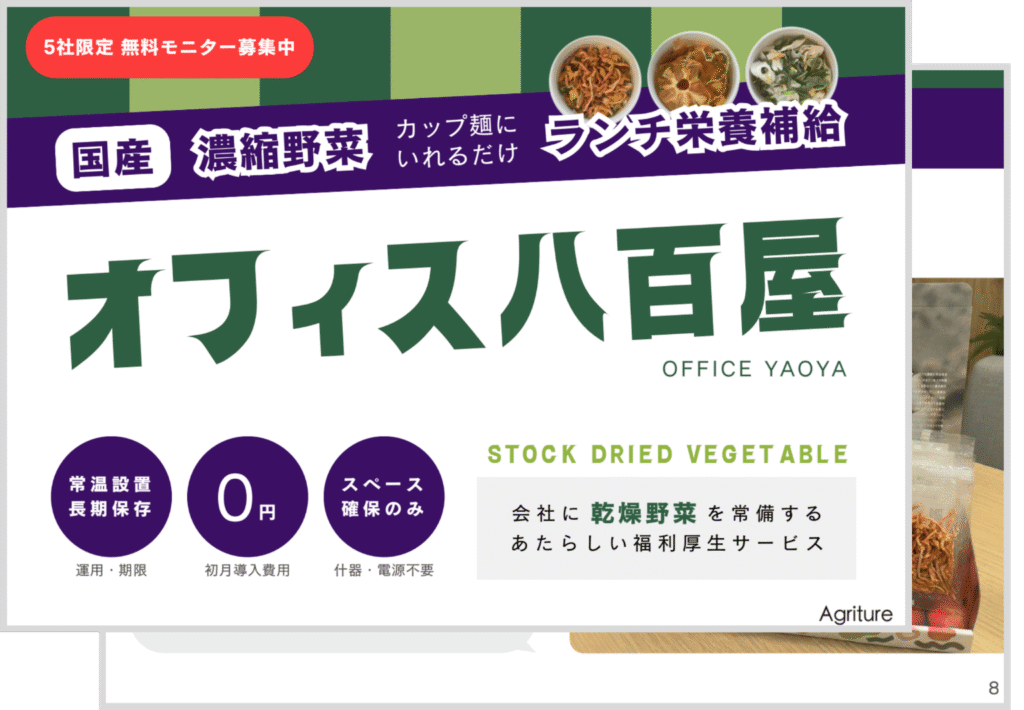
- Service details and vegetable lineup
- Pricing and plans
- How adoption and operation work
TOC
Sample sets are also available. Download the materials for details!
We offer sample sets so you can try Office Yaoya in small quantities. See the materials for details.
Not all workplace meal benefits are the same
Building a new staff cafeteria and putting a single box in the kitchenette are lumped together under the same term, "meal measures." The cost differs by more than 100 times, and so does the effort involved when you want to stop. Unless you separate these first, no comparison holds up.
In actual consultations, three things serve as the basis for decisions.
- How much employees pay per meal. If this is high, people won't use it even if the program exists
- How much the company pays each month. It scales with headcount × unit price, so the conclusion changes with company size
- Whether you can stop when you want to. Underestimate this, and you'll be stuck later
The third is easily overlooked. With types that install fridges or fixtures, removing them is more trouble than bringing them in. After installation work, securing space and announcing it internally, a decision to remove it after a year is hard to get approved. Conversely, something you can start just by placing it and end simply by stopping orders makes the decision to try it much lighter.
In the context of health and productivity management, what matters is less what you introduced than whether it has continued. Give whether it's sustainable the same weight as cost.
There are six types of meal measures a company can use
You could count endless variations, but grouped by how they operate, they come down to six. Each works under clearly different conditions.
1. Staff cafeteria
The most generous option. You can design nutritional balance, and it also becomes a place where employees meet. On the other hand, it requires kitchen equipment and outsourced operation, so it only works at sites that serve a certain number of meals.
For companies with few people per site, or those split across several small sites, it isn't even an option. For companies that already have a cafeteria, reviewing the menu is effective, but considering building one from scratch is limited to a small number of companies of sufficient size.
2. Installed office meal service (refrigerated/frozen)
A refrigerator or freezer is placed in the office and restocked with ready-made dishes or frozen lunches. Because no kitchen is needed, it is far easier to introduce than a cafeteria. It's the type that has grown most in recent years.
There are two sticking points. One is the cost and effort of installation itself. The other is that because it handles products with short best-before dates, unsold items have to be dealt with. When there is waste, a mood of "this didn't suit us" tends to set in, and the decision on whether to continue comes quickly.
3. Boxed lunch delivery / catering
In terms of cost per meal, this is actually very good. Contracting a set number in advance keeps the unit price down. For employees, it's simple: order, and lunch arrives.
The condition for it to work is advance contracts. Numbers are often fixed by the previous day, so it doesn't work for companies that can't predict how many people will be in the office, or those centered on departments that are often out. For companies with fixed office attendance, it's worth considering first.
4. Meal vouchers
Employees are given electronic vouchers they can use at participating restaurants and convenience stores. Because the company doesn't handle anything physical, the administrative burden is the lightest. It also works well for companies with a mix of remote and in-office work.
However, Whether there are participating stores nearby determines its value. At factories, suburban offices and regional sites, you can end up handing out vouchers with nowhere to use them. Before introducing them, check participating stores for each site on a map. In addition, this is a type where falling outside the tax requirements described later makes it taxable as salary.
5. Office snacks and drinks
Snacks and drinks are placed in the office and employees buy them as needed. The barrier to introduction is very low, and satisfaction comes easily. However, it's a weak case to present as "improving meals" in the context of health and productivity management. Its meaning changes depending on what you stock.
For differences by type of product stocked, see Comparison of office snack services.
6. Room-temperature installed service (dried vegetables, etc.)
Items that can be stored at room temperature are placed in a box for employees to use. Our Office Yaoya (office greengrocer) service falls into this category. Because no refrigeration is needed, installation is the lightest, and because the products keep well, there's no waste.
What sets it apart from the other five is that it doesn't provide a meal itself. Employees add it to the cup noodles or instant miso soup they bring, so rather than "eating that dish," it's a matter of "adding vegetables to their usual lunch." I'll go into this difference in detail later.
Put the other way, its limits are also clear. It can't be used without access to hot water. And on its own, it doesn't make a lunch. It assumes each person brings their own main meal. If you want the company to provide lunch, this type is ruled out.
| Type | Installation effort | Waste concerns | Ease of stopping | When it doesn't work |
|---|---|---|---|---|
| Operations outsourcing, inventory management | Very heavy | Yes | Low | Few meals per site |
| Installed office meal service | Heavy | Yes | Somewhat low | No space for installation |
| Delivered bento | Light | Depends on order volume | High | Office attendance is unpredictable |
| Meal-subsidy tickets | Very light | None | High | No participating stores nearby |
| Office snacks | Light | Depends on the products | High | You want to present it as improving meals |
| Room-temperature installed service | Very light | None | High | No hot water / you want to provide lunch itself |
Line them up by headcount and budget, and the choices narrow
This is the heart of this article. I said there are six types, but when you apply them to your own headcount, realistically only two or three remain.
First, let's check how employees think about money. Get this wrong, and no matter how much the company subsidizes, it won't be used. The following are not statistics but the price expectations we've heard from client companies and in sales meetings, contained in burdock and cocoa.
| What employees pay for lunch | How it's perceived |
|---|---|
| Eating out for lunch: 1,000-1,500 yen | Serves as the benchmark they want to stay under |
| Cup noodles 200-300 yen + vegetables 100 yen =400 yen | Still feels like a good deal |
| Boxed lunch for 500 yen | Feels cheap |
| Side dish / single item for 500 yen | Feels a bit expensive |
The same 500 yen feels cheap for a main meal but expensive for a side dish. This line determines whether a measure gets used. For items offered individually, it's safer to assume usage drops once the price goes above about 400 yen.
What remains differs for 10 people versus 100
These are ranges from other companies' quotes we've seen and heard about in consultations with us. They vary with conditions, so they aren't figures you can use as quotes as is. Use them as a guide for deciding the order of your considerations.
| Headcount | Realistic remaining options | Initial cost | Estimated monthly cost to the company | Where companies stumble |
|---|---|---|---|---|
| Up to 10 | Room-temperature installed / snacks | Almost none needed | A few thousand yen to 20,000 yen | May be turned down due to minimum lot requirements |
| 10-20 | Room-temperature installed / vouchers | Almost none needed | 10,000 to 50,000 yen | With few people, voucher fees are relatively expensive |
| 20-50 | Room-temperature installed / vouchers / boxed lunch delivery | Almost none needed | 10,000-100,000 yen | Fixed monthly costs of installed services feel heavy |
| 50-100 | Installed office meal service / vouchers / room-temperature installed | Incurred if refrigeration is installed | 50,000-250,000 yen | Things get complicated quickly when sites are split |
| 100-300 | Installed office meal service / vouchers / boxed lunch delivery | Fixtures and installation work | 150,000-600,000 yen | Attendance rates differ by department, creating a sense of unfairness |
| 300+ | Reviewing the staff cafeteria + combined use | Varies greatly by site | Designed per site | Sites other than headquarters get left behind |
We separated out initial costs because they can matter more than the monthly amount. For options that require refrigeration or fixtures, costs jump in the first year only. Comparing on monthly costs alone leads to the wrong decision.
What this table is meant to show is less the amounts themselves than the more people you have, the harder it is to hand out the same thing to everyone. From around 50 people, differences in attendance rates, sites and departments come to the surface. Try to provide the same thing to everyone, and someone will be left dissatisfied.
Conversely, companies of around 10 people face a different barrier. Many services set minimum user numbers or minimum order amounts, so you may not be able to sign up at all. Check this in advance. In our case, one box holds about 30 packs (30 servings), so companies can start at that unit. We've been introduced at small companies and even at some businesses run by a single person.
Learn about Office Yaoya
We have prepared materials
- Service details and vegetable lineup
- Pricing and plans
- How adoption and operation work
Sample sets are also available. Download the materials for details!
We offer sample sets so you can try Office Yaoya in small quantities. See the materials for details.
What can you do with a budget of 10,000, 50,000 or 100,000 yen?
Here's another angle on the headcount-first approach, since the budget is often decided first. When you're told "up to X yen a month this year," here's what works at each amount.
Up to 10,000 yen a month
At this budget, having the company cover everyone's cost doesn't work. Set it up so that employees pay for themselves and the company provides only the space and the system. With a placed-in-office service where employees pay cashless each time, the company spends almost nothing.
If you force company funding at this budget level, the subsidy per person comes to a few hundred yen a month, and to employees it makes no difference whether it exists. Rather than spreading the money thinly, instead of the company paying, stock things that can only be bought at work and satisfaction will be higher.
So what is the 10,000 yen for? Shipping, the first samples and tidying up the space. If you choose an option that doesn't require buying fixtures, this budget level works with a design that uses almost none of the budget.
Up to 50,000 yen a month
From here you can design company-funded support. But if it's for everyone every day, headcount becomes a barrier. For a 30-person company with 50,000 yen a month, that's about 1,600 yen per person per month. A half subsidy of 50 yen per use covers 32 uses a month; a 100 yen subsidy covers 16. That isn't enough if everyone uses it every day, so about once a week is a realistic line.
There are two ways to use it. One is a half subsidy to increase the number of uses. The other is being generous only on specific days of the week. The latter is easy to communicate internally just by deciding "the company pays on Wednesdays," and usage is easier to predict.
Taxes are the thing to watch here. If the company pays the full amount, the employee pays nothing and it becomes taxable as salary. Making it a half subsidy avoids this issue. Details are in the tax section later.
Up to 100,000 yen a month
At this level, you can use the budget to close gaps between sites. You can combine options, such as vouchers at headquarters and a placed-in-office service at smaller sites.
At this scale, satisfaction rises when you don't insist on a uniform company-wide approach. Rather than giving everyone the same amount, using it to make sure no site is left with nothing available reduces internal dissatisfaction.
Over 100,000 yen a month
Company-wide installed office meal services or vouchers become options. Services with fixed monthly fees can also be absorbed at this level.
What to watch out for is the proportion of fixed costs. If fixed monthly costs exceed half the budget, less money goes to what employees actually eat. When reviewing a quote, ask for a breakdown of fixed and variable costs, not just the total. Asking this makes the character of each service clear.
| Monthly budget | What works | Design tips |
|---|---|---|
| Up to 10,000 yen | Placed-in-office service paid by employees | The company provides only the space and system |
| Up to 50,000 yen | Half subsidy for placed-in-office service / subsidy limited to certain days | Don't spread it thin; pick days and be generous |
| Up to 100,000 yen | Placed-in-office service + vouchers combined | Use it to close gaps between sites |
| 100,000 yen+ | Company-wide installed office meal service / vouchers | Always check the breakdown of fixed and variable costs |
What about companies that can use neither a cafeteria nor vouchers?
Most comparison articles assume the choice is between a cafeteria and vouchers. Yet among the companies that consult us, our sense is that close to half can use neither.
- Few people per site. Neither cafeterias nor installed meal services work without enough meals served
- No participating stores nearby. Vouchers don't work at factories, suburban offices or regional sites
- Office attendance varies day to day. Boxed lunch delivery based on advance contracts doesn't work
- No space. There's nowhere to put a fridge or fixtures
If any of these four apply, what remains is a format that can be kept at room temperature and used only by those who want it. Because nothing is wasted when it isn't used, it works even for companies that can't predict attendance.
On high floors, going downstairs is a hassle
A surprisingly common reason for introducing it is how high up the office is.
When you work on a high floor of a building, even if there's a convenience store on the ground floor, taking the elevator down, queuing and coming back is a hassle. As a result, more days end with just the cup noodles or rice balls bought in the morning. Whether there's something on the floor to add to that changes what lunch consists of.
What works for this group is not a system that sends them out to buy something, but a system that adds to the food they already have.
Employees who aren't in the office say it's unfair
The weakness of placing things in the office is that people who aren't there can't use them. Leave this unaddressed, and mostly remote employees will say it's unfair.
There are two ways to address it.
- Position it as a perk for days in the office. Explain from the start that it isn't something handed out equally to everyone but something you can use when you come in. Presented as a measure to encourage office attendance, it makes sense
- Provide it to remote employees in a different form. If it can be shipped to homes, you can send it in bulk a few times a year
If you do the second, it needs to be something that can be shipped at room temperature, without refrigerated delivery. If shipping costs go up, this approach quickly stops working. Things like dried vegetables that can be shipped at room temperature are well suited to this use.
Either way, explaining it in advance is essential. Once people see it as "only those who come into the office benefit," that perception is hard to correct later.
Measures that fall out of use after introduction have things in common
The biggest waste with meal measures for health and productivity management is when they stop being used within a year of introduction. The budget has been spent and internal expectations raised once, so the next proposal becomes harder to get approved.
Measures that fall out of use have clear things in common.
The stronger the initial impact, the faster people tire of it
Right after introduction, novelty sends usage soaring. If you look at that figure and judge it a success, you won't be able to explain the drop six months later. People always tire of things they use every day. If you're going to judge, look at the figures from the third month onward.
If the price is high, people don't reach for it in the first place
The 400 yen and 500 yen lines mentioned earlier come into play here. If what employees pay out of pocket is no different from the nearby convenience store, there's no reason to buy at the office. You need to determine at the outset whether the price only works with a company subsidy or whether it will be chosen even without one.
New services keep appearing
Office meal services are a field with many new entrants. Because novel offerings appear regularly, people inside the company say "that one looks better." It's best to accept that services falling out of use is a common phenomenon in this field.
That's exactly why starting with something easy to switch away from lasts longer in the end. If the cost of withdrawing is low, you can try something else when it doesn't fit. Once you've installed equipment, you can't.
Just putting it out doesn't get it noticed
A surprisingly common failure is that employees don't know it exists even after it's installed. General affairs may think one company-wide email was enough, but nobody read it.
What actually works are measures like the following.
- Place it in the kitchenette or break area. If it isn't on the route people take at lunchtime, it disappears from view
- Post instructions on paper. Specific uses, like adding it to cup noodles or miso soup, lower the barrier to first use
- Make the first week free. Once people have used it, nobody needs it explained again.
- Get one regular user in each department. Seeing a colleague use it is what makes it spread.
The third one works especially well. As mentioned earlier, usage in this category spikes on the initial novelty and then falls off. Put the other way around, if people don't use it once at the start, it simply goes unnoticed and fades away. What you do in the first one to two weeks after launch shapes whether it takes hold.
What general affairs worries about before introducing a service
The people proposing a service and the people approving it are looking at different things. The questions that actually come from general affairs and HR staff focus on operations, not on health benefits.
| What they ask | What they really want to know |
|---|---|
| What is the best-before date? | Who throws away the leftovers? Will photos of discarded food circulate around the office? |
| How is payment collected? | Will general affairs have to handle cash? |
| Who restocks it? | Will it stop working if the person in charge is transferred? |
| Can we cancel at any time? | Can we back out if it doesn't suit us? |
| How much space does it need? | Will it take over a meeting room or lockers? |
Of these, waste and payment collection are the two most likely to stall approval. With items that have a short best-before date, someone ends up throwing away what is left over. Many companies dislike the ongoing situation of "throwing food away at the office" more than the task of disposal itself.
Payment collection is the same. If you collect money from employees each time, general affairs ends up with more work. Whether employees can pay directly by cashless payment is worth checking.
What to ask when getting quotes
When you request quotes from several services, you end up with documents that only list total amounts. You can't compare them like that. To put them on equal footing, decide in advance which items to ask about.
Ask for fixed and variable costs to be separated
A quote of "X yen per month" can mean completely different things depending on what is included. Ask for it to be split into fixed costs, which apply regardless of headcount, and variable costs, which apply only to what is eaten.
Services with high fixed costs become expensive when usage drops. Even if it is fine right after launch, the cost per meal jumps when usage falls six months later. Conversely, if costs are mainly variable, the bill goes down when the service isn't used. This also ties directly to how easy it is to withdraw.
Minimum contract period and cancellation notice period
If you sign without checking this, you may be stuck for a year after realizing the service doesn't suit you. Services that lend out fixtures often secure the cost of those fixtures through the contract period.
There are three things to ask: whether there is a minimum contract period, how many months' notice is required to cancel, and who pays to remove the fixtures. The third is easily overlooked and can become an internal problem when the bill arrives later.
Who handles restocking and payment
The operational workload doesn't appear on a quote. Because it doesn't appear, it gets left out of comparisons.
Is someone in-house expected to restock? Will payment collection be needed? Will invoices be consolidated into one per month? Asking these three questions shows whether the service will add work for general affairs after launch. A system that stops when the person in charge is transferred won't last.
| Item to ask about | Light if the answer is | Heavy if the answer is |
|---|---|---|
| Cost breakdown | Almost entirely variable costs | Fixed costs are half or more |
| Minimum contract period | None / a few months | 1 year or more |
| Cancellation notice | 1 Month Before | 3 months or more in advance |
| Fixture removal | No fixtures | Removal cost borne by the company |
| Replenishment | Shipped by the provider; just set it out | Managed by an in-house staff member |
| Payment collection | Employees pay directly | General affairs collects cash |
| Usage data | Monthly usage figures provided | No figures available |
A service that falls in the right-hand column of this table is not a bad service. The more comprehensive a service is, the more fixed costs and contract periods come with it. The point is to decide, before introducing it, whether you have the scale and certainty to take on that weight.
Getting the tax treatment wrong makes it taxable as salary
This is an area that changed just in 2026. The tax-exempt limit for meal subsidies was raised from 3,500 yen per month, where it had stayed for many years, to 7,500 yen per month. Companies that set their subsidy amounts based on the old 3,500 yen figure may want to revisit their design.
There are requirements that will cause problems later if you overlook them. The National Tax Agency sets out two conditions for tax exemption. If either one is not met, the benefit is taxed as salary。
- The officer or employee pays at least half of the value of the meals
- (Value of meals) − (amount paid by the employee) is 7,500 yen or less per month (excluding consumption tax and local consumption tax)
The National Tax Agency gives an example in which the monthly value of meals is 13,000 yen and the employee pays 6,000 yen. In this case the "at least half" requirement is not met, so the difference of 7,000 yen is taxed as salary. This is where you can get caught out if you only look at the monetary cap. (Source: National Tax Agency Tax Answer No. 2594, "When Meals Are Provided")
Another point to watch is subsidizing meals with cash. Except for cases where up to 650 yen per meal is paid because a late-night meal cannot be provided to late-night workers, the entire subsidy is taxed as salary. A "meal allowance of X yen per month" is disadvantageous in this respect.
On the other hand, Meals provided during overtime or night/day duty do not need to be taxed even when provided free of charge. Late-night meals during busy periods can be treated separately.
This information is current as of August 2026 (National Tax Agency Tax Answer No. 2594). In practice, having employees pay at least half makes it harder to fall outside the requirements. If employees pay the full amount, the issue doesn't arise at all. For detailed conditions and calculation examples, see Tax-exempt limits and tax treatment of meal subsidies.
How to write an internal approval request that gets through
Even once a program is decided, nothing starts until it gets through internal approval. Requests that struggle to get approved tend to share certain patterns.
Don't lead with health benefits
If you open with "it will help address insufficient vegetable intake," the request stalls at questions about cost-effectiveness. The effects of health programs don't show up in the short term, so arguing on that ground puts you at a disadvantage.
What works better is to start from problems that already exist in the company. Some employees skip lunch, people on high floors can't go out for lunch, candidates ask about benefits in interviews and there's nothing to tell them. Positioning the program as a solution to real problems makes the discussion concrete.
Write the conditions for stopping first
What approvers worry about is not starting, but being unable to stop. Writing up front that "we will reconsider continuing if usage falls below X%" makes the decision easier. Approval requests that state exit conditions get through more easily.
When you do, also write down how usage rate is defined. For a set-out snack service, it can be calculated as "monthly units consumed ÷ (employees in the office × working days)." If you use total headcount as the denominator, companies with mostly remote work will get a figure lower than reality.
Also decide when to evaluate. Right after launch the numbers spike from novelty, so treat the first three months as a trial period and don't use them for evaluation; looking at the average for months 4 to 6 gives a more realistic picture.
Try it once before submitting
It's faster to put the real thing out once than to have people decide on documents alone. Many services offer samples or free trials. Being able to attach "results from a trial on one floor" to your approval request makes it far more persuasive.
We also arrange samples after receiving a request for materials or an inquiry. We recommend seeing the actual product first before presenting it internally.
Agriture's service: add vegetables to your usual cup noodles for about 100 yen per serving
Here is how our service fits against the conditions covered so far.
We place domestically grown dried vegetables in the office, and for around 100 yen per serving, employees can add vegetables to cup noodles or instant miso soup they brought themselves.
Instead of serving a dish, it adds to the usual lunch
This is the decisive difference from other office food services. With bento boxes or prepared dishes, you "eat that dish," but dried vegetables can be added to a meal you already have. Your usual cup noodles become cup noodles with vegetables; it works as an addition.
This way, employees don't have to change their lunch habits. The same product works for people who bring bento and people who prefer noodles. Unlike fresh, frozen, or prepared foods, there is no prep or thawing.
Buy something at a convenience store in the morning and add one pack at lunch
At companies that have introduced it, it is typically used like this.
In the morning, employees buy cup noodles or rice balls at a convenience store on their way to work. At lunch, when they pour in hot water, they take a pack from the kitchenette and add it. They pay on the spot by scanning a QR code. The only extra step is opening the pack.
This minimal extra effort is what decides whether it keeps being used. Dishes to wash, a line in front of the microwave, placing orders by the previous day: adding just one step like this reduces the number of users.
Of course, people get tired of dried vegetables too if the same thing continues every day. As noted earlier, this happens across the whole category. In our case, items can be swapped out with each restock. That is also why we focus on mixes that contain several vegetables at once.
At companies where people cook, it is also used in other ways. If the kitchenette has a way to boil water, it can be enjoyed on its own as a soup. Because the use isn't restricted, it spreads in ways that fit each department's and individual's habits.
It keeps for about six months at room temperature, so nothing gets thrown away
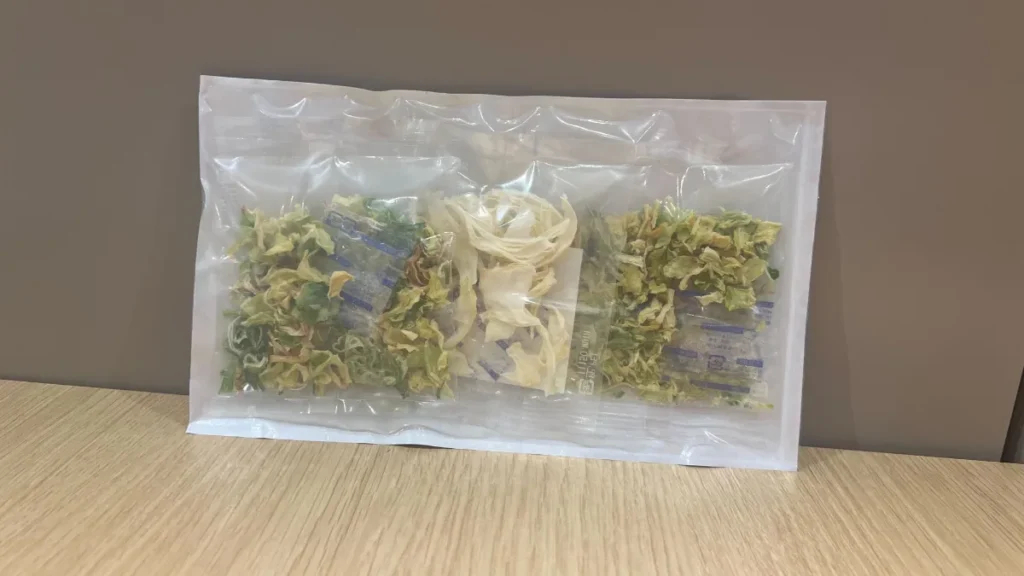
Dried vegetables keep for about six months at room temperature. The waste problem general affairs worries about structurally doesn't arise. No refrigerator is needed either, so setup is just putting out a box.
Restocks are shipped when stock runs out or is about to. It doesn't arrive automatically every month and pile up.
Sold in 30-pack units, so even small companies can use it
One box holds about 30 packs, or 30 servings. This small unit widens the range of companies that can introduce it. It is used not only by companies large enough to have multiple sites but also by relatively small companies and owner-operated businesses.
Office meal services are hard to make work unless a company is large enough to absorb the setup effort and cost, so they tend to be introduced at large companies. A 30-pack unit is a number that breaks away from that assumption.
Choose from three payment arrangements
You can choose whether employees pay 100%, the company pays, or the cost is split 50/50, depending on your company's situation. Given the tax requirements described above, having employees pay at least half is easier to manage.
Payment is made with a PayPay QR code that we provide. Because employees pay directly, general affairs doesn't need to collect cash.
Employees appreciate vegetables they don't usually eat
The best response comes from vegetable mixes, which provide several vegetables at once. Since one pack contains several kinds, there's no need to choose.
One that stands out is the sticky okra mix we offered at a past event. Okra is hard to fit into everyday meals, and even when it's in a convenience store salad, the amount is tiny. Added to miso soup, it can be eaten in a satisfying amount. The value was in getting a vegetable people don't normally reach for.
For the items we carry, see Product list. If you are planning a product under your own brand, see Dried vegetable OEM; for using non-standard vegetables, see Sustainable initiatives.
Download the office dried vegetable materials
We will send the materials to your email address based on the information you provide.
FAQ
Summary
There are six types of meal programs, but once you apply your headcount and site layout, realistically only two or three remain. Narrow them down first, then compare prices.
- For individual items, 400 yen is the dividing line for what employees will pay
- Above 50 employees, differences in office attendance and between sites create a sense of unfairness
- Companies of around 10 people should first check that they won't be turned down over minimum order quantities
- To be tax-exempt, the employee must pay at least half and the company's share must be 7,500 yen or less per month (excluding consumption tax). If either is not met, it is taxed
- Approval requests that state exit conditions up front get through more easily
And whether a program keeps being used after launch depends on price per serving and how easily people tire of it. Look at how easy it is to stop, not just how easy it is to start.
If you have already decided on a program and are moving on to filling out the survey or preparing the application, see our practical guide to reading the questions and setting numerical targets: Food Questions in the Health and Productivity Management Survey: What to Write to Score Points.
Source
The tax requirements were checked against the following (as of August 2026). Cost estimates summarize what we have seen and heard in consultations about introducing our service and are not statistics.
- No. 2594 When Meals Are Provided| National Tax Agency Tax Answer… The two requirements for tax exemption (employee pays at least half of the value of meals / company's share is 7,500 yen or less per month excluding tax), treatment of cash subsidies, payments of up to 650 yen per meal to late-night workers, and meals during overtime or night/day duty
Recommended reading
Related article: Comparison of office snack services・Tax-exempt limits and tax treatment of meal subsidies・Combining dried fruit and nuts. For service details, see Office services; if you are looking for dried vegetables for commercial use, see Dried vegetable OEM.
- Placed staff meals, chilled vs. room-temperature | 5 differences and how to choose
- Summary of tax benefits for dining subsidies | Tax-exemption requirements and expense booking
Author of this article
Related articles
-
 [2026 edition] What is a meal subsidy as an employee benefit? A guide to adoption steps and a comparison of popular services
 -
[2026 edition] Meal-subsidy benefits usable at convenience stores | 3 ways to adopt them tax-free
-
[2026 edition] 6 disadvantages of placed staff meals and how to avoid them | An adoption checklist to avoid failure
-
 A Must-See for HR: 12 Measures to Raise Employee Satisfaction Through Benefits
 -
 Food Questions in the Health and Productivity Management Survey: What to Write to Score Points
 -
Summary of tax benefits for dining subsidies | Tax-exemption requirements and expense booking
-
Meal-benefit plans that even small offices of 10 or fewer people can start
-
 Solving the office vegetable shortfall | How to choose a placed dried-vegetable service