
Placed staff meals, chilled vs. room-temperature | 5 differences and how to choose

"How is it different from the refrigerated type?" "Which one fits our office?" -- these are the first questions from HR and general-affairs staff who start comparing self-serve office cafeterias. The refrigerated type has the appeal of high satisfaction, with salads and prepared dishes arriving fresh, but the sticking points are a fixed cost of tens of thousands of yen a month and disposal loss. The room-temperature type, meanwhile, is a new kind that makes use of dried vegetables and freeze-dried soups, and can be run with no initial cost and almost zero disposal loss. In this article, we line the two up and compare them along five axes, and organize how to choose the type that fits your company's scale, budget, and way of working. At the end, we also introduce new options like Office Yaoya (office greengrocer), run by the Kai Group and Agriture.
- The mechanics and features of the refrigerator-installed type and the room-temperature type
- Five comparison points, including cost, disposal loss, and the barrier to introduction
- The benefit of the expanded tax-free allowance for meal subsidies under the FY2026 tax reform
- The "third option," a room-temperature office vegetable service using dried vegetables
TOC
Why office "food" has become a management issue
"We want to support employees' meals, but we can't afford to build a cafeteria" -- I often hear this from general-affairs staff.
The number of companies certified for health management, promoted by the Ministry of Economy, Trade and Industry, keeps rising year by year. Among them, meal support is a theme directly tied to employee satisfaction, and in benefits preference surveys "meal subsidies" consistently rank in the top three most popular measures.
That is where the self-serve office cafeteria that you can start just by placing a refrigerator or fixture is drawing attention. Just by setting it up in a corner of the office, it creates a system where employees can pick up a healthy meal anytime.
That said, when it comes time to introduce one, many people hesitate: "Refrigerated or room-temperature -- which fits us?"
This article organizes the differences between the two types along five angles and tells you how to choose the service that fits your company.
What is a refrigerator-installed service? Leading examples and mechanics
The refrigerator-installed type is a service that sets up a dedicated refrigerator in the office and delivers fresh food such as salads, prepared dishes, and fruit on a regular schedule.
Leading services and price benchmarks
| Service name | Monthly benchmark (excl. tax) | Features |
|---|---|---|
| OFFICE DE YASAI | From 68,000 yen | Introduced at 10,000-plus locations cumulatively. Salads and prepared dishes from 100 yen an item |
| Office Okan | From 66,000 yen | Prepared-dish specialist. Free refrigerator loan available |
| TUKTUK | Inquire for pricing | Office-convenience-store type. Pricing varies by coupon face value x number of people |
Benefits of the refrigerated type
- Fresh salads and prepared dishes can be eaten right away
- The "looks delicious" appeal tends to raise usage
- A lineup that makes it easy to keep a nutritional balance
Challenges of the refrigerated type
Frankly, the biggest headache with the refrigerated type is Food loss, contained in burdock and cocoa.
the short consume-by period of two to three days, so during the early introduction period when usage is unpredictable, the disposal rate tends to run high. In the industry, a disposal rate of around 10 to 20% is said to be common. On top of the monthly fixed cost, the cost of the discarded portion also arises, so there are no few voices saying, "It was pricier than expected."
Also, there are surprisingly many hurdles to clear before introduction, such as refrigerator installation space, power supply, and hygiene management.
What is a room-temperature service? A new option in dried vegetables
The room-temperature type is a type that places room-temperature-storable food in the office. Traditionally the focus was snacks and cup noodles, but recently dried vegetables and freeze-dried soups and other healthy options have been on the rise.
The mechanics of the room-temperature type
- Displaying room-temperature-storable food on shelves or racks
- A best-before date lasting several months to a year
- No refrigerator or power supply needed
- Delivery frequency of once or twice a month is enough
What we want to note here is the option of A room-temperature office vegetable service using dried vegetables is the idea. A leading example is Office Yaoya (office greengrocer), which the Kai Group's Agriture began offering in earnest in April 2026. Designed so you can supplement vegetables just by adding individually packaged dried vegetables -- 100% domestic vegetables, no sugar or additives, low-temperature dried to concentrate the umami and nutrients -- straight into a cup noodle or miso soup.
Dried vegetables can be eaten just by rehydrating with water or hot water, and nutrients such as fiber and minerals remain nearly intact. They keep at room temperature for three months or more, and being light and compact, they can be placed in a small space in the office -- that's the strength. What's more, because off-spec vegetables are bought from producers at a fair price and upcycled, health management and food-loss reduction can be achieved in a single service, which is a decisive difference from the conventional refrigerated type.
Refrigerated vs. room-temperature | Five comparison points
Here's the heart of it. Let's compare the two types in detail along five perspectives.
Point 1: Introduction and running costs
| Item | Refrigerator-installed type | Room-temperature type (dried vegetables) |
|---|---|---|
| Initial cost | 0 to 50,000 yen | 0 yen |
| Monthly fixed cost | From 66,000 to 68,000 yen | None (only what you stock) |
| Unit cost per item | 100 to 200 yen | 50 to 150 yen |
| Disposal cost | Equivalent to 10 to 20% of the monthly cost | Almost zero |
Because the refrigerated type requires a monthly fixed cost, if few people use it the effective cost per meal jumps. For example, at 68,000 yen a month with 10 users, that's 6,800 yen per person per month. And disposal cost is added on top.
Because the room-temperature type is pay-as-you-go for only what you stock, even a small office of about 10 people can start while keeping costs down-- that's the strength.
Point 2: Food loss and disposal risk
This is the biggest difference.
The refrigerated type centers on products with a consume-by period of two to three days. Whatever isn't used up after delivery becomes disposal as-is. For a company promoting SDGs efforts, a situation of throwing away food every week is hard to explain externally as well.
The dried vegetables of the room-temperature type, on the other hand, have a best-before date of six months to a year. You simply replenish with new stock while consuming day to day, so disposal loss can be held to almost zero.
Point 3: Installation space and the barrier to introduction
| Item | Refrigerator-installed type | Room-temperature type (dried vegetables) |
|---|---|---|
| Space needed | One refrigerator (about 0.5 tatami mats) | One shelf (about 0.1 tatami mats) |
| Power supply | Needed | Not needed |
| Hygiene management | Requires refrigerator temperature management and cleaning | Almost none needed |
| Installation lead time | 2–4 weeks | As little as a few days |
Quite a few offices find it hard to add equipment under tenant rules, or cannot secure a delivery route for a refrigerator. With the room-temperature type, you just set up a single shelf, which dramatically lowers the barrier to adoption.
Point 4: Menu satisfaction and how it is used
The refrigerated type is attractive for the fresh-made feel of its salads and prepared dishes, and satisfaction as a lunch substitute is fairly high.
Room-temperature dried vegetables are less about filling you up on their own and more suited as ”a little extra veg” to add to everyday meals.
Just a pinch of dried spinach or cabbage in miso soup or cup soup instantly boosts both color and nutrition. It lets you effortlessly make up for the vegetable shortfall in office lunches that tend to lean on convenience-store bento and cup noodles.
Point 5: Doubling as disaster-preparedness stock
This is a benefit unique to the room-temperature type.
Dried vegetables let you Because they keep for a long time at room temperature, they can be used as-is for disaster-preparedness stock.
The Cabinet Office guidelines recommend that companies stock three days' worth per person (9 L of water and 9 meals). By managing the dried vegetables that employees consume day to day on a rolling-stock basis, you can secure food containing vitamins and minerals even during a disaster.
The refrigerated type has no such dual-purpose approach. Meeting both BCP measures and health management at the same time is a strength unique to the room-temperature type.
Learn about Office Yaoya
We have prepared materials
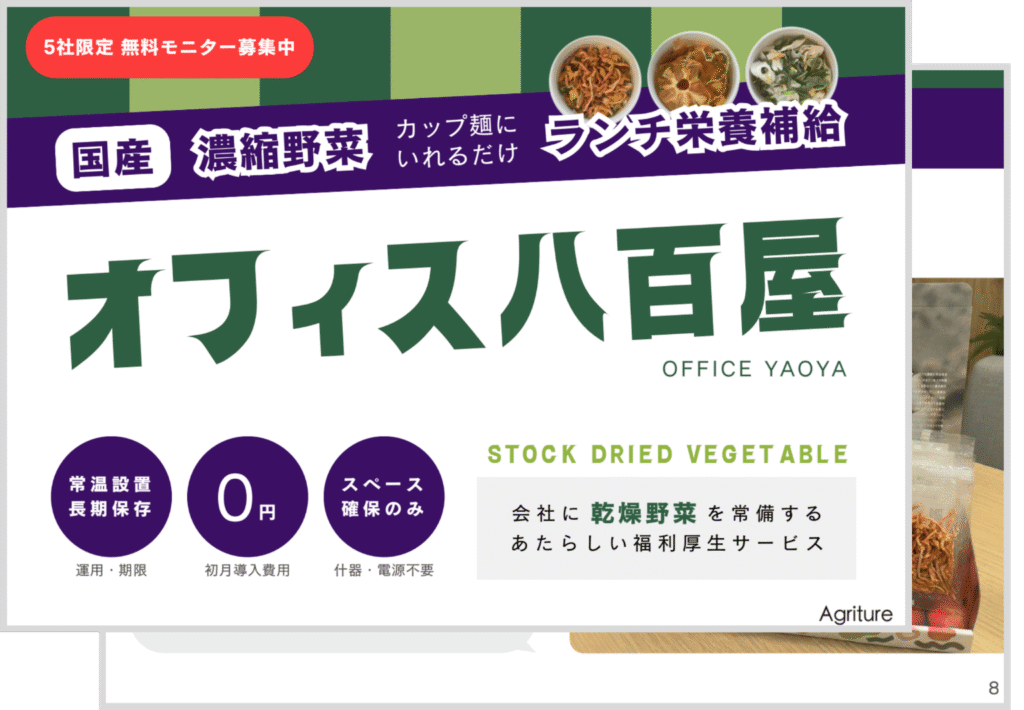
- Service details and vegetable lineup
- Pricing and plans
- How adoption and operation work
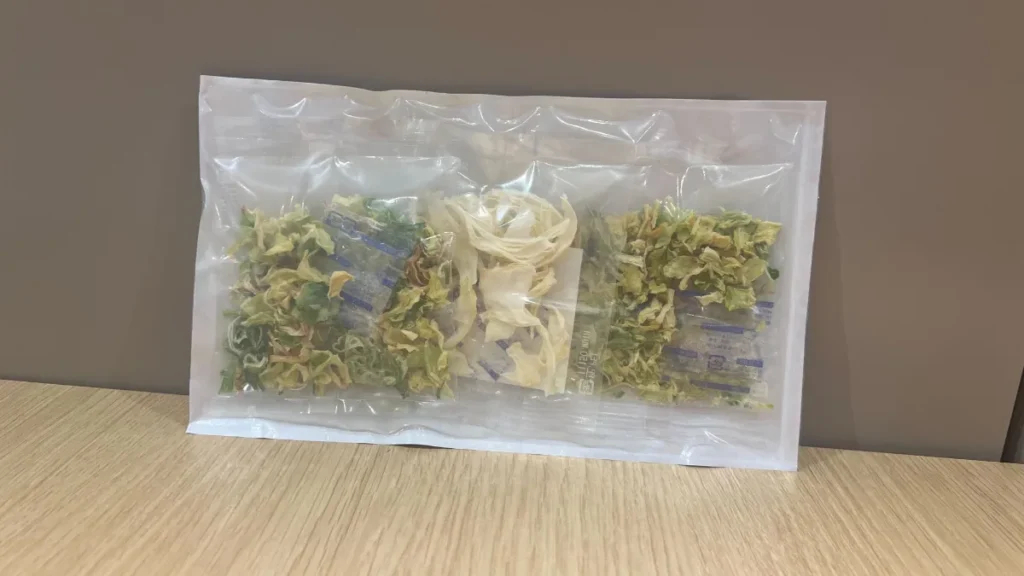
Sample sets are also available. Download the materials for details!
We offer sample sets so you can try Office Yaoya in small quantities. See the materials for details.
The effects of a stocked office cafeteria ”beyond meal support” | Internal communication and ways of working
When you listen to companies that have introduced a stocked office cafeteria, what earns even more praise than "getting vegetables" is the ripple effect on ways of working and the workplace atmosphere. Let us cover the benefits that are hard to see from a cost comparison alone.
It becomes a ”trigger” for internal communication
People naturally gather where food is set out. Conversations spring up like "What's that?" as someone adds dried vegetables to cup soup, and it becomes a starting point for cross-department small talk. It offers a way to recover the incidental communication that tends to decline as remote work spreads, starting from one corner of the office.
- People gather in the break area, and cross-department chatter increases
- Natural information exchange arises from conversations like "What are you putting in?"
- It gives new hires and mainly-remote members a chance to open up
It also fills the ”light hunger” of 24-hour, shift-based work
In locations without a nearby convenience store, or workplaces with late-night and early-morning shifts, being able to eat anytime, 24 hours a day, unbound by opening hours becomes a major value. Since the room-temperature type needs neither a power source nor a refrigerator, it is easy to place in a break area for night-shift workers or a corner of a factory, letting people replenish vegetables and soup at any hour.
- Vegetables can be supplemented even at suburban offices and factories far from a convenience store
- Usable at any hour as a light-hunger option for late-night and early-morning shifts
- No power or refrigerator needed, so it can go in a break room or a corner of a warehouse
It leads to health management and recruitment branding
The fact that a company invests in its employees' meals is an easy-to-grasp appeal for job seekers. For companies aiming to earn Health & Productivity Management Outstanding Organization certification, meal support is one of the more approachable measures. Having a benefit you can describe concretely on your recruitment page or in interviews also raises overall recruiting competitiveness.
- Becomes one of the initiatives evaluated for Health & Productivity Management Outstanding Organization certification
- Becomes a benefit you can describe concretely on recruitment pages and in interviews
- Can also be promoted externally in the context of SDGs and food-loss reduction
The FY2026 tax reform expands the tax-free allowance for meal subsidies
It is easy to overlook, but the FY2026 (Reiwa 8) tax reform raised the tax-free ceiling for meal subsidies from 3,500 yen to 7,500 yen per month. It is the first revision in 42 years, since 1984.
| Item | Before the revision | After the revision |
|---|---|---|
| Tax-free ceiling | 3,500 yen per month | 7,500 yen per month |
| Guideline cap on company contribution | 1,750 yen/person per month | 3,750 yen/person per month |
However, there are conditions to qualify for the tax exemption. The meal must be provided in kind, the employee must bear at least half of the meal cost, and on top of that the company's contribution must be 7,500 yen or less per month. If these three conditions are met, the subsidy is not taxed as salary (based on the National Tax Agency's treatment of meal subsidies).
A stocked office cafeteria makes it easy to take this "in-kind provision" form, letting you enhance benefits while making use of the tax-free allowance. If you are considering introducing or reviewing a meal-subsidy program, designing it around this allowance also strengthens your recruiting power。
Three steps to introduce a stocked office cafeteria without failure
When you are unsure "which fits better, refrigerated or room-temperature," thinking it through in the following three steps makes the decision easier.
- Step 1: Narrow your current challenge down to one| "We want to make up for a vegetable shortfall," "We want to support meals during overtime," "We want to appeal in recruiting"—once you decide the challenge you most want to solve, the features you need come into view.
- Step 2: Start small with the low-cost room-temperature type| With the room-temperature type, which you can start with zero initial cost, you can test risk-free while gathering usage-rate data. This is also the stage to grasp popular items through an employee survey.
- Step 3: Look at the data to decide on expansion or combined use| Once usage takes hold and more people say "we want something more filling," consider adding the refrigerated type or expanding the item lineup. Rather than going big from the start, grow it to match how it is used is the knack for avoiding failure.
Recommendations by type | Which suits companies like these
Companies suited to the refrigerator-installed type
- 50 or more employees, with a steady daily usage rate expected
- Space and a power source to place a refrigerator in the office
- Want to use "a visually generous spread" as a selling point of your benefits
- Can spend 70,000 yen or more per month on the meal-subsidy budget
Companies suited to the room-temperature type (using dried vegetables)
- Small and mid-sized offices with 10 to 50 employees
- Limited installation space
- Do not want to generate food loss (both SDGs and cost)
- Want to hit two birds with one stone alongside disaster-preparedness stock
- Want to start small and low-cost first
As a personal recommendation, the step of starting small with the room-temperature type first, gathering usage-rate data, and considering adding the refrigerated type if it gains traction is a far more sensible approach than bringing in the refrigerated type all at once and then struggling with waste.
Learn about Office Yaoya
We have prepared materials
- Service details and vegetable lineup
- Pricing and plans
- How adoption and operation work
Sample sets are also available. Download the materials for details!
We offer sample sets so you can try Office Yaoya in small quantities. See the materials for details.
Summary | Choose a stocked office cafeteria by cost and operating load
Both the refrigerated and room-temperature types have their merits. To organize the discussion so far, the points to choose by come down to cost, food loss, and ease of installation—these three.
| Decision criterion | Refrigerated type | Room-temperature type |
|---|---|---|
| Introduction cost | High | Low |
| Food loss | Incurred | Almost zero |
| Installation barrier | Somewhat high | Low |
| Menu satisfaction | High | Suited to "a little extra" |
| Doubles as disaster stock | Not possible | Available |
With the tax reform expanding the tax-free allowance now, it is an ideal time to consider introducing a stocked office cafeteria. First, check your own office environment and budget, and choose the type that fits. Price comparison of 8 stocked-service providers、10 tips for choosing a stocked-snack service Checking these together makes it easier to sort out each service's strengths.
Download the office dried vegetable materials
We will send the materials to your email address based on the information you provide.
FAQ
Recommended reading
Sustainable initiatives / Commercial dried vegetables / Product lineup / 5 reasons vegetables are necessary for strength training|Protein alone is not enough / [2025 edition] A thorough comparison of 7 vegetable-delivery services
- Does improving the meal environment lower turnover? Food and retention seen through data
- Food Programs for Health and Productivity Management: How Much Will It Actually Cost for a Company Our Size?
Author of this article
Related articles
-
 [2026 edition] What is a meal subsidy as an employee benefit? A guide to adoption steps and a comparison of popular services
 -
[2026 edition] Meal-subsidy benefits usable at convenience stores | 3 ways to adopt them tax-free
-
[2026 edition] 6 disadvantages of placed staff meals and how to avoid them | An adoption checklist to avoid failure
-
 A Must-See for HR: 12 Measures to Raise Employee Satisfaction Through Benefits
 -
 Food Questions in the Health and Productivity Management Survey: What to Write to Score Points
 -
Summary of tax benefits for dining subsidies | Tax-exemption requirements and expense booking
-
Food Programs for Health and Productivity Management: How Much Will It Actually Cost for a Company Our Size?
-
Meal-benefit plans that even small offices of 10 or fewer people can start