
Food Questions in the Health and Productivity Management Survey: What to Write to Score Points

You've started a meal program. All that's left is to fill out the survey, and that's where many people in charge get stuck. Where are the questions? What do you need to write to meet the criteria? How many figures are required? If you write without knowing this, what you are actually doing won't be reflected in the evaluation.
This article focuses solely on how to answer the meal-related questions in the Health and Productivity Management Survey and the application form for the small and medium-sized enterprise category. Question numbers, the structure of the answer options, required items, and the conditions that lead to non-certification are all described based on published documents we checked.
The current round is Health and Productivity Management Outstanding Organizations 2027 (fiscal Reiwa 8), with applications opening on August 17, 2026. However, the fiscal Reiwa 8 sample survey had not yet been released at the time of writing.
For that reason, question numbers are based on the most recently published fiscal Reiwa 7 (Health and Productivity Management Outstanding Organizations 2026) survey. Question numbers change from year to year. When actually filling it out, always check the numbers in the latest survey. The overall structure of what is asked doesn't change much from year to year.
One more note before we begin. The "Health and Productivity Management Survey" for the large enterprise category and the "Application Details Form" for the small and medium-sized enterprise category are separate documents. Q33 means different things in each. In this article, we always specify which document we're referring to. Explanations on other companies' sites sometimes mix the two, so don't rely on question numbers alone.
Learn about Office Yaoya
We have prepared materials
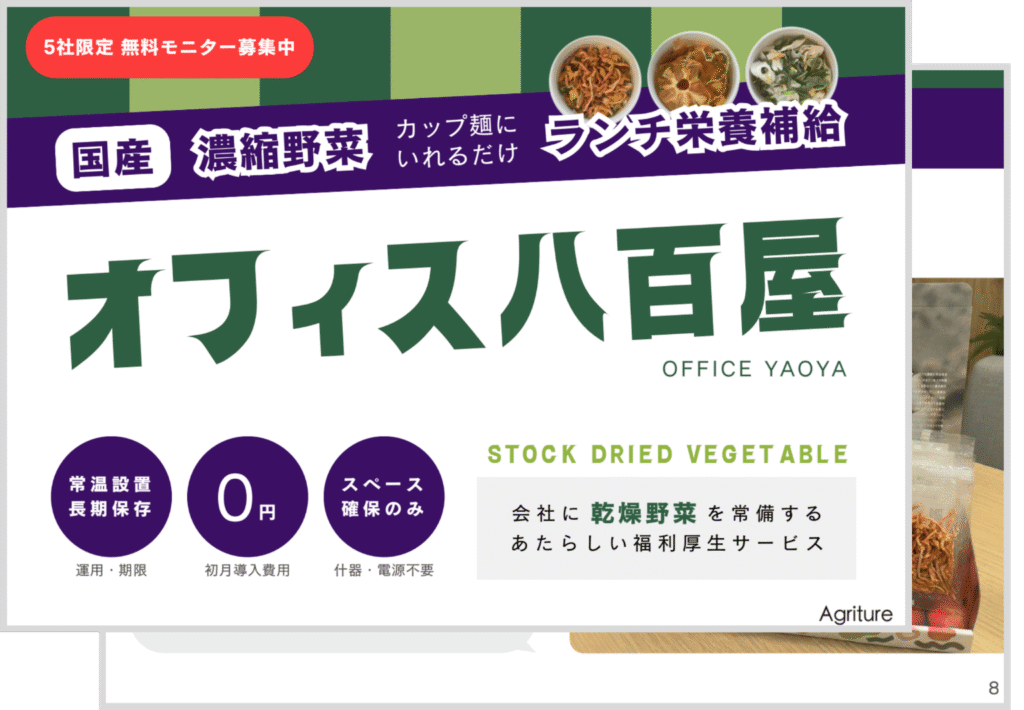
- Service details and vegetable lineup
- Pricing and plans
- How adoption and operation work
TOC
Sample sets are also available. Download the materials for details!
We offer sample sets so you can try Office Yaoya in small quantities. See the materials for details.
Where the meal questions are in the survey
First, locate them. Question numbers differ between the large enterprise category and the small and medium-sized enterprise category.
| Category | Question | Positioning |
|---|---|---|
| Large enterprise category | Q54 | Major item "3. Implementation of Systems and Measures" / middle item "Specific measures for employees' mental and physical health" / sub-item "Specific health maintenance and promotion measures" |
| Small and medium-sized enterprise category | Q25 | Same as above (evaluation item (12) on the application form) |
In both, the evaluation item is named "(12) Initiatives to improve eating habits". In the table of contents of the Health and Productivity Management Survey, it sits under "3. Implementation of Systems and Measures (3) Specific measures for employees' mental and physical health."
Q54 question text and answer options
Q54 for the large enterprise category reads as follows.
Q54. Do you provide specific support for improving eating habits (excluding training and information provision)? (Select all that apply)
There are three answer options.
- We implement employee-participation initiatives that meet the certification criteria
- We implement environment-improvement initiatives that meet the certification criteria
- We do not do anything in particular ⇒ Evaluation item not met
The first thing to note here is the parenthetical "excluding training and information provision". Holding a nutrition seminar or running an article about meals in the company newsletter does not count for this question. Training and information provision are covered by separate questions.
A company that has only held seminars can check only option 3 on Q54 and fail the item. This gap really does happen. Think of "specific support" as whether you are actually providing food or changing where people eat.
The difference between participation and environment-improvement initiatives
Either option 1 or option 2 alone meets the criteria. If you can check both, all the better.
| Category | Nature | Additional items asked in the SQ |
|---|---|---|
| Employee participation | Employees take part individually. You can count who participated | Percentage of eligible employees and percentage of participants |
| Environment improvement | Changes the workplace environment itself. Everyone is eligible | Percentage of eligible employees only |
Placing food in the workplace is classified as environment improvement. In this case, the eligible employees can be defined as "all employees working at that site." A participant percentage isn't required, so there's no need to worry about it. More on this in the next section.
"Initiatives that meet the certification criteria" are chosen from a fixed list
This is the first hurdle. Q54 seems simply to ask "Do you provide specific support for improving eating habits?", but what counts as "meeting the certification criteria" is listed specifically in the supplementary notes. Initiatives not on this list won't meet the criteria, however enthusiastically you carry them out.
For the large enterprise category (supplementary notes to the fiscal Reiwa 7 Health and Productivity Management Survey), the list is as follows.
| Category | Initiatives that meet the certification criteria |
|---|---|
| a. Employee participation | 1 Provide apps for improving eating habits, support such as calorie logging, etc. |
| a. Employee participation | 2 Run regular, ongoing programs to improve eating habits |
| a. Employee participation | 3 Provide individual guidance by registered dietitians |
| a. Employee participation | 4 Hold events featuring demonstrations of, or hands-on cooking with, health-conscious recipes |
| b. Environment improvement | 1 Improve the environment and provide support, through the employee cafeteria, catered bento, provision in kind, financial subsidies, etc., so that employees can eat health-conscious meals (nutritionally managed by specialists, third-party certified, etc.) according to their health issues and needs |
| b. Environment improvement | 2 Set up a consultation service staffed by registered dietitians, etc. |
| b. Environment improvement | 3 Provide breakfast in the employee cafeteria, etc. to address skipped breakfasts (excluding provision of beverages and nutritional supplements) |
Just putting food out isn't enough. The contents need backing
What is easily overlooked is the parenthetical in item 1 of b. Environment improvement.
Improve the environment and provide support so that employees can eat health-conscious meals (nutritionally managed by specialists, third-party certified, etc.) according to their health issues and needs
In other words, in the large enterprise category, simply placing food in the workplace does not meet the condition. You need backing for those meals, such as nutritional management by specialists or third-party certification. An explanation like "we provide healthy food" alone is weak.
If you use a service, check with the provider who handles nutritional management and whether it has certification. If you write without asking, you won't be able to show the basis for your answer.
In the small and medium-sized enterprise category, "provision in kind" is a separate option
Q25 for the small and medium-sized enterprise category has 10 answer options and a different structure. The actual options are as follows.
| Category | Option |
|---|---|
| Employee participation | 1 Provide apps for improving eating habits, support such as calorie logging, etc. |
| Employee participation | 2 Run regular, ongoing company-wide campaigns to improve eating habits (e.g., "eat until 80% full" campaigns, vegetable intake weeks) |
| Employee participation | 3 Provide individual guidance by registered dietitians |
| Employee participation | 4 Hold events featuring demonstrations of, or hands-on cooking with, health-conscious recipes |
| Environment improvement | 5 Improve the environment and provide support, through the employee cafeteria, catered bento, financial subsidies, etc., so that employees can eat health-conscious meals (nutritionally managed by specialists, third-party certified, etc.) |
| Environment improvement | 6 Provide health-conscious foods, etc. in kind |
| Environment improvement | 7 Offer health-conscious beverages and nutritional supplements through vending machines, visiting sales, etc. |
| Environment improvement | 8 Set up nutrition guidance and consultation services by outside providers, registered dietitians, etc. |
| Environment improvement | 9 Provide breakfast in the employee cafeteria, etc. to address skipped breakfasts (excluding provision of beverages and nutritional supplements) |
Option 10 is "We do not do any of the above ⇒ Evaluation item not met."
The one to note is option 6, "Provide health-conscious foods, etc. in kind". In the large enterprise category, provision in kind is included within a sentence conditioned on "nutritionally managed by specialists, third-party certified, etc.," but in the small and medium-sized enterprise category, it stands as a separate option. Companies that place health-conscious food in the workplace fit here straightforwardly under the small and medium-sized enterprise category.
If several apply, check all of them. There's no need to narrow it down to one.
Checking "we implement" isn't enough
In the large enterprise category, additional questions appear depending on the options selected in Q54. Some explanations get this wrong, so here it is precisely.
SQ1 and SQ2 are not two consecutive questions. They are separate entry fields, each corresponding to an option you selected.
| Option selected in Q54 | Field to fill in | What is required |
|---|---|---|
| 1 Employee participation | SQ1 | Select one from the a. Employee participation list / description of the initiative (up to 100 characters) / (a) percentage of eligible employees / (b) percentage of participants |
| 2 Environment improvement | SQ2 | Select one from the b. Environment improvement list / description of the initiative (up to 100 characters) / (a) percentage of eligible employees |
| Both 1 and 2 | Both SQ1 and SQ2 | Fill in each field |
The key point is that the environment-improvement field (SQ2) has no entry for the percentage of participants. You write only the percentage of eligible employees. Placing food in the workplace falls into this category, so you don't need to count "how many people actually used it" for the application.
However, Q71 (effectiveness evaluation), covered later, ultimately requires usage information. Think of it as keeping records for Q71, not counting for SQ2.
One more thing: in either field, there is a step where you first select one "priority initiative" from the list in the previous section. Writing the 100 characters comes after that. If you jump straight into the free-text field, you may end up writing something that doesn't match anything on the list.
Rules for entering percentages
The survey notes include specifications that are detailed but can't be ignored.
- Round percentages to one decimal place
- For participation initiatives held multiple times, answer with the actual number of people, not the cumulative count
- For initiatives started that fiscal year, you may answer with that year's results
The third point helps companies in their first year. There's no need to give up because "we have no results from the previous year." It is explicitly stated that initiatives started in the current year may be reported with the current year's results.
The second point is also easy to get wrong. If you add up participants for an initiative held several times a month, you get a cumulative count. Count a person as one no matter how many times they participated.
The 100-character field looks short, but if you cut too much, the substance doesn't come across. Skip the preamble and pack in the target group, frequency, and how you measure it, and it fills up just right.
These figures are made public
It's often overlooked, but answers to Q54 SQ1 and SQ2 are among the items scheduled for disclosure. They are listed as participation rates for each measure in the "List of items scheduled for disclosure" in Q6 of the survey.
This means they are treated differently from figures in internal documents. Make sure you have a basis you can explain if asked later. Put the other way around, choosing an initiative for which you can provide well-founded figures as your priority measure makes the writing easier.
How to keep usage records for Q71
SQ2 in the application doesn't require it, but the Q71 effectiveness evaluation covered later needs material showing how much the initiative was used. For initiatives that place food in the workplace, this tends to be the weak point.
To know whether what you've placed is actually being used, you need to decide on a method. The realistic options are roughly the following.
| Counting method | What you can get | Points to note |
|---|---|---|
| Payment data | Number of purchases, number of people who purchased | Recorded automatically with cashless payments. The least effort |
| Restocking frequency and quantity | Total units consumed | Can't be converted into numbers of people. Not usable as a basis for participant percentage, but useful for showing how widely it is used |
| Annual employee survey | Percentage of people who have used it | Easy to use as a participation rate. Keep the question the same every year |
The third option, the survey, is the easiest to work with. If you ask "Have you used it even once in the past year?", you get the participant percentage directly. If you don't change the wording each year, you can report year-on-year changes as is.
If payment data is recorded automatically, no tallying work is needed at all. When choosing an initiative, check whether figures are recorded automatically. If you choose a participation initiative, you need actual headcounts, so this matters even more.
How many of the 17 items do you need to meet?
The meal item is not mandatory. It is one of the optional evaluation items (1) to (17). However, as one of the items needed to reach the required number, it carries real weight.
| Category | Number of items that must be met |
|---|---|
| Large enterprise category | Of items (1) to (17), 14 or more |
| White 500 | Item (1) becomes mandatory, so 14 or more of items (2) to (17) (plus additional requirements) |
| Small and medium-sized enterprise category | 2 or more from (1) to (3) + 2 or more from (4) to (10) + 4 or more from (11) to (17) =8 or more of the 17 items |
| Special provision for small organizations | 2 or more from the promotion plan to (3) + 2 or more from (4) to (10) + 2 or more from (11) to (17) =6 or more |
| Bright 500 / Next Bright 1000 | Of items (1) to (17), 16 or more |
The large enterprise category requires 14 of the 17 items, meaning you can miss only 3. This lack of margin is why you can't afford to drop the meal item.
What to note in the small and medium-sized enterprise category is that (12) eating habits falls in the (11) to (17) block. This block requires at least 4 items, 4 out of 7, so there isn't much margin here either. If you drop meals, you need to meet 4 of the remaining 6.
If you're aiming for Bright 500 or Next Bright 1000, you need 16 of the 17 items. In practice, treat meals as mandatory.
Learn about Office Yaoya
We have prepared materials
- Service details and vegetable lineup
- Pricing and plans
- How adoption and operation work
Sample sets are also available. Download the materials for details!
We offer sample sets so you can try Office Yaoya in small quantities. See the materials for details.
If you don't describe an effectiveness evaluation, you won't be certified
This is the part we most want to convey in this article. The large enterprise category has a mandatory question that names eating habits explicitly: ★Q71.
Q71. In considering this fiscal year's health and productivity management policy, how do you evaluate the effectiveness of the health and productivity management measures implemented up to last fiscal year?
1 For each measure, we evaluate not only the results of the initiative (checkup rate, employee participation rate, participant satisfaction, awareness of the measure, overtime hours, etc.) but also improvements in lifestyle habits and awareness (sleep time, eating habits, percentage with exercise habits, smoking rate, stress check results, employee survey results, etc.)
2 For each measure, we only track the results of the initiative and do not evaluate improvements in lifestyle habits or awareness, or we do not evaluate effectiveness at all ⇒ Not certified as a Health and Productivity Management Outstanding Organization
If you select option 2, you are not certified at that point, no matter how many other items you meet.
And the condition for option 1 is evaluating not only the "results of the initiative" but also "improvements in lifestyle habits and awareness". Tracking only the participation rate does not qualify as option 1.
Q71 asks for figures at two levels
Q71 requires figures at two levels.
| Layer | What is measured | Example for a meal initiative |
|---|---|---|
| Level 1: Results of the initiative | Participation rate, awareness, satisfaction | Percentage of people who have used it, number of uses per month |
| Level 2: Improvements in lifestyle habits and awareness | Changes in eating habits themselves | Trends in responses to "Have you become more conscious of eating vegetables?" |
Level 2 figures can also be drawn from health checkup questionnaires. The questionnaire for specific health checkups includes questions on eating habits, so by consulting your occupational health staff you may be able to get aggregate figures. Before running your own survey, check whether there are figures already being collected in the company.
If you do create a new survey, don't add too many questions. One or two is fine. Being able to ask with the same wording every year matters more than the precision of the questions.
For the small and medium-sized enterprise category
For standard certification in the small and medium-sized enterprise category, Q25 is a yes/no judgment based on the options selected, and entering participation rate figures is not required. However, Q32 on evaluation and improvement is mandatory, contained in burdock and cocoa.
If you apply for Bright 500 or Next Bright 1000, additional questions apply. These are often confused, so here they are precisely.
- Q36 on the Application Details Form asks you to select "what management and officers are involved in." The indicator (KGI), its target value, and target year are entered in field (c) of SQ1, which opens when options 1 to 3 are selected
- Q38 on the Application Details Form asks "Do you evaluate the initiatives implemented up to last fiscal year?" Issues and initiative details are written in SQ1 onward
Bright 500 rankings are calculated not from individual questions but by applying scoring weights to six question categories. The Application Details Form states that the degree of involvement of management and officers / penetration within the organization / status of PDCA-related initiatives for health and productivity management / understanding of the health culture / status of the company's own communications / status of communications at external request are scored with weights of 20:10:35:20:10:5.
The heaviest is status of PDCA-related initiatives (35), which covers Q38 and its SQs. On its own it accounts for more than a third of the total. If you want to raise your ranking, start by increasing what you can write here.
Numerical targets go in Q33
The large enterprise category has one more mandatory question that leads to non-certification if missed: ★Q33.
1 We have drawn up a specific promotion plan and are carrying it out with numerical targets, a responsible party, and deadlines set.
2 We have not set a specific promotion plan ⇒ Not certified as a Health and Productivity Management Outstanding Organization
To select option 1, you must be carrying out the plan with numerical targets, a responsible party, and deadlines all set. Then, in SQ1, you enter the following for your top-priority health issue.
| Field | What to write |
|---|---|
| (a) Theme of the issue | Choose from 11 options |
| (b) Details of the issue and its basis | Up to 200 characters |
| (c) Promotion plan for this fiscal year's initiatives | Up to 200 characters |
| (d) Numerical target and deadline | Type of numerical target / current value / target value for this fiscal year / final target value / unit / target deadline (fiscal year) |
One thing to note is that SQ1 has no field for the "responsible party". The responsible party is a requirement included in the wording of option 1, not a separate entry field. You do need to decide internally who is responsible, but trying to write it into this field will only confuse you.
Fields (b) and (c) allow 200 characters. That is a different length from Q54's 100 characters, so write out your reasoning in full here.
Examples of numerical targets for meals
If you set targets too high, you'll end up revising them downward the next year. Rewriting unmet targets every year does you no favors, either in the evaluation or internally.
Targets like the following are easy to set.
- Type of numerical target: Percentage of employees who used a workplace meal initiative at least once a year / current value X% / target value for this fiscal year X% / final target value X% / deadline fiscal year X
- Type of numerical target: Percentage of employees answering "I make a point of eating vegetables" in the employee survey / current value X% / target value for this fiscal year X% / final target value X% / deadline fiscal year X
The first is a Level 1 figure and the second is a Level 2 figure. Setting up both lets you use them directly in the Q71 effectiveness evaluation. Linking the Q33 targets and the Q71 evaluation with the same figures makes them easier to write.
Wording that earns points and wording that doesn't
What you put in the 100 characters for Q54 SQ1 changes how it comes across. Here are the places where it actually makes a difference.
| Weak wording | Revised |
|---|---|
| We work on improving eating habits for our employees' health | Vegetables nutritionally managed by a registered dietitian are always stocked in the break rooms at all 13 sites. All employees can use them freely on working days, and monthly usage is tracked from cashless payment records |
| We offer nutritionally balanced menus | All set meals in the employee cafeteria are supervised by a registered dietitian, with vegetable and salt content shown on the ticket machine and menu board. The selection ratio for each set meal since labeling began is recorded monthly to track the share of health-conscious menus |
| We encourage healthy eating | Lunches with menus planned by a registered dietitian are provided to all employees every Tuesday and Thursday. Participation is optional, and usage is measured through pickup records and an annual employee survey |
The revised versions have three things in common.
- They state who is eligible (all employees / those who wish / specific sites)
- They state what is done and how often
- They state how it is counted
Including the third keeps it consistent with the percentages in SQ2. Few answers include the measurement method within the 100 characters.
Wording to avoid
Expressions like the following use up characters without conveying anything.
- "We are working to raise health awareness"... doesn't say what was done
- "We strive to enhance employee benefits"... doesn't answer the meal question
- "We hold seminars"... Q54 excludes training and information provision, so writing this here misses the mark
- "We plan to introduce this in the future"... not yet implementing corresponds to option 3
The third one happens especially often. Write about training and information provision initiatives in the separate question.
Records to keep on hand
If you try to gather everything at application time, something will always be missing. Decide what to keep throughout the year.
| What to keep | Where it is used | How to keep it |
|---|---|---|
| Internal notice showing the launch date and scope | Percentage of eligible employees in Q54 SQ1 and SQ2 | Save the company-wide email as is |
| Monthly usage data | Q71 effectiveness evaluation (participant percentage in SQ1 if you choose a participation initiative) | Payment history or delivery quantity records |
| Annual survey results | Improvements in lifestyle habits in Q71 | Keep the question wording fixed every year and save the aggregate figures |
| Promotion plan document | Numerical targets, responsible party, and deadlines in survey Q33 | Keep the record of approval by the relevant committee as well |
| Minutes of health and productivity management meetings | Q23 (additional requirement for White 500) | Keep them in a form that shows the agenda and decisions |
The one most often missing is the first row. You can't recall later when you started or which employees at which sites were covered. Simply saving one internal notice when you start is enough.
The second row relates to how you choose an initiative. If you count by hand, the records stop when the person in charge is transferred. Whether figures are recorded without any effort is something to check before introducing it.
Who writes it, and how to divide the work internally
The survey questions span health, labor, HR, and general affairs. If one person tries to fill in everything, they'll get stuck on questions where they can't obtain the supporting data.
Where the information for the meal questions comes from
| Information needed | Department that has it |
|---|---|
| Number of eligible employees, headcount by site | HR |
| Initiative launch date, contract details, costs | General affairs |
| Usage figures | General affairs or the outsourced provider |
| Aggregate eating-habit figures from health checkup questionnaires | Occupational health staff, health insurance society |
| Records of the meeting that approved the promotion plan | Corporate planning |
The most time-consuming part is obtaining aggregate eating-habit figures from health checkup questionnaires. Because individual-level data is subject to handling restrictions, you need to request the aggregate figures early. If you ask after the response period has started, you won't make it in time.
Make sure it can be completed even if the person in charge changes
Since applications are made every fiscal year, staff transfers are bound to happen. If information exists only in the previous person's head, the figures break off in the following year's application.
What helps is saving the previous year's answers exactly as submitted. If you summarize on one sheet what you wrote for each question, how, and where the supporting data came from, the next year becomes a matter of filling in the differences. If you rewrite without looking at the previous year's answers, the definitions of figures change even for the same initiative, and you can no longer explain year-on-year changes.
What to confirm with your outsourced provider
If the initiative itself is outsourced, the provider holds the usage figures. Checking at the time of contract whether they can provide an annual report saves you the trouble of requesting it at application time.
Conversely, with a provider that can't supply figures, you'll have to recount in-house for every application. This is worth checking when choosing an initiative.
If you're aiming for Bright 500 or Next Bright 1000
These are the top tiers of the small and medium-sized enterprise category. Bright 500 covers the top 500 organizations, and Next Bright 1000 covers ranks 501 to 1500.
There are two procedures that are easy to miss here. Both disqualify you for reasons unrelated to the substance of your initiatives.
- Enter "1" (intention to apply for Bright 500) in Q33 of the Application Details Form. Next Bright 1000 is selected from organizations applying for Bright 500, so if this is left blank you won't be eligible for Next Bright 1000 either
- Select one of options 1 to 3 in Q34 of the same form (consent to disclosure of evaluation results). If disclosure is not permitted, you won't be certified even if ranked within the top 500 or top 1500
In addition, you must answer the Bright 500 certification questions Q33 to Q41 and meet 16 or more of items (1) to (17). Since you can miss only one of the 17 items, the meal item is effectively assumed to be met.
If you don't make the top 1500, you are certified under the regular small and medium-sized enterprise category. Applying does not put you at a disadvantage.
White 500 in the large enterprise category
This is the title given to organizations in the large enterprise category ranked within the top 500.
In addition to being in the top 500, the following four items are also mandatory.
- Penetration of the health and productivity management promotion policy (Q17 SQ4)
- Disclosure of employee performance indicators and measurement methods (Q18 SQ3). The most recent actual value for absenteeism, presenteeism, or work engagement, the measurement standard, and the disclosure URL are required
- Working to spread health and productivity management as a top runner (Q20, Q21)
- Agenda items and decisions on promoting health and productivity management at management-level meetings (Q23)
Furthermore, Consenting to bulk disclosure of evaluation results, etc. (selecting one of options 1 to 3 in Q6) is a mandatory condition. If you don't consent to disclosure, you receive standard certification rather than White 500, even if ranked within the top 500.
What to submit by when, and how much it costs
The application period for the current round, fiscal Reiwa 8 (Health and Productivity Management Outstanding Organizations 2027), has already been announced. The later schedule had not been announced at the time of writing, so we've listed the previous year's (Health and Productivity Management Outstanding Organizations 2026) dates to give a sense of timing.
| Timing | Details | Certainty |
|---|---|---|
| August 17 to October 9, 2026, 5:00 p.m. | Response period for the Health and Productivity Management Survey (large enterprise category) | Announced |
| August 17 to October 16, 2026, 5:00 p.m. | Certification application period for the small and medium-sized enterprise category | Announced |
| Around early November | Application fee invoices sent | Previous year's schedule |
| Around late December | Feedback sheets issued (by email only) | Previous year's schedule |
| December 31, around 3:00 p.m. | Payment deadline for the application fee. Certification review begins once payment is confirmed | Previous year's schedule |
| Around March of the following year | Certification announced (March 9, 2026 in the previous year) | Previous year's schedule |
The response period runs from mid-August to mid-October. Most questions ask about the previous year's results, so the earlier you start, the more material you'll have to write about. However, as noted above, it is explicitly stated that initiatives started that year may be reported with that year's results. Even if your company started this year, don't assume you have nothing to write.
Application fees
| Category | Certification application fee (per application) |
|---|---|
| Large enterprise category | 80,000 yen (88,000 yen including tax) |
| Additional fee for large enterprise group applications | 15,000 yen (16,500 yen including tax) per organization certified at the same time |
| Small and medium-sized enterprise category | 15,000 yen (16,500 yen including tax) |
Some explanations say "applying is free," but there is a certification application fee. Bank transfer fees are paid by the applicant, and the fee is not refunded if you withdraw your application after payment or are not certified.
One useful thing to know is that if you only respond to the Health and Productivity Management Survey without applying for certification, there is no application fee. Even in this case, a feedback sheet is issued. No certification review is carried out, but you can see where your company stands and which items are weak. You can measure where you are in the first year and apply the following year.
Validity period
Certification is valid from the date of certification until March 31 of the following year. For Health and Productivity Management Outstanding Organizations 2026, that means from certification until March 31, 2027. It effectively lasts one year, so you need to apply every fiscal year.
Renewing every year also means continuing to produce the same figures every year. Figures gathered specially for a single application can't be reproduced the following year. Here again, what matters is whether the figures are naturally recorded through day-to-day operations.
Use the feedback sheet to see where your company stands
In late December, feedback sheets are issued to organizations that responded, by email only. They contain the material for deciding how to write next year's answers.
For meals, what to look at is how the evaluation axes are grouped. Q54 isn't evaluated on its own; it is grouped into the "improvement of lifestyle habits" evaluation axis and converted to a deviation score. Besides Q54, this axis includes Q55, Q56, Q62, and Q63.
What this means is that strengthening meals alone is unlikely to raise the deviation score for this axis. If the other questions on the same axis remain weak, meals get lost in the overall result. If you want to raise your ranking, it's more efficient to look axis by axis and start with the weakest question.
As for the rankings themselves, White 500 is defined as "ranked within the top 500" and Next Bright 1000 as "ranked 501 to 1500." Even if the ranking on your sheet falls short, you can still see which axes are weak. Use that as the basis for your next step.
A new commendation program for food education has been created
Starting in fiscal Reiwa 7, the notes to Q54 in the survey and Q25 in the small and medium-sized enterprise category include a reference to the "Commendation Program for Outstanding Food Education Organizations"newly established by the Ministry of Agriculture, Forestry and Fisheries. This year is the first time the Health and Productivity Management Survey itself has pointed to the ministry's commendation program.
For companies pursuing meal initiatives, this means the same material can be used to seek another external evaluation. Much of the record-keeping done for health and productivity management can be used as is.
Since the program isn't widely known yet, it can also be useful material when discussing health and productivity management internally. Details are published on the Ministry of Agriculture, Forestry and Fisheries website.
What to check before submitting
Finally, here is a summary of the meal-related points that are easy to miss. Some of them disqualify you for reasons unrelated to the substance of your initiatives, so run through them once before submitting.
- In Q54 (Q25 for SMEs), have you written only about training and information provision?
- In Q54, did you select your "priority initiative" from the list of certification criteria before writing the 100 characters?
- Do those 100 characters include the target group, frequency, and measurement method?
- For a participation initiative, did you enter the percentage of eligible employees and percentage of participants in SQ1; for an environment-improvement initiative, the percentage of eligible employees in SQ2? These figures are made public
- Is the participant percentage based on actual headcount (not cumulative counts)? Did you round the percentage to one decimal place?
- Does survey Q33 include all three: numerical targets, responsible party, and deadlines? If any are missing, you won't be certified
- Are you able to select option 1 in Q71? Participation rates alone aren't enough; you must also evaluate improvements in lifestyle habits
- Are the indicators set as targets in Q33 linked to the indicators evaluated in Q71?
- If aiming for Bright 500, did you enter "1" in Q33 of the Application Details Form and consent to disclosure in Q34 of the same form? (These are different from Q33 and Q34 of the survey)
- If aiming for White 500, did you consent to bulk disclosure in Q6?
- Is the application fee payment deadline (3:00 p.m. on December 31 in the previous year) built into your internal payment cycle?
The last item is administrative, but it's a genuine risk. Certification review proceeds only once payment is confirmed, so if payment is late, your application won't be reviewed. Invoices arrive in early November. If your company pays at the end of the month following the closing date, you may not make it in time as is. Pass the invoice to accounting as soon as it arrives.
Also check that for Q54 and Q25 you follow the procedure of selecting one option from the list in the earlier section before writing the text. If you start from free text, you'll end up with content that doesn't match anything on the list.
Download the office dried vegetable materials
We will send the materials to your email address based on the information you provide.
FAQ
Summary
The meal question itself is a judgment of whether you implement an initiative or not. However, the mandatory questions around it carry more weight.
- The meal question is Q54 for large enterprises / Q25 for SMEs. The evaluation item is (12) Initiatives to improve eating habits
- Q54 excludes training and information provision. Seminars alone don't meet the criteria. Initiatives are chosen from the list of certification criteria
- For large enterprises, the fields depend on the options selected. Participation initiatives go in SQ1, including the participant percentage; environment-improvement initiatives go in SQ2 with only the percentage of eligible employees. Both are made public
- If Q71 doesn't evaluate improvements in lifestyle habits, you won't be certified. Eating habits are named explicitly
- If Q33 doesn't include numerical targets, a responsible party, and deadlines, you won't be certified
- Required number of items: 14/17 for large enterprises, 8/17 for SMEs, 16/17 for Bright 500 and Next Bright 1000
- For environment-improvement initiatives in the large enterprise category, the meals need backing such as nutritional management by specialists or third-party certification
- Application fees are 80,000 yen (88,000 yen including tax) for large enterprises and 15,000 yen (16,500 yen including tax) for SMEs. It isn't free
The trick when writing is to link the Q33 targets and the Q71 evaluation with the same figures. If you use the indicators set as targets directly in the evaluation, both the effort of filling in the forms and the ease of reproducing them next year are kept to a minimum.
We operate Office Yaoya (office greengrocer), which places domestically grown dried vegetables in the workplace. Payment records are kept automatically, so you don't have to collect usage data by hand for the Q71 effectiveness evaluation. In the small and medium-sized enterprise category, it corresponds to option 6 of Q25, "Provide health-conscious foods, etc. in kind." For the items we carry, see Product list.
Source
The question numbers, answer options, certification requirements, schedules, and application fees in this article were checked against the following published documents (as of August 2026). Question numbers change from year to year, so check the latest survey when filling it out.
- Fiscal Reiwa 7 Health and Productivity Management Survey sample (large enterprise category)| ACTION! Health and Productivity Management (Certification Secretariat for Health and Productivity Management Outstanding Organizations)... Question text and options for Q54, Q33, Q71, and Q6, certification requirements, and the list of "initiatives that meet the certification criteria" in the supplementary notes
- Health and Productivity Management Outstanding Organizations 2026 (small and medium-sized enterprise category) application form sample| Same as above... Q25 options, Q33 and Q34, Q36 and Q38, Bright 500 scoring weights, certification validity period
- Health and Productivity Management Outstanding Organizations 2026 (small and medium-sized enterprise category) application guidance materials| Same as above... Background to the increase in evaluation items from 15 to 17, the change in the required number of items from 7 or more to 8 or more, and 16 or more items for Bright 500 and Next Bright 1000
- About applications| ACTION! Health and Productivity Management... Fiscal Reiwa 8 application periods (large enterprises: August 17 to October 9, 2026, 5:00 p.m. / small and medium-sized enterprises: August 17 to October 16, 2026, 5:00 p.m.)
- Certification application fees| ACTION! Health and Productivity Management... Large enterprises 80,000 yen (88,000 yen including tax), small and medium-sized enterprises 15,000 yen (16,500 yen including tax), no application fee when only responding to the survey
- Commendation Program for Outstanding Food Education Organizations| Ministry of Agriculture, Forestry and Fisheries
Recommended reading
Related article: Emergency stockpiles and dried vegetables・Sustainable initiatives. If you are planning a product under your own brand, see Dried vegetable OEM.
- Summary of tax benefits for dining subsidies | Tax-exemption requirements and expense booking
- Office snack adoption guide | A comparison of pricing and selection across 8 stocking-service providers
Author of this article
Related articles
-
 [2026 edition] What is a meal subsidy as an employee benefit? A guide to adoption steps and a comparison of popular services
 -
[2026 edition] Meal-subsidy benefits usable at convenience stores | 3 ways to adopt them tax-free
-
[2026 edition] 6 disadvantages of placed staff meals and how to avoid them | An adoption checklist to avoid failure
-
 A Must-See for HR: 12 Measures to Raise Employee Satisfaction Through Benefits
 -
 Summary of tax benefits for dining subsidies | Tax-exemption requirements and expense booking
 -
Food Programs for Health and Productivity Management: How Much Will It Actually Cost for a Company Our Size?
-
Meal-benefit plans that even small offices of 10 or fewer people can start
-
 Solving the office vegetable shortfall | How to choose a placed dried-vegetable service