
Solving the office vegetable shortfall | How to choose a placed dried-vegetable service
Office
Health management
Domestically grown
Employee benefits
Placed Vegetables
Vegetable deficiency

How much do you keep your daily vegetable intake in mind?
The daily vegetable intake recommended by the Ministry of Health, Labour and Welfare is 350 g. However, according to the 2023 National Health and Nutrition Survey, the average vegetable intake of Japanese aged 20 and over is only 256.0 g. It has significantly decreased over the past 10 years among men, and significantly decreased since 2015 among women as well. In other words, many Japanese are unable to take in the necessary amount of vegetables.
Especially for busy businesspeople, office lunches tend to skew toward bento or noodles, and constraints of time and options make it hard to secure vegetable quantity.
- Lunch skews toward bento, noodles, and rice bowls, with vegetable side dishes rarely attached
- Centered on eating out and convenience stores, adding a salad doesn't last
- Pre- and post-overtime snacking becomes snack foods, with no chance to take in vegetables
When vegetable shortfall continues, nutrients like vitamins, minerals, and fiber run short, leading to lowered immunity and higher lifestyle-disease risk. To maintain health, building a habit of consciously taking in vegetables matters.
TOC
The rise of office vegetable-intake support services
Services supporting vegetable intake at the office are increasing in options, centered on the installed type.
The flagship is "OFFICE DE YASAI (OFFICE DE YASAI)." This service launched in 2014 as an "installed-type health cafeteria®" where simply installing a refrigerator or freezer in the office brings regular deliveries of healthy salads, fruit, prepared dishes, and more. It has now been adopted at a cumulative total of about 15,000+ locations nationwide. A feature is that employees can take a healthy meal easily from 100 yen.
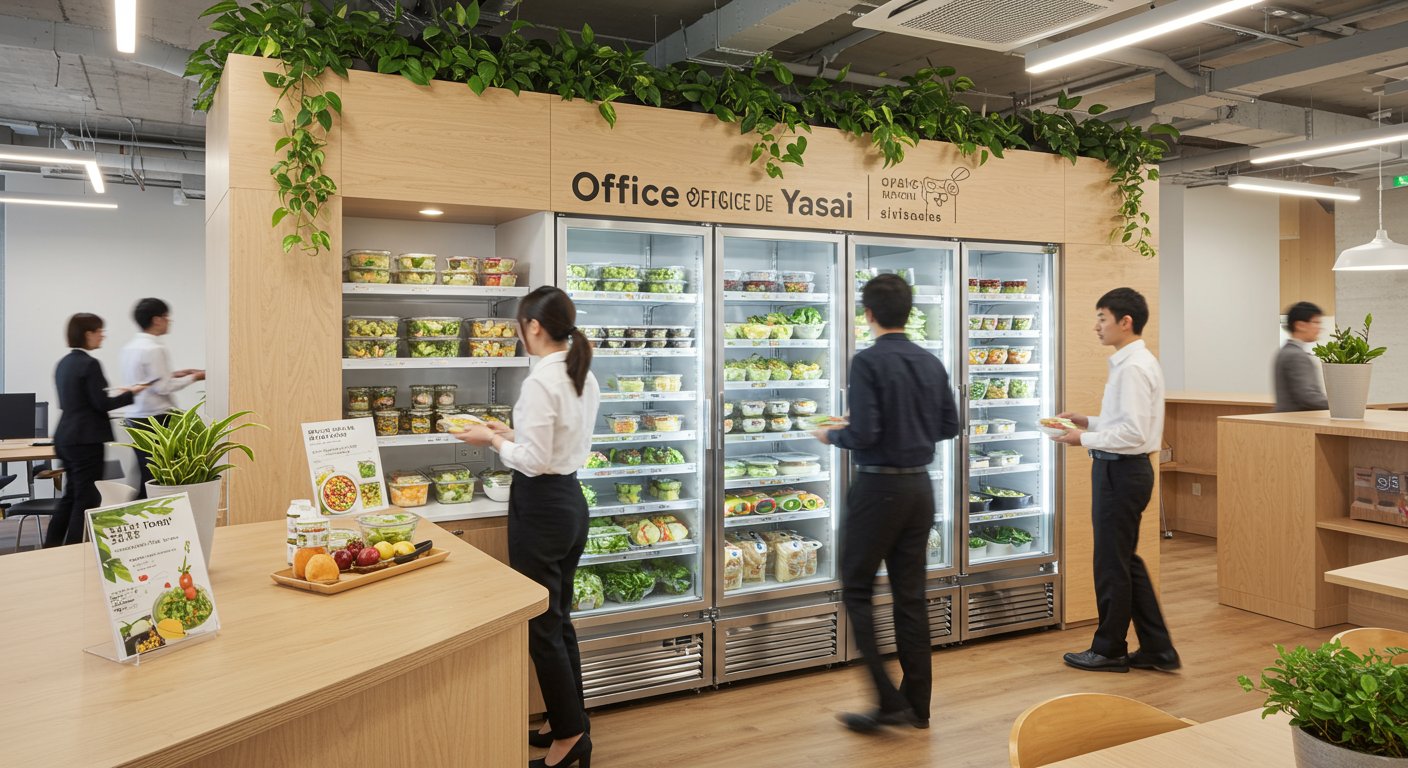
In addition, from February 2025, the comprehensive health company Tanita began offering an installed-cafeteria service called "Tanita Cafe at OFFICE." It is a corporate service where employees can freely choose and enjoy Tanita Cafe's healthy meals from a freezer installed in the office, supporting employees' health-building.
The feature of these services lies in achieving both ease and health. Busy office workers can take a healthy meal without being bound by time or place.
The diversification and evolution of services
Office vegetable-intake support services are evolving into higher-value-added mechanisms — not merely providing meals but expanding product lineups and addressing regional issues.
The representative service "OFFICE DE YASAI" handles about 100 items in 50 categories on the refrigerated "Yasai Plan" and about 30 items on the frozen "Gohan Plan," a rich lineup as a feature. With monthly-rotating menus and new-item additions, mechanisms for employees to choose enjoyably are advancing.
The adoption merits seen from a health-management perspective
Adopting a vegetable-intake support service is drawing attention as a corporate health-management strategy too.
Improving employees' health leads to management merits such as productivity gains and lower medical costs. In fact, centered on major companies, efforts at health management through food are being recognized, with some certified as "Excellent Health-Management Corporations (Large Enterprise Category, White 500)." The main merits obtained by adopting a vegetable-intake support service are as follows.
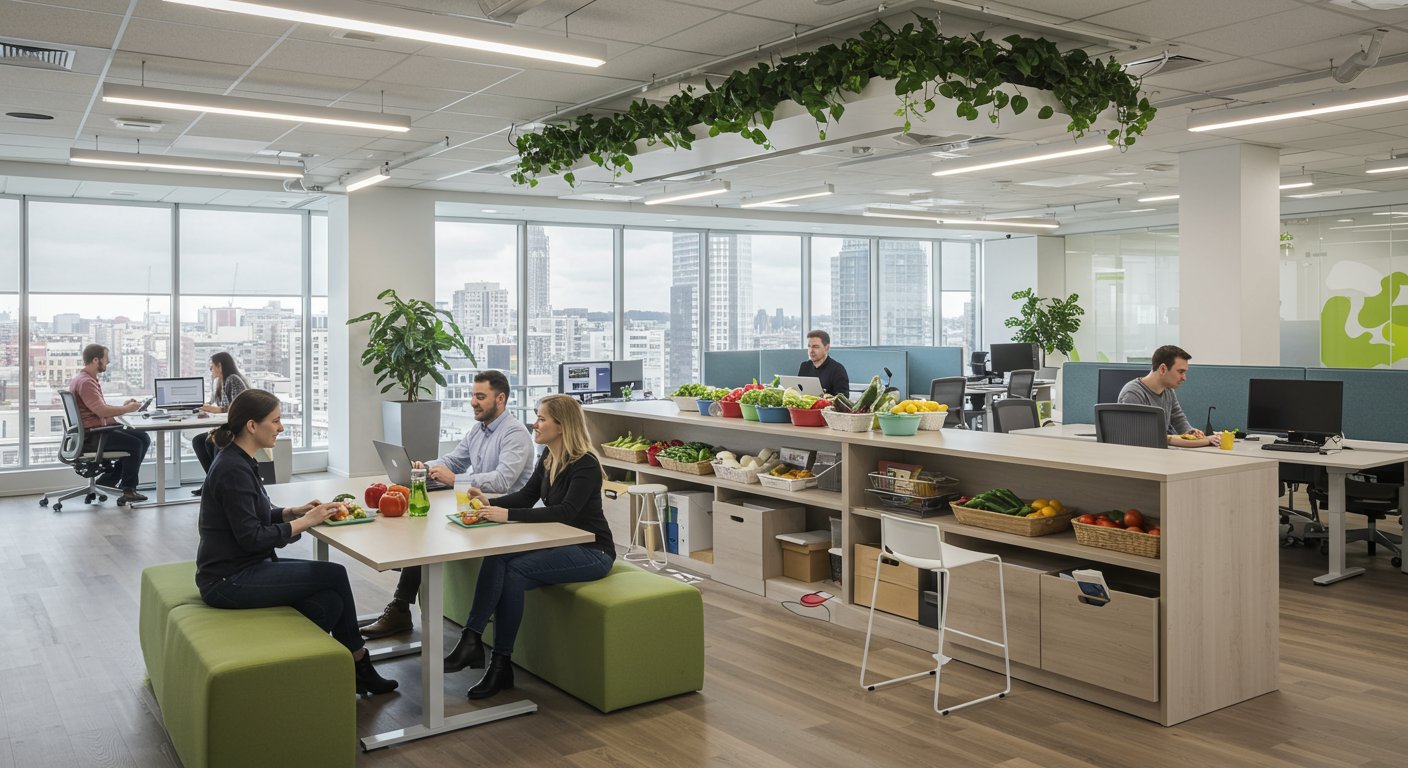
Improved employee health satisfaction
- Strengthened recruiting power through enriched employee benefits, and an appeal point in job listings
- Productivity gains
- Energizing internal communication
- External appeal as a health-management effort
- Especially now that recruiting is a seller's market, the importance of employee benefits as a factor in choosing a company is growing. According to a Tanita survey, while businesspeople want tasty, nutritionally balanced meals, in reality they prioritize price and shorter eating time, so there is a gap between ideal and reality.
The vegetable-intake support service that solves this issue also ties to a company's appeal on the recruiting and employee-retention fronts.
How do employees use it? Usage scenes for office vegetable services and how they get delivered
When considering adoption, one thing surprisingly easy to overlook is the usage scene of "how employees actually use it." Depending on the service type, both how it's used and how it's delivered change.
Morning, lunch, before overtime — the moments employees reach for it
The timing when employees use a vegetable service differs by scene: one item in the morning after arriving, a plus to a lunch that tends to be just a convenience-store bento, a snack before overtime. The refrigerated type lets you take a salad or prepared dish in place of lunch, while the room-temperature type of dried vegetables lets you add a pinch to miso soup or cup soup, increasing vegetable quantity without strain.
Delivery frequency and the labor of restocking and management
Delivery frequency and the labor of restocking and management also change by type. Organizing the general guides gives the following.
Delivery-frequency guide
| Item | Refrigerated type | Room-temperature type (dried vegetables) |
|---|---|---|
| About once a week | 1–2 times a month | Storage |
| Refrigerator needed | Just placed on a shelf at room temperature | General-affairs labor |
| Restocking and leftover management involved | Light — just leave it out | Suited workplaces |
| Larger offices with many users | Small-headcount, rotating-shift, or space-limited workplaces | Being able to operate without worrying about "when restocking is needed" is more effective the smaller the company where general affairs is a dual role. |
here too introduces this ease-focused way of choosing. Meal-benefit plans that even small offices of 10 or fewer people can start Menu examples and cost sense | how refrigerated and room-temperature types differ this way
Before introducing a service to employees, pin down what kind of menu is available and at what price.
The refrigerated type's menu, centered on salads and prepared dishes, is attractive in its breadth — smoothies, yogurt, even fruit. You can buy items from around 100 yen each, a handy lunch supplement for employees. But the company side incurs a fixed cost from several tens of thousands of yen a month, and in the early period when usage doesn't grow, the effective price per item can turn out high.
The room-temperature type of dried vegetables centers on the use of adding it to soup or miso soup, and there are also veggie-chip types you can eat as-is. With no monthly fixed cost and only the cost of what you stock, as one example it is easy to start at a controlled price even at a scale of 10–30 people. The refrigerated type has the edge in menu showiness, but the room-temperature type wins on cost and ease of management.
How do installed vegetables, meal subsidies, and staff cafeterias differ?
For office food support, besides installed vegetable services there are options like meal subsidies (meal vouchers, delivered bento) and staff cafeterias. Compared with the aim of resolving vegetable shortfall, each differs greatly in initial cost, operational labor, and ease of taking in vegetables.
Operational labor
| Form | Initial cost | Ease of taking in vegetables | Suited scale | Installed vegetable service |
|---|---|---|---|---|
| Free to a few tens of thousands of yen | Just place and restock | High (salads, dried vegetables) | From 10 people to large scale | Meal subsidy (meal vouchers, delivered bento) |
| Application and settlement paperwork | Low | Varies by menu | Workplaces with much time out of office | Staff cafeteria |
| Operations outsourcing, inventory management | Very high | High but depends on location | Large scale, fixed on-site work | At small companies and rotating-shift workplaces, a staff cafeteria isn't cost-justified, and meal subsidies leave clerical burden. When you want to fill vegetable shortfall pinpoint and keep general-affairs labor to a minimum, an installed vegetable service is realistic. If you want to go as far as designing a program, |
How to introduce a meal-subsidy employee benefit checking this together makes it easier to choose the combination that suits your company. Efforts to visualize vegetable intake
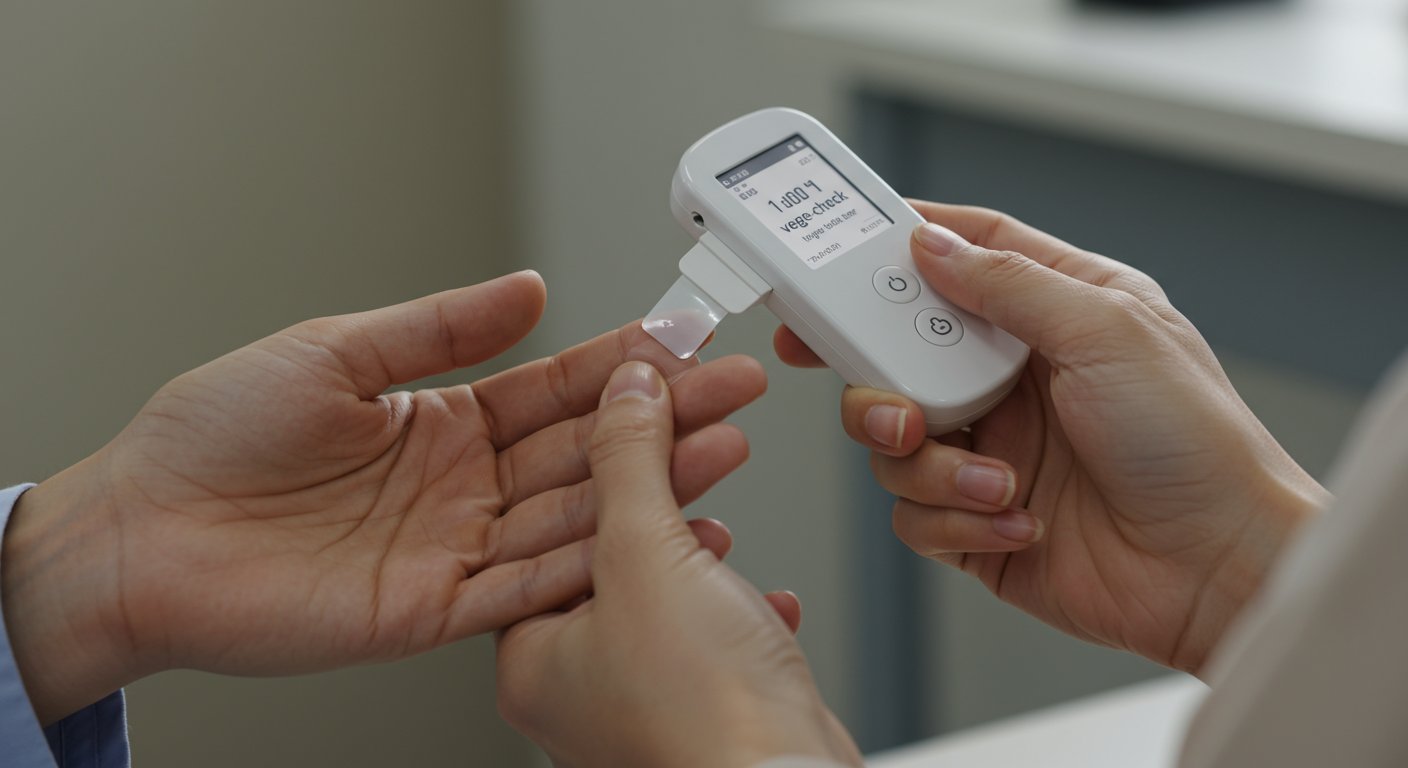
To promote vegetable intake, knowing your own intake status is also indispensable. "
VegeCheck®" provided by Kagome Co., Ltd. is drawing attention as a device that can estimate vegetable intake from the amount of carotenoids in the skin. It requires no blood draw and can measure easily in a short time, another feature. Utilized in diverse settings such as companies and municipalities, it is spreading as a tool that supports efforts in health-building and dietary improvement.
The rollout of corporate health seminars
Kagome also regularly holds webinars on promoting health management. It also provides information for corporate health-management staff, such as "Tips for advancing health management skillfully and enjoyably!" and "What mental care is needed for the health management of the future."
Furthermore, in the new corporate service "Tsunagaru, Midori Cooking" jointly developed by Kagome Co., Ltd. and ABC Cooking Studio Co., Ltd., they aim to promote communication and raise health literacy through cooking experiences. Reference
Services that encourage vegetable intake are expanding beyond meal provision to measurement and visualization and even internal education. Reference
A room-temperature dried-vegetable service to note in 2026
A new option appearing in 2026 is the
run by the Kai Group's Agriture Inc. Office Yaoya (office greengrocer). A design of 100% domestic vegetables, no sugar or additives, and individually packaged low-temperature-dried vegetables you can replenish simply by adding them straight to a cup noodle or miso soup. Because it buys off-grade vegetables — misshapen and unable to reach the market — from growers at fair prices and upcycles them, it achieves both health management and food-loss reduction in a single service. Room-temperature storage of three months or more means no refrigerator, and being able to start with no initial cost is also attractive.
Learn about Office Yaoya
We have prepared materials
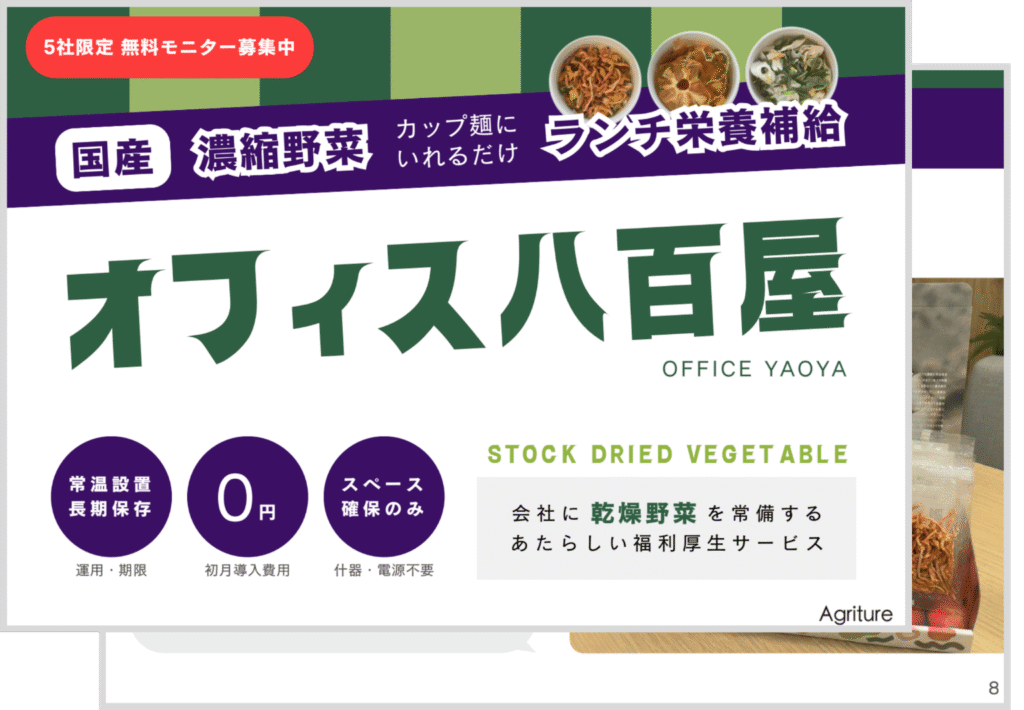
- Service details and vegetable lineup
- Pricing and plans
- How adoption and operation work
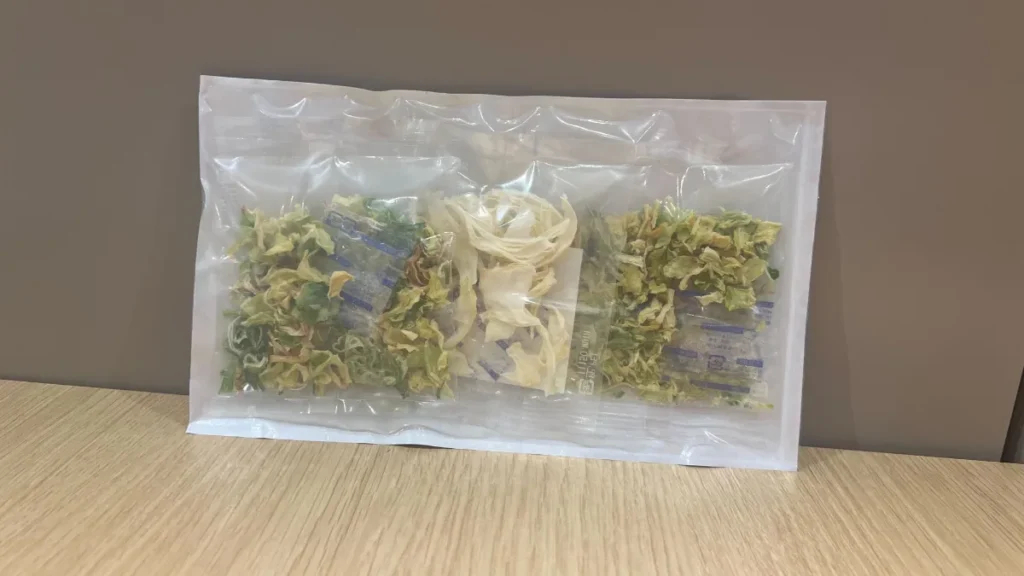
Sample sets are also available. Download the materials for details!
We offer sample sets so you can try Office Yaoya in small quantities. See the materials for details.
Efforts at regional health promotion through partnership with municipalities
Efforts to promote vegetable intake are spreading not only to companies but also to collaboration with municipalities.
- In Hokota City, Ibaraki Prefecture, drawing on the advantage of being Japan's top vegetable-output area, a project with Kagome to promote "health-focused town-building sparked by vegetables" has launched
- The "Tona-Vege Project" in Tonami City, Toyama Prefecture, involves residents, companies, and retailers to improve eating habits under the slogan "eat vegetables first"
- The Ministry of Agriculture, Forestry and Fisheries also runs a "Let's Eat Vegetables Project," backing vegetable intake at the national level
Such public-private efforts continue to spread toward health promotion nationwide.
Dried vegetables as an option at the office
Amid the spread of vegetable-intake efforts by municipalities and companies, as a means for busy businesspeople to take in vegetables in a familiar environment, dried vegetables are an option easy to keep up even in limited space. Because dried vegetables have had their moisture drawn off, they spoil less easily, store at room temperature for a long time, and are easy to handle even in offices with limited refrigerator space.
You can easily boost vegetable quantity just by adding them to soup or miso soup, and when a little peckish, you can also eat them as-is like dried tomato or veggie chips. That they can be worked into your usual working style without strain, with no cooking labor, is a major merit for busy office workers.
They are also lightweight and easy to carry, easy to match to diversifying working styles such as free-address offices and measures against vegetable shortfall for telework employees. As an item that supports building healthy eating habits, there is potential for the scope of application in corporate employee benefits to widen going forward.
FAQ
We have compiled questions often raised about office vegetable-shortfall measures and service adoption.
Learn about Office Yaoya
We have prepared materials
- Service details and vegetable lineup
- Pricing and plans
- How adoption and operation work
Sample sets are also available. Download the materials for details!
We offer sample sets so you can try Office Yaoya in small quantities. See the materials for details.
Summary: the future that vegetable intake at the office brings
The 350 g of daily vegetable intake recommended by the Ministry of Health, Labour and Welfare. To get closer to this goal in a busy office, a mechanism that lets employees "keep it up without strain" is indispensable.
Installed services like "OFFICE DE YASAI" and "Tanita Cafe at OFFICE" have high menu satisfaction and are welcomed by employees as a lunch supplement. On the other hand, dried vegetables — with zero initial cost, room-temperature storage, and little management labor — are an option easy to adopt even at small offices and rotating-shift workplaces. Choosing to match your company's headcount, budget, and working style is the shortcut to employee uptake.
Enriching meal support works positively not only for employee health but also on the recruiting and retention fronts. Being able to say concretely in job listings, "a company with food support," is a point apt to become an appeal now, when securing talent is difficult. As a first step in health management, we recommend starting small and growing it while watching employees' reactions.
[2025 edition] A thorough comparison of 7 vegetable-delivery services
Solve Vegetable Shortage Even with Convenience-Store Food! 5 Smart Ways to Supplement
Download the office dried vegetable materials
We will send the materials to your email address based on the information you provide.
Author of this article
Related articles
-
 [2026 edition] What is a meal subsidy as an employee benefit? A guide to adoption steps and a comparison of popular services
 -
[2026 edition] Meal-subsidy benefits usable at convenience stores | 3 ways to adopt them tax-free
-
[2026 edition] 6 disadvantages of placed staff meals and how to avoid them | An adoption checklist to avoid failure
-
 A Must-See for HR: 12 Measures to Raise Employee Satisfaction Through Benefits
 -
 Food Questions in the Health and Productivity Management Survey: What to Write to Score Points
 -
Summary of tax benefits for dining subsidies | Tax-exemption requirements and expense booking
-
Food Programs for Health and Productivity Management: How Much Will It Actually Cost for a Company Our Size?
-
Meal-benefit plans that even small offices of 10 or fewer people can start