
[2026 edition] What is a meal subsidy as an employee benefit? A guide to adoption steps and a comparison of popular services

"We're asked more often in recruiting interviews whether we have meal subsidies"; "we want the Certified Health & Productivity Management Outstanding Organization designation, but a cafeteria is out of budget"—these are common voices from HR and general affairs staff. Meal subsidies are a high-ROI benefit that can start from a few thousand yen a month yet works simultaneously on three fronts—recruitment branding, turnover, and health-management certification. Meet the Income Tax Act's tax-exemption requirements and you can implement them without cutting employees' take-home pay, while the company can book its share as welfare expenses. In this article, we organize—in a 2026 edition—the basics of meal subsidies, tax-exemption conditions, eight service types, a four-step adoption procedure, points for choosing, and even new dried-vegetable options such as the one run by the Kai Group × Agriture, Office Yaoya (office greengrocer) which we cover here.
TOC
What are meal subsidies | A 2026-edition look at their place among employee benefits
Meal subsidies is an umbrella term for welfare programs in which a company covers part of employees' meal costs. The forms of provision are wide-ranging: company cafeterias, catered bento, meal tickets, stocked office cafeterias, stocked snacks, dried-vegetable services, and more. What they share is that "the company invests continuously in an area directly tied to employees' QOL—their daily meals." Rather than the one-off impact of a salary or bonus, a design that builds a small satisfaction into each day's rhythm is what works for improving engagement and lowering turnover.
Three reasons meal subsidies are drawing attention
From 2025 into 2026, the number of companies adopting meal subsidies is rising sharply. Here we organize the three reasons behind it.
- The tax-exemption cap expands for meals from April 1, 2026 onward: already raised from 3,500 yen to 7,500 yen per month (the first revision in 42 years). The mechanism means the company's per-person share can more than double without being taxed
- A differentiator in the recruitment market: Mynavi Career Research Lab's job-hunting attitude survey reports that a certain share of job seekers say they "favor companies that engage in health management." Meal subsidies are becoming a standard recruitment-branding measure
- An evaluation item for Certified Health & Productivity Management Outstanding Organization: meal subsidies tie directly to the certification criterion "development of the food environment." You get closer to certification without building a cafeteria
The range of costs covered by meal subsidies
Even when we say "meal subsidies" in a word, the costs that qualify vary by method of provision. Together with the tax-exemption requirements described later, it's important to first confirm the scope your company can operate within.
| Method of provision | Eligible costs | Whether tax-free |
|---|---|---|
| Company cafeteria / catered bento | Meal ingredient costs, operation outsourcing fees, kitchen labor costs | ○ (requirements apply) |
| Meal tickets | Meal charges at partner stores | ○ (requirements apply) |
| Stocked office cafeteria / stocked snacks | Product cost, shipping fees | ○ (in-kind provision) |
| Dried vegetables / health snacks | Product cost | ○ (in-kind provision) |
| Meal provision during overtime | Catered-bento cost | ○ (up to 650 yen for late-night work) |
| Cash meal allowance | Added to salary | × (fully taxable) |
As a rule, "in-kind provision" is the condition for tax exemption, and a cash meal allowance is treated as salary. As for meal provision during overtime, as a rule it is tax-exempt when "the company provides the meal in kind." On the other hand, there is a separate rule under which, only in cases where a meal cannot be supplied during late-night work (10 p.m. to 5 a.m. the next morning), a cash payment of up to 650 yen per meal is treated as tax-exempt (please treat overtime and late-night work as separate matters). For detailed tax requirements, see Summary of tax benefits for dining subsidies | Tax-exemption requirements and expense booking.
Tax-exemption conditions for meal subsidies | Three requirements to keep in mind
To make meal subsidies tax-exempt, you must meet the requirements set out in Income Tax Act Basic Directive 36-38. Missing even one makes them subject to payroll taxation, so let's organize them first.
Requirement 1: The employee bears 50% or more of the meal cost
The employee must pay at least half of the meal's value (market price). For a 500-yen-per-meal bento, the floor is an employee share of 250 yen and a company share of 250 yen. If the company covers the full amount, that entire amount is treated as salary and becomes taxable.
| Meal cost | Employee's share | Company's share | Verdict |
|---|---|---|---|
| 500 yen | 250 yen (50%) | 250 yen (50%) | Tax-free OK ✅ |
| 500 yen | 200 yen (40%) | 300 yen (60%) | Taxable ❌ (under half) |
| 500 yen | 0 yen | 500 yen (100%) | Taxable ❌ (full company coverage) |
Requirement 2: The company's monthly share is within the tax-exemption limit
The condition is within 7,500 yen per person per month (applicable from April 1, 2026). Meals during late-night work are tax-exempt separately up to 650 yen per meal. When combining multiple meal subsidies, design so the total does not exceed the limit.
Requirement 3: In-kind provision, or an equivalent method
In-kind provision of meals is the rule. Meal tickets and electronic money are recognized as in-kind provision if they meet the conditions of "specific stores only, non-resalable, personal use only." On the other hand, a cash meal allowance is fully taxable regardless of the amount.
- Tax-exempt OK: company cafeteria, catered bento, stocked office cafeteria, dried-vegetable service, meal tickets (conditions met)
- Taxable NG: cash meal allowance, adding to salary via receipt reimbursement, uniformly adding a lunch allowance to salary
- Verdict varies: electronic-money top-ups (treated as in-kind if limited to specific stores / treated as cash if freely usable)
Operations like "adding 5,000 yen to salary as a lunch allowance" cannot be made tax-exempt.
The eight types of meal-subsidy services | Features and typical pricing of each
Meal-subsidy services can be broadly classified into eight types. Choosing among them to match your company's size, working style, and budget is the basic approach.
| We organize in a list the 22 Miyagi heirloom vegetables certified by the Japan Heirloom Vegetable Promotion Association, and in the following section explain 7 representative items in detail. First, let us grasp the whole picture. | Type | Service example | Billing unit | Estimated cost | Suited companies |
|---|---|---|---|---|---|
| No.1 | Company-cafeteria operation | SHiDAX, Green House | Monthly cost per person | 10,000–30,000 yen / person | 200 or more employees |
| No.2 | Catered bento | Tamagoya, Nichirei Foods Direct | Monthly cost per person | 5,000–10,000 yen / person | Sales offices, factories |
| No.3 | Meal tickets | Ticket Restaurant (Edenred) | Monthly per person (company subsidy amount) | 3,500–7,500 yen / person | Sales roles, combined with remote work |
| No.4 | Stocked office cafeteria | OFFICE DE YASAI, Office Okan | Company-wide monthly | 30,000–50,000 yen / month (30–100 people) | Offices of 30–200 people |
| No.5 | Stocked snacks | Office Glico, snaq.me | Company-wide monthly | 0–30,000 yen / month | Offices of 10 or more |
| No.6 | Dried vegetables / health snacks | Office Yaoya (Kai Group) | Company-wide monthly | 10,000–30,000 yen / month | 10 or fewer to mid-size |
| No.7 | Employee-benefit platforms | Benefit Station, RELO Club | Monthly per person (service usage fee) | 500–1,500 yen / person | Companies of 50 or more |
| No.8 | Meal provision during overtime | Uber Eats for Business, Demae-can for Business | Actual cost each time | Incurred only on overtime days | Roles with frequent overtime |
Large companies with 200 or more employees may also consider running a cafeteria, but with an initial investment of 10 million yen or more plus running costs in the millions per month, the barrier is high. For offices of 10–200, "stocked services" are the realistic option.
Features of the dried-vegetable / health-snack type
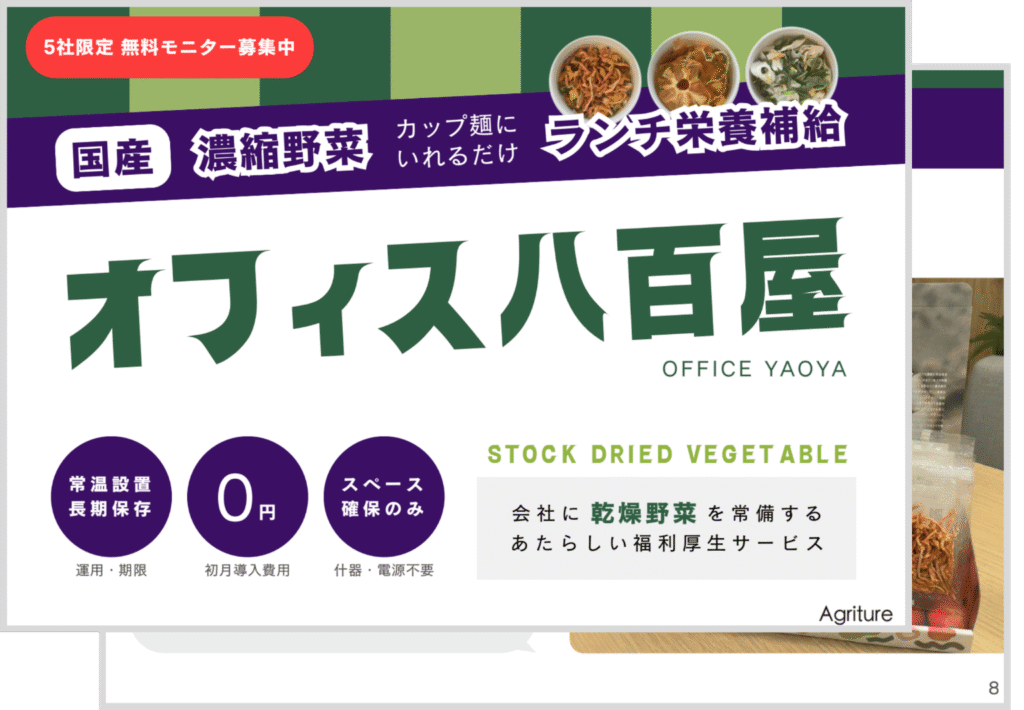
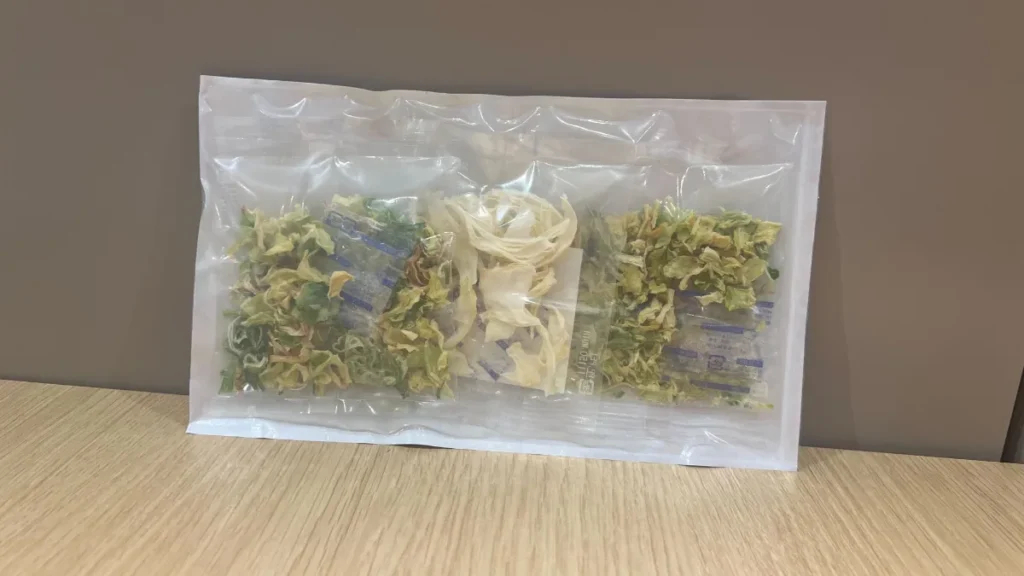
What Kai Group's Agriture Inc. began offering in earnest in April 2026, Office Yaoya (office greengrocer) is a new type even among stocked office cafeterias. Individually wrapped dried vegetables—100% domestic vegetables, no added sugar or additives, low-temperature dried—are designed so you can top up vegetables just by adding them straight to cup noodles or miso soup. Because it buys off-spec vegetables that are misshapen and cannot go to market at a fair price from producers and upcycles them, you can implement both health management and food-loss reduction in a single service.
- No initial fee, room-temperature storage of three months or more, no refrigerator needed
- Serves offices from 10 or fewer people; easy for startups to adopt too
- Comes with a CSR story of food-loss reduction by upcycling off-spec vegetables
- Designed for busy business people in their 20s–40s
Learn about Office Yaoya
We have prepared materials
- Service details and vegetable lineup
- Pricing and plans
- How adoption and operation work
Sample sets are also available. Download the materials for details!
We offer sample sets so you can try Office Yaoya in small quantities. See the materials for details.
How to introduce meal subsidies | Four fail-proof steps
The basic flow of meal subsidies is "service selection → contract → operation," but if you don't build internal consensus and organize requirements first, the usage rate struggles to grow after adoption. Here we've organized four steps to avoid failure.
Step 1: Clarify your company's needs and budget (2 weeks)
- Employee needs survey: use a questionnaire to grasp "desired meal-subsidy format," "willingness to share the cost," and "current meal issues"
- Budget ceiling: how much the company can bear per person per month (the 7,500-yen exemption cap is a rough ceiling)
- Number of people covered: how many to include (all employees or by department)
- Alignment with recruitment and health management: what you want meal subsidies to solve (retention, recruitment branding, health-management certification)
Step 2: Compare and trial three or more services (4 weeks)
"Don't decide on one company right away" is the iron rule. Get quotes from three or more, and if possible use a trial period (1–3 months) to gauge employee reactions. Narrowing the comparison to the following five axes makes judgment easier.
- Fee structure: flat monthly / usage-based / the company-employee split ratio
- Product lineup: whether it fits your needs (snacks / meals / health-focused)
- Operational burden: the effort of restocking frequency, inventory management, and payment processing
- Cancellation terms: minimum usage period, whether there is a penalty
- Fit with tax-exemption requirements: whether your operation can make it tax-exempt
Step 3: Prepare internal rules and confirm the tax treatment (2 weeks)
To book it as welfare expenses, you must state it in internal rules. Specifically, describe the meal-subsidy program's eligible parties, provision method, and usage rules in the "welfare rules" or "work rules." It's safest to ask a tax accountant or labor and social security attorney for a final check. When combining multiple meal subsidies in particular, always check whether the total exceeds the tax-exemption cap.
Step 4: full operation and effect measurement (ongoing)
Measure effectiveness at the 3-month, 6-month, and 1-year milestones after adoption. Track five indicators as fixed-point observations: "usage rate," "employee satisfaction," "health-checkup data (BMI, blood pressure, etc.)," "turnover rate," and "number of recruitment applications." If you can show improvement in figures, you can use it as content for Certified Health & Productivity Management Outstanding Organization application documents or recruitment pages. For detailed tips on getting internal approval, see Five tips for getting a health-management meal initiative approved internally.
Recommended services by company size | From 10 to over 500 people
For meal subsidies, the service that fits changes greatly by company size. The trick to avoiding failure is to choose by your own headcount, not "because other companies use it."
| Size | Recommended type | Specific service examples | Effects to aim for |
|---|---|---|---|
| 10 or fewer | Dried vegetables / stocked snacks | Office Yaoya, Okashi no March | Recruitment branding with no initial fee |
| 11–50 | Stocked office cafeteria / meal tickets | Office Yaoya, snaq.me, Ticket Restaurant | Improved employee engagement |
| 51–200 | Stocked office cafeteria + meal tickets combined | OFFICE DE YASAI + Ticket Restaurant | Obtaining health-management certification |
| 201–500 | Catered bento + stocked office cafeteria | Tamagoya + Office Okan | Differentiation in the recruitment market |
| 501 or more | Company-cafeteria operation + stocked office cafeteria | SHiDAX + Office Okan | Large-scale health-management initiatives |
Even startups of 10 or fewer can start meal subsidies. If anything, precisely because you're small, you can invest the per-person company share efficiently, which leads to differentiation in the recruitment market. For details, see Meal-benefit plans that even small offices of 10 or fewer people can start and use it as a reference.
Common failures with meal subsidies and how to avoid them
Here we organize three "common failures" heard from companies that adopted meal subsidies. Know them in advance and you can avoid them at the operational-design stage.
Failure 1: The usage rate doesn't grow / only some employees use it
"We set it up but no one picks it up" is caused by placement, lack of publicity, or a product-lineup mismatch. Building the following three points into operations improves the usage rate.
- Placement: put it in a high-traffic spot such as the pantry, break room, or near the copier
- Regular rotation: refresh the product lineup at least once a month (to prevent it going stale)
- Internal publicity: remind people of how to use it and of new products via chat, morning meetings, and the company newsletter
Failure 2: You fail to meet the tax-exemption requirements and it becomes payroll-taxed
"Full company coverage," "cash payment," and "only for specific executives" do not meet the tax-exemption requirements. Fixing the following three points before adoption keeps it from becoming a problem in a tax audit.
- Prepare internal rules: state "eligible parties, provision method, usage rules" in the welfare rules
- Method of collecting the employee's share: keep records via payroll deduction, cashless payment, a dedicated card, etc.
- Prior confirmation with a tax accountant: confirm in writing whether your operation meets the tax-exemption requirements
Failure 3: Operations stall when the person in charge changes
Meal subsidies require ongoing operation of "restocking, inventory management, usage records." When the general-affairs person transfers or resigns, the work tends to stall. Here are three measures to lower the risk of it becoming person-dependent.
- Documentation: put restocking, ordering, and inquiry handling into documents
- Automate the delivery cycle: choose a regular-delivery service to eliminate the effort of restocking
- Multi-person setup: assign a backup rather than a single person in charge, so handover is possible
Office Yaoya (office greengrocer) A service with an automated delivery cycle, such as this, is an option that minimizes the burden on the person in charge.
FAQ | Employee-benefit meal subsidy Q&A
Learn about Office Yaoya
We have prepared materials
- Service details and vegetable lineup
- Pricing and plans
- How adoption and operation work
Sample sets are also available. Download the materials for details!
We offer sample sets so you can try Office Yaoya in small quantities. See the materials for details.
Summary | Choose meal subsidies by "your company's size × purpose"
Meal assistance is a cost-effective employee benefit that can start from a few thousand yen a month and simultaneously helps with recruitment branding, reducing turnover and Health and Productivity Management certification. With the 2026 tax reform expanding the tax-free allowance from 3,500 yen to 7,500 yen per month, now is an ideal time to review how your program is designed.
The basics of choosing come down to narrowing by two axes: "your company's size + the issue you want to solve." For a startup of 10 or fewer, a stocked dried-vegetable service such as this; for a mid-size firm of over 200, a combination of a company cafeteria and a stocked office cafeteria—the optimal answer differs by size. Office Yaoya (office greengrocer) such as this.
Related article:
- Summary of tax benefits for dining subsidies | Tax-exemption requirements and expense booking
- A Must-See for HR: 12 Measures to Raise Employee Satisfaction Through Benefits
- Meal-benefit plans that even small offices of 10 or fewer people can start
- Office snack adoption guide | A comparison of pricing and selection across 8 stocking-service providers
- Five tips for getting a health-management meal initiative approved internally
- Office Yaoya | Just-place-it dried vegetables for disaster preparedness × health management

Download the office dried vegetable materials
We will send the materials to your email address based on the information you provide.
- Lessons from Office Convenience-Store Testimonials: Keys to Successful Adoption and How to Choose Without Failing
- [2026 edition] 6 disadvantages of placed staff meals and how to avoid them | An adoption checklist to avoid failure
Author of this article
Related articles
-
 [2026 edition] Meal-subsidy benefits usable at convenience stores | 3 ways to adopt them tax-free
 -
[2026 edition] 6 disadvantages of placed staff meals and how to avoid them | An adoption checklist to avoid failure
-
 A Must-See for HR: 12 Measures to Raise Employee Satisfaction Through Benefits
 -
 Food Questions in the Health and Productivity Management Survey: What to Write to Score Points
 -
Summary of tax benefits for dining subsidies | Tax-exemption requirements and expense booking
-
Food Programs for Health and Productivity Management: How Much Will It Actually Cost for a Company Our Size?
-
Meal-benefit plans that even small offices of 10 or fewer people can start
-
 Solving the office vegetable shortfall | How to choose a placed dried-vegetable service