
Health management and recruitment branding | Toward being a company chosen for its meal-related employee benefits

"We hire but people don't come." "Offer declines have increased."—These are serious worries for recruiters. Now that it's hard to make a difference through pay or name recognition alone, what's emerging as an important axis by which job seekers compare companies is "benefits," and among them, the "dietary environment." In a Mynavi survey, about 60% of job-hunting students answered that they "rate companies that engage in health management." Meal benefits are drawing attention within recruiting branding as a measure with the trifecta of being "cost-efficient, quick to start, and able to tell a story." This article organizes, from a practical viewpoint, the points job seekers truly value in benefits, why meal benefits work for recruiting branding, data showing the relationship between health management and recruiting power, and concrete measures usable for recruiting branding such as Office Yaoya (office greengrocer) operated by the Kai Group × Agriture.
- The Points Job Seekers Truly Value in Benefits
- Why Meal Benefits Work for Recruiting Branding
- Data Showing the Relationship Between Health Management and Recruiting Power
- Concrete Ways to Put Meal Measures to Use in Recruiting
- An ROI Comparison of Introduction Cost and Recruiting-Cost Reduction
"Our company's pay isn't bad, but people don't come"
If you're an HR professional, you've probably held a worry like this.
In fact, the criteria by which job seekers choose companies have changed greatly. Beyond pay and location, they're looking at "whether this company values its employees." And as material for that judgment, how substantial the benefits are is becoming ever more important.
What's especially worth noting is "meal benefits." The fact that the company is involved in daily meals becomes a message that "we're seriously thinking about employees' health."
This article explains, with data and cases, how meal benefits work for recruiting branding from the perspective of health management.
TOC
Job Seekers' Criteria for Choosing Companies Aren't "Pay" Alone
Cases Where Benefits Become the Deciding Factor in a Job Change
In job-site surveys, about 60% of job seekers answered that they value "how substantial the benefits are." Among younger people in their 20s and 30s in particular, this tendency is even stronger.
What's interesting is that among benefits, "meal-related" ones are highly popular. Compiling surveys from various staffing companies, the ranking looks like this.
| Rank | Popular benefits | Share who value it |
|---|---|---|
| 1st place | Housing allowance / rent subsidy | About 52% |
| 2nd place | Meal subsidy / cafeteria | About 45% |
| 3rd place | Enhanced health checkups | About 38% |
| 4th place | Remote-work allowance | About 35% |
| 5th place | Childcare / nursing-care support | About 33% |
Note that meal subsidy / cafeteria ranks second. Housing allowances carry high amounts, so the bar to introduction is high, but meal-related benefits can be introduced at relatively low cost. From a cost-effectiveness standpoint too, meal benefits are a "cost-efficient recruiting measure."
The Shift in Values of Gen Z and Millennials
Gen Z (born from the late 1990s to the early 2010s) and Millennials (born 1981–1996) are said to have a strong tendency to value a company's "social stance" and "efforts toward well-being."
For them, meal benefits aren't just a "nice perk." They receive it as a signal that "this company seriously considers employees' health and happiness."
Posts on social media like "our company's cafeteria is great" or "there's healthy soup in the office" going viral is an expression of these values too.
The "Final Push" That Prevents Offer Declines
Which company will a job seeker with multiple offers ultimately choose? If pay and job content are about the same, the "workplace environment" becomes the deciding factor.
If, during an office visit before accepting an offer, the break space had dried-vegetable soup and healthy drinks on hand, they'd intuitively feel "this is a company that values its employees," right?
The accumulation of small touchpoints like these is what works to lower the offer-decline rate.
3 Reasons Health Management Works for Recruiting Branding
Reason 1: Certified Health & Productivity Management Recognition Provides "Visualization"
The most effective way to promote your health-management efforts externally is obtaining the Ministry of Economy, Trade and Industry's "Certified Health & Productivity Management Outstanding Organization" recognition.
Once recognized, you can display the logo mark on your recruiting page and job postings. This becomes clear judgment material for job seekers.
In surveys of companies recognized as Certified Health & Productivity Management Outstanding Organizations, effects like the following have been reported.
| Effect item | Figure |
|---|---|
| Increase in number of applicants | Average 15–25% increase |
| Improved offer-acceptance rate | 5–10 point improvement |
| Improved employee retention | Turnover down 2–3% on average |
| Improved company image | Awareness up about 20% |
What tends to be overlooked here is that meal measures are among the relatively easy items to tackle within the recognition requirements for Certified Health & Productivity Management Outstanding Organizations. Compared with exercise programs or mental-health measures, they're easier to make apply to all employees, and easier to measure effects for.
Reason 2: "Food" Is a Daily Thing, So Its Appeal Is Strong
Unlike an annual health checkup or an exercise event a few times a month, meals are a daily thing.
"A benefit you can use every day" versus "a benefit a few times a year." Which is more appealing to a job seeker is obvious.
Summing up the strengths of meal benefits looks like this.
| Comparison axis | Meal benefits | Exercise programs | Mental-health measures |
|---|---|---|---|
| Frequency of use | Every day | 1–2 times a week | When needed |
| Eligible parties | All employees | Only those who wish | Only those who wish |
| Bar to use | Low | Medium to high | High (psychological resistance) |
| Felt effect | Felt immediately | 1–3 months | Several months |
| Appeal in recruiting interviews | High | Medium | Low |
Being able to say in an interview "our office keeps soup made with Kyoto-grown dried vegetables on hand" is a quietly big advantage. It's concrete and easy to picture, so it stays in a job seeker's memory.
Reason 3: Natural Spread on Social Media Can Be Expected
Food pairs superbly with social media.
"Today's office lunch." "The dried-vegetable soup at my company is delicious." Posts like these are often made by employees on their own initiative.
This is so-called "Employee Generated Content," and it's far more credible than what a company puts out itself. In recruiting branding, nothing is stronger than employees' real voices.
In fact, in one survey about 76% of job seekers answered that they "refer to employees' social media posts." The real voices of people who work there are trusted more than a company's official account.
5 Ways to Put Meal Benefits to Use in Recruiting
Method 1: Post Photos of the Dietary Environment on Your Recruiting Page
Post photos of dried-vegetable packages and soup lined up in the office break space on your recruiting page.
Just writing "meal subsidy available" in the text of a "benefits list" doesn't resonate with job seekers. When there are photos showing the actual dietary environment, it connects to the feeling of "I want to work here."
There are three points for taking the photos.
- Shoot in a bright environment with natural light
- Include scenes of employees actually eating
- Include not just the food packaging but also preparation scenes (pouring hot water, etc.)
Method 2: Write the Benefits Section of Job Postings Concretely
"Meal subsidy available" alone isn't enough information.
Write out concretely what's actually provided.
Bad example: Meal subsidy available
Good example: Kyoto-grown dried-vegetable soup kept on hand in the office (free). Weekly lunch catering (company-paid). Meal-subsidy vouchers of 3,500 yen per month.
Writing this concretely differentiates you from other companies' job postings.
Method 3: Build the Meal Space into the Office Tour During Interviews
When showing the office during an interview, be sure to include the meal space and break space on the route.
Just explaining "this is the break space, where you can freely have dried-vegetable soup or miso soup" greatly changes a job seeker's impression.
Going a step further, offering a cup of soup to those who come for an interview is also effective. The experience of "you can drink something like this every day" is more persuasive than words.
Method 4: Turn Your Health-Management Efforts into a Story
Be ready to tell the story of "why we started meal benefits."
"Our representative is from Kyoto, and it started from wanting employees to eat vegetables made by local farmers." With an episode like this, a company's values and culture come through.
Job seekers empathize not only with "what you do" but with "why you do it."
Method 5: Use Employees' Voices in Recruiting Content
Use interviews and comments from employees who use the meal benefits in your recruiting content.
"I look forward to the daily soup, and I can focus on afternoon work now." "I'm glad I can add a dish to my lunch." Real voices like these hit home with job seekers more than a company's official message.
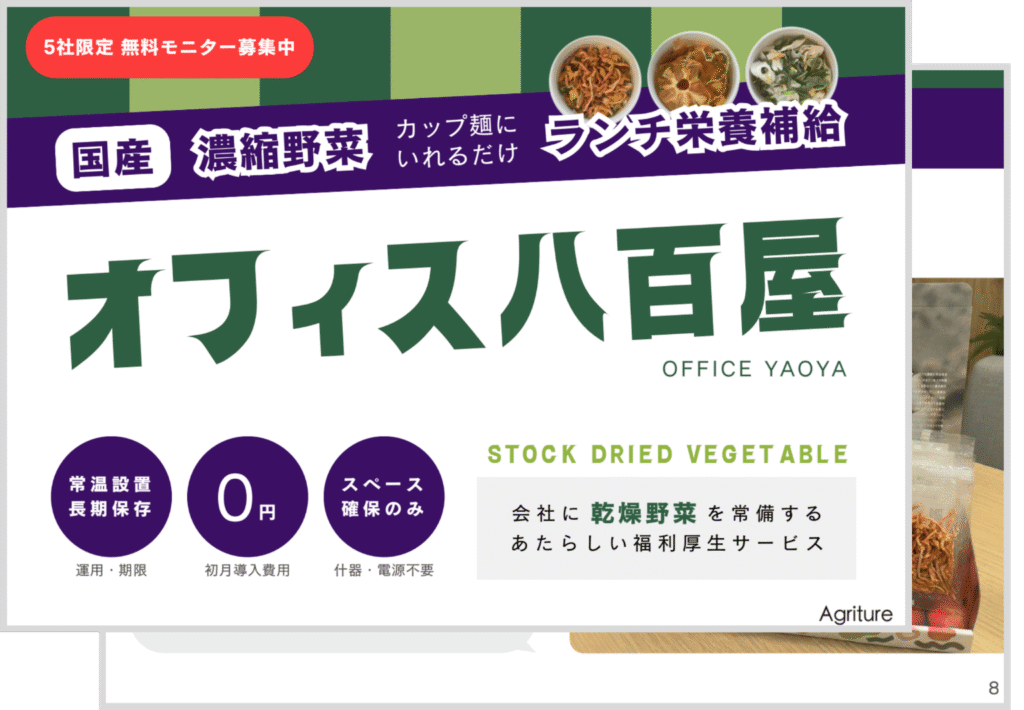
Learn about Office Yaoya
We have prepared materials
- Service details and vegetable lineup
- Pricing and plans
- How adoption and operation work
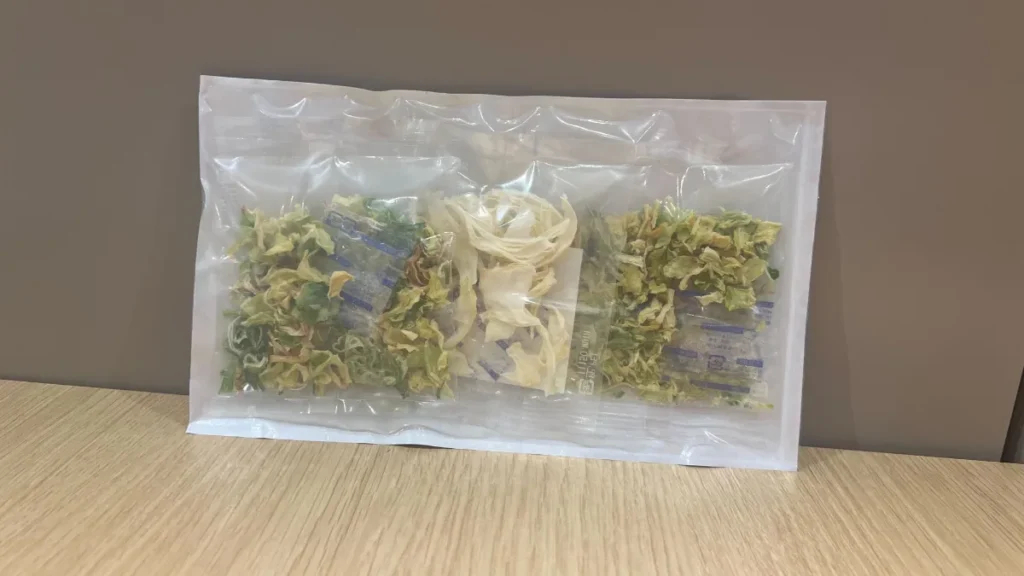
Sample sets are also available. Download the materials for details!
We offer sample sets so you can try Office Yaoya in small quantities. See the materials for details.
The ROI of Recruiting-Cost Reduction: Meal Benefits Are an "Investment"
The Reality of Recruiting Costs
Do you know the cost of hiring one person?
| Item | Cost guide |
|---|---|
| Job-media posting fees | 200,000–1,000,000 yen/posting |
| Recruitment-agency fees | 30–35% of annual salary |
| Labor cost for interviews | 50,000–100,000 yen/person |
| Post-hire training cost | 300,000–500,000 yen/person |
| Total recruiting cost per person | 800,000–2,000,000 yen |
For a 50-employee company with a 10% turnover rate, 5 people leave per year. Recruiting costs come to 4–10 million yen a year.
Multiplying the effect of meal benefits into this reveals some interesting numbers.
The Recruiting-Cost Reduction Effect from Lower Turnover
Suppose health-management efforts including meal benefits improve turnover by 2–3%.
If a 50-person company improves turnover from 10% to 7%……
| Item | Before introduction | After introduction |
|---|---|---|
| Turnover rate | 10% (5 people/year) | 7% (3.5 people/year) |
| Annual recruiting cost | 5–10 million yen | 3.5–7 million yen |
| Amount reduced | 1.5–3 million yen/year |
On the other hand, the cost of providing 3,000 yen/month in meal benefits to 50 people is 1.8 million yen a year.
With a reduction of 1.5–3 million yen against a cost of 1.8 million yen, recruiting-cost reduction alone roughly pays it back. Add in the effect of reduced presenteeism, and the ROI is reliably positive.
Higher Recruiting Quality from More Applicants
It's easy to overlook, but when the number of applicants rises, you gain the ability to "be selective."
Choosing 1 person from 10 applicants versus choosing 1 from 15 changes the quality of the hire, right? As a result, it also leads to better post-hire performance and fewer early departures due to mismatch.
This "higher recruiting quality" is hard to quantify, but over the mid-to-long term it's the part that delivers the greatest effect.
Keys to Success Learned from Adopting Companies' Voices
So It Doesn't Become a "Benefit in Name Only"
Even if you introduce meal benefits, if the usage rate is low, they can't be used for recruiting branding.
"We introduced it but no one uses it" is counterproductive. We've summarized the points for raising the usage rate.
| Point | Concrete actions |
|---|---|
| Ease of access | Install it where everyone can reach |
| Diversity of choices | A lineup that accounts for allergies and preferences |
| Regular rotation | Keep it from getting stale (add new products monthly) |
| Collecting feedback | Improve via a monthly survey |
| Management leading by using it | The president drinks the soup too |
"Management leading by using it" in particular tends to be overlooked, but the effect is enormous. Seeing the president drinking the office's dried-vegetable soup makes both employees and job seekers feel "this company is serious."
Elevating Meal Benefits into "Corporate Culture"
What you ultimately want to aim for is meal benefits becoming part of the corporate culture.
"Our company values food." When this perception permeates internally, employees start communicating that culture on their own.
Agriture provides dried vegetables directly connected to Kyoto farmers. With a story like "this vegetable was grown by such-and-such farmer in Kyoto," a meal becomes not just nutritional supplementation but something that embodies a company's values.
A Double Story of "Health Management × Food-Loss Reduction" with Meal Benefits
To stand out in recruiting branding, you need a "story that's hard for others to imitate." The Office Yaoya (office greengrocer) that the Kai Group × Agriture began offering in earnest in April 2026 is a benefit service that provides 100% domestic vegetables, sugar- and additive-free, low-temperature-dried, individually packed dried vegetables through the upcycling of off-spec vegetables. Because you can hold up two axes—"health management" and "food-loss reduction"—in a single measure, you can tell a differentiation story on job postings and corporate sites that others don't have. That its main target is busy business professionals in their 20s to 40s is also a reason it pairs well with hiring young talent.
Learn about Office Yaoya
We have prepared materials
- Service details and vegetable lineup
- Pricing and plans
- How adoption and operation work
Sample sets are also available. Download the materials for details!
We offer sample sets so you can try Office Yaoya in small quantities. See the materials for details.
Summary
Meal benefits in health management can be a powerful weapon for recruiting branding.
Now that the criteria by which job seekers choose companies are shifting from "pay" to "work environment," investing in meal benefits directly strengthens recruiting power.
For small and mid-sized companies in particular, being able to express a "warmth" and "attention to detail" that large firms lack through food is a major advantage. Even from a single cup of soup made with Kyoto-grown dried vegetables, the message that "this company values its employees" comes through.
We at Agriture propose dried-vegetable packs for offices. As a first step in recruiting branding, why not start by "placing healthy soup in the office"?
FAQ
Recommended reading
Sustainable initiatives / Commercial dried vegetables / Product lineup / Apple Variety Popularity Ranking! A Thorough Comparison Guide to Characteristics and How to Choose / Dried Vegetable (Sun-Dried Vegetable) Onigiri Project | Held Every Tuesday in Kikukawa, Tokyo
Download the office dried vegetable materials
We will send the materials to your email address based on the information you provide.
- Meal-benefit plans that even small offices of 10 or fewer people can start
- Does improving the meal environment lower turnover? Food and retention seen through data
Author of this article
Related articles
-
 [2026 edition] What is a meal subsidy as an employee benefit? A guide to adoption steps and a comparison of popular services
 -
[2026 edition] Meal-subsidy benefits usable at convenience stores | 3 ways to adopt them tax-free
-
[2026 edition] 6 disadvantages of placed staff meals and how to avoid them | An adoption checklist to avoid failure
-
 A Must-See for HR: 12 Measures to Raise Employee Satisfaction Through Benefits
 -
 Food Questions in the Health and Productivity Management Survey: What to Write to Score Points
 -
Summary of tax benefits for dining subsidies | Tax-exemption requirements and expense booking
-
Food Programs for Health and Productivity Management: How Much Will It Actually Cost for a Company Our Size?
-
Meal-benefit plans that even small offices of 10 or fewer people can start