
Reorder the apple variety ranking by cultivation area and the order changes like this

Summary of this article
We reordered the ranking of apple varieties by cultivated area from the Ministry of Agriculture, Forestry and Fisheries' Survey on Production Trends of Specialty Fruit Trees (FY2023). Fuji accounts for 15,626.9 ha, 47.3% of the total, and the top four varieties exceed 70%. We also organize, in a list of registration numbers and parent crosses, the distinction that Fuji is a MAFF-certified variety predating the Plant Variety Protection registration system, while Shinano Gold and Akibae are varieties bred and registered by prefectures.
On the supermarket shelf, "Fuji," "Shinano Gold," and "Orin" line up, and the price tags show only the variety name. Which is sweet, and which is at its best right now, can't be read from the name.
The apple is one of the few fruits whose varietal origins can be traced all the way through public records. The Ministry of Agriculture, Forestry and Fisheries' registered-variety database records 284 entries registered as the genus Malus. It retains the registration numbers, the names of the breeders, and the dates the rights expired. On top of that, how much of each variety is grown appears as actual area figures in MAFF's Survey on Production Trends of Specialty Fruit Trees.
In this article, we reorder apple varieties not by impressions of popularity or name recognition but by two primary sources: cultivated area and variety registration. On that basis, we cover the harvest-period categories, how far the sugar-content figures can be trusted, and the steps for choosing a single apple in the store.
TOC
How many apple varieties are there, in the end?
The number of varieties changes by an order of magnitude depending on the source. That's because the basis for counting differs, and none of the figures is wrong. Pinning down that difference first makes the rest easier to follow.
About 15,000 worldwide, about 2,000 in Japan
The booklet "Aomori Ringo," published by Aomori Prefecture, puts the number of apple varieties at about 15,000 worldwide and about 2,000 in Japan. About 50 are mainly cultivated within Aomori Prefecture, and about 40 are mainly shipped to market. According to the same source, about 300 varieties are cultivated at the Apple Research Institute of the Aomori Prefectural Industrial Technology Research Center, a local incorporated administrative agency.
In other words, around 40 varieties could appear in stores, and we remember the names of only about 10 of them. Between "2,000 varieties" and "40 varieties" lie old varieties no longer cultivated and lines preserved by research institutions.
284 registered Malus varieties, of which 123 still hold rights
Searching for the genus Malus in the Ministry of Agriculture, Forestry and Fisheries' registered-variety database returns 326 hits. The breakdown is 284 registered varieties and 42 whose applications were merely published without reaching registration (including 10 withdrawn and 2 rejected). The pending applications include varieties only just filed in 2026, such as the Aomori Prefectural Industrial Technology Research Center's "Aori 30" and Nagano Prefecture's "Shinano Stella."
Of the 284, breeder's rights still remain in force for 123. For the remaining 161, the term has expired or the rights have lapsed. In other words, nearly 60% of registered apple varieties are already in a state where anyone can freely propagate them.
Note that this figure is not the total number of apple varieties in Japan. Variety registration covers only applications filed after the system began, so "Fuji," "Tsugaru," "Orin," and "Kogyoku," cultivated before then, are not among these 326.
Some varieties have separate variety names and trademark names
Another source of confusion is cases where a single apple has two names. The Apple Research Institute of the Aomori Prefectural Industrial Technology Research Center explains this officially. "Aori 15" is the name on the variety registration, and "Hoshi no Kinka" is the trademark used when selling the fruit. "Aori 27" and "Chiyuki" stand in the same relationship.
The institute's reference numbers take the form "Aori No. ◯," which is the name used at the selection stage. The correspondences published by the institute are as follows.
- Aori No. 2 → Tsugaru (no trademark)
- Aori No. 9 → Aori 9 (no trademark)
- Aori No. 15 → Aori 15 → Hoshi no Kinka
- Aori No. 16 → Aori 16 → Koizora
- Aori No. 21 → Aori 21 → Shunmei 21
- Aori No. 24 → Aori 24 → Hatsukoi Gurin
- Aori No. 27 → Aori 27 → Chiyuki
So the name you see in stores differs from the name in statistics and registries. The Aomori Prefectural Industrial Technology Research Center recommends calling them by the trademark, but when researching a variety, you won't reach the information unless you check both names.
Reordered by cultivated area, the variety ranking looks like this
Here is the main point. The Ministry of Agriculture, Forestry and Fisheries' Survey on Production Trends of Specialty Fruit Trees records the cultivated area of each apple variety by prefecture. In the latest FY2023 data, 107 varieties were counted, totaling 33,051.4 ha.
The top four varieties exceed 70% of the total
Ordered by largest area, the top entries are as follows. The lineup should differ considerably from a name-recognition ranking.
| Rank | Variety name | Planted area (ha) | Share | Ripening period |
|---|---|---|---|---|
| 1 | Fuji | 15,626.9 | 47.3% | Late-season |
| 2 | Tsugaru | 3,439.9 | 10.4% | Early-season |
| 3 | Orin | 2,428.2 | 7.3% | Late-season |
| 4 | Jona gold | 2,206.6 | 6.7% | Mid-season |
| 5 | Shinano Sweet | 1,116.7 | 3.4% | Mid-season |
| 6 | Shinano gold | 903.1 | 2.7% | Mid-season |
| 7 | Akibae | 576.2 | 1.7% | Mid-season |
| 8 | Hirosaki Fuji | 519.0 | 1.6% | Mid-season |
| 9 | Hokuto | 518.9 | 1.6% | Mid-season |
| 10 | Mutsu | 424.5 | 1.3% | Late-season |
| 11 | Toki | 417.8 | 1.3% | Mid-season |
| 12 | Kogyoku (Jonathan) | 393.4 | 1.2% | Mid-season |
| 13 | Miyabi Fuji | 343.7 | 1.0% | Late-season |
| 14 | Mishima Fuji | 340.7 | 1.0% | Late-season |
| 15 | Gunma Meigetsu | 329.0 | 1.0% | Late-season |
| 16 | Cosmo Fuji | 314.6 | 1.0% | Late-season |
| 17 | Korin | 309.1 | 0.9% | Mid-season |
| 18 | Kio | 283.8 | 0.9% | Early-season |
| 19 | Yataka | 166.6 | 0.5% | Mid-season |
| 20 | Kinsei | 159.3 | 0.5% | Late-season |
First-place "Fuji," at 15,626.9 ha, accounts for 47.3% of the total. Adding from second-place "Tsugaru" through fourth-place "Jonagold," the top four varieties reach 71.7%, with the remaining 103 varieties splitting the other 30%.
Add Fuji's bud sports and it exceeds half
In the table, the names "Hirosaki Fuji," "Miyabi Fuji," "Mishima Fuji," and "Cosmo Fuji" appear. These are bud sports or early-ripening lines of "Fuji," grouped as "early-ripening Fuji" in Aomori Prefecture's materials, which list Hirosaki Fuji, Beni Shogun, Korin, Ryoka no Kisetsu, Honoka, Yataka, and others.
Summing the area of varieties whose names include "Fuji" gives 1,729.2 ha. Adding Beni Shogun, Korin, Ryoka no Kisetsu, Honoka, and Yataka, which Aomori Prefecture lists as early-ripening Fuji, brings the Fuji-line total to 17,931.7 ha, or 54.3% of the total. That means more than half of Japan's apple orchards are filled with Fuji and its lines.
Popularity rankings and cultivated-area rankings are different things
Kogyoku is 12th at 393.4 ha, a 1.2% share. It's a variety often named for confectionery use, but its actual planting is only one-fortieth of Fuji's. Conversely, "Hirosaki Fuji" and "Miyabi Fuji" barely appear in general articles, yet in area they are on the same level as Kogyoku.
How often you see a variety in stores depends not only on cultivated area but also on storability and shipping timing. Late-season Fuji appears on shelves year-round, while extra-early varieties are seen only for a short period in summer—that owes to differences in shelf life, not just area. Even so, the fact of which variety is chosen, and how much, in the growing regions appears only in these area figures.
Below the top 20, varieties of roughly 1 to 10 ha line up one after another—Kurenai no Yume at 2.7 ha, Sour Rouge at 1.4 ha, Suwakko at 1.0 ha, and so on. You can only encounter such varieties at farm-direct shops and roadside stands. If you find the name, it's worth picking up as that year's encounter.
In harvest volume, Aomori and Nagano make up about 80% of the national total
Asked about as often as varieties is the ranking of growing regions. For this, the Ministry of Agriculture, Forestry and Fisheries' Crop Statistics Survey (fruit trees) publishes harvest volumes by prefecture each year. The latest is FY2024.
The national harvest is 609,200 tons
| Rank | Prefecture | Harvest volume (t) | Share of national total | Bearing-tree area (ha) |
|---|---|---|---|---|
| 1 | Aomori | 370,500 | 60.8% | 19,100 |
| 2 | Nagano | 106,400 | 17.5% | 6,530 |
| 3 | Iwate | 36,700 | 6.0% | 2,110 |
| 4 | Yamagata | 32,700 | 5.4% | 1,960 |
| 5 | Fukushima | 19,400 | 3.2% | 1,120 |
| 6 | Akita | 18,600 | 3.1% | 1,100 |
| 7 | Hokkaido | 6,710 | 1.1% | 501 |
| 8 | Gunma | 5,840 | 1.0% | 387 |
| ― | Nationwide | 609,200 | 100% | 33,700 |
Aomori Prefecture, at 370,500 tons, is 60.8% of the national total, and Nagano Prefecture, at 106,400 tons, is 17.5%. These two prefectures make up 78.3%. Third-place Iwate Prefecture, at 36,700 tons, is about one-tenth of Aomori's.
There are two area statistics, and the figures don't match
Here, care is needed in handling the figures. The bearing-tree area for FY2024 shown by the Crop Statistics Survey is 33,700 ha nationwide, whereas the total of the earlier by-variety cultivated area (FY2023) was 33,051.4 ha. On top of the survey years being one year apart, there is a difference in definition: one is the area of fruit-bearing trees, the other the area under cultivation.
When citing a figure, it can't be compared unless you note which survey and which year it's from. For differences in flavor and climate by region, Differences among apple-growing regions for more.
FOR BUSINESS
Looking for dried apples as a raw material?
We dry and grind domestically grown apples to supply them. Feel free to specify cut shape and particle size, and to discuss ongoing supply. Specifications are Dried apple listed at.
Small-quantity purchases are available through our sister brand's online store, OYAOYA.
Varieties that grew and shrank over the past five years
The Survey on Production Trends of Specialty Fruit Trees is conducted on an ongoing basis, so comparing it with past data reveals the turnover of varieties. We compared the national totals for FY2018 and FY2023.
The ones that lost area were the standard top varieties
| Variety name | FY2018 (ha) | Reiwa 5 crop year (ha) | Change (ha) |
|---|---|---|---|
| Fuji | 18,223.0 | 15,626.9 | −2,596.1 |
| Tsugaru | 4,193.7 | 3,439.9 | −753.8 |
| Orin | 2,641.7 | 2,428.2 | −213.5 |
| Jona gold | 2,394.7 | 2,206.6 | −188.1 |
| Korin | 412.7 | 309.1 | −103.6 |
| Yoko | 148.9 | 81.8 | −67.1 |
| Hokuto | 562.1 | 518.9 | −43.2 |
| Senshu | 133.0 | 96.6 | −36.4 |
| Miyabi Fuji | 36.9 | 343.7 | +306.8 |
| Cosmo Fuji | 50.8 | 314.6 | +263.8 |
| Mishima Fuji | 118.6 | 340.7 | +222.1 |
| Akibae | 456.8 | 576.2 | +119.4 |
| Shinano Rip | 44.9 | 155.1 | +110.2 |
| Gunma Meigetsu | 232.5 | 329.0 | +96.5 |
| Shinano gold | 810.5 | 903.1 | +92.6 |
| Total | 35,893.5 | 33,051.4 | −2,842.1 |
The total area has shrunk by 2,842.1 ha. Most of the decrease is Fuji, which contracted 2,596.1 ha over five years, a rate of 14.2%. Tsugaru also fell 18.0%. As apple cultivation itself contracts, the top varieties are absorbing that decline.
The ones growing are early-ripening Fuji and Nagano and Gunma varieties
On the other hand, some varieties are increasing. Miyabi Fuji grew 9.3-fold, from 36.9 ha to 343.7 ha, and Cosmo Fuji grew 6.2-fold, from 50.8 ha to 314.6 ha. Both are bud sports of Fuji, lines that can be harvested earlier than Fuji. The main Fuji declining while early-ripening Fuji increases is a movement in which you can read the regions' wish to spread out the harvest work.
Among prefecture-bred varieties, Nagano Prefecture's Shinano Rip grew 3.5-fold, from 44.9 ha to 155.1 ha, and Gunma Prefecture's Gunma Meigetsu grew 41.5%, from 232.5 ha to 329.0 ha. Nagano Prefecture's Akibae also grew 26.1%, and Shinano Gold 11.4%.
The ranking five years from now won't be the same as today's
If this trend continues, Fuji's share will fall further, and mid-season varieties will gain relative presence. The variety ranking is not fixed; it moves every year as a result of replanting in the growing regions. Don't take a ranking article's order at face value—check which year and which figures it's from.
Varieties that predate variety registration, and those registered later
Searching for "Fuji" in the registered-variety database turns up nothing. This isn't an omission; it's because the registration mechanism is different. Understanding this lets you draw the line on how far to trust a variety's information.
Fuji is registered as "Ringo Norin No. 1"
The NARO Institute of Fruit Tree and Tea Science states explicitly of Fuji: "It is a variety bred before the variety registration system under the Plant Variety Protection Act. It is registered as a MAFF-certified variety." Its registration number is "Ringo Norin No. 1." Its former line name is recorded as "Ringo Tohoku No. 7" and its cross as "Ralls Janet × Delicious."
It was bred at the Tohoku Branch of the Ministry of Agriculture and Forestry's Horticultural Experiment Station, then located in Fujisaki, Aomori Prefecture. Through relocation and consolidation, the organization is now the NARO Institute of Fruit Tree and Tea Science (Morioka City). NARO explains that the variety name derives from Fujisaki, its breeding site, and Mount Fuji. For the characteristics of Fuji itself, Characteristics of Fuji apples, which covers this in detail.
There are other MAFF-certified varieties
Fuji is not the only MAFF-certified variety. In NARO's materials, "Akane" is registered as "Ringo Norin No. 2" (registration date October 21, 1970; cross Kogyoku × Worcester Pearmain), and "Sansa" as "Ringo Norin No. 7" (October 31, 1986; Gala × Akane). Sansa has also received variety registration under the Plant Variety Protection Act, with registration number 1565.
"Tsugaru" was bred by the Aomori Prefectural Apple Experiment Station and was name-registered from "Aori No. 2" as "Tsugaru" in 1975. It doesn't come up in a search of the current variety registration database. Of the genus Malus recorded in the registered-variety database, the earliest registered is "Senshu" (Akita Prefecture, registration number 42) in March 1980. The system got going around that time, and varieties that had spread before then were outside its scope from the start.
Orin, Kogyoku, and Jonagold have no registration
Orin was bred by Tadanosuke Otsuki of Koori, Date District, Fukushima Prefecture, and was named in 1952. Aomori Prefecture's materials, too, only state that it "was named," and the name appears neither in the registered-variety database nor in NARO's list of MAFF-certified varieties. Kogyoku originates in New York State, USA, and was introduced to Japan by the Hokkaido Development Commission (Kaitakushi) in 1871. Jonagold, also bred at the New York State Agricultural Experiment Station, was introduced to Japan by the Akita Prefectural Fruit Tree Experiment Station in 1970.
The Survey on Production Trends of Specialty Fruit Trees distinguishes this difference in its "Registered" and "Unregistered" columns. The survey notes that "Registered" includes varieties whose registration has been canceled or whose registration period has expired.
Breeder's rights have a term, which was extended in 2026
Receiving variety registration gives rise to breeder's rights, but these have a term. Nagano Prefecture's Shinano Gold was registered on August 11, 1999, and its breeder's rights lapsed on August 12, 2024. Akibae's lapsed on March 12, 2002, and Shinano Sweet's on August 23, 2014. For varieties whose rights have expired, propagating and selling saplings becomes free.
According to the Ministry of Agriculture, Forestry and Fisheries, an amendment to the Plant Variety Protection Act extended the term of breeder's rights from July 24, 2026. For registered varieties whose rights remained in force on that date, the term becomes 40 years from the date of variety registration for perennial plants such as apples. Toki (registration number 12306) and Shinano Rip (26584) still hold rights.
Whether a variety's rights are still in force shapes how widely it spreads. The Ministry of Agriculture, Forestry and Fisheries advises that propagating and transferring the seedlings of a registered variety requires a licensing procedure from the breeder's rights holder. Aomori Prefecture's Hatsukoi Grin (Aori 24) was the first domestically bred variety to adopt a club system, with an association of growers handling production and sales. Conversely, varieties whose rights have expired, such as Shinano Sweet and Akibae, can be planted regardless of region.
Listing the main varieties by registration number and parentage
We have compiled the sources covered so far onto a single sheet. Entries with a registration number are taken from the Plant Variety Registration Database; those without are drawn from published materials of NARO, Nagano Prefecture, and Aomori Prefecture.
20 varieties with known registration numbers and breeders
| Variety name | Variety registration | Breeder / Registrant | Parentage | Harvest (breeding site) |
|---|---|---|---|---|
| Fuji | apples Norin No. 1 | Ministry of Agriculture and Forestry Horticultural Experiment Station, Tohoku Branch | Kokko × Delicious | Late October to early November |
| Tsugaru | Name registered (1975) | Aomori Prefectural Apple Experiment Station | Golden Delicious × Jonathan | Early September to Mid-month |
| Orin | Not registered | Mr. Tadanosuke Otsuki (Koori, Fukushima) | Golden Delicious × Indo | Late October to early November |
| Jona gold | Not registered | New York State Agricultural Experiment Station | Golden Delicious × Jonathan | Mid-October |
| Kogyoku (Jonathan) | Not registered | Native to the United States (introduced in 1871) | ― | Mid-October |
| Mutsu | Not registered | Aomori Prefectural Apple Experiment Station | Golden Delicious × Indo | Mid-season to late-season |
| Akane | apples Norin No. 2 | Ministry of Agriculture and Forestry Horticultural Experiment Station | Jonathan × Worcester Pearmain | Early to mid-September |
| Sansa | No. 1565 Norin No. 7 | NARO | Gala × Akane | Early September |
| Senshu | No. 42 | Akita Prefecture | Tsugaru × Star king Delicious | Mid-season |
| Yoko | No. 129 | Gunma Prefecture | Golden Deli cious seedling | October 20 to around the 25th |
| Hokuto | No. 368 | Aomori Prefecture | Fuji × Mutsu | Late October to early November |
| Gunma Meigetsu | No. 2816 | Gunma Prefecture | Akagi × Fuji | Late October |
| Akibae | No. 3411 | Mr. Takeo Odagiri (Nakano, Nagano) | Senshu × Tsugaru | Early September |
| Kio | No. 3947 | Iwate Prefecture | ― | Early-season |
| Shinano Sweet | No. 5139 | Nagano Prefecture | Fuji × Tsugaru | Early to mid- Mid-month |
| Shinano gold | No. 7328 | Nagano Prefecture | Golden Deli cious × Senshu | Mid- to late October |
| Aika no Aroma | No. 9130 | Mr. Hideo Fujimaki (Nagano City) | Fuji natural hybrid seedling | Mid- to late October |
| Hoshi no Kinka (Aori 15) | No. 11593 | Aomori Prefectural Industrial Technology Center | Fuji × Aori No. 3 | Late October |
| Toki | No. 12306 | The company Harada Seed | Orin × Kogetsu | Early October |
| Chiyuki (Aori 27) | No. 16787 | Aomori Prefecture | Kinsei × Mahe 7 | Mid-October |
Trace the parentage and the same names come up again and again
Read the table vertically and the same names appear as parents again and again. Golden Delicious appears six times (Tsugaru, Orin, Jonagold, Mutsu, Shinano Gold, Yoko), Fuji five times (Hokuto, Gunma Meigetsu, Shinano Sweet, Aika no Kaori, Hoshi no Kinka), Jonathan three times (Tsugaru, Jonagold, Akane), and Tsugaru three times (Senshu, Akibae, Shinano Sweet).
Golden Delicious is a yellow variety born in the United States, and the leading yellow-skinned varieties—Orin, Mutsu, and Shinano Gold—all descend from it. When you pick a yellow apple at the store and sense a similar flavor lineage, it is no coincidence.
Records of parentage sometimes disagree from source to source. In the characteristics summary of its variety registration, Hokuto is described as a hybrid seedling of Fuji and Mutsu, but in the materials Aomori Prefecture currently publishes the mother is listed as Fuji and the father as unknown. More than 40 years have passed since registration, and such differences remain where parentage was re-examined later.
Varieties with Fuji as a parent all lead with sweetness. Gunma Meigetsu and Hokuto develop a lot of honey core, and Hoshi no Kinka is reported at 15–16% sugar content. Even when the names are all over the place, varieties that taste alike share overlapping parents. Rather than memorizing variety names, tracing the parents sorts things out faster.
Varieties bred by individuals can become mainstays too
Look at the registrant column and you find not only prefectures and research institutions but the names of individuals lined up. Akibae was bred by Mr. Takeo Odagiri of Nakano, Nagano, and Aika no Kaori by Mr. Hideo Fujimaki of Nagano City. In the 2023 crop year Akibae spread to 576.2 ha, seventh nationwide.
Counting the registrants of the 284 Malus entries recorded in the Plant Variety Registration Database, those by parties other than prefectures, universities, and public research institutions—that is, by individuals and private companies—number 183, or 64.4%. The entity registering the most varieties is also a private seed company, with 23 to its name. Prefectural experiment stations are not the only ones creating varieties.
Such individually bred varieties begin with a bud sport or seedling found by chance in a single orchard. Miyabi Fuji and Mishima Fuji, both bud sports of Fuji, spread more than threefold in five years—the result of good specimens being selected and propagated within the growing region.
Harvest-season categories and when apples reach the shelf
Apples are harvested from August through November, then stored and distributed into the following year. Knowing the harvest-season categories gives you a sense of what state the apples now on the shelf are in.
Where the lines fall between extra-early, early, mid, and late varieties
Aomori Prefecture spells out the criteria for classification by harvest time. Varieties harvested by around August 20 are extra-early, by around September 20 early, by around October 20 mid-season, and from around October 20 onward late-season. The Survey on Production Trends of Specialty Fruit Trees classifies varieties into the same four categories.
| Category | Harvest guide | Main varieties | Refrigerated keeping guide |
|---|---|---|---|
| Extra-early varieties | Around August 20 or earlier | Natsumidori, Koizora, Tsugaru Hime | About 2 weeks |
| Early varieties | Around September 20 or earlier | Tsugaru, Kio, Shinano Lip | About 1.5 to 2 months |
| Mid-season varieties | Around October 20 or earlier | Jonagold, Jonathan, Akibae, Toki | 2 months or more 3 months |
| Late varieties | Around October 20 and later | Fuji, Orin, Mutsu, Gunma Meigetsu | 3 to 8 months |
Eat summer apples quickly, like peaches
The Apple Research Institute puts the shelf life of extra-early varieties at, at most, about two weeks refrigerated. That is more than a tenfold gap from the three to eight months of late-season varieties, and the summer heat speeds the decline in quality further. The image of "apples as a fruit that keeps" is a story about late-season varieties like Fuji.
When you get hold of an extra-early apple, chill it in the fridge and eat it right away. Treat it like a peach or a melon and you will not go wrong. Because they are not distributed in large volumes, these are varieties you most often come across at roadside stations and farm-direct centers in the growing regions.
In the 2023-crop statistics, only four varieties are classed as extra-early: Natsumidori at 9.1 ha, Aori 16 (Koizora) at 23.5 ha, Tsugaru Hime at 18.4 ha, and Merci at 3.1 ha. Together they come to just 54.1 ha, only 0.16% of the national apple-growing area. Summer apples are hard to find because the amount grown is, from the outset, smaller by orders of magnitude.
Sun Fuji until March, Hoshi no Kinka until June
Even among late-season varieties, the period on the market differs by variety. Non-bagged Fuji—grown without bags, left to ripen, and then harvested, so-called Sun Fuji—is said to be good to eat until March. Fuji still on the shelf into early summer has been given extra treatment, such as bag cultivation, early harvesting, or CA storage.
Hoshi no Kinka is a long-keeping type that stays good to eat until June under ordinary cultivation and refrigeration, and the Apple Research Institute introduces it as a variety with an ultra-long shelf life. For the knack of storing them at home, see how to store apples in winter.
CA storage is a method that adjusts the composition of the air to suppress respiration. According to Aomori Prefecture's materials, the oxygen that makes up 21% of the air is lowered to 1.8–2.5%, the 0.04% of carbon dioxide is raised to 1.5–2.5%, and the fruit is held at around 0°C. As of 2023, about 46% of the prefecture's storage capacity is CA storage.
How far can the sugar-content figures actually be verified?
"Sugar-content rankings" turn up often in articles about apples, but most give no source for the numbers. The varieties whose sugar content is published in official materials are, in fact, quite limited.
Only varieties held by their breeding institution have published sugar figures
The parties that publish sugar content as a figure are the institutions that bred the variety. The Nagano Prefecture Fruit Tree Experiment Station publishes the sugar and acid content of varieties it bred, and Aomori Prefecture gives the same figures for its own new varieties. NARO likewise lists the sugar content of the varieties it bred.
| Variety name | Sugar content | Acidity | Source | Measurement conditions |
|---|---|---|---|---|
| Fuji | 14~16% | 0.4~0.5% | NARO | Breeding site (Morioka) |
| Sansa | 13~14% | About 0.4% | NARO | Breeding site (Morioka) |
| Akane | 11~12% | 0.6~0.7% | NARO | Breeding site (Morioka) |
| Takane | 14~15% | About 0.3% | Nagano Prefecture Fruit Tree Experiment Station | Breeding site (Suzaka) |
| Shinano Sweet | 14~15% | About 0.3% | Nagano Prefecture Fruit Tree Experiment Station | Breeding site (Suzaka) |
| Shinano gold | 14~15% | About 0.5% | Nagano Prefecture Fruit Tree Experiment Station | Breeding site (Suzaka) |
| Shinano Dolce | 14~15% | About 0.5% | Nagano Prefecture Fruit Tree Experiment Station | Breeding site (Suzaka) |
| Shinano Red | About 13% | 0.4~0.5% | Nagano Prefecture Fruit Tree Experiment Station | Breeding site (Suzaka) |
| Shinano Piccolo | About 14% | About 0.4% | Nagano Prefecture Fruit Tree Experiment Station | Breeding site (Suzaka) |
| Shinano Pucchi | 13~14% | About 0.3% | Nagano Prefecture Fruit Tree Experiment Station | Breeding site (Suzaka) |
| Hoshi no Kinka | 15~16% | About 0.3% | Aomori Prefecture | ― |
| Chiyuki | About 15% | About 0.3% | Aomori Prefecture | ― |
| Koizora | About 13% | About 0.35% | Aomori Prefecture | ― |
| Benihatsumi | 13~14% | About 0.4% | Aomori Prefecture | ― |
| Hatsukoi Grin | 13~15% | About 0.8% | Aomori Prefecture | ― |
| Aori 13 | 14~15% | About 0.3% | Aomori Prefectural Industrial Technology Center | ― |
Varieties not in this table are ones for which no sugar-content figure could be found in official materials. For Tsugaru, Orin, Jonagold, Jonathan, Mutsu, and Hokuto, even Aomori Prefecture's materials go no further than word descriptions such as "strongly sweet" or "well-balanced sweetness and acidity," with no figures given.
Even the same variety tastes different by where it is grown
The figures themselves also have a range. The Nagano Prefecture Fruit Tree Experiment Station states plainly of Shinano Gold that "fruit grown in cold regions is more acidic," and attaches the same note to Shinano Dolce. The 14–15% sugar figure is a guide for Suzaka, its breeding site, and the impression changes once the growing region changes.
It is therefore a stretch to build a "sugar-content ranking" by lining up figures from different sources. When the breeding institutions differ, so do the measurement methods and the years measured, and they are not on the same footing. This article, too, assigns no rankings.
Growing regions gauge sugar content and honey core by machine
On the shipping floor, sugar content is measured not by feel but by machine. According to Aomori Prefecture's materials, harvested apples are run through an optical-sensor sorting machine and graded by size and shape as well as degree of coloring, sugar content, and the state of the honey core.
There is also an explanation of what the honey core really is. Starch made in the leaves is converted to sorbitol and carried to the fruit; the sorbitol that is no longer converted into fructose or sucrose collects in the gaps between cells and draws in moisture. This is the honey core. Aomori Prefecture notes that "the honey core itself is not very sweet" and explains that an apple with honey core is evidence of advanced ripening.
Whether honey core forms is also a trait of the variety. The Nagano Prefecture Fruit Tree Experiment Station states plainly of Shinano Sweet that "no honey core forms in the flesh," and in the characteristics summaries of the Plant Variety Registration Database the amount of honey core for Shinano Sweet and Shinano Gold is rated "none to slight." Pick a variety that forms no honey core and you will not find any, however hard you look.
The steps for choosing an apple at the store
Once you know the variety, the next step is picking a single apple from within that variety. Deciding on an order cuts the time you spend hesitating in the aisle. Check the following six points in order, from the top.
Step 1: Check which variety is in season right now
The first thing to look at is the variety name on the price tag. From August to early September it is the season for extra-early to early varieties, in October for mid-season, and from November on for late-season. Fuji on the shelf past March can be assumed to have gone through bag cultivation or CA storage.
When the season and the variety match, there is a good chance the apple was harvested not long ago. Conversely, if early-season Tsugaru is on display in December, it is a stored item.
Step 2: Look at the ground color
For red varieties, look at the ground color rather than the depth of red. The ground color is the base color before the red develops; in many varieties it shifts from yellow-green to yellow. A ground color tinged with yellow is a sign of advanced ripening.
For yellow varieties, the color at full ripeness differs from variety to variety. Nagano Prefecture describes Shinano Gold as "colored light yellow over a yellow-green ground color, with no stripes," and Aomori Prefecture calls Orin "yellow-green." Orin keeps its yellow-green even when ripe, so there is no need to wait for it to turn fully yellow.
Step 3: Pick it up and check the weight
At the same size, choose the heavier one, because weight is a guide to how much juice there is. The characteristics summaries in the Plant Variety Registration Database even include an item for "amount of juice," rated for each variety. Shinano Sweet, Shinano Gold, and Hokuto are all classed on the juicier side.
One that feels light in the hand may have lost moisture during storage. The same goes for one whose skin dents when you press it.
Step 4: Look at the stem and the base
Choose one whose stem (the fruit stalk) is thick and firm and not shriveled. The stem dries out after harvest, so it serves as a clue to freshness.
As for the hollow at the base, a lingering green tint means it is young, while a touch of yellow means ripening has advanced. You can take the greener side if you want a crisp bite, or the yellower side if you are after sweetness.
Keep an eye out for bruises and blemishes too. Where the surface is dented, the flesh inside can turn brown when cut. That is no problem if you eat it right away, but if you plan to keep it more than a week, choose one without blemishes. For storing apples bought in bulk, see How to store apples for more.
Step 5: A sticky surface is not a defect
The surface of the skin can feel sticky, and some people worry that wax has been applied. Aomori Prefecture explains that this is a phenomenon called "oil rise" (aburaagari). Its main components are linoleic acid and oleic acid, which increase as the apple ripens and come to the surface of the skin.
This phenomenon is seen in Jonagold and Tsugaru, and Aomori Prefecture takes it as a sign of good ripeness. There is no need to wipe it off and no reason to avoid it.
Step 6: Honey core cannot be told for certain from the outside
There is no reliable way to spot honey core from the outside. In the growing regions they go so far as to view the inside with optical sensors, so there are limits to the naked eye at home. One that looks translucent on the base side is sometimes cited, but it is not a sure thing.
If you are after honey core, the quick route is to choose a product labeled as having it. Honey core forms readily in late-season varieties, and Aomori Prefecture's materials state that Hokuto and Gunma Meigetsu develop a lot of it.
Choose the variety to suit how you will eat it
Whether a variety suits a purpose is determined by the strength of its sweetness and acidity, the firmness of its flesh, and how it breaks down when heated. Working backward from the use narrows the options all at once.
For eating fresh, choose by sweetness and juice
Chosen for eating fresh are varieties high in sugar and rich in juice. Within the range where official materials give sugar content, Hoshi no Kinka comes in at 15–16%, Chiyuki at about 15%, Fuji at 14–16%, and Shinano Sweet and Shinano Gold at 14–15%.
If you dislike tartness, choose one low in acidity. Shinano Sweet, Chiyuki, and Hoshi no Kinka are all around 0.3% acidity. By contrast, Hatsukoi Grin is around 0.8% acidity, and Aomori Prefecture describes its flavor as rich with pronounced tartness. The amount of acidity, more than the strength of the sweetness, is what divides preferences.
The firmness of the flesh also shapes the impression. Aomori Prefecture says Shinano Gold "stores well," while Nagano Prefecture rates its "flesh firmness and flesh texture as medium." If you want a firmer bite, buying right after harvest is the sure bet. The longer the storage period, the softer the flesh becomes.
For baking or stewing, choose a variety with acidity
In cooked dishes, acidity provides the backbone. Aomori Prefecture's materials describe Jonathan as having "a strong acidity, yet a refreshing aroma and sweetness that make for good eating quality," noting it has high processing suitability and is the most popular variety for juice, confectionery, and cooking.
When Jonathan is out of season, Jonagold can take its place. Aomori Prefecture explains that its acidity gives it processing demand for uses such as juice. Mutsu is also an aromatic variety with high processing suitability.
If time passes after cutting, choose a variety that resists browning
When time passes after cutting, as with salads or bento boxes, a variety whose flesh resists browning is useful. Chiyuki is a variety that Aomori Prefecture explicitly describes as "suited to salads and processing because the flesh does not discolor easily."
The characteristic summaries in the registered-variety database also include an evaluation item for "flesh browning," recorded for each variety. When browning is a concern, choosing from this angle makes handling easier.
When drying, do not choose high-sugar varieties
Finally, a word on variety selection from the processing side. A variety that tastes good eaten fresh is not necessarily good once dried.
High sugar content makes the sweetness excessive
In drying, the sugars concentrate as moisture is removed. If the original sugar content is too high, the sweetness becomes excessive and comes through as harshness. High-sugar raw material can also discolor during storage. It is troublesome because it does not show at the prototype stage and surfaces only some time after shipping. (From experience at Agriture)
The selection standard is a well-balanced variety that is neither too sweet nor too acidic. A variety skewed to one extreme will have only that element stand out after drying. A variety with a good sweet-acid balance gives a more stable result than a variety at 15–16% sugar content.
Yield is 7% to 10%
From 1 kg of fresh apples, you get about 70 g to 100 g of dried product. To make 1 kg of product, you need 10 kg to 14 kg of fresh fruit. The measured figure is lower than the theoretical value calculated from moisture content, because the removal of skin, core, and seeds and the process losses are added on. When using off-grade fruit, a step to cut away damaged parts is added, which lowers it further. (Based on our own research)
The best-before date of the dried product is about 6 months from the shipping date. Domestic dried products made without sugar have no sugar-based water retention, so their shelf life is shorter than sugar-candied imported products. The preparation steps are How to dry apples.
Mixing varieties adds depth to the flavor
There is also a method of drying a sweet variety and an acidic variety separately and mixing them afterward. Sweetness and acidity coexist within one pack, making it less tiring to eat. Ways to eat dried apples are Arrangements for eating dried apple.
At Agriture we dry domestic vegetables and fruits with warm air, and handle grinding down to the equivalent of 100 mesh and small-pack filling from 10 g up. The specifications for dried apples are Dried apple product page listed at.
FOR BUSINESS
Looking for dried apples as a raw material?
We dry and grind domestically grown apples to supply them. Feel free to specify cut shape and particle size, and to discuss ongoing supply. Specifications are Dried apple listed at.
Small-quantity purchases are available through our sister brand's online store, OYAOYA.
FAQ
Summary
The lineup of an apple variety ranking changes depending on what you base it on. By cultivated area, the top for FY2023 is Fuji at 47.3% of the total, the top four varieties make up 71.7%, and including the Fuji lineage it exceeds half. By prefecture for harvest volume, Aomori and Nagano account for 78.3%.
A variety's origin can be traced from its registration number. Shinano Gold is No. 7328 bred by Nagano Prefecture, Toki is No. 12306 by Harada Seed Co., Ltd., and Hoshi no Kinka is No. 11593 by the Aomori Prefectural Industrial Technology Center. On the other hand, Fuji falls under a different system as "Ringo Norin No. 1," and Orin and Jonathan are not in the registered-variety database.
Sugar content can be used as an indicator of quality, but figures appear in official materials only for varieties held by the breeding institutions, and they shift by growing region as well. It is safer not to read a sugar-content ranking that lines up figures from different sources as a ranking.
In the store, check that the season and variety match, confirm the ground color, choose the heavier one among apples of the same size, and look at the color of the stem and the calyx end. In this order you can decide in a few dozen seconds. If you are interested in varieties grown overseas, Popular apple varieties from overseas.
Honey-cored Shinshu apple, domestic dried apple
Sugar-free, a crunchy new texture—dried fruit of honey-cored "leaf-unremoved Shinshu apple"
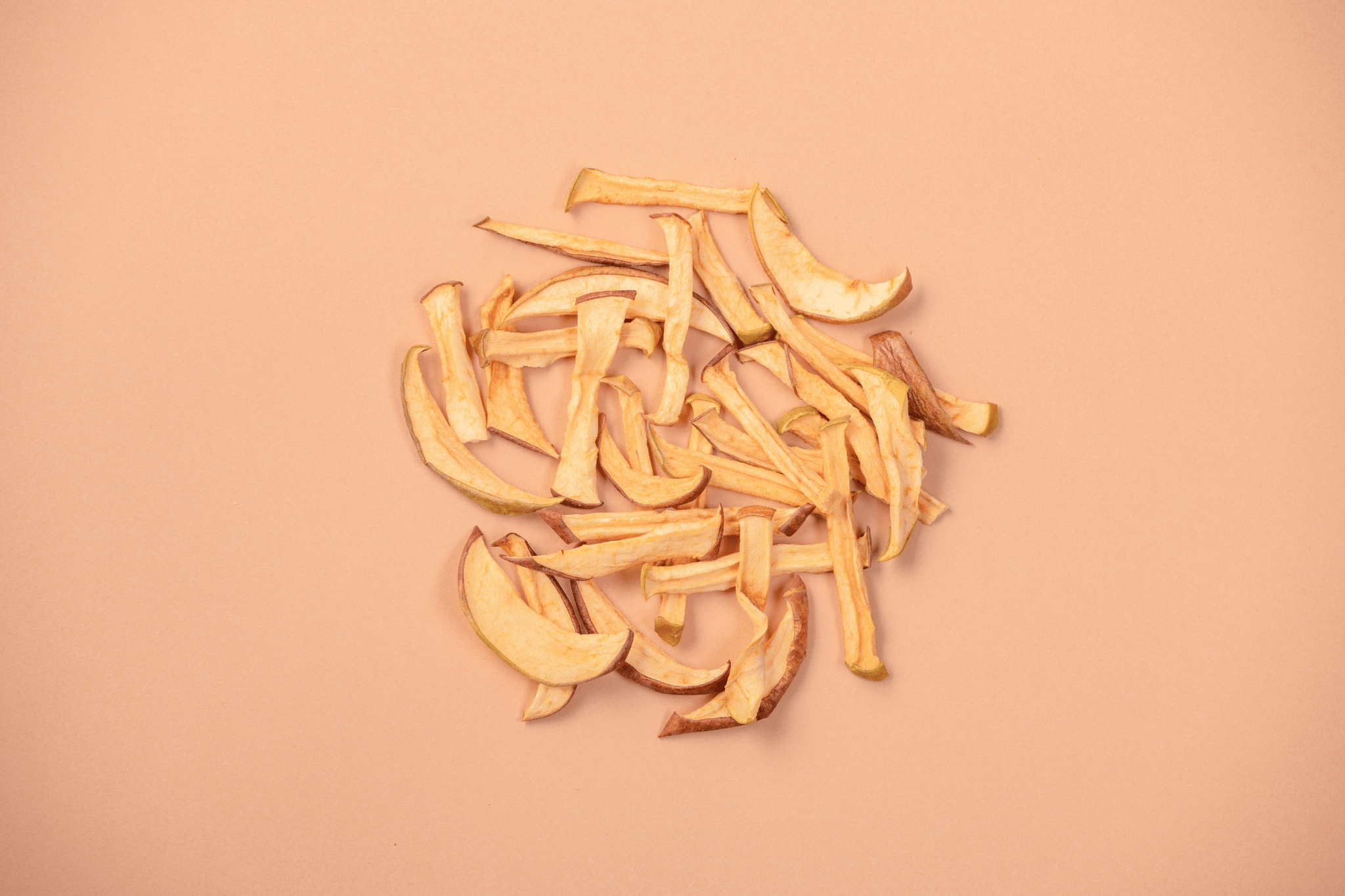
- Made with honey-cored "leaf-unremoved Shinshu apple"
- Sugar-free, dense natural sweetness
- Available in two forms, stick and dice
- What are the challenges of apple farming? A thorough explanation of the current state and solutions
- Domestic lemon does not reach 10,000 tons a year. What to look at if you use it down to the rind
Author of this article
Related articles
-
 Preventing vegetable shortfall while dieting | Add dietary fiber with dried vegetables
-
 Aojiru vs. vegetable juice vs. dried vegetables, thoroughly compared | Which method truly works for beating vegetable deficiency?
-
 What is yakuzen? Its meaning, the difference from kampo, and the basics of starting with familiar ingredients explained
-
 What's the Difference Between Yakuzen and Kampo? A Gentle Look at Food vs. Crude Drugs, Purpose, and Philosophy
-
 Assembling domestically grown yakuzen ingredients: the difference between familiar vegetables and imported crude drugs
-
 Complete guide to using dried mugwort | From rehydrating to popular recipes and storage tips
-
 We checked how to make and use yuzu shichimi against long-established makers' blend charts and ingredient labels
-
How to make yomogi mochi with dried mugwort | Ingredients, amounts, and foolproof tips explained