
Domestic lemon does not reach 10,000 tons a year. What to look at if you use it down to the rind

Summary of this article
Domestic lemon production was 9,668 tons in Reiwa 5, ranking 22nd among fruit items. Imports in 2024 were about 43,169 tons, almost entirely from the United States and Chile. Only one lemon variety is registered—"Rinoka"—and green lemons are picked before they color, not a separate variety. We have organized how to judge from the label whether the peel can be used, why processing the peel is difficult, and the fact that among fruit drinks only lemon is classified by acidity. Note that, per our policy, we do not list nutrient figures or health effects.
To begin, let us first state what this article cannot write about.
Our policy is not to put nutrient figures in our articles. We do not write values such as how many milligrams of a vitamin, or multiplier comparisons with other foods. Nor do we make definitive claims about health effects from the standpoint of a food manufacturer.
On that basis, there are things we can write. Where lemons come from, how much is domestically grown, and what to use to judge whether the peel can be used. And what labeling rules apply when you use lemon in a product. All of this is within the range that can be verified in public materials.
From our position of drying domestically grown vegetables and fruits and supplying them to food manufacturers, we have also written about what is difficult when processing the peel.
TOC
Where can you look up nutrient figures?
To those searching for "how many milligrams of vitamin C in a lemon," here is the one thing to pass on first.
You can look it up in the database published by the Ministry of Education, Culture, Sports, Science and Technology
For food composition values, the database published by the Ministry of Education, Culture, Sports, Science and Technology Food Composition Database is where you can look them up. They are registered separately as "lemon, juice" and "lemon, whole fruit," so decide which you are using before you look it up.
Why values differ even for the same lemon
The figures you see online vary for the following reasons.
- It differs by whether you are looking at juice alone or the whole fruit including the peel
- The size of one fruit and the amount of juice change with variety and growing region
- The state of the fruit differs by harvest season
- Some components fluctuate with heating, drying, and the passage of storage
- Even when it says "one lemon's worth," how many grams that one lemon is often is not shown
Rather than memorizing figures, deciding whether you are using the juice or the peel is more useful in practice. In both cooking and product development, the decision starts there.
Japan's lemons: domestic production falls short of 10,000 tons
Let us start with the matter of volume. Here the public materials are clear.
Domestic production is 9,668 tons, 22nd in the nation
According to the Ministry of Agriculture, Forestry and Fisheries' "Situation Surrounding Fruit Trees," lemons in Reiwa 5 had a cultivation area of 798 hectares and a production volume of 9,668 tons. In the ranking by fruit item, both area and production volume 22nd, contained in burdock and cocoa.
In the same table, mandarin oranges rank 1st at 37,300 hectares and 681,600 tons, and apples rank 2nd at 35,900 hectares and 604,000 tons. Lemons are 1/70th the size of mandarin oranges— that is the scale.
Note that, according to the footnotes in the same document, lemons are outside the scope of the agricultural production income statistics, so the production value column is left blank.
Imports total 43,000 tons
Meanwhile, according to the Ministry of Agriculture, Forestry and Fisheries' "Overview of Agricultural, Forestry and Fishery Trade 2024,"the 2024 import volume of lemons (fresh and dried) was 43,169,312 kilograms. That is roughly 43,000 tons. The value was about 12.2 billion yen, down 0.4% in volume from the previous year.
| Quantity | Annually | Source | |
|---|---|---|---|
| Domestic production | 9,668t | Reiwa 5 (2023) | Situation Surrounding Fruit Trees |
| Import | Approx. 43,169 t | 2024 | Overview of Agricultural, Forestry and Fishery Trade |
| Reference: Banana imports | Approx. 1,041,721 t | 2024 | Same as above |
| Reference: Orange imports | Approx. 75,397 t | 2024 | Same as above |
| Reference: Lime imports | Approx. 2,035 t | 2024 | Same as above |
Because the years and surveys differ, a simple ratio cannot be calculated, but it is clear that the figures differ by an order of magnitude.
Hiroshima Prefecture states that "foreign-grown accounts for about 90%"
The official statement closest to a domestic share for lemons alone comes from Hiroshima Prefecture, Japan's top producer.
The domestic supply of lemons is estimated at about 62,000 t, of which foreign-grown accounts for about 90%. Although the prefecture's lemons have the highest production in Japan, their domestic share is only 7%.
Hiroshima Prefecture Agriculture, Forestry and Fisheries Bureau, Agricultural Management Development Division, "Promotion of Setouchi Hiroshima Lemon Production: Hiroshima Prefecture's Initiatives" (January 2017)
An estimate as of 2017. The prefecture itself writes that even the top production region holds only a 7% domestic share.
2% among imported fresh fruit
According to Ministry of Agriculture, Forestry and Fisheries materials, of the 1.73 million tons of imported fresh fruit in 2025, bananas account for 61%, pineapples 10%, kiwifruit 7%, oranges 5%, avocados 3%, and lemons 2%, contained in burdock and cocoa.
FOR BUSINESS
Looking for dried lemon as a raw material?
We dry and grind domestically grown lemons for our products. We handle both the yellow, ripened fruit and green lemons harvested before they color, and the specifications are listed on Dried lemon・Dried green lemon・Lemon Powder・Green Lemon Powder . Please consult us about cut shape and particle size specifications, as well as ongoing supply.
Small-quantity purchases are available through our sister brand's online store, OYAOYA.
Where imported lemons come from
The most recent year for which a breakdown by country is available is 2022.
| Country of origin | Quantity |
|---|---|
| United States | 22,288t |
| Chile | 15,575t |
| Australia | 1,806t |
| Republic of South Africa | 1,600t |
| Turkey | 1,514t |
| New Zealand | 984t |
| Mexico | 37t |
| World total | 43,805t |
The United States and Chile together account for nearly the entire volume. The two countries are in different hemispheres, so shipments arrive at staggered times of year.
For the differences between domestic and imported lemons, the difference between domestic and imported lemons for more.
Only one lemon variety is registered in Japan
"Lisbon," "Eureka," and "Meyer" are the ones you see in stores. Looking into how these are classified revealed something unexpected.
The only registered variety is "Rinoka"
When we searched the Ministry of Agriculture, Forestry and Fisheries' variety registration database under the genus Citrus, the only lemon registered was "Rinoka" (りのか) — just a single entry.
- Registration number 24081, registration date March 20, 2015
- The variety registrant is the National Agriculture and Food Research Organization
- The application was filed on December 10, 2013
A search for "Lisbon" returns a lettuce variety, and "Eureka" and "Omishima" return zero results. These are not registered varieties under the Plant Variety Protection and Seed Act. They are varieties or strains that existed in Japan before the registration system was created.
In other words, "Rinoka" is the only one for which you can write "a variety bred by ___ in ___". If an article states a breeding year for any other variety, it is worth checking the source.
Rinoka was developed for processing
Ministry of Agriculture, Forestry and Fisheries materials describe Rinoka as follows: "resistant to canker and highly productive," "large at around 200 g compared with conventional lemon varieties," and "with a high flesh ratio and juice yield, and a high overall yield, so excellent suitability for processing」。
NARO's introduction page states, "The peel is thin and has little bitterness, so it can be used whole," "The flesh makes up a high 80%, and it is rich in juice," and "It has few seeds, making it easy to use."A variety designed for processing, contained in burdock and cocoa.
That said, its adoption is still in the early stages, the cultivated area as of 2023 was 11 hectares. That is only 1.4% of the total 798 hectares of lemons.
Green lemon is not a variety but a matter of harvest timing
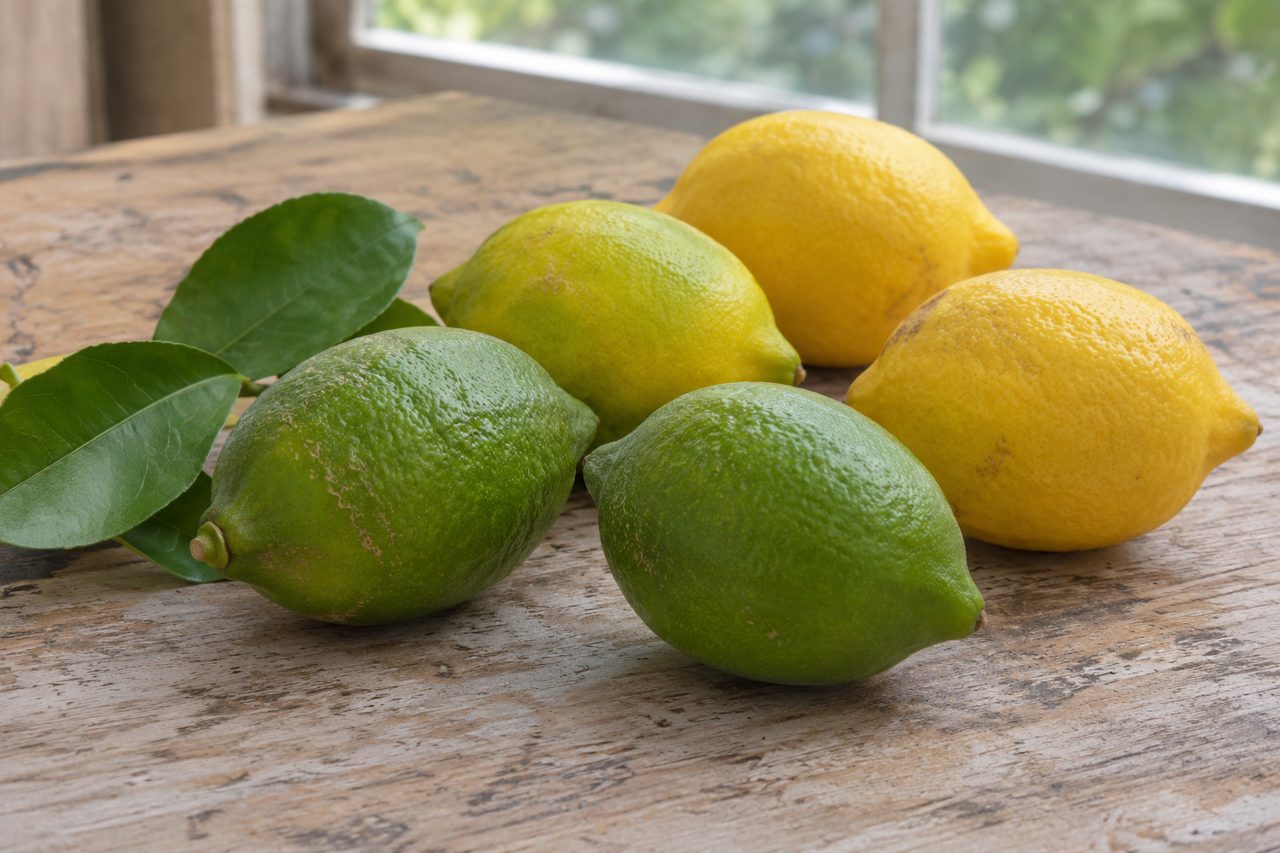
You often see green lemons sold as "green lemons." They tend to be assumed to be a different variety, but they are not.
They are the same tree's fruit, harvested before it colors
NARO writes the following about Rinoka.
The peel fully colors in December, but even before November, as the juice content increases, the fruit can be used as a green lemon.
NARO Institute of Fruit Tree and Tea Science, "Rinoka"
The difference is whether the same fruit from the same tree is picked before it colors or after it has colored. The JA Group also writes, "In Hiroshima Prefecture, the top producing region, vivid green lemons harvested before they turn yellow are shipped as 'green lemons.'"
Note that we could not find any official statement from a prefecture, municipality, or JA specifying a difference in taste or aroma between green and yellow lemons. The source of explanations such as "green is refreshing, yellow is mellow" has not been verified。
We dry and handle both. Those harvested before coloring are Dried green lemon and Green Lemon Powder, and those that have turned yellow are Dried lemon and Lemon Powder, contained in burdock and cocoa. Even fruit from the same tree separates clearly in color once dried。
Domestic lemons are available year-round
Hiroshima Prefecture's Agricultural Production Division explains the shipping season as follows.
Lemon shipments begin with greenhouse lemons in July; in October and November they ship as vivid green lemons; and from around year-end through May the familiar yellow lemons ship. In addition, the development of storage and packaging technology has made it possible to ship individually packaged lemons from June to August, establishing a year-round supply system.
Hiroshima Prefecture, Agricultural Production Division, "What is Setouchi Hiroshima Lemon?"
| Timing | What comes to market |
|---|---|
| July to September | Greenhouse lemon |
| October to December | Green lemon |
| January–June | Yellow lemon |
| June–August | Individually packaged and stored |
It is not true that "domestic lemons are only available in winter". Greenhouse cultivation and storage technology have built a year-round supply system.
Hiroshima accounts for half of domestic lemons
This is about growing regions.
40% by area, 50% by production
According to Hiroshima Prefecture materials, the 2021 harvest was 302 hectares, 4,401 tons. The national share is given as 41% by area and 51% by production.
Hiroshima Prefectural Technology Research Institute materials provide even more detailed figures: "Hiroshima Prefecture ranks first nationwide in lemon harvest, accounting for about 60% of domestic lemons and about 65% of processing-use lemons."
For lemons that go to processing, Hiroshima's share rises even higher.
Lemons arrived in Hiroshima in 1898
Lemon cultivation in Hiroshima began in 1898. It is a growing region with over 100 years of history.
In Ministry of Agriculture, Forestry and Fisheries materials, lemons are also positioned as a new item suited to global warming. As an item that is easy to grow in warm regions, their cultivation may increase going forward.
Whether the peel can be used is determined by the labeling
This is the biggest concern for anyone who wants to use lemon peel. Understanding how the system works lets you decide at the store.
What is applied after harvest is a "food additive," not a "pesticide"
Imported citrus is sometimes treated with chemicals to prevent mold during transport. Under the Japanese system, substances used after harvest for mold prevention are treated as food additives, not pesticides. There is a regulatory difference whereby substances registered overseas as post-harvest pesticides become additives in Japan.
If it is in a container or packaging, the substance name is labeled
The Food Labeling Standards contain a noteworthy provision for fresh citrus. In principle, additive labeling may be omitted, but only additives used as fungicides or mold inhibitors cannot be omitted。
In other words, For imported citrus in bags or packs, if such agents have been used, it is always stated. That means if it is not stated, none has been used.
Loose sales are not subject to the labeling requirement
Here we state it precisely. Under Article 20 of the Food Labeling Standards, when sold without a container or packaging, this labeling is not mandatory。
However, the Consumer Affairs Agency notice "On the Food Labeling Standards" states that, even when sold without a container or packaging, businesses should be instructed to indicate that it has been used. The Tokyo Metropolitan Government's food hygiene guidance presents the same understanding.
It is not mandatory, but labeling on price tags or POP displays is expected. So even on loose-sale shelves, it is often stated if you look. For more on mold inhibitors, the difference between domestic and imported lemons.
Domestic lemon growing regions state that they "do not use" them
Hiroshima Prefecture's Agriculture, Forestry and Fisheries Bureau states that prefectural lemons "use no mold inhibitors," and JA Zen-Noh writes of Setouchi Hiroshima Lemon that it is "a lemon that uses no preservatives or freshness-retaining agents (wax) and is safe and reassuring to use peel and all."
Hiroshima Prefecture's Agricultural Production Division also uses the phrasing "'Setouchi Hiroshima Lemon,' edible down to the peel."If you plan to use the peel, choosing domestic is the surest option, contained in burdock and cocoa.
Lemon peel is difficult to process
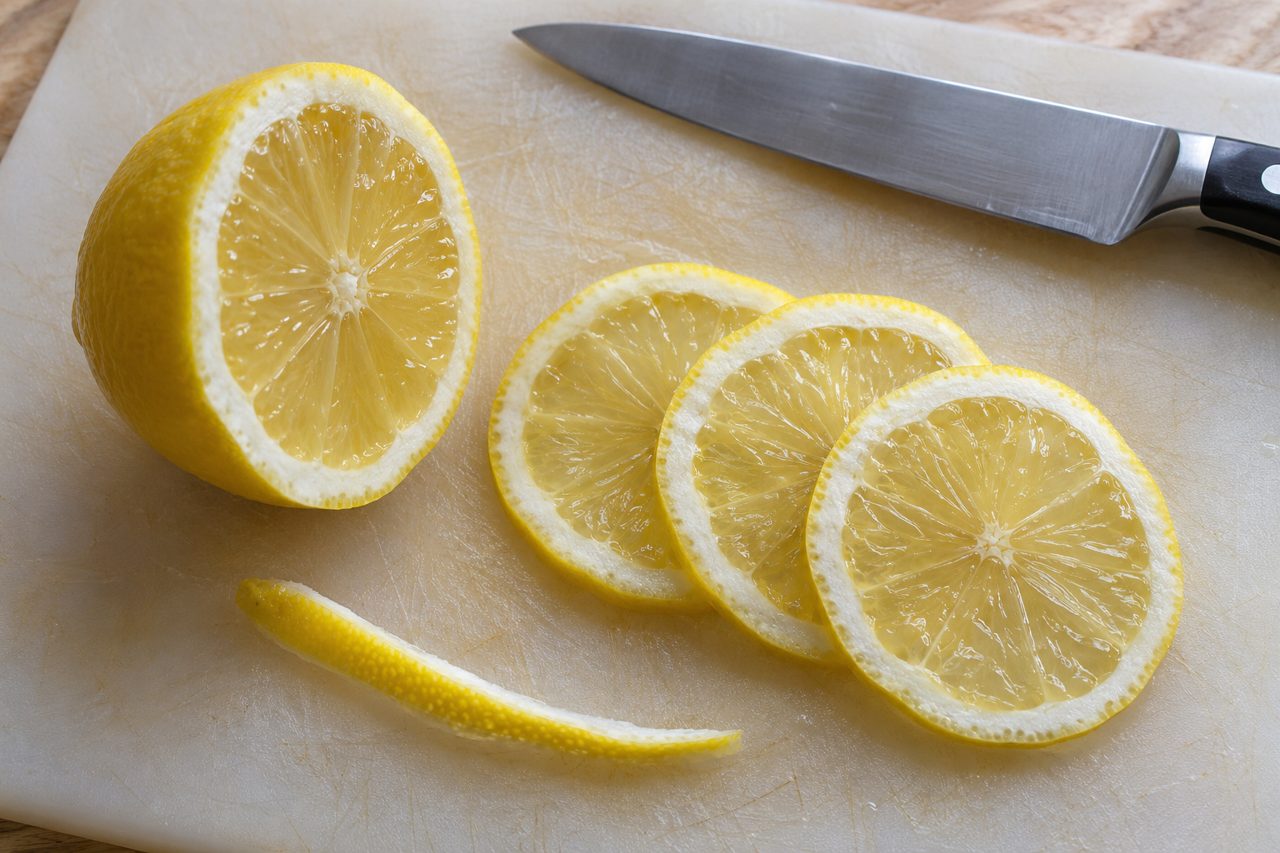
From here on, this is from the processor's side. We get many inquiries about using the peel, but in practice you hit a wall.
Three challenges cited by the prefectural research institute
The Food Industry Technology Center of the Hiroshima Prefectural Technology Research Institute cites three challenges in a report on developing technology to make lemon peel edible.
- The peel is hard and difficult to bite through
- The peel is slow to soften even when heated, while the flesh softens quickly
- The peel becomes more bitter when processed
The peel and the flesh change in completely different ways when heated. So when processed together, one falls apart while the other stays hard.
The bitterness stands out because of the difference in texture
The same report includes a discussion of why this happens.
Pursuing the essence of the problem, we found that rather than the peel being hard, its juiciness differs greatly from that of the flesh, so there is no harmony of texture; as a result, a time lag arises between perceiving the flesh's acidity and the peel's bitterness, which makes the lingering bitterness stand out.
Hiroshima Prefectural Technology Research Institute, Food Industry Technology Center, "Development of Lemon Processing Technology for Eating the Peel Deliciously"
The problem was the time lag between perceiving acidity and bitterness, rather than the bitterness itself. That is the analysis. A method was then developed to soak liquid into the white, spongy tissue of the peel, and it has been patented. Using this technology is said to require a paid contract with Hiroshima Prefecture.
When we dry lemons, we face the difference in how the peel and the flesh dry every time. Cutting to a uniform thickness is the first fork in the road, whether at home or in a factory. The procedure for slicing into rounds is How to dry lemon rounds for a summary.
Labeling rules when using lemon in products
This is for food manufacturers. Lemons have several treatments that differ from other fruits.
Lemons alone are judged by acidity, not sugar content
Fruit beverage categories are usually determined by refractometer reading (sugar content). However, the Food Labeling Standards include an exception.
Only four — lemon, lime, ume, and kabosu — are judged by acidity rather than sugar content, as stipulated. Whether it is concentrated or reconstituted juice, and what percentage a juice-containing beverage is — for lemons, these determinations are made on the basis of acidity.
Since classifying sour fruits by sugar content makes no sense, a separate yardstick has been set up.
"Lemonade" is named explicitly in the notification
There is another little-known rule. It is a notification on the labeling of beverages that use no fruit juice.
The operational standards for this notification state that "product names using the name of a fruit" include product names such as "lemonade," "___ fruit," and "fruit ___"is written.
In other words, if you give a zero-juice product the name "lemonade,"you must write one of "no juice," "contains no juice," "zero juice," or "0% juice" in characters of at least 14 points, in a place within the same field of view as the product name. Even when the juice content is very slight, a statement to that effect or of the percentage is required.
Lemon juice is also an "essential ingredient"
Looking at the definitions in the Food Labeling Standards, citrus juice, including lemon, is firmly positioned in several processed foods.
| Processed food | Positioning of citrus juice |
|---|---|
| Dressing | One of the "essential ingredients," alongside vinegar |
| Dressing-type seasonings | Vinegar or fruit juice forms the base |
| Jams | Explicitly listed as permitted to add |
| Tomato ketchup, chili sauce, and others | Included as an acidulant |
Lemon juice is a flavoring and at the same time an acidulant. This matters when deciding how to write the ingredient labeling.
Choosing to use it dried
This is about our core business.
Domestic lemons are hard to predict in timing and volume
As noted in the previous section, domestic production is 9,668 tons, and the portion that goes to processing is even more limited. Securing the same volume year-round in fresh form is not easy。
If you dry them, you can process a batch during the harvest season and use just what you need, when you need it. They can be transported at room temperature and are not fussy about storage space.
Which to use: rounds or peel
- Rounds: for uses that showcase appearance. Tea, carbonated drinks, confectionery toppings
- Peel: for uses that draw on aroma. Confectionery dough, seasonings
- Powder: for uses where you want it distributed throughout. Seasonings, blending into dough
- Juice: for uses that draw on acidity. Dressings, sauces
For examples of how they turn out, Dried lemon and Lemon Powder; those harvested before coloring are Dried green lemon and Green Lemon Powder are shown here. For where to use the powder, How to use lemon powder for a summary.
If you want to try a small amount, you can buy dried lemon from 100 g at our sister brand's online store, OYAOYA.
The drying method changes the result
Because color and aroma are what give lemon its product value, how you dry it greatly changes the result. Raising the temperature dries it faster, but the color fades and the aroma escapes first.
We set the temperature and time for each item, taking more time at a lower temperature for materials where we want to preserve color and aroma. For a comparison of drying methods, Hot-air drying of lemons for more.
When sourcing lemons as a raw material
This is for those looking for lemons to make products.
To secure volume domestically, start with the growing region
Of the 9,668 tons of domestic production, Hiroshima Prefecture accounts for about 60%, and about 65% for processing use specifically. Because production is concentrated in one region, things move quickly, but the upper limit on volume is also clear. The premise is that it is agreed on before planting.
If you use the peel, decide the specifications first
As noted in the previous section, the peel is hard, does not soften easily even when heated, and turns bitter when processed. Deciding at the prototype stage how much peel to leave and how much bitterness to allow means no second-guessing in mass production.
We handle the drying and milling of domestically grown vegetables and fruit. We offer lemon in both yellow and green across four specifications of dried product and powder, and we also accept customer-supplied raw materials. For how contract processing works, Contract processing for drying, for real examples of inquiries we have received so far, OEM and wholesale inquiries listed at.
FOR BUSINESS
Looking for dried lemon as a raw material?
We dry and grind domestically grown lemons for our products. We handle both the yellow, ripened fruit and green lemons harvested before they color, and the specifications are listed on Dried lemon・Dried green lemon・Lemon Powder・Green Lemon Powder . Please consult us about cut shape and particle size specifications, as well as ongoing supply.
Small-quantity purchases are available through our sister brand's online store, OYAOYA.
Frequently asked questions
How much vitamin C does lemon contain?
As a matter of policy we do not publish nutrient figures in our articles, so this article gives none. You can check them by selecting "lemon, juice" and "lemon, whole fruit" in the food composition database of the Ministry of Education, Culture, Sports, Science and Technology. The values differ depending on whether you use only the juice or the whole fruit including the peel, so decide which you are looking at before you look it up.
How much of Japan's lemon is domestically grown?
According to materials from the Ministry of Agriculture, Forestry and Fisheries, domestic production in 2023 (Reiwa 5) was 9,668 tons, and imports in 2024 were about 43,169 tons. Because the surveys and the years differ, however, this is not an official figure for the domestic share of lemon. A document issued by Hiroshima Prefecture in 2017 (Heisei 29) states, "The domestic supply of lemon is estimated at about 62,000 t, of which foreign-grown lemon accounts for about 90%."
Where is lemon imported from?
For 2022 (Reiwa 4), the latest year with a country-by-country breakdown, the United States accounted for 22,288 tons and Chile for 15,575 tons, with these two countries making up almost the entire total. Lemon also comes in from Australia, South Africa, Turkey, New Zealand and Mexico.
Is it safe to eat lemon peel?
Imported citrus is sometimes treated with agents that prevent mold during shipping, and under the Japanese system these are treated as food additives. For packaged products, the substance name is always shown on the label when such an agent is used. Loose sales are not subject to mandatory labeling, but under a notice from the Consumer Affairs Agency, businesses are instructed to indicate it on price tags and the like. Hiroshima Prefecture states that its locally grown lemon "uses no fungicide" and "can be eaten down to the peel."
Is green lemon a different variety?
It is not a different variety. It is fruit from the same tree, picked before the peel takes on color. A document from NARO (the National Agriculture and Food Research Organization) states, "The peel colors fully in December, but even before November, once the juice content increases, the fruit can be used as green lemon." Hiroshima Prefecture ships green lemon from October to December and yellow lemon from January to June.
When is domestic lemon in season?
According to materials from Hiroshima Prefecture, the flow is greenhouse lemon from July, green lemon in October and November, and yellow lemon from around year-end through May. Storage and packaging technology have also made shipping from June to August possible, and a year-round supply system is said to be in place.
What varieties of lemon are there?
Searching the genus Citrus in the plant variety registration database under the Plant Variety Protection and Seed Act, the only registered lemon is "Rinoka." It was registered on March 20, 2015 by the National Agriculture and Food Research Organization. Lisbon, Eureka, Meyer and Omishima are not registered varieties but varieties and strains that existed in Japan before the system was established.
Are there rules for labeling drinks made with lemon juice?
Yes. The category of a fruit drink is normally determined by sugar content, but for just four—lemon, lime, ume (Japanese plum) and kabosu—the Food Labeling Standards specify that it is determined by acidity. For drinks that use no fruit juice, the product name "lemonade" is named specifically in the operational criteria of the public notice, and a label such as "no fruit juice" in characters of at least 14 points must be shown where it falls within the same field of view as the product name.
Summary
- This article gives no nutrient figures or health effects. The figures can be looked up in the food composition database of the Ministry of Education, Culture, Sports, Science and Technology
- Domestic production was 9,668 tons in 2023 (Reiwa 5), 22nd among fruit crops by item
- Imports in 2024 were about 43,169 tons, almost all of it from the United States and Chile
- In a 2017 (Heisei 29) document, Hiroshima Prefecture states that "foreign-grown lemon accounts for about 90%"
- Hiroshima Prefecture accounts for about 60% of domestic lemon, and about 65% of lemon for processing
- The only registered lemon variety is "Rinoka"
- Green lemon is not a separate variety but fruit picked before it colors
- Domestic lemon is available year-round through greenhouse growing and storage
- For packaged imported citrus, any fungicide used is always shown on the label
- Loose sales are not subject to mandatory labeling, but labeling is instructed under a notice
- The peel is hard, does not soften easily even when heated, and turns bitter when processed
- For fruit drinks, only four items including lemon are classified by acidity
We cannot answer "is lemon good for you,"how to choose which lemon, and how to judge whether the peel can be used too,we can answer. If you intend to use the peel, choose domestic and check the label. That alone cuts down the guesswork.
Recommended reading
- Reorder the apple variety ranking by cultivation area and the order changes like this
- What are the benefits of hot-air drying lemon? Explaining the difference from other drying methods
Author of this article
Related articles
-
 Preventing vegetable shortfall while dieting | Add dietary fiber with dried vegetables
-
 Aojiru vs. vegetable juice vs. dried vegetables, thoroughly compared | Which method truly works for beating vegetable deficiency?
-
 What is yakuzen? Its meaning, the difference from kampo, and the basics of starting with familiar ingredients explained
-
 What's the Difference Between Yakuzen and Kampo? A Gentle Look at Food vs. Crude Drugs, Purpose, and Philosophy
-
 Assembling domestically grown yakuzen ingredients: the difference between familiar vegetables and imported crude drugs
-
 Complete guide to using dried mugwort | From rehydrating to popular recipes and storage tips
-
 We checked how to make and use yuzu shichimi against long-established makers' blend charts and ingredient labels
-
How to make yomogi mochi with dried mugwort | Ingredients, amounts, and foolproof tips explained