What are the challenges of apple farming? A thorough explanation of the current state and solutions

Summary of this article
The challenges of apple farming lie in aging and a shortage of successors—with core farm workers declining about 30% from 2015 to 2021—and climate change from global warming. Aomori Prefecture's average annual temperature has risen 3°C since 2013, worsening poor coloring and the spread of pests and diseases. This article explains solutions such as storage technology, smart agriculture, high-density dwarf cultivation, and shifting to processing use, along with cultivation cases in warm regions.
TOC
The overall picture of the challenges apple farming faces now
Apples are familiar on the table, but at their growing sites a number of structural problems overlap. Declining successors, changing cultivation environments, labor concentrated in the harvest season, and ever-rising costs. It is not any single cause, but the way multiple challenges interlock and sap producing regions' vitality, that is the difficulty of apple farming.
Here we first organize the phenomena occurring in the field, then look concretely at the solutions producing regions are actually working on. Understanding challenges and countermeasures as a set brings into view the direction of the apple industry to come.
A structure in which challenges chain together
Apples are a fruit tree that takes years from planting to harvest, and yearly care greatly determines quality. Because of this, they have a nature prone to a chain: if labor is short, work is delayed; if work is delayed, quality drops; if quality drops, revenue falls.
Because leaving one challenge unaddressed worsens another, producing regions are called on to advance multiple countermeasures at once.
Organizing the main challenges in a list
| Challenge area | What is happening in the field |
|---|---|
| Successors | No successor is decided, so experience and orchards are hard to pass on |
| Cultivation environment | Summer high heat causes poor coloring and sunburn, and shifts in flowering timing |
| Labor | Work such as harvesting and thinning concentrates in a short period |
| Revenue | Against rising material costs, price pass-through is slow to progress |
We dig into the substance of each from the next section in order.
Aging and successor shortage, a root challenge
The most serious issue in apple-producing regions is the problem of the people who carry out cultivation. While the generation that long supported the orchards reaches the age of retirement, the structure in which successors do not readily appear is spreading in each region.
The successor shortage is not merely a numbers problem; its difficulty lies in stopping the succession of cultivation techniques and the orchards themselves.
Why successors are not decided
Apple cultivation is built on an accumulation of judgments honed over years of experience—pruning, thinning, judging when to harvest. This skill cannot be acquired overnight, and those taking it on need corresponding resolve and time.
The difficulty of forecasting revenue, and the large burden of the equipment and orchard needed at the start, are also reasons the younger generation finds it hard to take the step.
What happens when orchards aren't passed on
- Orchards where care has stopped increase and easily become sources of pests and diseases
- Trees left unharvested increase
- The whole region's shipment volume thins, and its presence in the market declines
Because abandoning one plot affects the surrounding orchards too, the successor problem needs to be faced community-wide. The differences in cultivation environment by producing region are also organized in The main apple-producing regions and their characteristics.
Moves to support new-entry farmers
In response to such circumstances, producing regions are advancing training systems, orchard placement services, and mechanisms for veterans to pass techniques to new-entry farmers. It is an effort to gradually lower the hurdle of technical succession by having experienced people work alongside newcomers.
Changes in cultivation environment from climate change
Apples are a fruit tree that prefers a cool climate and is sensitive to temperature changes. When summer heat grows severe, effects on fruit quality tend to appear directly.
Because climate change reaches the whole producing region at once, there is a difficulty that individual farmers alone cannot fully handle.
Poor coloring and sunburn brought by high heat
An apple's red color deepens in the period before harvest when temperatures fall. If high temperatures continue into autumn, coloring fails to progress and poor coloring easily occurs. For a fruit judged by appearance, this is a problem directly linked to product value.
When strong sunlight continues to hit the fruit, sunburn that discolors the surface also occurs. It is one reason fruit raised with great effort falls outside the shipping standard.
Shifts in flowering timing and effects on pollination
When early-spring temperatures are unstable, flowering timing may shift forward or back. If flowering comes early, the risk of late frost damaging the blossoms rises, and if it fails to align with the active period of pollinating insects, fruit set is affected too.
Unsettled weather in the harvest season has become a factor that determines whether a year's effort pays off.
Reconsidering varieties to match environmental change
Moves are emerging to diversify cultivation risk by combining varieties that are relatively heat-tolerant or that harvest at different times. The diversity of varieties grown around the world is covered in Overseas apple varieties.
Securing labor and the seasonal concentration of work
Apple cultivation has work throughout the year, but it has the characteristic that a great deal of labor is suddenly needed at specific times. This seasonal concentration makes securing labor difficult.
Because failing to complete the work within a limited period directly affects quality and yield, arranging people is a shared worry of producing regions.
Why work concentrates in one period
Thinning is the work of thinning out fruit to enrich the ones left, and missing the right timing affects quality. Harvesting also requires judging when the fruit is at its best, and it must be picked all at once before it over-ripens on the tree. Both are tasks that concentrate in a short period.
During this period, many orchards cannot manage with family operation alone and must rely on outside labor.
The effect of labor shortage on quality
- Delayed thinning makes fruit small and worsens size uniformity
- Delayed harvesting causes over-ripening, lowering shelf life and texture
- Work can't keep up, and fruit that can't be shipped results
Whether you can secure the needed number of people when needed determines that year's management.
Ways to smooth out the work peak
Efforts are advancing to disperse work by combining varieties that harvest at different times, and to share labor within the community. Smoothing the peak even a little is the key to making the most of limited labor.
Challenges of price, cost, and revenue
Apples raised with great effort do not always translate into commensurate revenue. While costs rise, the situation in which it is hard to pass them on to the selling price squeezes farmers' management.
If revenue isn't stable, it also becomes a factor making the next generation hesitate to enter farming, connecting to the successor shortage.
Ever-rising production costs
The costs of fertilizer, agricultural materials, and fuel essential to cultivation are rising, pushing up production costs. Hiring labor for care adds personnel costs, and the smaller the operation, the heavier the burden.
Because the selling price cannot be raised immediately even as costs increase, it is a structure in which profit is easily squeezed.
The relationship between grade and price
Apples are graded by the good or bad of their appearance, and prices differ accordingly. Even if the taste is fine, fruit that falls outside the standard for coloring, shape, or surface flaws is traded cheaply or loses its outlet.
That a certain proportion of fruit raised with great care is downgraded on appearance alone is a major worry in the field.
An approach to lifting revenue
Rather than relying only on market shipment, the idea of widening outlets through processing and direct sales to increase revenue sources is spreading. How to make use of off-spec fruit is taken up in detail in the solutions in the latter half.
Solution 1: Leveling out shipments through storage technology
Technology to keep apples, which concentrate in the harvest season, high in quality for a long time eases both the price and labor challenges at once. Ingenuity in storage is a countermeasure directly linked to stabilizing producing regions' revenue.
Rather than selling harvested fruit off immediately, a mechanism to put it out in line with demand is taking shape.
The mechanism of CA storage
CA storage is a method of adjusting the composition and temperature of the air inside the storeroom to suppress apples' respiration and preserve freshness. By slowing the fruit's aging, texture and flavor are easier to maintain even after time passes from harvest.
With this technology, apples can be shipped over a long period even after the concentrated autumn harvest, enabling year-round supply.
The management stability year-round shipping brings
- The price collapse from concentrated supply right after harvest can be eased
- Shipments can be planned to match periods of high demand
- Staying on shelves for a long time helps maintain the producing region's name recognition
Being able to choose when to ship creates room for price negotiation and makes management forecasts easier to draw. For tips on home storage, see how to store apples in winter.
Solution 2: Smart agriculture and labor-saving technology
The introduction of technology that supplements labor shortage and reduces the burden of work is advancing. By supporting work that has relied on experience with machines and data, the aim is to keep the orchard running even with limited people.
Labor saving is a countermeasure that works simultaneously on the two challenges of successor shortage and labor concentration.
Work support by robots and drones
Technologies that take over human work are appearing, such as machines that assist harvesting and drones that make chemical spraying efficient. They reduce the burden of walking around a large orchard and let limited labor be directed to important work such as judgment and decision-making.
Leaving work at high places or with heavy items to machines curbs strain on the body and also helps create an environment where a wide range of generations can work.
AI sorting and efficient cultivation management
A sorting mechanism that uses cameras and AI to automatically judge fruit color, size, and flaws greatly lightens the labor- and time-intensive sorting work. Grading criteria also become easier to keep stable.
Efforts to record orchard data and use it in cultivation management also help less-experienced people learn the techniques.
Dwarf cultivation to make work easier
Dwarf cultivation, which trains trees low, lets work be done at hand-reach height without relying on stepladders, raising the efficiency of thinning and harvesting. It also has the advantage of allowing more trees to be planted and starting harvest earlier while trees are young, balancing labor saving with early revenue.
Solution 3: Farmland consolidation, scaling up, and incorporation
Moves to have the community collectively take on the burden individual farmers bear are also spreading. It is an effort to raise efficiency and continuity by consolidating orchards and work.
As successors decline, it has become one answer to the question of how to keep protecting orchards.
The effect of joint sorting and joint shipping
Consolidating and jointly operating a sorting facility means individual farmers don't have to bear the latest sorting equipment alone. Consolidating shipments unifies grades and delivers substantial volume stably to the market.
The great advantage of joint operation is that investments hard for a single household can be shared across the community.
Succession of orchards through incorporation
- Passing on orchards as an organization rather than an individual, keeping continuity
- Hiring employees and passing on techniques systematically
- Making use of scale to streamline material procurement and sales
A mechanism in which successors aren't limited to a single person is a realistic safeguard against the successor problem.
The efficiency and challenges consolidation brings
Scaling up raises efficiency, but the labor to manage a large orchard and the ingenuity to keep quality consistent are also essential. Consolidation shows its effect precisely when combined with labor-saving technology.
Solution 4: Sixth-order industrialization and making use of off-spec apples
Efforts to turn fruit that falls outside the standard on appearance into valuable products through processing are spreading. Making use of fruit that might otherwise have been thrown away connects to both lifting revenue and reducing food loss.
Sixth-order industrialization, which handles everything from production to processing and sales in one integrated flow, is a countermeasure that greatly widens producing regions' outlets.
Why off-spec apples arise and where they go
For reasons such as shallow coloring, misshapen form, or small surface flaws, a certain proportion of fruit falls outside the standard for eating fresh even though the taste is fine. Such fruit can regain its inherent value by being sent to processing.
The outlets of processing are wide-ranging: juice, jam, confectionery ingredients, and dried apple.
Upcycling through drying
Drying is a processing method that concentrates the fruit's flavor while raising its shelf life. Fruit hard to distribute fresh gains shelf life through drying and becomes usable across a wide range of raw materials such as confectionery, bread, and cereal.
Agriture, too, continues efforts to dry off-spec vegetables and fruit—working with contract farms and welfare facilities in northern Kyoto—reinventing farm produce with nowhere to go into products (from Agriture's experience). The technique of drying is one means of confronting the off-spec challenge producing regions carry. Our own dried apple product is on the dried apple product page.
What sixth-order industrialization brings to producing regions
- Off-spec fruit becomes a revenue source, lifting farmers' take-home
- Processed goods become a billboard conveying the producing region's brand
- Fruit is used up without waste, reducing food loss
A stance that doesn't rely only on shipping for fresh eating raises resilience to price fluctuation and supports producing regions' sustainability.
Summary: grasp challenges and solutions as a set
The challenges of apple farming arise from a chain of successor shortage, climate change, labor concentration, and unstable revenue. Rather than considering one problem in isolation, grasping them as connected to one another is the starting point toward solutions.
Leveling out shipments through storage technology, labor saving through smart agriculture, succession through farmland consolidation and incorporation, and making use of off-spec fruit through sixth-order industrialization. These countermeasures not only ease separate challenges but generate synergy when combined.
Making use of off-spec fruit through drying and other processing is a realistic move that supports producing regions on both the revenue and food-loss fronts. Protecting those who grow, and the accumulated ingenuity of using fruit without waste, will shape the apple farming of the future.
Honey-cored Shinshu apple, domestic dried apple
Sugar-free, a crunchy new texture—dried fruit of honey-cored "leaf-unremoved Shinshu apple"
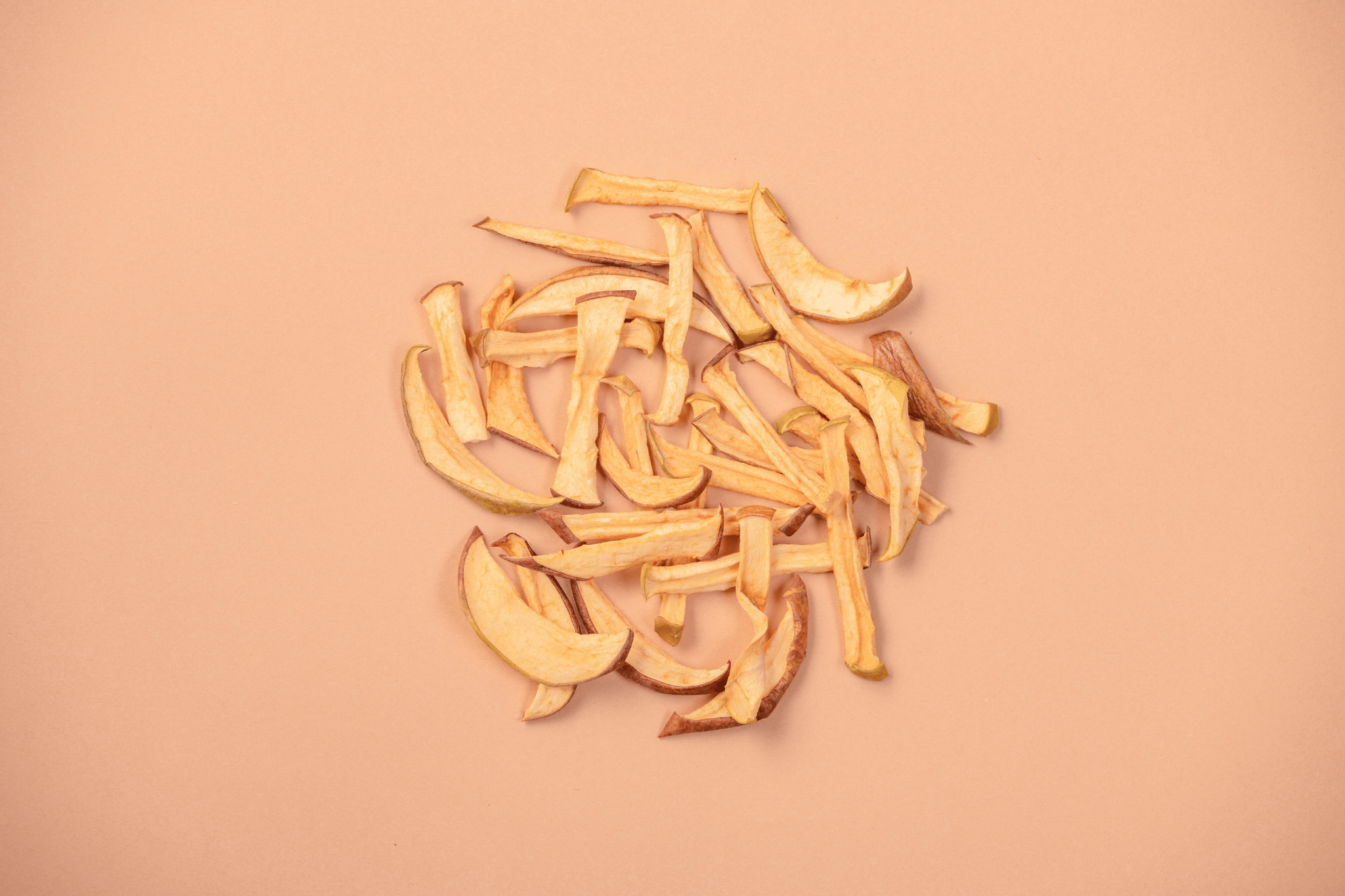
- Made with honey-cored "leaf-unremoved Shinshu apple"
- Sugar-free, dense natural sweetness
- Available in two forms, stick and dice
Recommended reading
- Differences among apple-producing regions | Comparing Aomori, Nagano, and Yamagata
- 10 popular overseas apple varieties
- How to Store Apples in Winter: 10 Tips to Make Them Last
- Domestic dried apple (non-bagged Shinshu apple)
FOR BUSINESS
乾燥りんごを、原料としてお探しですか
国産のりんごを乾燥・粉砕してお出ししています。カット形状や粒度の指定、継続してのお取引もご相談ください。規格は 乾燥りんご に掲載しています。
少量でのご購入は、姉妹ブランドの通販サイト OYAOYA で承っています。
- A Thorough Guide to Drying Apples! 3 Steps and Tips You Can Do Easily at Home
- りんご品種ランキングを栽培面積で並べ直すと順位はこう変わる