
Kyoto Vegetables and Dashi —The Resonance Between the Ingredient's Voice and the Dashi—

Summary of this article
A column in which chef Yu Yoneyama explains the resonance between Kyoto vegetables and dashi. He introduces dashi choices for each ingredient—the fructan of Kujo negi with the glutamic acid of kombu (a sugar level of 8 degrees or higher), kombu with a little niboshi for Kamo eggplant, and dried shiitake's guanylic acid for mibuna. He also covers how to make a shojin dashi by soaking 20 g of kombu and 3 dried shiitake in 1 L of water for 8–12 hours, a comparison of how Horikawa gobo finishes with different dashi, a Kyoto-style dashi recipe you can make at home, and a vegetable broth made with dried Kyoto vegetables.
When I am cooking, what always comes to mind is the question of "how to listen to the voice of the ingredient." Among these, the relationship between Kyoto vegetables and dashi is, I think, something that answers that question head-on. Kyoto vegetables have flavor that stands out even when simply boiled. But by pairing them with dashi, their individuality takes on a sharper outline and leaves a deeper aftertaste.
TOC
Kujo negi — a tune of kombu dashi that envelops sweetness
For example, Kujo green onion. In winter, Kujo negi becomes very sweet after being touched by frost. It is delicious enough just put into a hot pot as is, but when paired with kombu dashi, that sweetness is rounded out and supported. The glutamic acid of kombu resonates with the fructose and glucose the negi holds, spreading in the mouth like a single chord. It does not assert itself strongly but quietly draws close. As a chef, such a relationship feels above all precious to me.
The science behind the affinity of Kujo negi and kombu dashi
Kujo green onion's main sweetness components are fructan (a polymer of fructose) and glucose. When combined with the glutamic acid of kombu dashi, a synergistic umami effect arises on the tongue. This combination produces a "gentle umami" different from that of bonito dashi (inosinic acid).
Frost-touched Kujo negi in winter can reach a sugar level of 8 degrees or higher, and simply simmering it in kombu dashi completes a soup with an elegant sweetness. Kyoto vegetable calendar, check the season and use negi from the sweetest period—that is the point.
Kamo eggplant — a restrained dashi that brings out aroma and oil
On the other hand, Kamo eggplant. This round eggplant, harvested at the height of summer, has dense flesh, and when it absorbs oil it takes on a texture that seems to melt into a luscious softness. When making it into dengaku, coating it with miso enriched with bonito dashi is beautiful too, but I sometimes deliberately hold back on the bonito.
When I want to bring the eggplant's own aroma and the sweetness of the oil to the fore, kombu with a little niboshi, layered with just enough white miso, is enough. Then the "voice of the eggplant itself," which would otherwise be hidden behind the boldness of bonito, quietly peeks out.
Using dashi differently for Kamo eggplant
Kamo eggplant tends to absorb oil, so as a rule it is best to use dashi sparingly. Bringing bonito dashi fully to the fore hides the sweetness of the oil, so dashi made from kombu with a little niboshi, layered with white miso, is just the right balance.
When making it into agebitashi, fry it in 170°C oil for 3 minutes, then soak it in chilled bonito dashi (8 parts dashi : 1 part light soy sauce : 1 part mirin). Chilling it in the refrigerator for at least 2 hours lets the flavor settle in.
FOR BUSINESS
乾燥野菜を業務用でお探しですか
国産の野菜・果物を乾燥し、必要に応じて粉砕してお出ししています。扱っている品目は100種前後で、規格は 乾燥品の一覧・パウダーの一覧 に掲載しています。
少量でのご購入は、姉妹ブランドの通販サイト OYAOYA で承っています。
The philosophy of dashi in Kyoto cuisine
When I think about it, I believe that in the history of Kyoto cuisine, "dashi" was not merely a seasoning but a "place" that resonated with vegetables and tofu. Even without using animal-based dashi, how many dishes has shojin dashi made from kombu and dried shiitake supported? There was a philosophy there of wanting to convey the savory essence of vegetables directly. That is precisely why dashi, while a "supporting player," always feels to me an indispensable foundation of a dish.
What is vegetable dashi? A new option for sustainable umami
How to make shojin dashi and apply it to Kyoto vegetables
The basic way to make shojin dashi is to soak kombu and dried shiitake in water overnight. Soak 20 g of kombu and 3 dried shiitake in 1 L of water and refrigerate for 8–12 hours. This flame-free "cold-water extraction" is less prone to off-flavors and is ideal for bringing out the delicate taste of Kyoto vegetables.
Shogoin kabura's senmaizuke-style pickles and Shogoin daikon's furofuki also go well with this shojin dashi. Sustainable food culture, dashi that uses no animal-based ingredients is also drawing attention from this perspective.
Horikawa gobo — the wonder of how dashi changes its expression
Horikawa gobo's simmered dishes also tell the story of the relationship with dashi well. Horikawa gobo has a hollow at its center, and letting it absorb umami there makes it all the more delicious. Simmered in a strong bonito dashi it takes on a bold flavor; steeped in just kombu and light soy sauce it finishes as softly as a clear tone.
Even with the same gobo, when the dashi it resonates with changes, its expression transforms completely. In musical terms, this might be like accompaniment. The melody is left to the gobo itself, and the dashi plays the role of deciding in what key to support that melody. When I think about cooking, that is how I feel.
A comparison of Horikawa gobo's finish by dashi
Horikawa gobo Comparing simmered dishes of by dashi, the difference is obvious. Bonito dashi: a bold, masculine flavor. Kombu dashi: a calm, elegant finish. Dried shiitake dashi: deep richness and complex umami. Blended dashi (kombu + bonito): a well-balanced, classic taste.
Because Horikawa gobo has a hollow at its center, the dashi it absorbs penetrates to the core. Slowly over low heat simmering to let it absorb is the trick to making the dashi permeate throughout.
Mibuna — dried shiitake dashi that brings out the aroma
Also, among Kyoto vegetables there are some that prize "aroma."
For example, mibuna,. This green, with its faint pungency and freshness, can sometimes lose its pure aroma somewhere if simmered in bonito dashi. At such times, I choose dried shiitake dashi. The guanylic acid of shiitake gently envelops the bitterness and pungency of the mibuna and brings out its aroma. It shows a completely different expression. Choosing the dashi is also the work of changing the "tone of voice" of the ingredient.
A dialogue in the kitchen day by day
What is fascinating on the chef's front line is sensing, with each day's purchase, "what kind of voice today's vegetables have." If the Kujo negi's aroma is strong, use more kombu; if the Kamo eggplant is watery, add a slightly stronger dash of bonito. Small adjustments that cannot be measured in numbers are in fact what produce the big differences in a dish. The word "dialogue" fits perfectly, and I think a plate that holds true only for that day and that moment is born.
FOR BUSINESS
乾燥野菜を業務用でお探しですか
国産の野菜・果物を乾燥し、必要に応じて粉砕してお出ししています。扱っている品目は100種前後で、規格は 乾燥品の一覧・パウダーの一覧 に掲載しています。
少量でのご購入は、姉妹ブランドの通販サイト OYAOYA で承っています。
In closing — dashi is a mirror that reflects the ingredient
When you hear "Kyoto vegetables and dashi," it may seem at first glance a simple, commonplace combination. But behind it lie countless choices about how to listen to the ingredient and what resonance to create. Sometimes you make the dashi strongly felt for impact; sometimes you hold it back to the very limit and let the ingredient speak. Neither is right—there is only facing the question of "how to draw close to that day's vegetables."
As I have continued to stand in the kitchen as a chef, I have learned little by little.
Dashi is not something that "adds flavor," but a "mirror that reflects the ingredient." To convey the voice of Kyoto vegetables as it is, what tone do you layer on? That accumulation, I think, is what has carried Kyoto's food culture down to today.
Today again, vegetables arrive. I open the box, check the aroma, touch them with my fingers, and gauge their weight. In that moment, I think, "Now, what resonance shall I add to this voice?" Dashi is something that quietly grows within such daily exchanges.
A Kyoto-style dashi recipe you can easily make at home
To make Kyoto-style dashi at home, just soak 10 g of kombu (one 10 cm square) in 500 ml of water for 30 minutes, heat over low heat, and lift it out just before boiling. Add 10 g of bonito flakes to this, simmer for 1 minute, and strain to complete the first dashi.
Manganji togarashi's yaki-bitashi and Kujo green onion's clear soup—it can be used across Kyoto-vegetable cooking in general. Leftover dashi keeps for about two weeks frozen.
Vegetable broth made with dried Kyoto vegetables
Dried Kyoto vegetables vegetable broth (vegetable dashi) is also a new way to enjoy Kyoto vegetables and dashi. Soaking dried Kujo negi, dried Shogoin kabura, and dried carrot in water and simmering over low heat for 30 minutes completes a golden soup that uses no animal-based ingredients at all.
This vegetable broth concentrates the umami of Kyoto vegetables, and is delicious to drink on its own as well as a base for miso soup and simmered dishes.
Kyoto vegetable columns to read together
The world of "heat control" paired with dashi, and "subtractive cooking" that makes the most of dashi's umami—please have a look at these too. In "Pairing Kyoto vegetables with sake," we introduce the pleasure of dashi and sake resonating together.
We have materials available to help you understand dried processing OEM
Agriture OEM, flexibly handling everything from small lots to large lots
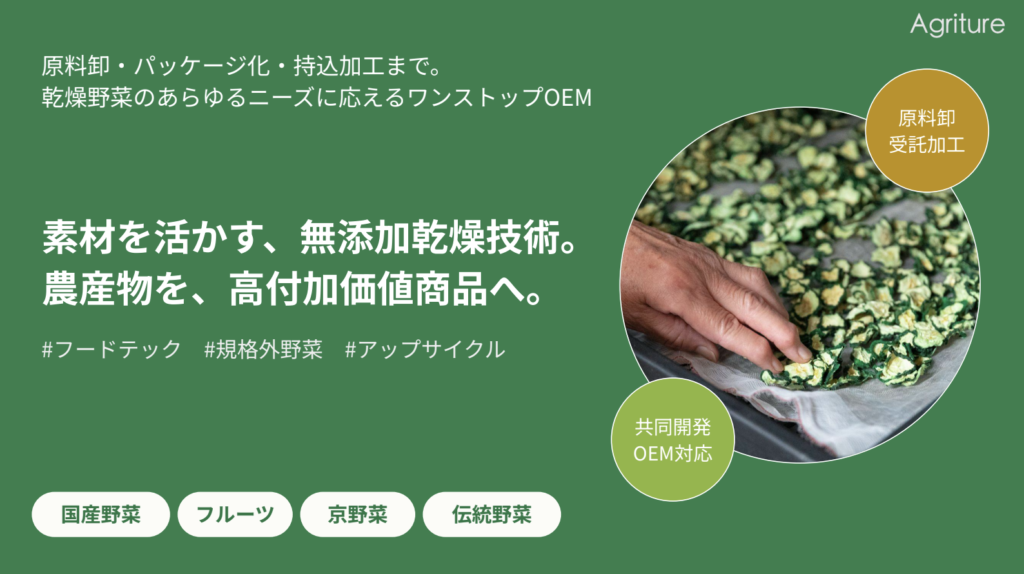
- OEM available from small lots of 10 kg
- Drying of brought-in raw materials also possible
- Support from processing to filling in one place
Download the OEM contract processing materials
We will send the materials to your email address based on the information you provide.
- The Real Reason Chefs Use Kyoto Vegetables
- Kyoto Vegetables and Sake. The Happy Relationship of a Dish and a Cup.
Author of this article
Related articles
-
 京野菜は何品目あるのか、読み方の一覧と認定の枠組みから確かめる
 -
 Drying Is Another Kind of Cooking
 -
 The Technology to Lock In the Season. The Seasonal Story Dried Vegetables Connect.
 -
 The Cut Face of a Vegetable. The Difference the Cut Makes.
 -
 Tasting Kyoto Vegetables by Aroma. The Pleasure of Cooking That Begins at the Tip of the Nose
 -
 Vessels and Kyoto Vegetables. Creating the Scenery of Plating.
 -
 Vegetables and Heat Control. Between High and Low Flame
 -
 Kyoto Vegetables and Sake. The Happy Relationship of a Dish and a Cup.