What is vegetable dashi? A new option for sustainable umami

Summary of this article
Vegetable stock (veggie broth) is made by simmering vegetable peels, ends, and cores in water, drawing out the vegetables' umami without any animal ingredients. Cooking researcher Takako Nakamura advocated and popularized it. We explain suitable vegetables like onion, carrot, and celery leaves, and unsuitable ones such as bitter melon and broccoli (except the stem), and introduce the benefits of using dried vegetables for commercial use.
In Japan's long-standing food culture, dashi is the foundation of cooking and a key element in producing delicate umami. Stocks of animal or seaweed origin, such as bonito flakes and kombu, are the basis of Japanese cuisine, playing the role of adding rich flavor to a whole dish.
Yet as food culture diversifies and food globalizes, the traditional concept of dashi is newly evolving. One example is the birth of "vegetable stock." Vegetable stock is a dashi that draws out the umami of vegetables without any animal ingredients, drawing attention as a new form of stock that makes the most of ingredients' natural sweetness and deep flavor.
This article explains vegetable stock (veggie broth) in detail — its definition and history, how to make it, which vegetables suit it and which don't, and its commercial uses and connection to food-loss reduction.

TOC
What is vegetable stock (veggie broth)?
Definition and basic idea
Vegetable stock (veggie broth) is a dashi made by simmering in water the parts of vegetables usually thrown away — peels, ends, cores, and the areas around seeds. It uses no animal ingredients at all, drawing out umami from vegetables alone. Pectin and sugars in the vegetables' cell walls dissolve out with heating, producing a gentle sweetness and body.
"Vegebroth" is a coined word combining vegetable and broth, popularized by culinary researcher Takako Nakamura. It is also attracting attention as a cooking method for efficiently obtaining the phytochemicals (plant chemicals) in vegetable scraps. Polyphenols and similar compounds are said to be concentrated in vegetable skins.
The history of vegetable stock
Japan's dashi culture, using bonito flakes and kombu, is said to have been established in the Muromachi period. Meanwhile, the idea of drawing umami from vegetables itself is old, and Buddhist vegetarian cuisine (shojin ryori) has long used plant-based stocks made with kombu and dried shiitake.
In Western cooking too, bouillon de légumes (vegetable bouillon), made using vegetable scraps, is one of the basics of French cuisine. Today's veggie broth can be seen as a development that fuses the wisdom of these Eastern and Western food cultures. Against a backdrop of rising health-consciousness and growing vegan populations, demand for plant-based stocks and seasonings is growing worldwide, and in Japan too, powdered vegetable-stock products are on the rise.
Vegetables suited and unsuited to vegetable stock
Vegetables suited to stock
What suits vegetable stock are vegetables with sweetness and umami and little harshness. Vegetables high in the umami components glutamate and guanylate add depth to the stock's flavor. The table below summarizes vegetables suited to stock.
| Category | Suitable vegetables | Character it brings to the stock |
|---|---|---|
| Root vegetables | Onion (with skin), carrot, daikon | Natural sweetness, body |
| Leafy greens | Celery leaves, parsley stems, cabbage core | Aroma, refreshing flavor |
| Mushrooms | Shiitake (stem, stem base), enoki | Umami from guanylate |
| Others | Tomato ends, area around kabocha seeds, corn cob | Acidity, sweetness |
Vegetables unsuited to stock
Vegetables with strong harshness or bitterness spoil the stock's flavor, so it's best to avoid them. Take particular care with the following, as even a small amount can change the flavor of the whole stock.
| Vegetables best avoided | Reason |
|---|---|
| Goya | Strong bitterness transfers to the whole stock |
| Eggplant (without removing the harshness) | Can produce an astringent, harsh taste |
| Broccoli (parts other than the stem) | Can give off a distinctive sulfurous smell |
| Outer cabbage leaves (in quantity) | Too much brings out a grassy note |
| Spinach, | High in oxalic acid, a source of astringency |
How to make vegetable dashi
Basic steps
Making vegetable stock is very simple. No special tools or techniques are needed — what's in a home kitchen is plenty.
- Prepare the ingredients: For every 1 liter of water, prepare two handfuls of vegetable scraps (about 200–300 g). Add 1 teaspoon of sake.
- Put them in a pot: Put the water, vegetable scraps, and sake in a pot and set it over heat
- Simmer over low heat: Simmer gently over low heat for 20–30 minutes without boiling. Boiling brings out off-flavors, so take care
- Strain: Remove the vegetable scraps with a colander or strainer and it's done
The key is not to boil it. Simmering slowly over low heat extracts the vegetables' umami and nutrients thoroughly. Adding a little sake removes off-odors from the vegetables and brings out the umami. The finished stock takes on a clear golden color, with a gentle flavor into which the vegetables' sweetness and umami have dissolved. It's delicious on its own, and just adding a little salt makes it enjoyable as a soup.
Storage method
Finished vegetable stock keeps for 3–4 days refrigerated. If you can't use it up right away, freezing it in an ice-cube tray is recommended. Frozen, it keeps for about a month, and you can thaw just what you need. Portioning it into single servings — one bowl of miso soup, one serving of soup — greatly reduces cooking effort. At home, making a batch on the weekend and using it easily in weekday cooking is efficient and convenient.
The benefits of vegetable stock made with dried vegetables
Consistent quality
When you make stock from fresh vegetable scraps, the flavor varies with the type and amount of trimmings that come up that day. Dried vegetables Using lets you make a stock with a consistent flavor from the same ingredients and same amounts every time
.
Especially at sites where flavor variation isn't allowed, such as restaurants and catering facilities, vegetable stock made with dried vegetables is a major advantage. Being easy to measure and highly reproducible for recipes also makes it well suited to commercial use.
Hygiene and shelf life
Fresh vegetable scraps have a short shelf life, starting to spoil in 2–3 days even refrigerated. It's often hard to accumulate enough. In summer especially, spoilage is faster and hygiene risks rise. Dried vegetables can be stored long-term at room temperature and taken out only as needed, giving peace of mind on hygiene management too. You can keep using them at a consistent quality regardless of season.
Concentration of umami
Also, because water activity is lowered in the drying process, the risk of bacterial growth is extremely low. It's an ingredient easy to adopt even in commercial kitchens where HACCP compliance is required. Being easy to manage in inventory and able to respond immediately to sudden large-batch cooking is a big advantage that fresh vegetables lack.
With their moisture removed, dried vegetables have concentrated umami components. Dried shiitake in particular has more guanylate than in its fresh state, and even more umami dissolves out during rehydration. Combining it with the glutamate of dried onion creates a synergistic umami effect, letting you make a deeply flavored stock no less rich than an animal-based one. Dried tomato is also very rich in glutamate, delivering excellent flavor as a base for Western-style soups and risotto.
Commercial uses of vegetable stock
Handling vegetarian and vegan menus Vegetarian As inbound tourists to Japan increase year by year, Japanese cuisine is drawing attention from overseas. At the same time, for tourists who avoid animal foods — such as
and vegans — it can feel a little high a hurdle.
Allergy-conscious
Using vegetable stock, you can make standard Japanese dishes — miso soup, udon, simmered dishes, hot pots — vegetarian- and vegan-friendly. Just replacing bonito stock with vegetable stock lets you add compatible menu items without changing the basic structure of a dish, a big advantage for restaurants. A Japan Tourism Agency survey also cited "insufficient handling of dietary restrictions" as a difficulty visitors face with food, so responding to diverse food cultures with vegetable stock will only grow more important. Stock made with animal foods can't be used by those with crustacean allergies (shrimp stock) or seafood allergies (bonito stock). Vegetable stock can be made from only vegetables that aren't among the 28 designated allergen items, so it can greatly reduce allergy risk
. It's an option easy to adopt for school lunches, hospital meals, and meals at care facilities too. At nurseries and kindergartens in particular, more facilities are considering switching to vegetable stock from the standpoint of preventing allergy incidents. Potential for handling
inbound demand
Not only for tourists visiting Japan, but also for people who want to choose health- and environment-conscious meals, vegetable stock makes Japanese cuisine more accessible. For those who need halal or kosher food for religious reasons, plant-based vegetable stock also serves as a base for menus that are easy to accommodate. Just offering vegetable-stock miso soup at a hotel or ryokan breakfast buffet lets you accommodate guests from a wide range of food-culture backgrounds.
The link between food-loss reduction and vegetable stock
Using vegetable trimmings
The biggest sustainable point of vegetable stock is that you can use, as stock ingredients, the vegetable peels, ends, cores, and stems that are normally thrown away. According to Ministry of Agriculture, Forestry and Fisheries data, Japan generates about 5.23 million tons of food loss a year (FY2021 estimate). Of that, the amount from households reaches about 2.44 million tons, and vegetable cooking scraps make up a large share. Using vegetable cooking scraps as stock is an effort that directly reduces food loss, whether at home or in commercial use.
Non-standard vegetables (Source: Ministry of Agriculture, Forestry and Fisheries, "Estimated food-loss volume (FY2021)")
Making effective use of dry processing Non-standard vegetables that are merely irregular in shape but have no issue with taste or quality can also be put to good use by drying them into stock ingredients. At Agriture, we sustainable the non-standard vegetables that come from partner farms, and provide them as dried vegetables for various uses including stock. Through a processing structure based on agriculture-welfare collaboration, we've built a system that contributes to both local agriculture and welfare.
For companies that prioritize
food production, vegetable stock made with dried vegetables becomes an option with a story, including the social responsibility of the sourcing.
New possibilities for vegetable stock
That vegetable stock is spreading can be seen as proof that Japanese food is evolving flexibly with the times while protecting tradition. Beyond those with dietary restrictions for health or religious reasons, vegetable stock is embraced by people who want to take in more vegetables day to day, and by those who want to enjoy the taste of ingredients simply. For those mindful of reducing salt too, the umami of vegetable stock is a way to achieve a satisfying flavor even with less salt. Commercial dried vegetables Recently, easy-to-use products such as home-use powdered vegetable stock are increasing. School lunches also draw stock using leftover vegetables, and vegetable stock is gradually taking root in daily life. Some restaurant chains are beginning to switch all menu items to a vegetable-stock base, and commercial demand is expected to expand further. OEM manufacturing Going beyond the frame of "a Japanese-food alternative for foreigners," vegetable stock is becoming something that enriches Japanese food culture itself. Perhaps a "Japanese cuisine of the future" — one that treasures tradition while coexisting with diverse values — is being born right here.
If you're interested in developing vegetable stock using
, please feel free to contact us. We handle small-lot
Recommended reading
sustainable / Commercial dried vegetables / Product list / Novelties / dry processing / Powder
We have materials available to help you understand dried processing OEM
Agriture OEM, flexibly handling everything from small lots to large lots
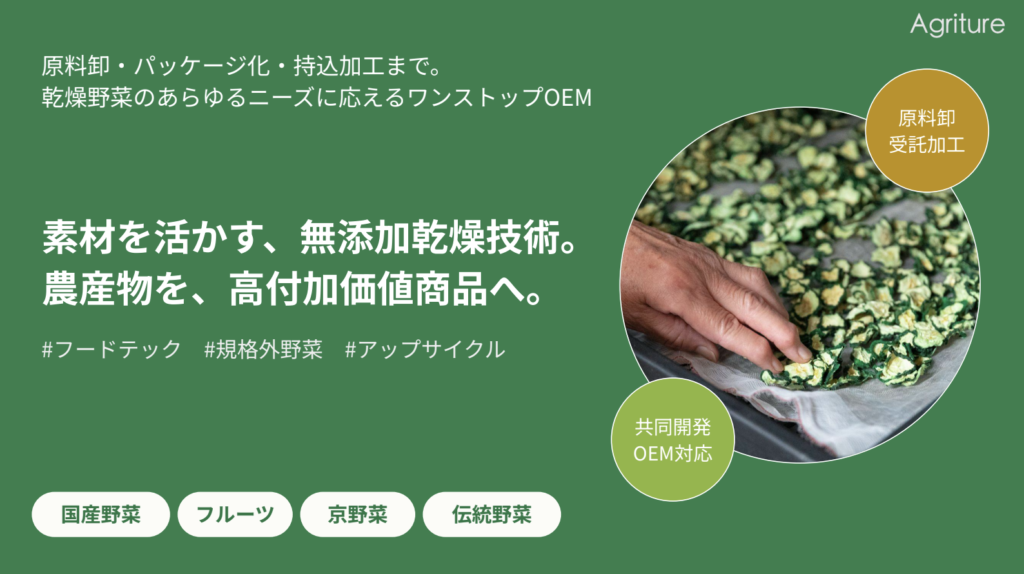
- OEM available from small lots of 10 kg
- Drying of brought-in raw materials also possible
- Support from processing to filling in one place
Download the OEM contract processing materials
We will send the materials to your email address based on the information you provide.