Self-Check Your Vegetable Shortage! Confirm Your Health with a 10-Item Checklist You Can Do Right Now

Summary of this article
A natural increase in vegetable intake
TOC
When practicing it, be mindful of eating in the order fiber-rich vegetables → protein dishes → carbohydrates. Note, though, that carbohydrate-heavy vegetables such as potatoes and kabocha squash have limited effect.
Against the 350 g of vegetables a day recommended by the Ministry of Health, Labour and Welfare, the Japanese average intake stands at only about 280 g. By making eating vegetables first a habit, naturally increase your vegetable intake and lead a healthy diet. Starting today, why not try eating vegetables first at just one meal? A small change in eating habits may bring a large health benefit.
You can check your health with a 10-item self-diagnosis checklist for vegetable shortfall. The Japanese average vegetable intake is 256 g, about 94 g short of the 350 g target, and three or more checks means caution. It examines three categories: eating patterns, food choices, and eating habits and awareness. We also explain overseas research showing that low vegetable and fruit intake raises the risk of reduced work productivity.

Insufficient vegetable intake isn't just a nutrition issue. It leads to an unbalanced diet and affects everyday physical condition. The vitamins, minerals, and dietary fiber in vegetables are basic nutrients that support our health.
SourceIn your daily meals, are you getting enough vegetables?、In fact, the Japanese average vegetable intake stands at only about 256 g, some 94 g short of the 350 g a day recommended by the Ministry of Health, Labour and Welfare. Among younger generations from their 20s to 40s in particular, this vegetable shortfall is becoming even more serious. For businesspeople who, amid busy days, tend to rely on eating out and convenience-store food, a vegetable shortfall has become an unavoidable challenge.A vegetable shortfall isn't merely a nutritional issue. It becomes a factor that raises the risk of everyday troubles like constipation, rough skin, and irritability, as well as lifestyle-related diseases such as high blood pressure, diabetes, and dyslipidemia. The vitamins, minerals, and dietary fiber in vegetables are basic nutrients that support our health.
Japan Health Insurance Association, "Add 70 g to your daily meals for a healthy life"
Ministry of Health, Labour and Welfare, "FY2023 National Health and Nutrition Survey"
Created based on the above
| Category | A vegetable-shortfall self-check list of 10 items you can do right now |
|---|---|
| Let's check your vegetable-intake status. | Look back on your usual diet with the 10-item checklist below. If there are items you check, they're warning signs of a vegetable shortfall. |
| Check items (count how many apply) | |
| Eating patterns | |
| You eat only two meals a day, or just one | |
| You often make do with eating out or a convenience-store bento | You get home late and tend to make do at night with eating out or something you bought |
| You're not fond of cooking and hardly ever cook | |
| Food choices | |
| You often eat processed or instant foods | You often make do with just a rice bowl for a meal |
| You tend to make do with drinks and snacks rather than a meal | |
| Eating habits and awareness |
There are vegetables you dislike You think skipping meals is a good way to lose weight, contained in burdock and cocoa.
SourceYou've never been mindful of your vegetable intakeA vegetable shortfall isn't merely a nutritional issue. It becomes a factor that raises the risk of everyday troubles like constipation, rough skin, and irritability, as well as lifestyle-related diseases such as high blood pressure, diabetes, and dyslipidemia. The vitamins, minerals, and dietary fiber in vegetables are basic nutrients that support our health.
Count how many apply.
If three or more apply, you're likely in a state of vegetable shortfall
Tokyo Metropolitan Bureau of Social Welfare and Public Health, "Vegetable-Intake Self-Check"
Here's something worth knowing: the free medicinal constitution diagnosis from "Yasai Yakuzen," a sister media we at Agriture operate. Yakuzen is food wisdom that, based on the ideas of Eastern medicine, selects ingredients to match each person's constitution. Once you know your own constitution type — such as "prone to feeling cold" or "tires easily" — it becomes easier to choose ingredients suited to you even when making up for a vegetable shortfall.
Just answer with a nickname and a few questions to learn your type and the ingredients that suit you well. Along with resolving a vegetable shortfall, try it casually as a hint for rethinking your diet.
▶ Try the "Medicinal Constitution Diagnosis" for choosing ingredients from your constitution
The health risks a vegetable shortfall causes and its impact on work performance
A vegetable shortfall may be affecting your work too.
The wide range of nutrients in vegetables, such as potassium, dietary fiber, and the pigment components of green and yellow vegetables, are known to be useful in keeping daily eating habits in order.
A shortage of these nutrients leads to an unbalanced diet. It's a point worth reviewing in your daily eating habits.
SourceConcrete health risks from a vegetable shortfallA vegetable shortfall isn't merely a nutritional issue. It becomes a factor that raises the risk of everyday troubles like constipation, rough skin, and irritability, as well as lifestyle-related diseases such as high blood pressure, diabetes, and dyslipidemia. The vitamins, minerals, and dietary fiber in vegetables are basic nutrients that support our health.
The potassium in vegetables promotes the excretion of salt and helps prevent high blood pressure. Dietary fiber curbs the absorption of cholesterol and carbohydrates, preventing obesity and sharp blood-sugar rises. The pigment components in green-and-yellow vegetables have strong antioxidant action, preventing the oxidation of LDL cholesterol and helping prevent arteriosclerosis.
Even busy businesspeople can increase their vegetable intake with a few tweaks.
Easy-to-start tweaks for getting vegetables
- Work them in a little at a time across three meals: getting 350 g in one meal is hard, so add one small bowl of salad, ohitashi, or a simmered dish to each meal. The remaining 94 g is roughly half a tomato, a third of an onion, or 2–3 cabbage leaves.
- Use make-ahead dishes: freezing things like kinpira gobo, dried-daikon strips, or spinach ohitashi lets you add a dish with no effort.
- Choose easy-to-cook vegetables: use cherry tomatoes you just wash, broccoli or cauliflower you microwave, and pre-cut raw vegetables.
- Use vegetable juice and supplements as backups: for a morning glass with no time or on days out of the office. Since fiber is easily reduced and the satisfaction of chewing is hard to get, combining them with solid vegetables is the basic approach.
New options in the office environment
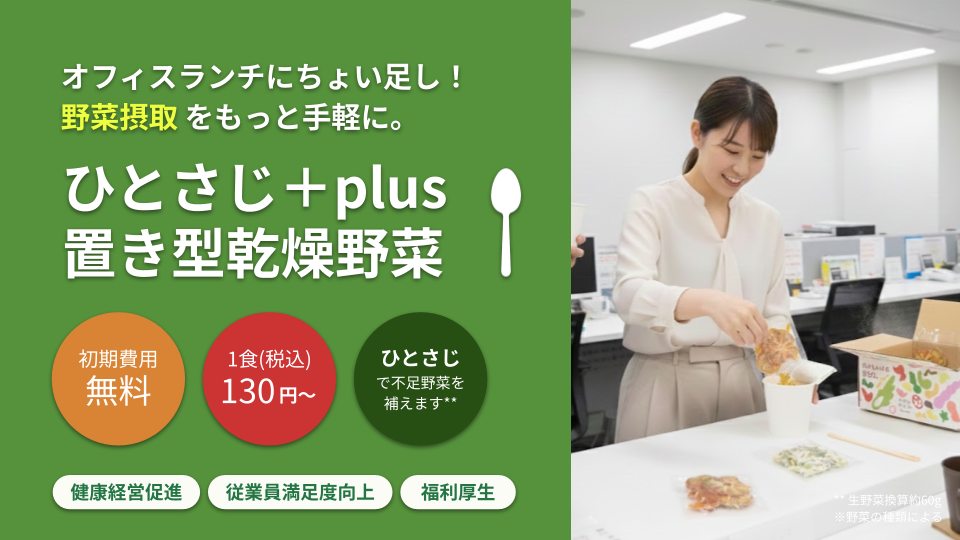
Office-oriented dried-vegetable services are drawing attention. They can be stored long-term, take little cooking effort, and by keeping them on your desk let you get vegetables easily, free from constraints of time and place. Vegetable products in forms with excellent shelf life and convenience, such as dried vegetables and vegetable powder, not only fit busy modern people's lifestyles but also contribute to reducing food loss.
From the standpoint of corporate health management too, adopting such services is advancing as a solution useful for maintaining and improving employees' health. Improving employees' health also leads to management benefits such as higher productivity and lower medical costs.
For example, Agriture's office-oriented dried vegetables are made by buying from producers domestic vegetables that are sufficient in taste and nutrition but hard to bring to market because their shape doesn't meet standards, then drying them at low temperature in partnership with contract farms and welfare facilities in northern Kyoto. Handling nearly 100 varieties including Kyoto vegetables, they're designed so that, without relying on sugar or additives, the ingredient's flavor remains, letting you supplement vegetables just by adding a pinch to cup soup or miso soup. By making use of non-standard vegetables, the act of eating itself leads directly to reducing food loss. (Insight from our own production floor)
Improve a vegetable shortfall with continuous self-monitoring
Just by measuring, you can improve your vegetable intake.
It's been confirmed that a single measurement at a health event or the like doesn't improve a vegetable shortfall. In a survey targeting staff at the Konan Ward Office in Yokohama, those who continued measuring once a month for two months improved their estimated vegetable intake by 49 g, while those who left a two-month interval saw no improvement in vegetable intake.
Ongoing self-monitoring helps. It has been reported that even without special guidance, "just measuring" raises awareness of vegetable intake.
Accurately measure your vegetable-intake status, make up the shortfall toward the Japanese vegetable-intake target of 350 g, and confirm the results of your efforts through the change in your score with a re-measurement. This simple repetition leads to ease of continuing.
SourceArtec Co., Ltd., "An 'improve your vegetable shortfall just by measuring' program with the VegeMeter”A vegetable shortfall isn't merely a nutritional issue. It becomes a factor that raises the risk of everyday troubles like constipation, rough skin, and irritability, as well as lifestyle-related diseases such as high blood pressure, diabetes, and dyslipidemia. The vitamins, minerals, and dietary fiber in vegetables are basic nutrients that support our health.
Summary: actions to start improving your vegetable shortfall today
Improving a vegetable shortfall can start today.
First, check your vegetable-intake status with the 10-item self-check list. Those who checked three or more items are likely in a state of vegetable shortfall. But there's no need to worry. Just consciously working in another 94 g of vegetables gets you to the 350 g recommended by the Ministry of Health, Labour and Welfare.
Insufficient vegetable intake affects everyday physical condition and nutritional balance. Increasing vegetable intake leads to a balanced diet.
Even busy businesspeople can increase their vegetable intake with a few tweaks — using make-ahead dishes, choosing easy-to-cook vegetables, using office-oriented dried-vegetable services. By carrying out continuous self-monitoring, you can expect even more effective improvement.
Your health can be protected by your own choices. Why not start a vegetable-conscious diet today?
At Agriture, we provide information that lets you "know correctly and work it in without strain" about the challenge of vegetable shortfall, and help you find a way of getting vegetables that suits your lifestyle. With science-based information and practical options, we face the challenge of the Japanese vegetable shortfall.
Recommended reading
- Ways to resolve a lack of vegetables that even busy people can practice
- Symptoms that appear when you don't eat vegetables
- How to resolve a lack of vegetables even with convenience-store food
- Dealing with vegetable shortfall and constipation
- A service that solves the office vegetable shortfall
Learn about Office Yaoya
We have prepared materials
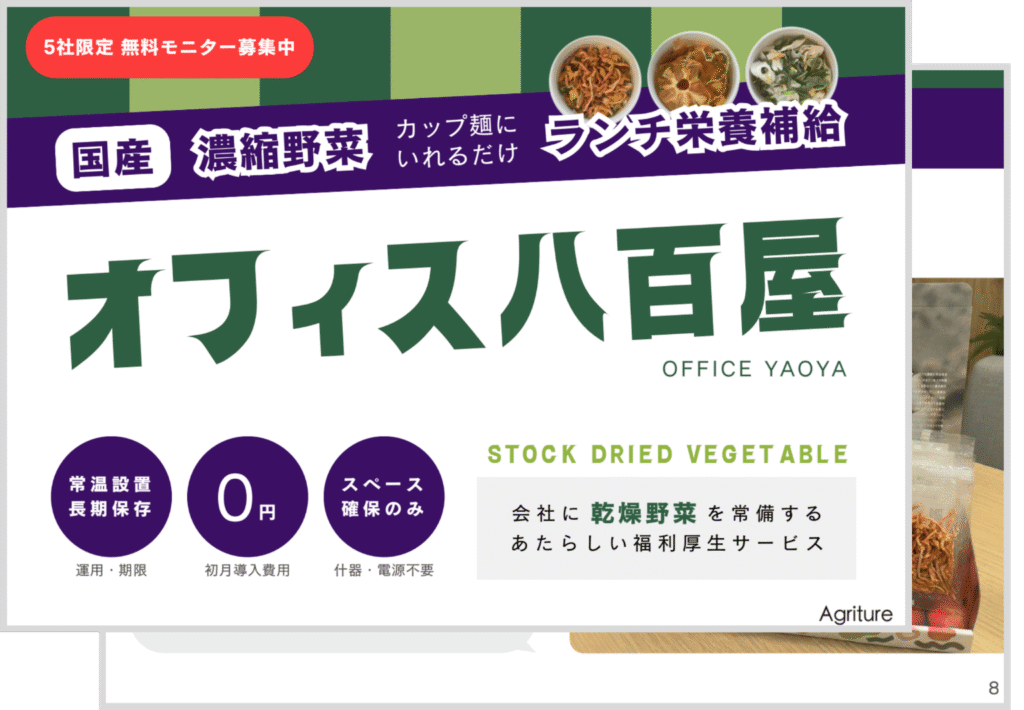
- Service details and vegetable lineup
- Pricing and plans
- How adoption and operation work
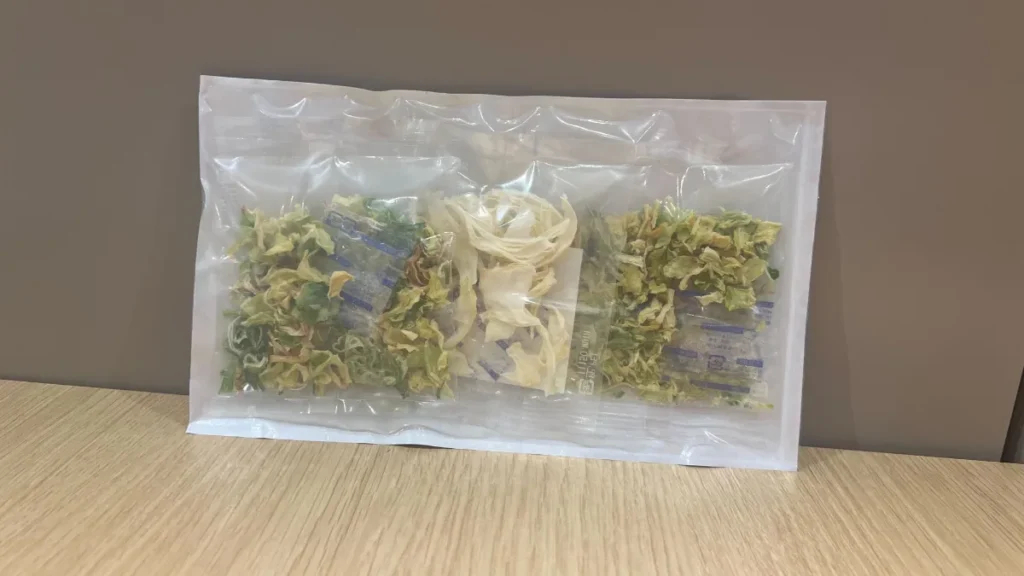
Sample sets are also available. Download the materials for details!
We offer sample sets so you can try Office Yaoya in small quantities. See the materials for details.
FAQ
We've compiled frequently asked questions about the vegetable-shortfall self-check.
Download the office dried vegetable materials
We will send the materials to your email address based on the information you provide.
- What is vegetable dashi? A new option for sustainable umami
- [Latest 2025] A thorough comparison of 7 recommended vegetable powders