
The Secret to Vegetable Dashi Is Dried Vegetables! Tips for Drawing Out Umami

Summary of this article
We organize the mechanism, selection, storage, and practical Japanese/Western/Chinese use of raising vegetable-dashi umami with dried vegetables, along with Agriture's commercial know-how of Kyotango-grown dashi tomatoes (Momotaro) and dried Kujo negi and its powdering OEM development.
The combination of vegetable dashi and dried vegetables is a use that makes it easier to achieve both umami density and time-saving compared with the method of taking dashi from fresh vegetables. Dried vegetables, with their moisture removed, have relatively concentrated taste components such as glutamic acid and aspartic acid, which dissolve directly into the rehydration liquid. Using materials narrowed by cultivar and origin—such as the Kyotango-grown dashi tomatoes (large-fruited Momotaro) and dried Kujo negi that Agriture handles—you can build a highly reproducible dashi, from restaurant prep to the base design of processed foods.
This article organizes the mechanism of raising vegetable-dashi umami with dried vegetables, material selection and storage, Japanese/Western/Chinese recipes, and the design points to cover for OEM and commercial use, along with practical know-how using Agriture's Kyotango-grown materials. For the overall picture of vegetable dashi, see Introduction to plant-based dashi, and for how to make it, see How to make vegetable dashi.

TOC
The mechanism by which dried vegetables draw out umami
The reason dried vegetables' umami is strong is that the moisture is removed and glutamic acid, aspartic acid, and sugars are relatively concentrated. Vegetables are originally 80–90% moisture, and driving off this moisture makes the taste components per weight much more concentrated, giving dashi power even in small amounts. The reason we choose the Momotaro cultivar for the Kyotango dashi tomatoes is that large-fruited varieties have a lot of glutamic acid in the jelly part, and dashi-suited umami remains readily even after drying.
Taste components by material and changes after drying
We summarized the taste components that concentrate by material and the changes that occur with drying. Agriture suppresses the volatilization of taste components with low-temperature drying (in the 50–60°C range), a design where aroma and umami remain readily even after rehydration.
| Material | Main taste components | Change from drying |
|---|---|---|
| Onion | Glutamic acid, sugars | Sugars concentrate, and fragrance rises readily during cooking |
| Carrot | Aspartic acid, sugars | Sweetness concentrates. The color also deepens |
| Large-fruited tomato | Glutamic acid | Acidity becomes gentle and umami comes to the fore |
| Celery | Aroma components, aspartic acid | A refreshing aroma remains (with low-temperature drying) |
| Dried shiitake | Guanylic acid | Almost absent in fresh shiitake; generated by an enzymatic reaction during the drying and rehydration process |
The mechanism by which guanylic acid multiplies umami
The guanylic acid abundant in dried shiitake works to deform the tongue's umami receptors and retain glutamic acid for a long time. As a result, the synergistic effect of glutamic acid × guanylic acid raises the umami intensity far more than either alone. In plant-based vegetable dashi, the combination of kombu, large-fruited tomato, onion (glutamic-acid sources) + dried shiitake (a guanylic-acid source) is the royal road.
- Kombu + dried shiitake: a clear-umami composition close to the ichiban dashi of Japanese cuisine
- Dried large-fruited tomato + dried shiitake: for Western-style and plant-based ramen
- Dried onion + dried carrot + dried shiitake: an all-purpose household vegetable dashi
Don't throw away the rehydration liquid
Because taste components also dissolve into the water used to rehydrate dried vegetables (the rehydration liquid), the basic rule is to use it as dashi as is. An operation of throwing away the rehydration liquid and simmering only the ingredients means flushing away the extracted taste, greatly lowering the concentration of the dashi.
- Rehydration time: 30 minutes to overnight. The thicker the material, the more time to allow
- Cold-water rehydration: flavor remains readily and aroma loss is small. Good compatibility with prep operations of chilled storage from the night before
- Warm-water rehydration: extraction is fast, but volatile aromas escape easily. Use it when prioritizing speed
How to choose and store dried vegetables
Even if dried vegetables look similar, the flavor changes greatly with the drying method, raw-material cultivar, and storage state. For dashi uses, the three priority check items are "whether it is low-temperature dried," "whether the cultivar is fixed," and "whether the color and aroma are close to the material's own."
The difference by drying method is especially large, and between Agriture's low-temperature drying and high-temperature drying or sun-drying, a difference easily emerges in the degree of flavor retention in the finish.
| Drying method | Temperature range | How taste and aroma remain | Suitability for dashi uses |
|---|---|---|---|
| Low-temperature drying | 50〜60℃ | Taste and aroma remain readily | ◎ Suited to dashi (adopted by Agriture) |
| High-temperature drying | 70〜100℃ | Volatile aromas escape easily | △ For uses emphasizing color and rehydration |
| Sun-drying | Relies on outside air temperature | Large lot differences by season and weather | △ Variation management is difficult for commercial use |
| Freeze-dried | Sublimation at around -40°C | Excellent at maintaining flavor and shape | ○ A strong option if it fits the cost |
Using commercial and household differently
The basic is to choose by two points: "how long you can use it up" and "how much lot variation you tolerate." The longer the use-up period, the more a portioned pack suits; the more you need a fixed lot, the more commercial large-capacity and cultivar designation suit.
| Use | Recommended pack | Points to note |
|---|---|---|
| Restaurant prep | Commercial large-capacity (500g to 1kg) | After opening, transfer to an airtight container and use silica gel together |
| Processed-food OEM | Commercial, lot-designated | Suppress flavor variation by fixing origin, cultivar, and drying method |
| Everyday household use | Portioned pack (20–100g) | Choose on the assumption of using it up within 1–2 months of opening |
Points for judging quality
- Color: vivid, with the original vegetable color not dulled. Ones discolored brown are a sign of degradation or high-temperature drying
- Aroma: the material's aroma rises firmly when opened. Avoid odorless or musty-smelling ones
- Drying method: low-temperature drying (50–60°C) is advantageous for taste and aroma retention. High-temperature drying and sun-drying tend to show lot differences
- Dried shiitake: choose ones that are thick-fleshed and whose caps are not too open. Log-cultivated is said to be richer in natural guanylic acid than bed-cultivated
- Cultivar designation: for OEM and commercial use, designating even the cultivar (e.g., Momotaro for large-fruited tomato) suppresses lot differences
Tips for long-term storage
Room-temperature storage is basic for dried vegetables, but avoiding humidity and direct sunlight lets you keep the flavor for a long time. After opening, transferring to an airtight container and putting in a desiccant such as silica gel suppresses moisture absorption. When using a large amount for commercial purposes, an operation of portioning into amounts you can use up and storing with air removed is stable.
- Room temperature and a cool, dark place are basic. The refrigerator gets damp easily from condensation, so for uses that repeatedly reopen, it is rather unsuited
- Portioned storage that reduces the number of open-close cycles makes lot differences less likely
- Even within the best-before date, if it smells like turned oil (an oxidized smell), refrain from using it
FOR BUSINESS
乾燥野菜を業務用でお探しですか
国産の野菜・果物を乾燥し、必要に応じて粉砕してお出ししています。扱っている品目は100種前後で、規格は 乾燥品の一覧・パウダーの一覧 に掲載しています。
少量でのご購入は、姉妹ブランドの通販サイト OYAOYA で承っています。
Practical uses of vegetable dashi × dried vegetables
Vegetable dashi using dried vegetables can be applied to any cuisine—Japanese, Western, or Chinese. We organize the practical points by application.
Basic preparation (time-saving version)
With dried vegetables, you can take dashi just by soaking them in water. Put 5g each of dried Carrot, dried Onion, dried Celery, and dried shiitake into 1L of water, let it stand for 30 minutes, then simmer over low heat for 15 minutes to complete it. Compared with the prep time of chopping and simmering fresh vegetables, the essence of the time-saving is that the whole process of taking out a knife and cutting board is omitted.
- The operation of soaking in water the night before and chilled-storing → firing up in the morning has a large time-saving effect
- Keeping it at 80–90°C without boiling suppresses the volatilization of taste
- The rehydrated vegetables can be used as ingredients in the dish as is (two birds with one stone)
Western style (mirepoix + dried tomato)
Adding dried large-fruited tomato to a mirepoix of dried onion, dried carrot, and dried celery swings it toward Western-style bouillon. Lightly sautéing in olive oil and then adding water adds fragrance from the Maillard reaction, and it can be used as a base for potage, minestrone, and plant-based ramen.
- Well-suited dishes: potage / minestrone / plant-based ramen / risotto
- Axis of the combination: mirepoix (onion, carrot, celery 2:1:1) + dried large-fruited tomato
- Tip for finishing: lightly sautéing in olive oil before adding water lends fragrance
Japanese style (kombu + dried shiitake + dried carrot)
Making the synergistic effect of glutamic acid × guanylic acid with kombu + dried shiitake, and adding sweetness with dried carrot, gives an all-purpose Japanese-style dashi usable in miso soup, simmered dishes, and takikomi gohan. Adding a little soy sauce brings umami even more to the fore, making it a composition that easily gives satisfaction even in a reduced-salt design.
- Well-suited dishes: miso soup / simmered dishes / takikomi gohan / udon and soba broth
- Axis of the combination: kombu + dried shiitake + dried carrot (underpinning the sweetness)
- Tip for finishing: a little soy sauce brings umami to the fore. Good compatibility with a reduced-salt design
Chinese style (dried Kujo negi + dried shiitake + dried onion)
Kyoto-grown dried Kujo negi, being a leaf-negi type, has softer leaves than dried white-negi (fukabuka negi) products, and its sweetness dissolves readily into the rehydration liquid. Whereas ordinary dried long negi (white negi) finishes leaning toward aroma, Kujo negi finishes achieving both sweetness and aroma, with a unique presence as a base for Chinese soups and plant-based ramen. On the other hand, oversimmering makes the leaf color escape readily, while the sweetness comes out more strongly, so if you want to keep the color, adding it near the finish is the suitable operation.
- Well-suited dishes: Chinese soup / plant-based ramen / hot pot / dipping-sauce dashi for gyoza
- Axis of the combination: dried Kujo negi + dried shiitake + dried onion
- Tip for finishing: a few drops of taihaku sesame oil. When you want to keep the color, add the negi late in the simmering
Use in commercial and processed foods
Dried vegetables are also a material that takes the lead in commercial and processed-food OEM. With a good balance of lot stability, storability, and cost, and giving flavor in small amounts, it is a form easy to handle in formulation design. What is especially big for processing makers is that they can secure dashi at a consistent quality and cost year-round even in the off-season when fresh vegetables are scarce and prices soar, making it a foundational material for mass-producing vegetable-based products without being swayed by the season.
Dashi-suited materials that Agriture handles
Agriture produces dried vegetables at Kyotango, Kyoto Prefecture, and at manufacturing bases in Nagano, Mie, Ehime, and Okinawa. The materials especially often requested for dashi uses are the following.
| Material | Growing region | Main use |
|---|---|---|
| Dashi dried tomato (Momotaro) | Kyotango, Taniyoshi Farm | Plant-based ramen, Western-style soups |
| Dried Kujo green onion | Kyoto | Chinese cuisine, ramen, hot pot |
| Dried onion | Domestically grown | Bouillon, curry, folding into hamburg steak |
| Dried carrot | Domestically grown | Simmered dishes, takikomi gohan, miso soup |
| Vegetable powder (30-plus kinds) | Domestic blend | Dashi packs, granular bouillon, fish paste products |
Cultivar selection for dashi dried tomato
In July 2024, Agriture released a dashi dried tomato made by low-temperature drying large-fruited tomato (Momotaro, Kyotango-grown). Large-fruited tomatoes have a lot of glutamic acid in the jelly part, and whereas small-fruited types (mini tomatoes) emphasize the flesh's sugar content, large-fruited types suit a dashi-oriented umami design. Sourcing from Taniyoshi Farm the "fully ripe fruit that ripened, rose in sugar content, and cannot be shipped to market," we finish it into a material that can build a dashi with depth without using anything of animal origin.
- Large-fruited tomato (Momotaro): glutamic acid concentrated in the jelly part. Suited to dashi
- Mini tomato: flesh sugar content is primary. Suited to snacks and confectionery
- Procurement background: utilizing Taniyoshi Farm's off-spec fully ripe fruit (contributing to food loss)
- Use: plant-based ramen / Western-style soups / a base for processed foods
Development in powdering and dashi packs
Powdering dried vegetables broadens the scope of commercialization as dashi packs, granular bouillon, and soup bases. Covering the features by form makes the design smooth at the time of OEM consultation.
- Dashi pack: fill nonwoven fabric with vegetable powder + dried materials. Suited as a base for takikomi gohan and miso soup
- Granular bouillon: complete with salt design included. For restaurant cooking-time reduction and household use
- Powder (material): directly folded into hamburg steak, tsukune, and fish paste products. For plant-based product formulation
Filling OEM of vegetable powder is organized at Vegetable powder filling OEM.
We have materials available to help you understand dried processing OEM
Agriture OEM, flexibly handling everything from small lots to large lots
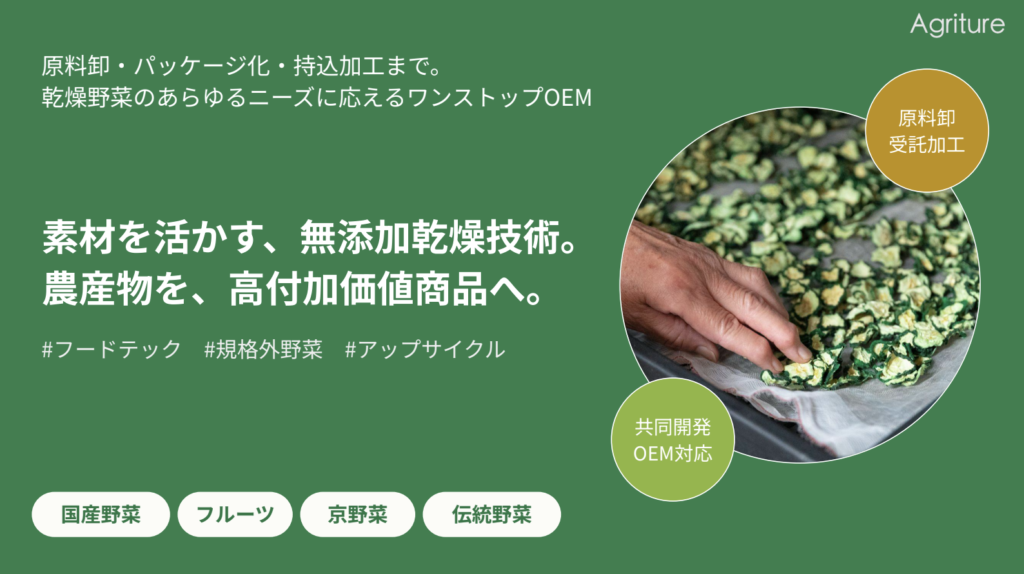
- OEM available from small lots of 10 kg
- Drying of brought-in raw materials also possible
- Support from processing to filling in one place
FOR BUSINESS
乾燥野菜を業務用でお探しですか
国産の野菜・果物を乾燥し、必要に応じて粉砕してお出ししています。扱っている品目は100種前後で、規格は 乾燥品の一覧・パウダーの一覧 に掲載しています。
少量でのご購入は、姉妹ブランドの通販サイト OYAOYA で承っています。
FAQ
Does dried vegetable dashi become stronger than fresh vegetables?
Compared at the same weight, it becomes stronger. As moisture (80–90% of the vegetable) is removed, the glutamic acid and aspartic acid per weight become relatively concentrated, giving flavor in small amounts. However, because high-temperature drying makes aroma components escape easily, choosing by low-temperature drying or cultivar designation (e.g., Momotaro for large-fruited tomato) is less likely to fail.
May I use the rehydration liquid?
Using it is the basic. Because a large amount of taste components dissolves into the rehydration liquid, use it as dashi as is. Rehydration time is 30 minutes to overnight; rehydrating in cold water retains flavor more readily, while warm water extracts faster but tends to let the aroma escape.
How should it be stored?
Room temperature and a cool, dark place are basic, avoiding humidity and direct sunlight. After opening, transferring to an airtight container and putting in a desiccant such as silica gel keeps it fresh. The refrigerator gets damp easily from condensation, so it is rather unsuited for uses that repeatedly reopen.
Can I consult you about commercial dried vegetables?
Yes. Agriture accommodates commercial supply of Kyotango-grown dashi dried tomato, dried Kujo negi, dried onion, dried carrot, and vegetable powder, and dashi OEM (formulation design, powdering, dashi packs, granular bouillon). By fixing cultivar, origin, and drying method, we can design to suppress lot-to-lot flavor variation. Food OEM no Madoguchi (Agriture) Please consult us.
Can I take an authentic dashi with dried vegetables at home too?
You can. Using dried vegetables lets you skip taking out a knife and cutting board, so you can make an authentic vegetable-dashi-based miso soup or soup in 15 minutes even in the busy morning hours. The operation of soaking in water the night before and completing it with 15 minutes of firing up in the morning is a time-saving routine that also takes root easily at home.
Summary
Dried vegetables are an "umami-concentrated ingredient" whose taste components are relatively concentrated as moisture is removed. Using the whole thing down to the rehydration liquid and being conscious of the synergistic effect of glutamic acid × guanylic acid, you can build a powerful dashi without using anything of animal origin. For commercial use, fixing origin, cultivar, and drying method lets you secure a dashi of stable flavor even in the off-season, making it a material easy to operate year-round in processed-food and restaurant prep.
The overall picture of how to make it is at How to make vegetable dashi, the basics of plant-based dashi at Introduction to plant-based dashi, and commercial selection at How to choose commercial vegetable dashi. For OEM inquiries, Food OEM no Madoguchi (Agriture).
Download the OEM contract processing materials
We will send the materials to your email address based on the information you provide.
If you are considering product development with off-spec or your own farm's vegetables:From planning to processing, materials, package printing and novelties, you can consult us through a single point of contact. → Learn more about one-stop product development
- How to use commercial vegetable powder | Uses at restaurants and storage
- 6 Practical Techniques to Cut the Initial Costs of OEM Filling | Start Smart with Small-Lot Support
Author of this article
Related articles
-
 柚子の皮の使い道は干すと広がる、果汁と種まで使い切る手順
 -
 Adding Vegetables to Your Morning with Dried Vegetables: A Guide to Getting Dietary Fiber Easily
 -
 Predicting the Dried Vegetable Market in 2030! An Explanation of Growth Fields and the Latest Trends
 -
 Food OEM Market Trends 2026: A Growth Strategy Seen Through Small-Lot and Domestic-Ingredient Needs
 -
 How to Use OEM Matching Sites: Efficiently Finding the Optimal Manufacturing Partner
 -
 How to proceed with hometown-tax product development | OEM techniques that make the most of local ingredients
 -
 Creating a regional brand with a Kyoto-vegetable OEM | The complete flow from planning to sales
 -
 Kyoto ingredient processing OEM | How to make the most of Kyoto vegetables and quality control