
How to Make Dried Tomatoes: Drying Tips, and How Cherry and Large Tomatoes Turn Out Differently

Summary of this article
After explaining three ways to make dried tomatoes at home, this article sums up what we have learned as a drying manufacturer: whether a tomato is suited to drying depends on its type. Cherry tomato types have a high sugar content, so water is harder to remove; the sweetness is rich, but designing for shelf life is difficult. Large tomato types dry easily, and drying balances their acidity and sweetness, making them well suited as a base for stock and soups. We also cover storage guidelines, and drying conditions and minimum lots for commercial and OEM production.
Ripe Tomato dried to make dried tomatoes.
a processed food prized for a deep richness and aroma entirely different from fresh tomatoes. Tomatoes are about 90% water, and removing that water through drying concentrates their umami. Agriture, specializing in vegetable stock, Tomatoes for dashi specialized for vegetable dashi, and Overdone tomato with sugar content raised to the extreme. Because they shrink to about 10–15% of their fresh weight, even a small amount can have a big impact on the flavor of a whole dish.
They are gaining attention as an ingredient that works across all kinds of dishes, including pasta, bread, meat dishes, stews, and salads. In addition to how to make them at home, this article shares what we have learned as a drying manufacturer: whether a tomato is suited to drying differs clearly by its type.
TOC
Three drying methods you can do at home
First, here are three methods you can try at home. The result and effort differ, so choose based on your goal.
| Method | Approximate time | Finish | Suited to |
|---|---|---|---|
| Oven | 1 hour + 15-30 minutes | Dries evenly and consistently | Those who don't want to fail |
| Microwave | 5 minutes + 5 minutes or more | Quick but prone to uneven drying | Those who want to make a small amount quickly |
| Low-temperature oven | 100-120 minutes | Retains color and aroma; suited to semi-dried | Those who want to bring out the natural flavor |
The basic oven method
The easiest and most reliable method is drying with an oven.
Prepare 1/2 to 1 teaspoon of salt for 250 g of medium tomatoes. Wash the tomatoes, remove the stems, cut them in half lengthwise, and scoop out the seeds with a spoon. Place them cut-side down on a paper towel and thoroughly remove the surface moisture.
Line a baking sheet with parchment paper, arrange them cut-side up, and sprinkle salt evenly. Bake in an oven preheated to 140°C for about 1 hour, take them out once, and wipe off the moisture that has come out of the tomatoes with a paper towel. Bake a further 15–30 minutes, then let them dry completely in a well-ventilated spot while still on the sheet.
Quick cooking with the microwave
If you want to make them without spending time, the microwave is handy.
The prep is the same as the oven: cut the tomatoes in half, remove the seeds, and wipe off the surface moisture. Line a heatproof dish with a paper towel, arrange them cut-side up, and sprinkle salt. Heat in a 600 W microwave for 5 minutes, wipe off the moisture that comes out, and heat a further 5 minutes. If moisture remains, repeat 1–2 minute heating while watching them until completely dry.
Tips for a semi-dry finish with low-temperature drying
To make the most of the value of domestic ingredients, low-temperature drying is recommended.
Drying slowly for about 100–120 minutes in a low-temperature oven around 100°C keeps the color naturally intact and makes the aroma and umami less prone to breaking down. Drying all at once at high heat can darken the color and produce a scorched flavor, but drying slowly at low temperature makes the traits of domestic ripe tomatoes—soft acidity and a fruity aroma—stand out. For details, also see The appeal of domestic dried tomatoes. Stopping at the semi-dry state gives a soft finish that's delicious eaten as-is.
We have materials available to help you understand dried processing OEM
Agriture OEM, flexibly handling everything from small lots to large lots
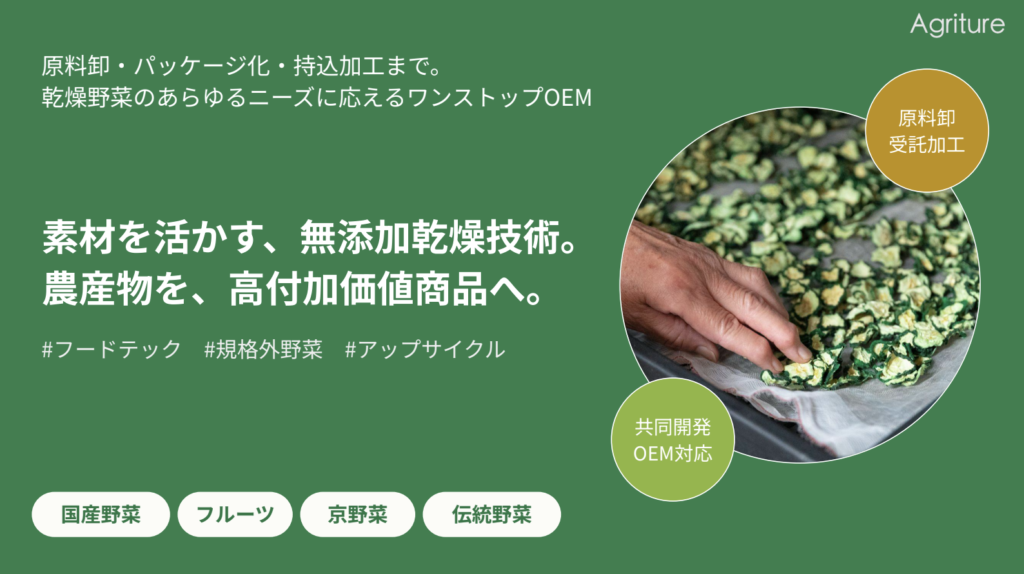
- OEM available from small lots of 10 kg
- Drying of brought-in raw materials also possible
- Support from processing to filling in one place
Whether a tomato is suited to drying depends on its type
This is what we notice most in actual drying work. It's commonly said simply that "dried tomatoes taste better because their sweetness is concentrated," but cherry tomato types and large tomato types are opposites in both how easily they dry and what the finished product is best used for.
| Item | Cherry-tomato type | Large-fruit type |
|---|---|---|
| Sugar content of fresh fruit | Higher (roughly 7-10 Brix) | Lower (roughly 4-6 Brix) |
| Ease of drying | Water is hard to remove and it takes time | Dries easily |
| Sweetness after drying | Strong | Moderate |
| Acidity after drying | Weak | Moderate |
| Shelf life | Tends to be shorter | Easier to make longer |
| Suited use | Confectionery, snacks, and nibbles | Stock, stews, and cooking ingredients |
*These are practical guidelines based on experience. They vary depending on variety, harvest time, and drying conditions.
Cherry tomato types: rich sweetness, but hard to dry
Cherry tomatoes have a high sugar content, and drying brings their sweetness clearly to the fore. However, because they contain more sugar, water is harder to remove and drying takes longer. Even when you think they're thoroughly dry, moisture tends to remain, and they easily absorb humidity after drying, which makes designing for shelf life difficult.
Because of this, cherry tomato types are suited to confectionery, snacks, and nibbles and other products that put sweetness front and center. They pair well with selling in small packs that turn over quickly, while products intended for long-term storage or export require careful design.
Large tomato types: easy to dry and suited to stock
Large tomatoes have relatively pronounced acidity, and although they contain a lot of water, their lower sugar content means drying progresses more easily. As drying removes water, the balance of acidity and sweetness evens out and settles into a well-rounded flavor.
Because their umami is concentrated, they are excellent as a stock ingredient. They serve as a base for Western and Chinese-style stocks and suit ingredients meant for cooking with heat, such as stews, sauces, risotto, and oil-marinated preparations. Agriture offers a separate tomato for stock to make use of this characteristic.
Work backward from what you want to make to choose the variety
- Sweet dried tomatoes for confectionery or snacks → cherry tomato types
- A base for soups or stews → large tomato types
- A longer best-before date → easier to design with large tomato types
- For home use, large types are also easier if you want to shorten drying time
Points to know for making dried tomatoes
Why choose ripe tomatoes
Ripe tomatoes are what suit drying.
Fully ripe tomatoes are rich in the components that create umami, and drying concentrates that flavor. Using high-sugar cherry tomatoes highlights natural sweetness and a refined aftertaste, but as noted above, drying takes time. Fully ripe large tomatoes, on the other hand, lose the sharp edge of their acidity when dried and end up with a well-rounded flavor. It's not about which is better; choose according to what you want to make is the knack for avoiding failure.
Why salt is used and what it does
Why is salt necessary for making dried tomatoes?
Using salt draws water out of the tomato faster through osmosis. When salt is present outside the tomato skin, which acts as a semipermeable membrane, water inside passes through the membrane to the outside, shortening drying time. Salt also makes it harder for bacteria to multiply, so mold and spoilage are less likely. On top of that, a little salt brings out the sweetness of the tomato, a benefit in terms of flavor.
Distinguishing sun-drying from oven-drying
In Japan's climate, complete sun-drying can be difficult.
Partly because of high humidity, sun-drying fresh tomatoes from the start tends to lead to mold. Drying them in the oven at a low temperature of around 100 degrees for about 100 minutes, then sun-drying them for 1 to 2 days, produces attractive dried tomatoes. When sun-drying, always place them somewhere well ventilated and be careful not to expose them to night dew. Combining oven drying and sun-drying is a realistic method for making them in Japan.
We have materials available to help you understand dried processing OEM
Agriture OEM, flexibly handling everything from small lots to large lots
- OEM available from small lots of 10 kg
- Drying of brought-in raw materials also possible
- Support from processing to filling in one place
How to store and use dried tomatoes
Three methods that enable long-term storage
How long they keep varies greatly depending on the storage method. Choose it together with the degree of drying.
| Storage method | Guideline | Point |
|---|---|---|
| Refrigerated | About 2 weeks | This is the basic method for semi-dried tomatoes |
| Frozen | 2–3 months | Dividing into small portions makes them easier to use |
| Oil-marinated (refrigerated) | About 2 weeks | Submerge so they are covered with oil |
| Oil-marinated (thoroughly dried + cool, dark place) | 3-4 months | Boil the jar and wipe away all moisture |
For long-term storage, use thoroughly dried tomatoes. Sterilize the jar and lid by boiling, briefly blanch the dried tomatoes in a boiling liquid of water and white wine vinegar in a 1:1 ratio, and then wipe off moisture thoroughly with paper towels. If they are completely submerged in olive oil, they keep for about 3 to 4 months in a cool, dark place. Any remaining moisture can cause spoilage, so checking that they are fully dry is essential.
Ideas for using them in cooking
Dried tomatoes change character depending on how you rehydrate them.
Rehydrated plump in water or lukewarm water they're easy to use in simmered dishes, and chopped fine as-is they add an accent to salads and dips. The rehydration liquid also has tomato umami dissolved into it, so you can use it as a base for soup or risotto. Steeping them in olive oil to make a homemade tomato oil lets you easily add flavor to salads and pasta.
Chopped and mixed into bread dough, they give the baked bread a rich aroma, and they go wonderfully with cheese. They also pair surprisingly well with Japanese dishes: used in simmered chicken or seasoned rice cooked with ingredients, their umami spreads through the whole dish. Even when fresh tomatoes are hard to come by, they are a pantry staple that can anchor the flavor.
We have materials available to help you understand dried processing OEM
Agriture OEM, flexibly handling everything from small lots to large lots
- OEM available from small lots of 10 kg
- Drying of brought-in raw materials also possible
- Support from processing to filling in one place
Making dried tomatoes for commercial use or OEM
When mass-producing them as a product, conditions differ from home production. Home ovens can process only a limited amount at a time, so commercial production uses hot-air dryers (air drying).
Agriture also handles in a low-temperature range of about 45℃, taking time to dry them. Drying quickly at high temperatures tends to deepen the color and produce a scorched flavor, so the aim of removing water at a restrained temperature is to preserve the balance of aroma and acidity in domestically grown ripe tomatoes.
| Item | Agriture's support |
|---|---|
| Drying method | low-temperature hot-air drying (around 45°C as a guide) |
| Minimum lot | Drying of customer-supplied raw materials from 1 kg of raw material / our own stocked raw materials from 100 g |
| Shape | Slices, cuts, powder, etc. can be specified |
| Variety selection | We can discuss cherry tomato or large tomato types depending on the application |
A common stumbling block at the product design stage is deciding on the variety first. The suitable type changes depending on whether you want to use it in confectionery or as a soup base. Deciding on the application and expected lot size first lets you work backward to choose the raw material. For how to proceed with small lots, see Minimum lot sizes for food OEM.
Frequently asked questions about dried tomatoes
Should dried tomatoes be stored refrigerated or at room temperature?
Fully dried, crisp tomatoes keep for about 1 month at room temperature, but semi-dried tomatoes or those with remaining moisture keep for about 2 weeks refrigerated or 2 to 3 months frozen. Remaining moisture can cause mold, so check that they are fully dry before storing.
What are the benefits of oil-packing?
Steeping them in olive oil extends the storage period to 3–4 months, and the aroma of herbs and garlic transfers, letting you use them directly in cooking. But if moisture remains, germs will grow, so the trick is to dry them completely before packing.
Which is better suited to drying, cherry tomatoes or large-fruit tomatoes?
In terms of ease of drying, large tomatoes win. Cherry tomatoes have a high sugar content, so water is harder to remove, drying takes longer, and they easily absorb humidity afterward, which makes designing for shelf life difficult. Large tomatoes have less sugar and dry more readily, and drying balances their acidity and sweetness, making them suited as a base for stock and soups. A practical approach is to choose by application: cherry tomato types for sweet confectionery or snacks, and large types for cooking ingredients or stock.
Why are cherry tomatoes hard to dry?
Because high sugar content makes it harder for water to escape. High-sugar fruit may not dry completely even with hot-air drying and can stop at a semi-dried state. While the sweetness comes through richly and the result tastes good, the remaining moisture makes designing for storage difficult. For products that need a long best-before date, this is what decides whether they can be used.
What are the tips for making them in bulk commercially?
Home ovens can process only a limited amount at a time, so commercial production uses hot-air dryers (air drying). At Agriture, we dry slowly at low temperatures of around 45°C as a guide, designed to retain color and aroma. Finishing so that no moisture remains after drying is key to ensuring storage stability.
Can I consult about dried tomato OEM for small lots?
At Agriture, drying of customer-supplied raw materials starts from 1 kg of raw material, and using our own stocked raw materials starts from 100 g. You can test with a small quantity first, see the response, and then move on to mass production. If you tell us your application and preferred lot size, we can advise you, starting with choosing the tomato type.
Recommended reading
Summary: work backward from variety and application
Dried tomatoes are a preserved food you can make at home.
You can choose a method that suits your setup, such as an oven, microwave, or low-temperature drying. Using fully ripe tomatoes and drying them slowly at low temperatures produces dried tomatoes full of umami. Stopping at semi-dried keeps them soft enough to eat as is, while drying them completely allows long-term storage.
Beyond that, keep in mind the difference between types: cherry tomato types are sweet but hard to dry and difficult to design for shelf life, while large types dry easily and suit stock. Once you've decided what you want to make, the variety to choose narrows down naturally.
When you've bought tomatoes in bulk or harvested plenty from your home garden, try making dried tomatoes. If you're considering mass production as a product, tell us your application and expected lot size, and we can advise you starting from raw material selection.
Download the OEM contract processing materials
We will send the materials to your email address based on the information you provide.
If you are considering product development with off-spec or your own farm's vegetables:From planning to processing, materials, package printing and novelties, you can consult us through a single point of contact. → Learn more about one-stop product development
FOR BUSINESS
乾燥トマトを、原料としてお探しですか
国産のトマトを乾燥・粉砕してお出ししています。カット形状や粒度の指定、継続してのお取引もご相談ください。規格は Dried tomato・Tomato Powder に掲載しています。
少量でのご購入は、姉妹ブランドの通販サイト OYAOYA で承っています。
- How to start coffee OEM at small lots | 3 formats and 7 ordering points
- What Are Dried Tomatoes? A Basic Guide to Types, Flavor and Uses
Author of this article
Related articles
-
 柚子の皮の使い道は干すと広がる、果汁と種まで使い切る手順
 -
 Adding Vegetables to Your Morning with Dried Vegetables: A Guide to Getting Dietary Fiber Easily
 -
 Predicting the Dried Vegetable Market in 2030! An Explanation of Growth Fields and the Latest Trends
 -
 How to Use OEM Matching Sites: Efficiently Finding the Optimal Manufacturing Partner
 -
 How to proceed with hometown-tax product development | OEM techniques that make the most of local ingredients
 -
 How to source commercial vegetable powder in small lots, and how to use it
 -
 What is vegetable paste? The difference from powder, dried vegetables, purée, and extract
 -
 How to Use Fruit Powder | Substitution Design for Confectionery and Sweets