
How to choose dried tomatoes | Domestic, additive-free, no added salt

Summary of this article
We organize how to choose domestic dried tomatoes from a practical perspective, using four checkpoints: (1) domestic or imported, (2) additive-free (whether salt, sugar, or preservatives are present), (3) whether there is certification such as Organic JAS, and (4) processing style. We cover how to read ingredient labels, how to judge additive-free, buying from the sister brand OYAOYA for individuals, and Agriture's commercial OEM—introducing how to use each purchasing route.
Domestic dried Tomato When choosing, simply keeping in mind four checkpoints—"domestic or imported," "additive-free (whether salt, sugar, or preservatives are present)," "whether there is certification such as Organic JAS," and "processing style"—greatly changes your satisfaction after buying. On store shelves lately, more products put additive-free or domestic labeling front and center, but many also contain salt, glucose, or vegetable oil in the ingredients, and if you don't read the package labeling carefully, you can end up buying something different from what you expected. This article organizes how to choose domestic dried tomatoes from a practical perspective, and for those who want to buy small quantities as individuals, we introduce the sister brand OYAOYA's domestic dried tomatoes, and for those who want to source commercially in bulk, the route to Agriture's commercial dried tomato product page—all together.

TOC
Four checkpoints when choosing domestic dried tomatoes
When choosing domestic dried tomatoes, the four things to check are "(1) domestic or imported," "(2) additive-free," "(3) whether there is Organic JAS / organic certification," and "(4) processing style." Keeping these four in mind reduces cases where you look at the ingredient label after a mail-order delivery and regret it. Below we explain each checkpoint concretely.
(1) The difference between domestic and imported
The biggest advantage of domestic dried tomatoes is that you can trace them all the way to the grower and growing region. For example, Agriture's sister brand OYAOYA uses Momotaro-type large-fruit tomatoes grown at its partner farm, Taniyoshi Farm in Kyotango, Kyoto, and handles everything from harvest to washing, cutting, and drying at a processing base within Kyoto Prefecture. Because the ingredient name, grower, and growing region are printed on the package, buyers can choose quality at the farm level. Imported products, on the other hand, are mostly from Italy or Turkey; they can be bought for around 1,200 yen per 500 g, but the grower is hard to trace, and origin labeling often stops at the country level, such as "product of Italy" or "product of Turkey." If you prioritize cost for commercial use, imported; if you want to trace to the farm for home use or gifts, domestic—that's how the choice breaks down.
| Comparison item | Domestic dried tomatoes | Imported dried tomatoes |
|---|---|---|
| Price range guideline (500 g) | 2,000–3,500 yen | 1,200–2,500 yen |
| Ingredient traceability | Traceable to grower and growing region | Often stops at variety or origin labeling |
| Additive-free rate | Many additive-free, reduced-pesticide products | Many products contain salt or vegetable oil |
| Main purchase channels | D2C, farm-direct sites, sister brands | Imported-food specialty shops, Amazon, Rakuten |
| Suited use | Home use, gifts, processed foods | Commercial bulk sourcing |
(2) Additive-free (whether salt, sugar, or preservatives are present)
Even when labeled "additive-free," some products actually contain salt or glucose. "Additive-free" on a package requires a specific note of which additives are absent. If the ingredient column says "tomato, salt," then even if preservatives and colorants are additive-free, salt is included. If you're mindful of reducing salt or watching your sodium intake, we recommend choosing a fully additive-free type whose ingredient is "tomato only."
- Fully additive-free type: ingredient is "tomato only." Contains no salt, sugar, or vegetable oil at all. You can enjoy the natural sweetness and acidity as is
- Preservative-free type: preservatives and colorants are additive-free, but some products use a small amount of salt in the pre-drying treatment. Check the package labeling for whether "salt" is in the ingredients
- Salt/oil type: oil-packed, semi-dried, and the like. Contains salt and olive oil, suited to use as a seasoned product
- Sugar/glucose type: products with sweetness added afterward. Common in products eaten as-is like dried fruit. Those watching carbs should check the sugar content
(3) Whether there is Organic JAS / organic certification
If you're particular about organic or reduced-pesticide growing, check for the Organic JAS mark. Organic JAS is a national certification system under which only ingredients grown, in principle, without synthetic pesticides or chemical fertilizers can carry the label, and certified products bear the Organic JAS mark on the package. Even without the mark, some products state "reduced-pesticide" or "pesticide-free cultivation," but since these aren't third-party certified, checking the growing method on the grower's blog or the product detail page is the sure route.
| Certification / standard | Points to judge by | Price-difference guideline | Suited use |
|---|---|---|---|
| Organic JAS certified | Organic JAS mark on the package. In principle no synthetic pesticides or chemical fertilizers | 1.2–1.3× a standard product | Baby food, health-conscious, gifts |
| Reduced-pesticide / pesticide-free labeling | Grower's own standard. Not third-party certified, so check details on the farm's blog or sales page | Same as standard–1.1× | Home use, farm-support purchases |
| Grower's own cultivation standard | Specially-cultivated-produce labeling, or voluntary labeling of pesticide-free / chemical-fertilizer-free | 1.1–1.2× a standard product | Discerning restaurants, D2C purchases |
| No certification / standard noted | General conventional cultivation. Only grower info on the package | Standard product baseline price | Commercial bulk sourcing, EC mail order |
Organic JAS certified domestic dried tomatoes tend to run 20–30% higher per 100 g than standard products. Products aimed at baby food and health-conscious buyers often carry Organic JAS certification, and choosing a certified product for presents or gifts gives peace of mind.
(4) Processing style (dried, oil-packed, semi-dried)
Domestic dried tomatoes split into three types by processing method: "dried only," "oil-packed," and "semi-dried." The dried-only type keeps for 6 months or more at room temperature and offers great flexibility in volume. The oil-packed type is ready to eat and suits antipasti, while semi-dried leaves some moisture for a juicy texture. Choosing from the three types to match the use means fewer misses.
| Processing style | Suited use | Shelf stability | Volume guideline |
|---|---|---|---|
| Dried only (additive-free) | Cooking in general, dried-fruit style, gifts | 6 months at room temperature | 15g〜500g |
| Salted semi-dried | Appetizers, nibbles, salad toppings | 1–2 months refrigerated | 80g〜200g |
| Oil-packed | Antipasti, jarred gifts, bread fillings | 6–12 months at room temperature | 80g〜180g |
If you want to eat them as-is like dried fruit, the additive-free dried-only type; if you want a cooking accent, semi-dried; if you want to use them for bread or jarred gifts, oil-packed—sorting by use makes the order of product selection easier to decide.
How to read ingredient labels and spot additive-free products
Ingredient labels are written according to rules set by the Food Labeling Act, listed in order of the largest amount used. For dried tomatoes, "tomato" comes first, but you can judge whether it's additive-free by the ingredients that follow. Here we summarize the labeling checkpoints to be sure to review before buying.
- Whether "salt" is in the ingredients: those looking for a no-salt type should be sure to check. Even a small amount must be labeled, so always check the back of the bag
- Whether "sugar" or "glucose" is in the ingredients: check here if you want to avoid products with sweetness added afterward. When watching carbs, also check the sugar content
- Whether "vegetable oil" or "olive oil" is in the ingredients: sometimes included in oil-packed or semi-dried products
- Presence of preservatives or antioxidants: even products claiming additive-free may contain vitamin C (an antioxidant)
- Manufacturer/seller labeling: when the manufacturer name and growing region (Hokkaido, Kyoto, Okinawa, etc.) are clearly stated, you can trust it as domestic
The labeling column also states the content volume, best-before date, and storage method. Don't judge the content by the bag size alone—always check the gram figure. Common home-use packs range from 15 g to 500 g, and choosing a portion size to match your use and frequency makes them easier to use up. In addition to ingredients, checking the genetically-modified labeling and allergen labeling helps you avoid trouble when buying for gifts.
For rehydration and concrete cooking uses, see The complete guide to using dried tomatoes, and for home storage techniques, How to store dried tomatoes, which we've compiled separately—refer to them at the stage of deciding your use.
FOR BUSINESS
乾燥トマトを、原料としてお探しですか
国産のトマトを乾燥・粉砕してお出ししています。カット形状や粒度の指定、継続してのお取引もご相談ください。規格は Dried tomato・Tomato Powder に掲載しています。
少量でのご購入は、姉妹ブランドの通販サイト OYAOYA で承っています。
Where can you buy domestic dried tomatoes?
There are four representative places to buy domestic dried tomatoes: D2C in-house sites, farm-direct mail order, department-store online shops, and general EC malls. If you want to try small amounts as an individual, choose a D2C site or farm-direct mail order; if you want to buy in bulk as an ingredient for processed foods, choose a commercial contact—that makes it easier to balance shipping cost and price. Agriture handles both individual sales and commercial OEM, so you can choose the purchasing route that fits your use.
Choosing between individual purchase and commercial sourcing
If you're buying domestic dried tomatoes as an individual, Agriture's sister brand OYAOYA is recommended. It's an additive-free type made from Kyoto-grown ripe large-fruit tomatoes (Momotaro type) finished with low-temperature drying, offered in a wide range of volumes—20 g, 80 g, 200 g, and 500 g—so it suits both those who want to try a small amount and those who want to buy in bulk. Shipping is calculated by OYAOYA's set rules, and there's a system for free shipping depending on the purchase amount.
| Volume | OYAOYA price | Suited use |
|---|---|---|
| 20 g (1 bag) | About 600 yen | Trial purchase, small cooking amounts, gifts |
| 80g | About 2,000 yen | Home staple, cooking once or twice a month |
| 200g | About 3,800 yen | Cooking classes, weekly home use |
| 500g | About 12,000 yen | Processed-food maker prototypes, restaurants |
If you want to use domestic dried tomatoes commercially or as a processed-food maker, Agriture's dried tomato product page lets you inquire and handle everything from 10 bags (100 g per bag) to large lots of 10 kg or more, plus customization of cut thickness and shape. Since we support OEM and PB product development, we're also chosen by businesses that want to launch their own brand of domestic dried tomatoes. For commercial selection, also see the article How to choose commercial dried tomatoes.
| Purchase route | Recommended user | Minimum lot | Features |
|---|---|---|---|
| OYAOYA (for individuals) | Home, gifts, cooking classes | 20g〜 | A sister brand delivering additive-free, ripe Kyoto-grown Momotaro large-fruit tomatoes |
| Agriture product page (commercial) | Restaurants, processed-food makers | From 10 bags (100 g per bag) | Handles OEM with cut thickness, shape, and large lots |
| Farm-direct mail order (Kochi, Okinawa, etc.) | Individuals who want to support a region | 15g〜 | Many additive-free types of region-specific varieties |
| EC such as Amazon, Rakuten | Individuals who want the fastest delivery | 100g〜 | Easy to compare with shipping included, and you can check reviews |
For the basics of domestic dried tomatoes and an overview of the types, see What are dried tomatoes? Nutrition, types, and uses explained for beginners, where we go into detail—first-time buyers can grasp the big picture by reading that first.
We have materials available to help you understand dried processing OEM
Agriture OEM, flexibly handling everything from small lots to large lots
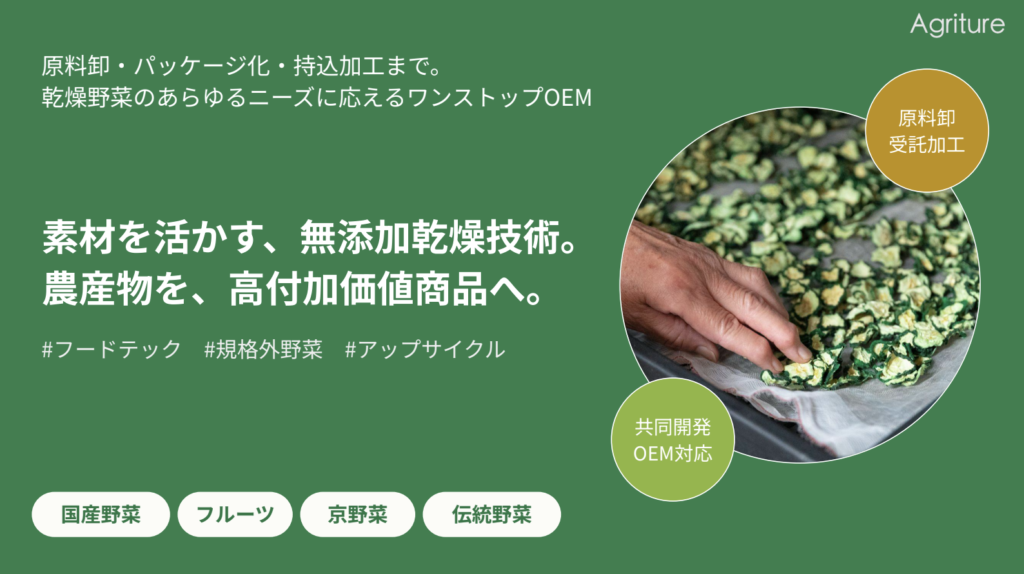
- OEM available from small lots of 10 kg
- Drying of brought-in raw materials also possible
- Support from processing to filling in one place
FOR BUSINESS
乾燥トマトを、原料としてお探しですか
国産のトマトを乾燥・粉砕してお出ししています。カット形状や粒度の指定、継続してのお取引もご相談ください。規格は Dried tomato・Tomato Powder に掲載しています。
少量でのご購入は、姉妹ブランドの通販サイト OYAOYA で承っています。
FAQ
What's the difference between domestic and imported dried tomatoes?
The biggest differences are traceability all the way to the grower and growing region, and a higher additive-free rate. Domestic runs 2,000–3,500 yen per 500 g, about 1.5× the price of imported, but because the growing region—Kyoto, Hokkaido, Okinawa, Kochi and so on—is labeled, many products can be used with confidence for home use or gifts. Imported products can be bought from 1,200 yen per 500 g and suit commercial use.
Where should I look to tell if a domestic dried tomato is additive-free?
Check the ingredient column on the back of the bag. If it says "tomato only," it's a fully additive-free type; "tomato, salt" means only salt is used; and if it continues "tomato, olive oil, salt, herbs," it's an oil-packed type. Checking for the Organic JAS mark as well lets you verify the growing method too.
Where's a good place to buy domestic dried tomatoes in small amounts as an individual?
Agriture's sister brand OYAOYA is recommended. It uses Kyoto-grown ripe Momotaro-type large-fruit tomatoes finished with low-temperature drying, in a range of volumes—20 g, 80 g, 200 g, 500 g—suited to both trial purchases and bulk buying. Since there's a system for free shipping above a set amount, it's an easy-to-use D2C shop even for a first purchase.
Are domestic dried tomatoes more expensive than imported ones?
Per 500 g, domestic is a guideline of 2,000–3,500 yen and imported 1,200–2,500 yen, so domestic runs about 1.3–1.5× the price of imported. Organic JAS certified products cost a further 20–30% more. The reason for the price gap lies in the cost of contract farming with domestic growers and the rigor of traceability management.
What are the storage period and method for domestic dried tomatoes?
A guideline is 6 months at room temperature for fully additive-free types and 6–12 months at room temperature for oil-packed types. Store in a cool, dark place away from heat and humidity, and after opening, transfer to a zipper bag or airtight container and use up promptly. Detailed home storage techniques are compiled in our sister article, How to store dried tomatoes.
Summary: If you're choosing domestic dried tomatoes
When choosing domestic dried tomatoes, simply keeping in mind four checkpoints—(1) domestic or imported, (2) additive-free (whether salt, sugar, or preservatives are present), (3) whether there is certification such as Organic JAS, and (4) processing style—greatly changes your satisfaction after buying. Always check the ingredient label on the back of the bag, and sorting between the fully additive-free "tomato only" type and seasoned types containing salt or olive oil lets you avoid a mismatch with your use.
If you want to try domestic dried tomatoes as an individual, OYAOYA's domestic dried tomatoes—an additive-free finish of ripe Kyoto-grown large-fruit tomatoes—is a good place to start. For those who want to source commercially in bulk or develop OEM or PB products, please get in touch via Agriture's dried tomato product page. Both are part of the same series, born from the same production line and delivering ingredients from partner farms within Kyoto Prefecture.
Download the OEM contract processing materials
We will send the materials to your email address based on the information you provide.
If you are considering product development with off-spec or your own farm's vegetables:From planning to processing, materials, package printing and novelties, you can consult us through a single point of contact. → Learn more about one-stop product development
- Learning the secrets to success and market strategy from overseas-expansion cases of dried goods
- Drip Pack Gift OEM: A Guide to 5 Filter Types and Specifications by Use
Author of this article
Related articles
-
 Adding Vegetables to Your Morning with Dried Vegetables: A Guide to Getting Dietary Fiber Easily
 -
 Predicting the Dried Vegetable Market in 2030! An Explanation of Growth Fields and the Latest Trends
 -
 Food OEM Market Trends 2026: A Growth Strategy Seen Through Small-Lot and Domestic-Ingredient Needs
 -
 How to proceed with hometown-tax product development | OEM techniques that make the most of local ingredients
 -
 Creating a regional brand with a Kyoto-vegetable OEM | The complete flow from planning to sales
 -
 Kyoto ingredient processing OEM | How to make the most of Kyoto vegetables and quality control
 -
 How to source commercial vegetable powder in small lots, and how to use it
 -
 Heirloom vegetable OEM | A commercialization case guide using Kyoto vegetables and local ingredients