
How to start coffee OEM at small lots | 3 formats and 7 ordering points

Summary of this article
A guide to starting coffee OEM in small lots, explained across three formats (beans, drip bags, RTD). It covers flavor determined by roast level and origin, differentiation with specialty coffee (SCA score of 80+, single origin, processing methods), 7 points for small-lot ordering, drip-bag-specific design (bean weight, bag material, filter, grind), 5 common failure patterns, appropriate specs by sales channel, a formula for back-calculating retail price, and 6 leading companies—a practical guide so even first-timers won’t stumble on coffee OEM.
Small-lot coffee OEM ordering is a way to bring your own-brand coffee to market with limited risk. For each of the three formats—beans, drip bags, and RTD (PET bottle / can)—the minimum lot, unit price, and equipment differ. With a small-lot-capable maker, you can 50–500 units prototype and produce from that range, keeping initial investment low and starting with test sales.
In this article, we organize small-lot coffee OEM across three formats and roast-level design, 7 points for small-lot ordering, failure cases, price ranges, and leading OEM companies—covering everything from consultation to delivery, for those making their first original coffee.
What you'll learn in this article
- The 3 formats of small-lot coffee OEM (beans / drip bags / RTD)
- Differentiating with a roast-level × origin chart
- 7 things to confirm when ordering small lots
- Drip-bag-specific design elements
- 5 common failure patterns and how to handle them
- Sales channel × retail-price back-calculation formula
弊社(Agriture)での対応範囲について
弊社は焙煎の設備も、コーヒー豆を挽く設備も持っていません。生豆の焙煎や粉砕のご依頼はお受けできません。お受けしているのは、挽いた粉の状態でお送りいただいた原料の小袋充填・ドリップバッグ充填と、野菜・ハーブを使ったブレンドの設計です。

We have materials available to help you understand dried processing OEM
Agriture OEM, flexibly handling everything from small lots to large lots
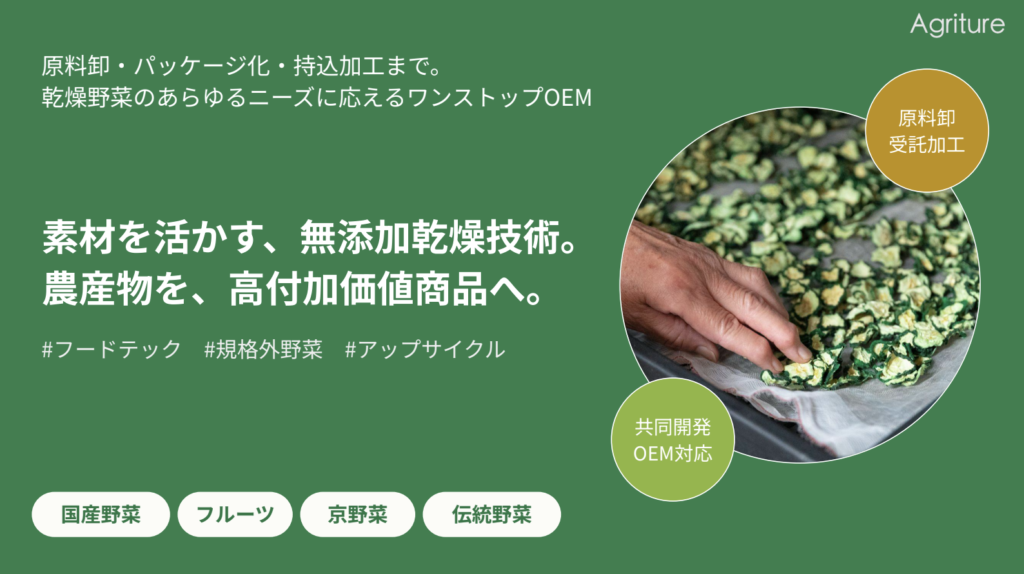
- OEM available from small lots of 10 kg
- Drying of brought-in raw materials also possible
- Support from processing to filling in one place
TOC
The 3 formats of small-lot coffee
Small-lot coffee OEM has three main formats. The minimum lot, unit price, and sales channels change greatly by format,so deciding which format to compete in first is the starting point of the design.
| Form | Minimum lot | Unit-price range | Main sales channels |
|---|---|---|---|
| Beans / ground | 50–500 bags | 800–3,000 yen / bag | In-house roasteries, EC, gifts |
| Drip bags | 100–1,000 units | 80–300 yen / unit | Hotel rooms, novelties, gifts |
| RTD (can / PET) | 5,000–10,000 units | 100–250 yen / unit | Vending machines, convenience stores, offices |
焙煎そのものを委託する先をお探しの場合は、上表の自家焙煎メーカーにご相談ください。
For small lots, the lower limit changes by an order of magnitude depending on the format,so choose based on your brand’s funding and sales plan. Beans / ground is the easiest format to start in small lots and makes it easy to convey a commitment to roasting, but you need to get used to handling the grind and the best-before period (about two weeks after opening). Drip bags has stable demand for gifts and corporate novelties, and because the shop side doesn’t need to hold the technology or equipment, it’s also used as a hotel amenity. RTD requires large capital investment, making it a difficult field to enter in small lots.
Flavor determined by roast level and origin
Coffee flavor is largely determined by the combination of roast level and origin. Think of the roast level as handling the “flavor structure” and the origin the “flavor character.” Even with the same Ethiopian beans, a light roast is fruity and bright while a dark roast brings bitterness to the fore and turns smoky—the roast level greatly changes the impression.
When designing an original coffee, first decide the roast level, then match the origin to it is the standard approach. Anticipate what flavor your target customers want, and work backward from there to choose the roast level and origin.
| Roast level | Representative origins | Flavor character | Suited sales channel |
|---|---|---|---|
| Light roast | Ethiopia, Kenya, Colombia | Fruity, tart, bright | Specialty shops, EC |
| Medium roast | Colombia, Guatemala, Brazil | Balanced, with moderate bitterness and sweetness | General EC, gifts, hotels |
| Medium-dark roast | Brazil, Peru, Tanzania | Rich body, sweetness, nutty notes | Cafés, coffee shops, corporate |
| Dark roast | Indonesia, Brazil, Vietnam | Bitter, full-bodied, smoky | For iced coffee, blend base |
In light roasts, “tartness and aroma” take the lead
A light roast is characterized by fruity tartness and a bright aroma,sometimes likened to wine. Ethiopian Yirgacheffe and Kenyan Arabica pair well with light roasting, expressing flavors like berries, citrus, and flowers. Light roasts are favored at specialty-coffee shops and craft-focused EC, and single origin × light roast is the basic formula for differentiation.
Medium roast is the crowd-pleasing standard
A medium roast has a good balance of tartness, bitterness, and sweetness,a roast level that a wide range of people—from coffee beginners to veterans—can enjoy. Central-to-South-American beans like Colombia, Guatemala, and Brazil pair well with medium roasting, and it’s the mainstream roast level for gifts and hotel-room drip bags. Because taste preferences are less likely to split, for channels that reach an unspecified broad audience,choosing medium roast first is the safe bet.
Dark roast is the standard for café commercial use
A dark roast brings bitterness, richness, and smokiness to the fore. It pairs superbly with milk and is prized for commercial use as a base for café lattes and cappuccinos or for iced coffee. Indonesian Mandheling and Brazilian Santos are representative, and for café, coffee-shop, and corporate commercial use,dark-roast blends often become the flagship product.
If you’re aiming to differentiate in small lots, light roast × single origin is the most open position. Major brands center on medium-dark blends, and distinctive light-roast brands are mostly run by individuals and small roasters, so even a new entrant can compete. In particular, single-estate lots from Colombia, Ethiopia, Costa Rica, and the like are a field where it’s easy to command a high price through story and traceability.
FOR BUSINESS
乾燥野菜のOEM・受託加工を承ります
国産の野菜・果物の乾燥、100メッシュ相当までの粉砕、10g以上の小袋充填までをお受けしています。小ロットの試作から量産までご相談ください。寄せられた相談の実例は OEM・卸のご相談 に掲載しています。
乾燥品の賞味期限は、出荷日から6ヶ月程度を目安にご案内しています。
Differentiating with specialty coffee
Specialty coffee refers to high-quality beans that have earned a cupping score of 80 or more on the SCA (Specialty Coffee Association) scale. Traceability is secured across every step from production to roasting, and they’re handled as single origin—single estate, single variety, single harvest. They pair extremely well with small-lot OEM and are a shortcut for a new brand to enter the high-price zone..
| Features | Specialty coffee | Commodity coffee |
|---|---|---|
| Quality standard | SCA 80+ | Commercial grade |
| Traceability | Specified down to estate, variety, and processing method | Origin country only |
| Harvest and processing | Hand-picked, washed / natural / honey | Machine-picked, batch-processed |
| Unit price (green beans) | 1,500–5,000 yen / kg | 300–800 yen / kg |
| Sales channel | Specialty shops, EC, subscription | Mass retail, commercial use |
3 reasons to choose specialty
① Clear differentiation angle: You can speak to the estate name, variety, altitude, and processing method, making it a field where it’s easy to build a brand story.② You can justify a high price: Having a third-party benchmark in the SCA score makes it easier to explain “why this price.”③ Small-lot sourcing is possible: Single-estate, single-harvest lots circulate in units of a few tons, so even a new brand can create character with a small purchase.
Major processing methods
| Processing method | Features | Representative origins |
|---|---|---|
| Washed | Clean tartness, clear flavor | Ethiopia, Kenya, Colombia |
| Natural (sun-dried) | Fruity, with a wine-like finish | Ethiopia, Brazil |
| Honey (semi-washed) | Balance of sweetness and body | Costa Rica, Nicaragua |
| Anaerobic | Strong aroma, distinctive tartness | Parts of Colombia and Ethiopia |
Simply writing the processing method on the package or product description conveys an “in-the-know” feel that resonates with specialty-tier customers. Anaerobic and honey types in particular are still new to the Japanese market, making them options where scarcity is easy to turn into a story.
7 points for small-lot ordering
When ordering coffee OEM in small lots, confirming 7 points in advance reduces the back-and-forth on prototypes. Roasting, grind, and packaging in particular are hard to change later.
| Point | Things to confirm |
|---|---|
| Specifying the roast level | Clearly state light / medium / medium-dark / dark roast |
| Grind | Whole bean / medium-coarse / medium / fine |
| Bag form and material | With valve / oxygen absorber / aluminum lamination |
| Best-before date | 3–6 months after roasting; 12 months or more for drip bags |
| MOQ | Alignment with the inventory volume the shop can sell |
| Lead time | Prototype 1–2 months / production 1–2 months |
| Tasting and samples | Compare 2–3 different roast profiles |
Before ordering, aligning the “roast-level terms” with the maker at the consultation stage is the single most important thing. “Medium roast” has different color standards (Agtron value) at each supplier, so confirm with an actual roasted sample before settling the production spec. Proceeding while the desired flavor direction remains vague leads to “this isn’t the flavor we wanted” after production.
Drip-bag-specific design
For drip bags, four elements—bean weight, bag material, filter structure, and grind—determine the flavor. Even with the same beans, the grind for drip bags is designed separately from bean/ground sales, so a dedicated discussion is needed.
| Element | Design approach |
|---|---|
| Bean weight | 8–12 g (single-cup); 7–10 g for hotels |
| Bag material | Aluminum lamination + oxygen absorber to retain aroma |
| Filter | Immersion / percolation / hybrid |
| Grind | Medium-fine grind dedicated to drip bags |
For bean weight, 10 g is standard,an amount that brews one cup with 150–200 ml of hot water. For gift use, “10 bags per box” is mainstream, and the common design keeps the per-bag cost at 200–300 yen while raising the unit price with box design. For hotel rooms, unit price takes priority, so some cases keep it to 7–8 g and aim for a cost under 100 yen.
5 common failure patterns
Here are the failures that tend to occur in small-lot coffee OEM, along with how to handle them. All are problems preventable through prior discussion..
| Failure | Symptom | Remedy |
|---|---|---|
| Roast unevenness | Color and flavor differ between lots | Specify Agtron value / approve samples |
| Grind too fine | Grounds too fine, causing clogging | Specify grind by number (mesh) |
| Aroma loss | Weak aroma when opened | Oxygen absorber + valve-equipped packaging |
| Short best-before date | Degradation from store inventory | Order planning back-calculated from the roast date |
| Package mismatch | Doesn’t stand out on the shelf / weak gift feel | Design separate specs by sales channel |
In particular, Roast unevenness often surfaces at the production stage and is hard to notice with a single prototype. For production, specify the roast level by number, such as “Agtron value ◯–◯,”specify the roast level by number,and set up a flow that pre-approves samples for each lot. Confirming the maker’s technical capability and consultation setup can greatly reduce roast unevenness.
We have materials available to help you understand dried processing OEM
Agriture OEM, flexibly handling everything from small lots to large lots
- OEM available from small lots of 10 kg
- Drying of brought-in raw materials also possible
- Support from processing to filling in one place
Appropriate specs by coffee sales channel
For small-lot coffee products, the appropriate specs change by sales channel. Even with the same 100-unit lot, EC and hotel rooms call for completely different designs in unit price and packaging.
| Sales channel | Recommended form | Unit-price range | Packaging |
|---|---|---|---|
| EC direct sales | Beans / ground / drip bags | 1,500–3,500 yen / bag | Mail-delivery compatible, lightweight |
| Hotels / inns | Drip bags | 50–100 yen / unit | Individually wrapped, logo-printed |
| Novelties | Set of 1–3 drip bags | 100–300 yen / set | Simple bag, noshi-compatible |
| Gift | Boxed drip bags | 1,500–5,000 yen / box | Decorative box with carry handle |
| Cafés / coffee shops | Beans / ground (per 1 kg) | 3,000 to 8,000 yen/kg | Commercial aluminum bag |
Coffee retail-price back-calculation formula
Reverse-calculating the upper limit of the OEM cost from the retail price reveals The allocation of bean grade, roasting cost, and packaging is determined. Here are calculation examples organized by gross-margin ratio.
| Gross-margin rate | Retail 1,500 yen | Retail 3,000 yen | Retail 5,000 yen |
|---|---|---|---|
| 30% (retail/volume) | OEM cost ≤ 1,050 yen | ≤ 2,100 yen | ≤ 3,500 yen |
| 40% (standard) | ≤ 900 yen | ≤ 1,800 yen | ≤ 3,000 yen |
| 50%(D2C) | ≤ 750 yen | ≤ 1,500 yen | ≤ 2,500 yen |
| 60% (premium) | ≤ 600 yen | ≤ 1,200 yen | ≤ 2,000 yen |
For bean and ground-coffee sales, 60% of the cost is green beans and roasting, with 30% for packaging and equipment operation and 10% for testing and handling fees—this is the typical breakdown. With small-lot orders the cost ratio can rise to 70–80%, so if you want a 50% gross margin you need to design your retail price around brand value, packaging, and story.
Leading coffee-OEM companies
As places to discuss small-lot coffee OEM, Food OEM Directory here are companies among our listings with a strong reputation for technical skill, store track record, and flexibility in prototyping.
| Company name | Area of strength |
|---|---|
| Hakata Coffee Kobo | In-house roasting, over 25 years of drip bags, Fukuoka |
| Base Coffee Inc. | Specialty-coffee specialist, Aichi |
| Freshness Inc. | 50 years of coffee expertise, drip-bag OEM, Tokyo |
| KUNZUDO | Craft coffee OEM, ingredients × coffee |
| shimaji coffee | In-house roasting, liquid, latte base, Hiroshima |
| Agriture Inc. | 野菜・ハーブのブレンド設計と小袋充填(焙煎・粉砕は非対応) |
All coffee and tea OEM companies are the Food OEM Portal "Coffee & Tea" list here. Clarify your desired roast level, format, and lot size, then request quotes from about three companies to compare—that's the practical approach.
FOR BUSINESS
乾燥野菜のOEM・受託加工を承ります
国産の野菜・果物の乾燥、100メッシュ相当までの粉砕、10g以上の小袋充填までをお受けしています。小ロットの試作から量産までご相談ください。寄せられた相談の実例は OEM・卸のご相談 に掲載しています。
乾燥品の賞味期限は、出荷日から6ヶ月程度を目安にご案内しています。
Small-lot coffee summary
To start coffee OEM in small lots, choose the format → roast level and origin → grind size and bag format → tasting → mass production—build it up in that order. Light roast × single origin in particular is an open position, so it's an easy area for a distinctive brand to differentiate.
Before ordering, a 7-point check and—specifying numeric values for Agtron score and grind mesh—will go a long way toward avoiding the "this isn't the taste I expected" problem after production. Working backward from your in-store inventory volume and target retail price to set cost, lot size, and lead time is the basis of small-lot ordering.
Download the OEM contract processing materials
We will send the materials to your email address based on the information you provide.
Recommended reading
If you are considering product development with off-spec or your own farm's vegetables:From planning to processing, materials, package printing and novelties, you can consult us through a single point of contact. → Learn more about one-stop product development
- How to choose a coffee OEM vendor | 5 vendor categories and a quote check
- How to Make Dried Tomatoes: Drying Tips, and How Cherry and Large Tomatoes Turn Out Differently
Author of this article
Related articles
-
 Original coffee marketing strategy | Ways to grow sales
 -
 ベジタリアンとは?国の規格が分けている4つの区分と食べられないもの
 -
 長ねぎと白ねぎは同じもの?ねぎの種類と呼び名を国の資料で確かめる
 -
 柚子の種類は何種類あるのか、公の資料で名前が残る系統を数えた
 -
 ゆずの時期は年に二度、青ゆずは7月から黄ゆずは10月から
 -
 ゆずの産地は高知が半分を占め、二位は徳島から愛媛に変わった
 -
 Preventing Food OEM Failures: Common Failure Cases and Countermeasures for Success
 -
 How to find a food OEM | How to efficiently find the best manufacturing partner