Dried island chili pepper

Dried island chili is a commercial material that turns "shima togarashi," the fiercely hot chili representative of Okinawa's island vegetables, into raw material in whole form. A small fruit of the bird's-eye chili lineage, it is characterized by strong heat said to surpass takanotsume and Tabasco. At Agriture, we develop it in parallel with island chili powder (made to order) that powders the same island chili, proposing whole dried island chili for uses in appearance, stewing, and steeping, and the powder for even heat blending into sauces and seasonings.
Compared with other chilies such as purple chili, Fushimi chili, and Manganji chili, island chili can differentiate on its "strong heat said to surpass takanotsume and Tabasco," the "Okinawan food culture represented by koregusu (awamori steeping)," and the "look of a small whole fruit." It is a material for which we receive many prototyping inquiries as a raw material for koregusu, chili oil, spicy seasonings, super-spicy snacks, hot sauce, and Okinawa-soba condiments.
TOC
Three Commitments Behind Agriture's Dried Island Chili
1. Low-temperature drying that makes the most of heat and red color
Island chili's individuality is its strong heat and the vivid red of the ripe fruit. At Agriture, we hold down the drying temperature and design the process to remove moisture in a short time, keeping the heat and red color in the finish as much as possible. It becomes a factor that governs the quality of final products that make the most of both heat and color, such as koregusu and chili oil.
2. Whole form
Island chili is dried whole as a small fruit. Whole, it can be used as-is for steeping in awamori or soy sauce (koregusu), chili oil and spicy oil that heat it in oil to transfer the heat, and whole addition to stews. It can also be developed for crushing and powdering, so you can select the shape to suit the use of your final product.
3. Choosing Okinawa-grown island chili for the raw material
At Agriture, we use Okinawa-grown island chili, assessing depth of red color, buildup of heat, and uniformity of the fruit to turn it into raw material. Material with visible origin makes traceability easy to design, and is one reason it is chosen in prototyping by seasoning and snack makers.
Product catalog showing the items we handle
Flexible support from small lots to large lots
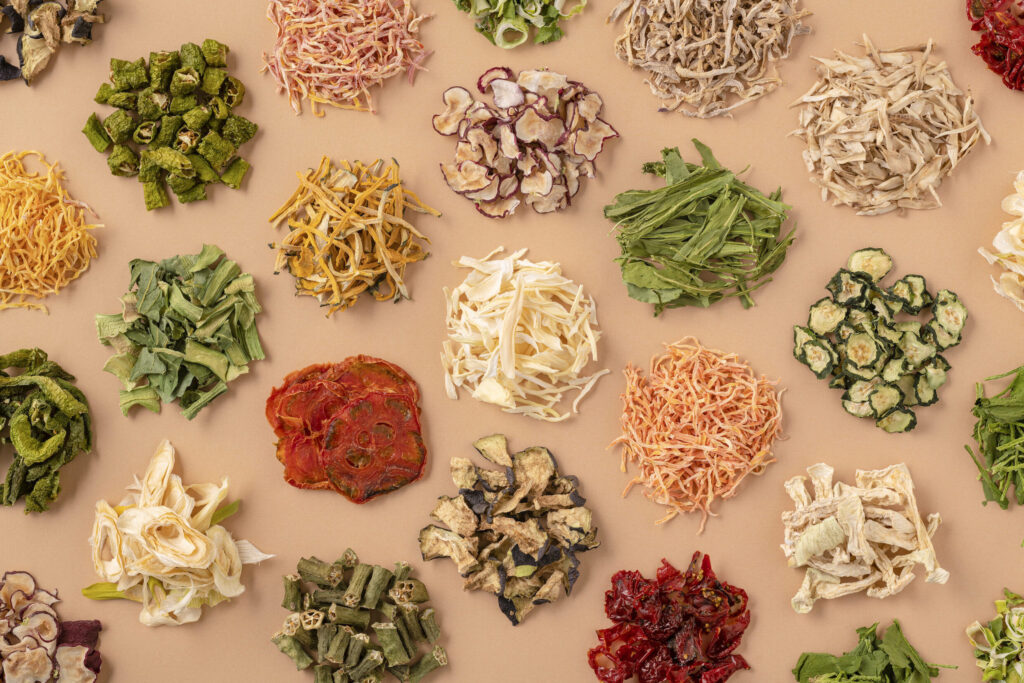
- Sold in small lots from 1 kg
- Handling heirloom vegetables from across Japan
- Dried fruits and herbs also supported
Features of Commercial Dried Island Chili
Even among chili-type dried materials, island chili is a material with a unique position for the strength of its heat, its small look, and its presence in Okinawan food culture. We organize its strengths—envisioning whole form—from six perspectives.
Heat said to surpass takanotsume
Island chili is of the bird's-eye chili lineage, high in the heat component capsaicin, characterized by strong heat said to surpass takanotsume and Tabasco. Because it can produce strong heat in small amounts, it suits product designs that make heat the selling point.
The look of a small whole fruit
You can use small fruits of about 2–3 cm whole. In awamori-steeped koregusu or spicy oil, the look instantly recognizable as island chili becomes the product's individuality.
Suitability for koregusu
Dried island chili can be used as the main raw material for koregusu, steeped in awamori or soy sauce. It suits products that promote Okinawan food culture, such as steeping seasonings, spicy sauces, and hot sauces.
Low-temperature drying that keeps the red color
Island chili, whose red color dulls easily with high-temperature drying, is slowly dried in a low-temperature range to keep the color. In spicy oil, chili oil, and steeping seasonings, the vivid red stands out.
Effective in small amounts = cost efficiency
Because of its strong heat, sufficient heat can be produced with a small blend. It is a material that can raise the design efficiency of heat in spicy seasonings, snacks, and processed foods.
Use in combination with powder
Using it together with powdered island chili powder (made to order) lets you design recipes that combine the look (whole) with even heat dispersion into sauces and seasonings (powder).
Product specifications (commercial)
Basic specifications at the prototype stage are as follows. Purchase lot, lead time, and packaging format are worked out through individual consultation.
| Item | Details |
|---|---|
| Product name | Dried island chili pepper |
| Raw material | Shima togarashi (Okinawa-grown) |
| Shape | Whole. Crushing and powder processing also handled |
| Appearance | Small fruits of about 2–3 cm, vivid red color |
| Aroma | A stimulating, hot aroma characteristic of chili |
| Net content | Individual quote according to use and lot |
| Best-before date | About 6 months from the shipping date |
| Storage method | Avoid high temperature, high humidity, and direct sunlight; after opening, seal and store in a cool, dark place |
| Minimum prototype lot | From 1 kg of raw material (small lots in 100 g units can also be discussed) |
Customization support
You can consult us from the prototyping stage on shape, blending, packaging, and through to finished product. Because we refine the recipe while keeping records, quality stays consistent between prototype and mass production.
| Item | Available | Details |
|---|---|---|
| Shape adjustment | Whole / crushed / powder | Steeping and stewing use whole, condiments use crushed, seasonings use powder |
| Powdering | Fine powder (made to order) | For powder blending into spicy seasonings, sauces, and snacks |
| Blend design | Blended with other chilies and spices | Design the overall heat level of the final product by blending with other chilies |
| Packaging form | Commercial bulk / small bag / individual wrapping | Handled from bulk for seasoning raw material to packs for snacks |
| OEM productization | End-to-end support through the finished product | From planning to production of koregusu, chili oil, spicy seasonings, and super-spicy snacks |
For those considering the fine-powder type
For uses where you want to spread island chili's heat evenly, such as blending into spicy seasonings, sauces, and snacks, the powdered island chili powder (made to order) is well suited. For details, please see the island chili powder page.
Commitments to variety, grower, and growing region
Island chili is a chili of the bird's-eye chili lineage (scientific name Capsicum frutescens), family Solanaceae, an edible plant representative of Okinawa's island vegetables. At Agriture, we make origin, harvest season, and buildup of heat the axis of our raw-material design.
BRAND | The positioning of island chili raw material
Island chili is the fiercely hot chili that has supported Okinawan food culture—koregusu, chili oil, spicy sauces, Okinawa-soba condiments, and more. At Agriture, we translate this strong heat and food culture into a commercial raw material, providing it as an ingredient usable in a wide range of final products from seasonings and snacks to processed foods.
PRODUCER | Basic policy for sourcing and coordination
We select lots with consistent depth of red, buildup of heat, and uniformity of the fruit, coordinating directly with the growing region. At the prototyping stage, we obtain small quantities from multiple suppliers, evaluate them for red-color retention and heat stability after drying, and then build the supply line for mass-production lots.
REGION | Characteristics of the main growing region
Island chili is an island vegetable grown mainly in Okinawa, and its strong heat builds up under a mild climate. Beginning with koregusu steeped in awamori, it is a raw material for seasonings essential to Okinawan homes and eateries. At Agriture, we assess Okinawa-grown ones for the red color and heat suited to drying and turn them into raw material.
CULTIVATION | Harvest season and heat
Island chili is harvested most in summer through autumn, and there are ones harvested while still green and ones that have ripened red. The redder, riper fruit tends to have more heat and color. At Agriture, we mainly select ripe fruit with built-up heat and red color and turn them into raw material.
Low-temperature drying technology and quality control
Prompt drying after sorting and cap treatment
Because island chili is a small fruit, we sort by color development and damage and treat the caps as needed before drying. By moving promptly to drying before post-harvest deterioration progresses, we finish it under conditions that achieve both red color and heat.
Retention of heat and red color through low-temperature drying
High-temperature drying dulls the red color and can produce a scorched smell. By removing moisture slowly in a low-temperature range, we achieve a finish where a vivid red and the strong heat characteristic of island chili remain. When using it for koregusu, steeping it whole in awamori or soy sauce lets the heat and color dissolve out slowly. For chili oil and spicy oil, heating the whole fruit slowly in low-temperature oil transfers the heat and aroma without scorching.
Use cases
We organize into six categories the uses for which we receive prototyping inquiries at Agriture. Each is an example of recipe design that makes the most of island chili's strong heat, red color, and whole form.
1. Koregusu and steeping seasonings
It can be used as the main raw material for koregusu, steeped in awamori or soy sauce. Steeping it whole lets the heat and red color dissolve out slowly, and it can be developed into seasonings, spicy sauces, and hot sauces that promote Okinawan food culture.
2. Chili oil and spicy oil
It can be used as a heat raw material for chili oil, spicy oil, and edible seasonings. Heating the whole fruit slowly in low-temperature oil transfers the heat and aroma without scorching. It suits products that want to achieve both heat and aroma, such as mala oil and homemade chili oil.
3. Spicy seasonings and spice blends
Processed into crushed or powder, it can be used in spicy seasonings such as shichimi, ichimi, and mala mix. Because it can produce strong heat in small amounts, it suits designs for spice blends built around heat. Blended with other chilies, you can design the overall heat level.
4. Super-spicy snacks and processed foods
It can be used as a raw material for processed foods that make heat the selling point, such as super-spicy snacks, senbei, and delicacies. You can make the most of both the strength of the heat and the look in product design, such as dusting it on in powder or crushed form and using whole for a visual impact.
5. Retort, frozen foods, and prepared dishes
It can be built in as a heat-adding raw material for retort curry, mala-type frozen prepared foods, soups, and the like. It can be secured stably as room-temperature stock, and using whole, crushed, and powder differently lets you adjust how the heat comes out and the look.
6. Okinawan cuisine and local food
It can be used as a raw material for Okinawan cuisine and local food, such as a condiment for Okinawa soba and heat-adding for champuru. Together with koregusu, it can be developed as a material for product lines themed on Okinawan food culture.
How to Use It Commercially
Basics of use
- Koregusu: steep it whole in awamori or soy sauce. Heat and color come out in a few days to a few weeks
- Chili oil and spicy oil: heat the whole fruit slowly in low-temperature oil, transferring heat and aroma without scorching
- Condiment and seasoning: crush it, or make it into powder, and dust it on dishes and processed foods
- Stewing: add it whole to stews, checking the heat and removing it partway
Blending guide
- Koregusu: steep about 3–5 dried island chilies per 100 ml of awamori as a guide
- Chili oil: extract 3–6 dried ones per 100 ml of oil at low temperature as a guide
- Spicy seasoning: adjust the overall heat level by blending with other chilies
- Because strong heat comes out in small amounts, first prototype on the low side and adjust while checking the heat
How to store
- Before opening: store in a cool, dark place at room temperature, away from heat, humidity, and direct sunlight
- After opening: transfer to a zip bag or airtight container and use up within 1 to 2 months
- The best-before date is about 6 months from the shipping date. Note that light and moisture absorption change the red color
- When handling, take care not to touch your hands or eyes, and wash your hands well after working
Related cases and articles
- Dried Manganji Chili – a non-spicy Kyoto-vegetable chili
- Dried Purple Chili – a chili for color
- Dried Shima Rakkyo – an Okinawan island vegetable
- List of dried vegetable raw materials
- Consult us on food OEM and raw material supply
Product catalog showing the items we handle
Flexible support from small lots to large lots
- Sold in small lots from 1 kg
- Handling heirloom vegetables from across Japan
- Dried fruits and herbs also supported
Frequently asked questions
How hot is it?
Island chili is of the bird's-eye chili lineage, characterized by strong heat said to surpass ordinary takanotsume and Tabasco. Because sufficient heat comes out in small amounts, it suits product designs that make heat the selling point. How hot to make the final product can be designed by the blend amount and by blending with other chilies.
Can it be used as a raw material for koregusu?
This is one of the uses we are asked about most. Steep whole dried island chili in awamori or soy sauce, and the heat and red color dissolve out slowly, making koregusu. It can be used as a core raw material for products that promote Okinawan food culture, such as steeping seasonings, spicy sauces, and hot sauces.
Can I use it whole? Or should I crush it?
Use it differently by application. Steeping (koregusu), chili oil, and stewing use it whole, while condiments and spicy seasonings suit crushed or powder. Whole has a visual impact, and crushed and powder make it easier to spread the heat evenly—that is the difference. The shape can be discussed at the prototyping stage.
How does it differ from island chili powder?
Dried island chili (whole) suits uses that make the most of steeping, stewing, and appearance, while the powder suits even heat blending into sauces, seasonings, and snacks. Koregusu and chili oil call for whole; spicy seasonings and dusting call for the powder. Using both together lets you design recipes that combine appearance with even heat.
What is the minimum prototype lot?
Prototyping is accepted from 1 kg of raw material, and because it is a strongly hot material, small lots in 100 g units can also be discussed. You can run multiple conditions in parallel, such as comparing whole, crushed, and powder shapes, or comparing blends with other chilies. Full production is from 10 kg, and we can support you through OEM finished-product development.
Please tell me the best-before date and how to store it.
The best-before period is roughly six months from the shipping date. While unopened, avoid heat, humidity, and direct sunlight, and store in a cool, dark place at room temperature. Because island chili fades in red easily under light and moisture absorption, we recommend transferring to a zip bag or light-blocking container after opening and using it up within one to two months. When handling, please take care not to touch your hands or eyes.
Recommended reading
- Dried Manganji Chili – a non-spicy Kyoto vegetable
- Dried Purple Chili – a chili for color
- Dried Shima Rakkyo – an Okinawan island vegetable
- List of dried vegetables
- List of powders
Download the product catalog
We will send the materials to your email address based on the information you provide.