Dried Shima Rakkyo


Dried Shima Rakkyo: product overview
Dried shima rakkyo made from shima rakkyo, an Okinawa traditional and island vegetable, concentrating its characteristic pungency and crispness. Low-temperature drying firmly preserves its distinctive aroma and pungency, and when rehydrated, a texture close to fresh can be enjoyed. Storable long-term, it is a convenient ingredient that handles a wide range of commercial cooking, from condiments and dressed dishes to stir-fries.
It is also prized as a condiment or nibble for Okinawan cuisine and as an accent in processed foods.
Dried shima rakkyo: three points of care
01 Using shima rakkyo, an Okinawa traditional vegetable
We use "shima rakkyo," a traditional vegetable grown in Okinawa, as the raw material. Compared with ordinary rakkyo, it is smaller, more strongly aromatic, and characterized by a distinctive sharp pungency. We source it from partner farmers in Okinawa.
02 Low-temperature drying preserves the crispness
Through a drying method that draws out moisture slowly at low temperature, a crisp bite returns even after rehydration. Designed as a commercial raw material that stores long-term while retaining the aroma components easily lost in high-heat drying.
03 Sugar- and additive-free
No sugars or additives whatsoever. The raw material is only Okinawa-grown shima rakkyo, suiting product development that wants to put Okinawa's food culture and traditional vegetables front and center as the ingredient.
Product catalog showing the items we handle
Flexible support from small lots to large lots
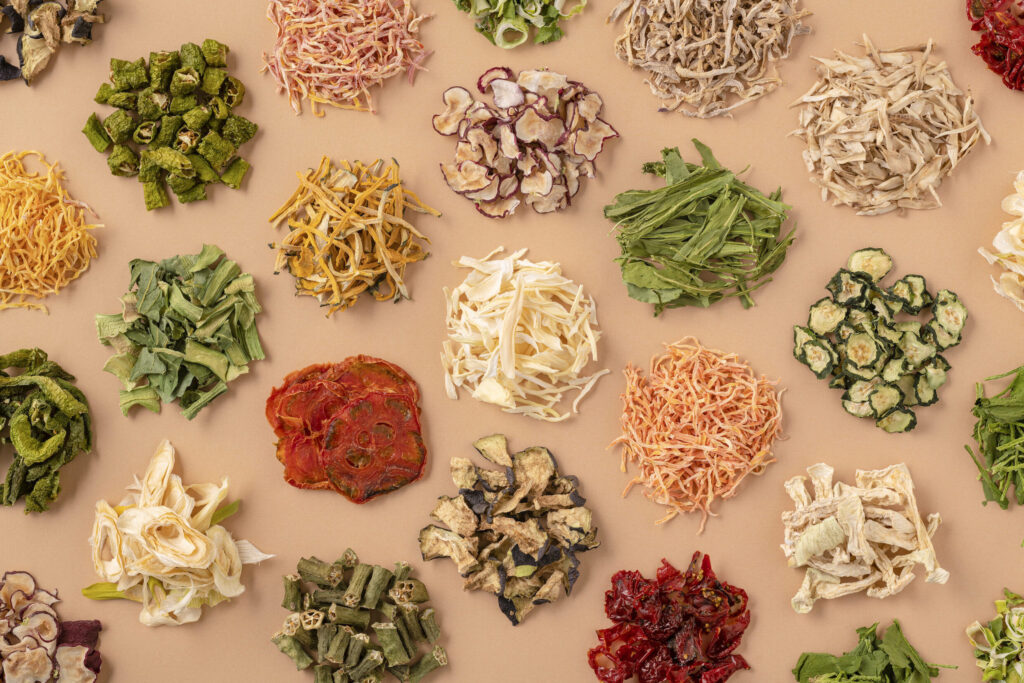
- Sold in small lots from 1 kg
- Handling heirloom vegetables from across Japan
- Dried fruits and herbs also supported
TOC
Features of commercial dried shima rakkyo
An Okinawa-grown traditional vegetable
Uses Okinawa-grown shima rakkyo, known as an island vegetable. Sourced from partner farmers, it secures traceability from cultivation to processing.
Slice specification
The slice shape is designed to be usable as-is as an ingredient for dressed dishes, pickles, stir-fries, and sauces. Rehydration time is short too, making it an easy shape to build into volume-production lines.
Crispness that returns on rehydration
The texture after rehydration is close to fresh shima rakkyo, without spoiling the finished flavor. It can also be used as a garnish for chilled tofu and sashimi, or as a condiment for Okinawan cuisine.
6-month room-temperature storage
Fresh shima rakkyo has low shelf stability and is difficult to handle, but the dried product is set with a 6-month room-temperature best-before date. It is a form that also readily handles shipping from remote islands.
Small-lot 100g support
Available from a minimum of 10 bags in 100g units. We respond flexibly to small-start needs, such as Okinawan restaurants, local prepared-food makers, and craft-sauce brands.
Powder-processing support
Powder processing from the same raw material is also possible. It can be processed into a form easy to apply as a raw material for aromatic pastes, sauce bases, and original seasonings.
Dried shima rakkyo: product specifications
Item | Details |
|---|---|
Raw material growing region | Okinawa (partner farmers) |
Specification | Sliced |
Storage method | Room temperature (store away from high heat and humidity) |
Best-before date | 6 months from the shipping date |
Minimum lot | From 10 bags / 100 g |
Powder | Available |
Manufacturing period | March |
Customization and OEM support
Commercial shiitake powder is here
OEM support: available
Manufacturing in large lots: available (advance consultation required three months before the manufacturing period)
POWDER
A shima rakkyo powder product is also available
Shima rakkyo powder, made by finely milling the same Okinawa-grown shima rakkyo, is also available for OEM. It suits applications where you want to spread flavor and aroma evenly, such as original spicy seasonings, spice mixes, and flavoring prepared dishes.
Commitments to variety, grower, and growing region
BRAND
Cultivar:Uses "shima rakkyo," known as an Okinawa traditional vegetable. Compared with mainland rakkyo, it is smaller with stronger aroma and pungency—a subtropical vegetable with a distinctive character.
PRODUCER
Producer:In partnership with partner farmers within Okinawa, we source from growers where information from cultivation to procurement can be tracked.
REGION
Production area:Okinawa. A leading example of island vegetables nurtured in a subtropical climate and distinctive soil environment, characterized by a character of aroma and pungency unobtainable on the mainland.
CULTIVATION
Cultivation method:Shima rakkyo grown by cultivation suited to Okinawa's climate is harvested in early spring, its natural season. After harvest, it is shipped directly to the processing base while still fresh.
*Reference: OYAOYA product page
Low-temperature drying preserves shima rakkyo's aroma and pungency
Shima rakkyo's appeal—its aroma and pungent components—are volatile, delicate components easily lost in high-heat drying. By using low-temperature drying, Agriture retains these aromatic components as much as possible, giving a finish where a crisp texture and near-fresh flavor return after rehydration.
💡 TIPS | Drying-processing trivia
For aromatic vegetables like shima rakkyo, storing them sealed and separate from other ingredients prevents aroma transfer. Because the dried product's texture changes greatly with the water temperature and time of rehydration, using brief soaking, cold-water rehydration, and the like to match the application makes the finish easier to control.
Use cases for commercial dried shima rakkyo
Okinawan restaurants and izakaya
Usable year-round in standard Okinawan local dishes, such as garnishes for chilled tofu and sashimi, miso-dressed dishes, and bonito-dressed dishes. You can turn shima rakkyo's appeal into a menu while reducing prep loss.
Prepared-food and pickle makers
Usable as an ingredient in prepared-food products such as Okinawan-style pickles, lightly pickled dishes, dressed dishes, and namul. Because it can be used with only rehydration, it is easy to build into volume-production lines and lets you make the most of shima rakkyo's characteristic crisp texture and pungency. Room-temperature storage allowing stable prep regardless of season is also an advantage.
Seasoning and sauce makers
As an ingredient in developing Okinawa-flavored seasonings such as spicy miso, aromatic soy sauce, dressings, and original sauces. Combined with powder processing, you can also design it to spread the flavor more evenly.
Restaurant chains and takeout
As a garnish or flavor-changing item for yakitori, fried foods, chanpuru, and more, it adds a pungent accent. Being able to offer shima rakkyo, which is hard to supply year-round, throughout the year is also a strength.
OEM and regional-brand products
Used as an ingredient for regional-brand products using Okinawa traditional vegetables, local seasonings, and souvenirs. It secures raw-material traceability that lets you clearly state "Okinawa-grown, made with shima rakkyo" on the package.
How to use commercial dried shima rakkyo and related cases
Agriture's dried shima rakkyo can be used in a wide range of ways: after rehydration, straight as an ingredient for condiments, dressed dishes, and pickles; fried in oil into a chips-style snack; or powdered and processed into a base for spice mixes and seasonings. We also receive many inquiries for it as a raw material for local-product and souvenir OEM using Okinawa traditional vegetables.
Related cases
- What Is Shima Rakkyo? Explaining Its Difference from Ordinary Rakkyo, How to Eat It, and Its Nutrition
- A list of heirloom vegetables of the 8 prefectures of Kyushu and Okinawa|A thorough introduction to characteristics, growing regions, and seasons
- Okinawa island vegetables: individualistic vegetables nurtured by a subtropical climate
Product catalog showing the items we handle
Flexible support from small lots to large lots
- Sold in small lots from 1 kg
- Handling heirloom vegetables from across Japan
- Dried fruits and herbs also supported
Commercial Dried Shima Rakkyo: OEM Consultation FAQ
From how large a minimum lot can you accommodate?
Available from a minimum of 10 bags in 100g units. You can consult us from small-quantity prototypes and small-lot development of prepared dishes and seasonings.
Do you publish prices?
Because it varies by origin, lot, specification, and packaging spec, we do not publish it uniformly. If you tell us your desired application and quantity, we will provide a quote.
How long is the lead time?
Shima rakkyo's main production period is March. During periods when stock is available, it can ship in as little as 1 to 2 weeks, but for volume production, please inquire by 3 months before the production period.
Can you issue a certificate of origin for the raw material?
Origin labeling stating it is Okinawa-grown and contracted-grower information can be shared as needed. It can be used as an attachment to spec sheets.
Can you provide pesticide/analysis reports?
The partner farmers' cultivation records and necessary analysis results can be shared case by case. If there are items you need, please let us know in advance.
Are HACCP and export support possible?
Production is under a HACCP-compliant processing system, and we also handle raw-material supply for product planning that assumes overseas export.
Please tell me how to proceed with an OEM consultation
Please let us know your desired use, quantity, and delivery date via the inquiry form. We propose everything from sample provision, specification adjustment, and prototyping to full production in one stop.
RETAIL
For those looking to purchase in small packs
If you want to check the flavor before personal use or prototyping, you can obtain retail packs using the same raw material at our sister brand OYAOYA's online shop.
Recommended reading
- What Is Shima Rakkyo? Explaining Its Difference from Ordinary Rakkyo, How to Eat It, and Its Nutrition (Column)
- A list of heirloom vegetables of the 8 prefectures of Kyushu and Okinawa|A thorough introduction to characteristics, growing regions, and seasons (Column)
- Okinawa island vegetables: individualistic vegetables nurtured by a subtropical climate (Column)
Download the product catalog
We will send the materials to your email address based on the information you provide.