
7 Criteria for Judging a Commercial Dried Fruit Supplier

Summary of this article
We explain, from a practical standpoint, 7 criteria for evaluating commercial dried-fruit suppliers. We organize matching the drying method (low-temperature, hot-air, FD, sugar-preserving, vacuum) to the fruit's sugar content (Brix), the types and shapes of dried fruit (whole, slice, dice, stick, chip), items by genre, the axes for judging domestic vs. overseas, residual pesticides and HACCP, the difference between no-added-sugar and sugar-preserved, and sample handling, price structure, small-lot support, and spec-sheet preparation. We introduce the maker table on the Food OEM Portal, Agriture's lineup of 13 domestic dried-fruit items, dry-pear (Nijisseiki pear), and the real example of One's Daily's leaf-left-on apple sticks.
Commercial dried-fruit suppliers—when choosing one, judging by price alone often leads to regret over "sugar content, additive-free, lot, and lead time." Because the optimal drying method for dried fruit changes greatly with the sugar content (Brix) of the fresh fruit used as the raw material, whether a supplier has processing know-how matched to the fruit's sugar content is a decisive point that governs quality and storage stability.
This article organizes the 7 checkpoints for evaluating commercial dried-fruit suppliers, together with issues specific to dried fruit (drying methods by sugar content, no-added-sugar support, domestic vs. overseas, pet use), based on the production know-how of Agriture's domestic dried-fruit lineup.

TOC
To avoid regret in choosing a supplier
Dried fruit has a strong "you don't know the quality until after you buy" character, and the origin, sugar content, and processing conditions of the fresh fruit greatly affect the finished result. To receive a stable supply for commercial use, you need to choose a supplier with drying know-how matched to the fruit's characteristics, not just price, lot, and lead time.
Dried-fruit suppliers fall broadly into 3 types
| Type | Features | Suited to |
|---|---|---|
| Direct sales from domestic makers | Thorough quality control, small-lot support, centered on domestic ingredients | Domestic appeal, gifts, additive-free products |
| Via trading firms and wholesalers | Bulk procurement of many items (domestic and imported), handles high-mix low-volume | High-mix use in bakeries and confectionery |
| Direct import from overseas makers | Thailand, Turkey, the Philippines and the like are mainstream; large lots, low unit price | Cost-focused high-volume products |
First, clarify your own priorities
"Domestic or imported," "no-added-sugar or sugar-preserved," "whole or slice," "single item or multi-item mix." No supplier satisfies all of these. Decide the customer segment your product targets (clean-label-focused / cost-focused / gifts) first, clarify your priorities, and then work through the 7 items.
- Ingredient origin (domestic / overseas / presence of a contract-farming system / origin certification)
- Processing style (sugar-preserved / no-added-sugar / low-temperature drying / freeze-drying)
- Shape specs (whole / slice / dice / stick / chip)
- Lot scale (100 g prototype / mid-lot of tens of kg / large lot of hundreds of kg or more)
- Brand appeal axis (clean label / cost / origin story / gift)
Types and characteristics of dried fruit
Commercial dried fruit divides into types along three axes: processing method, shape, and item. In many cases the suitable type is decided first by the product you make (bakery / cereal / confectionery / for tea / for pets), so proceeding in the order of defining specs → selecting a supplier is efficient.
Types by processing method
Dried fruit divides broadly into 5 types by how the moisture is removed. Since the suitable method changes with the fruit's sugar content, rather than the all-purpose "hot-air drying only," a supplier that can optimize per fruit is desirable.
| Processing method | Features | Suited fruits |
|---|---|---|
| Low-temperature drying (45–60°C) | Retains color, aroma, and enzymes / stabilizes at a final moisture of 15% or less | Strawberry, pear, citrus, peach |
| Hot-air drying (70–80°C) | Suited to short-time, high-volume processing / low cost / easy to scorch | Apple, banana chips, pineapple (sugar-preserved) |
| Freeze-dried (FD) | Retains color, shape, and texture to the maximum / highest unit price | Strawberry (confectionery), high-value-added gifts |
| Sugar-preserving (syrup-soaking / sweetened drying) | Soaked in sugar solution then dried / sugar boosts storage stability / strictly speaking, closer to "sweetened preservation processing" than "drying" | Papaya, mango, cranberry, glacé cherry |
| Vacuum drying / microwave | Fast and even / an alternative to FD / equipment-dependent | High-sugar fruit, high-function food ingredients |
Types by shape
The shape of dried fruit ties directly to how it's used in the final product. Dice for bakery kneading, chip for cereal, whole for gifts, stick for pet snacks, FD slice for confectionery toppings.
| Shape | Main use |
|---|---|
| Whole (entire fruit) | Gifts, presents, straight-up snacking |
| Sliced | Cereal, granola, yogurt topping |
| Dice (cubes) | Bakery kneading, pound cake, fruit granola |
| Stick | Pet snacks, for children, portable snacks |
| Chip / flake | Cereal, topping, blend |
| Powder | Confectionery, drinks, functional foods (details in How to choose commercial fruit powders) |
Main items (by genre)
We've organized widely distributed items by genre. The origin, season, and procurement lot differ by item, and domestic products in particular have many highly scarce items, so securing them early matters.
| Genre | Representative items |
|---|---|
| Berries, small fruits | Strawberry, blueberry, cranberry, raisin |
| Citrus | Yuzu, lemon, mikan, shikuwasa |
| Pome and stone fruits | Apple, pear (Nijisseiki), peach, apricot |
| Tropical and subtropical fruits | Mango, pineapple, banana, papaya, kiwi |
| Scarce domestic items | Dried pear (Kyotango), dried watermelon, dried mikan, dried Manganji |
FOR BUSINESS
乾燥野菜のOEM・受託加工を承ります
国産の野菜・果物の乾燥、100メッシュ相当までの粉砕、10g以上の小袋充填までをお受けしています。小ロットの試作から量産までご相談ください。寄せられた相談の実例は OEM・卸のご相談 に掲載しています。
乾燥品の賞味期限は、出荷日から6ヶ月程度を目安にご案内しています。
How drying methods change by sugar content (know-how from Agriture's production floor)
The biggest factor determining dried-fruit quality is the compatibility between the ingredient's sugar content (Brix) and the drying-temperature profile. At Agriture's production floor, we finely adjust drying conditions to each fruit's sugar content to prevent scorching, browning, and texture defects. When choosing a commercial supplier, it's important to confirm whether they have this "processing know-how by sugar content."
| Fruit | Sugar-content guideline (Brix) | Recommended drying method |
|---|---|---|
| strawberry | 10〜13 | Low-temperature drying + FD together (to retain pigment) |
| Citrus (lemon, mikan) | 10〜12 | Low-temperature drying (prevents browning from acidity) |
| Pear (Nijisseiki) | Around 12 | Semi-dry finish with low-temperature drying |
| apples | 13〜15 | High-temperature drying (low-temperature also an option when you want to keep the color) |
| Peach, apricot | 10〜13 | Low-temperature drying (keeps the fibers intact) |
| mango | 13〜18 | Semi-dry or low-temperature over a long time |
| Banana | 18〜25 | Low-temperature or chip type (to guard against scorching) |
Source: A thorough guide to fruit sugar content (Aozora Ichiba)、Sugar-content table (Atago Co., Ltd.), and know-how from Agriture's production floor.
💡 Agriture's production know-how
Starting at a low temperature and raising it in stages (45–50°C → 55–65°C) removes internal moisture evenly and finishes at a final moisture of 15% or less, ensuring appearance, taste, aroma, and storage stability all at once. Since microbial activity is limited around 60% sugar content, we also keep the sugar profile in mind for semi-dry finishes.
Reference: Points for adjusting dried-fruit sugar content and setting the optimal drying temperature (newji)、How to make no-added-sugar homemade dried fruit (Shizuoka Seiki), and know-how from Agriture's production floor.
Check 1 | Ingredient traceability and origin
Dried-fruit quality ties directly to the quality of the fresh fruit. Whether they can disclose information on domestic/overseas origin, cultivation history, and residual-pesticide testing lets you judge a supplier's quality-control stance.
Axes for judging domestic vs. overseas
| Item | Domestically grown | Overseas |
|---|---|---|
| Price | Higher (2–5× overseas) | Low |
| Item variety | Limited (centered on off-spec use) | Abundant |
| Brand appeal | Strong (scarcity, origin story) | General (cost appeal) |
| Reliability on residual pesticides | High (domestic standards) | Needs checking (varies by origin and trading firm) |
| Stable supply | Short season, highly seasonal | Stable year-round |
Residual pesticides, cultivation history
- Frequency of residual-pesticide testing and the testing body (in-house or outsourced)
- Presence of third-party certification such as JAS Organic or GLOBAL G.A.P.
- Whether there is a contract-farming system (a fixed origin rather than spot buying)
- Support for special cultivation methods like leaf-left-on apples (Nagano)
Check 2 | Manufacturing process and quality-control system
Confirm the drying method (low-temperature / hot-air / FD / sugar-preserving) and the state of food-safety management (HACCP, ISO 22000, FSSC 22000).
Main drying methods and the plant's scope
Whether one company can cover multiple methods or specializes in a particular method changes the range of products it can propose. Confirm the scope of support for the product category you want to develop.
| Drying method | Things to confirm | Points to note |
|---|---|---|
| Low-temperature drying | Temperature setting range (45–60°C) / whether there's a staged-heating program | Whether records and evidence of set temperatures are kept |
| Hot-air drying | Throughput and drying time / conveyor-type or batch-type | Whether there have been scorching cases |
| Freeze-dried | Freezing temperature / degree of vacuum / in-house equipment or partnered | High unit price, large lot constraints |
| Sugar-preserving, semi-dry | Sugar profile / timing of sugar addition | Hard to reconcile with a no-added-sugar appeal |
| Vacuum, microwave | Scale of capital investment / equipment utilization rate | Lot constraints, high unit price |
Checklist for certifications and inspection equipment
| Category | Item to confirm |
|---|---|
| Certification | HACCP, ISO 22000, FSSC 22000, JAS Organic, GLOBAL G.A.P. |
| Inspection equipment | Metal detector, X-ray inspection, weight checker, moisture meter, refractometer |
| Allergen management | Cleaning procedures / changeover records for lines shared with nuts, wheat, and soy |
| Ingredient intake | Acceptance criteria for origin certification, residual-pesticide testing, and microbial testing |
| Final product inspection | Water activity (Aw), microbes, color difference, sensory |
💡 Points to confirm
Beyond just whether they hold HACCP certification, whether records are kept makes the practical difference. Confirming whether they'll show you one lot's records at an audit request reveals the depth of their quality control.
Check 3 | Handling of sugar and additives (specific to dried fruit)
For dried fruit, whether sugar, oil, and antioxidants (such as sulfur dioxide) are used becomes the core of product differentiation. Decide the direction of your label first, then choose a supplier that can support it.
The difference between sugar-preserved, dried, and semi-dry (easily confused)
"Sugar-preserved," "semi-dry," and "dried (fully dried)" tend to be conflated, but they are entirely different categories with different processing mechanisms, moisture values, and storage stability. In product design, decide first which type you're aiming for.
| Type | Processing method | Moisture-value guideline | Shelf stability |
|---|---|---|---|
| Dried (fully dried) | Moisture removed by drying only | 15% or less | Long-term room-temperature storage (6–12 months) |
| Semi-dry (partially dried) | Drying stopped partway | 25〜35% | Requires refrigeration / shorter (1–3 months) |
| Sugar-preserving (syrup-soaking / sweetened drying) | Soaked in sugar solution then dried | 20–30% (water activity controlled by sugar) | Mid-term room-temperature (3–6 months) |
⚠️ Storage risks of semi-dry
Semi-dry is "delicious" but has a high moisture value of 25–35%, and water activity (Aw) can exceed 0.7, so there's a risk of mold and yeast growth in room-temperature storage. No-added-sugar semi-dry is especially risky, and packaging design combining multiple measures—refrigerated distribution, oxygen absorbers, aluminum pouches, gas flushing—is essential. The best-before date must also be verified individually with accelerated testing.
Suited uses for no-added-sugar vs. sugar-preserved vs. semi-dry
| Type | Features | Suited use |
|---|---|---|
| No added sugar (additive-free dried) | The fruit's natural sweetness and acidity / somewhat shorter storage period / prone to pigment discoloration | Clean-label appeal, pet use, health-conscious gifts |
| Sugar-preserved (sweetened drying) | Sugar boosts storage stability, soft texture / higher calories / hard to reconcile with an additive-free appeal | Confectionery, bakery kneading, high-volume consumption |
| Semi-dry (no added sugar, mid-range moisture) | Most delicious but hard to store / packaging design and logistics conditions are key | High-value-added gifts, D2C direct sales (refrigerated distribution) |
Related article: A Thorough Explanation of the Difference Between Candied Dried Fruit and the Sugar-Free Type
The practice of an additive-free appeal
- Whether you can clearly state no use of antioxidants (sulfur dioxide, sulfites)
- Packaging design that ensures storage life even without preservatives, colorants, or flavorings
- For pet products, complete non-use of salt, sugar, and flavorings is required
- Latest compliance with the Consumer Affairs Agency's "additive-free" labeling rules (2022 revision)
Check 4 | Sample handling and prototype support
The first prototype handling and the accuracy of the quote reveal a supplier's stance. This is the part where you carefully assess before mass production, and cutting corners here leads directly to trouble afterward.
Industry norms for sample provision
| Stage | Guideline provision amount | Cost |
|---|---|---|
| First inquiry | Off-the-shelf sample 30–100 g | Free to shipping-only |
| Prototype before spec decision | 100 g–500 g (including condition adjustment) | Paid (guideline of 10,000–50,000 yen per lot) |
| Final prototype before mass production | 1kg〜5kg | Paid (based on mass-production unit price) |
Common failure patterns at the prototype stage
| Failure pattern | How to avoid it |
|---|---|
| Color darker than expected / darkening | Confirm the relationship between sugar profile and drying temperature in advance. Solved with staged heating in low-temperature drying |
| Texture varies | Specify the ingredient's sugar-content range (e.g., Brix 12–14). Put the sorting criteria in writing |
| Flavor changes from the prototype at mass production | Use ingredients from the same farm and same period for the prototype lot and the mass-production lot |
| Yield differs greatly from the estimate | Record the measured yield at the prototype stage (a guideline of 10–20% varies by fruit) |
For One's Daily's dried apple sticks, Agriture worked with representative Mayuka Morisaki (a cooking researcher) on concrete feedback handling at the prototype stage, bringing it to commercialization as a product humans and dogs can share.
Check 5 | Price structure and quote transparency
Domestic × additive-free × specialist × small-lot runs a guideline of 2–5× the unit price of general-distribution overseas products. Confirming whether the quote discloses the price breakdown lets you gauge the counterpart's reliability.
Price breakdown a quote should include
| Item | Typical ratio | Points to check |
|---|---|---|
| Ingredient cost (fresh fruit) | 40〜60% | Range of variation by origin, variety, grade, and time-of-year specification |
| Processing cost | 20〜30% | Difference by drying method (FD / low-temperature / hot-air) |
| Packaging cost | 10〜20% | Depends on specs such as individual packaging, gas flushing, aluminum pouch |
| Logistics cost | 5〜15% | Refrigerated/room-temperature, number of bases, small-shipment surcharge |
| Overhead and profit | 5〜10% | Inspection costs, management costs, and profit included |
Yield (ratio of fresh fruit → dried product)
| Fruit | Yield guide | Notes |
|---|---|---|
| Strawberry, berries | 8〜12% | Drops sharply with over 90% moisture |
| Apple, pear, peach | 12〜18% | Drops slightly from core and skin removal |
| Banana | 20〜25% | High sugar, low moisture |
| mango | 15〜20% | Skin and seed removal involved |
| Citrus (mikan, lemon) | 10〜15% | Varies greatly depending on whether the peel is used |
What's behind a "too cheap" quote
- Mixing in imported goods: cases where a "domestic" label uses some imported ingredients
- Origin fraud: the distribution route is opaque and not procured directly from contract farms
- Low-grade ingredients: using near-disposal ingredients even below off-spec
- Skipping inspection and verification costs: residual-pesticide and microbial testing are missing
- Bulking up with additives: compressing weight-based cost with sugar and antioxidants
Check 6 | Minimum lot and lead-time support
Because dried-fruit ingredients have a limited season, sourcing design premised on an annual procurement plan is essential. Confirm the step width from small-lot prototype → mass production, and the flexibility of the annual plan.
Lot and lead-time guideline
| Stage | Lot guideline | Lead-time guideline |
|---|---|---|
| First prototype | 100g〜1kg | 2–4 weeks |
| Small-lot mass production | 5kg〜20kg | 3 to 6 weeks |
| Full mass production | 50kg〜500kg | 6–12 weeks |
| Spot addition | From a few kg | 1–2 weeks depending on stock |
Annual procurement calendar (season of domestic fruits)
| Fruit | Harvest season | Peak processing period |
|---|---|---|
| strawberry | December–May | January–April |
| Pear (Nijisseiki) | August to September | Throughout the prefecture |
| apples | September–November (year-round via storage) | October–December |
| Peach | June–September | July–August |
| mikan | November to February | December to February |
| Yuzu, lemon | October–December | November to January |
Check 7 | State of spec sheets and certification documents
In commercial transactions, the state of spec sheets and certification documents is a precondition for starting business. Confirm the content, update frequency, and issuance speed of the documents.
Main documents needed for transactions
| Document | Content | Renewal frequency |
|---|---|---|
| Food spec sheet | Ingredients, composition, nutritional components, allergens, shape, moisture, Aw | At spec changes |
| Basis for best-before date setting | Accelerated-test and real-time-test data, the setting logic | At formulation changes |
| Residual-pesticide test results | Test items, testing body, detected values, standard values | Once or twice a year |
| Microbial test results | Aerobic plate count, E. coli, mold, yeast, Staphylococcus aureus | Per lot or periodic |
| Hygiene certificate | Hygiene management status of the manufacturing facility | Once a year |
| Certificate of origin | Certification of the ingredient's growing region and grower | Per lot |
Additional documents for export
- HS code: tariff classification (e.g., dried fruit falls under heading 0813)
- Certificate of Origin (CO): issued by the chamber of commerce
- Health Certificate: issued according to the requirements of the importing country
- Residual-pesticide report: test items per the destination, such as EU or US standards
Dried-fruit makers to find on the Food OEM Portal
To broadly compare commercial dried-fruit suppliers, Food OEM Directory and the maker listing lets you filter by condition. Below we summarize representative dried-fruit-capable makers.
| Maker name | Area of strength | Base |
|---|---|---|
| Agriture Inc. | Wide range of domestic dried-fruit items, low-temperature drying, small-lot prototypes | Kyoto Prefecture (Kyotango and 4 other sites) |
| Kyotango City Food Processing Support Center | Public food-processing support, drying-process prototypes | Kyotango, Kyoto |
| Noka no Mikata Ltd. | Farm collaboration, drying of local fruits | Kyoto Prefecture |
Agriture's dried-fruit lineup
Agriture also supports domestic fruit × additive-free processing track record and small-lot prototype support from 100 g are its strengths. It has accumulated dried-fruit commercialization know-how on two axes: running its own D2C brand and collaborating with a major pet-food maker. See the Domestic dried-fruit specialist maker | commercial and PB products page for the full list.
| Genre | Items handled |
|---|---|
| Pome and stone fruits | Dried apple・Dried pear・Dried peach |
| Citrus | Dried mandarin・Dried lemon・Dried shikuwasa |
| Berries, small fruits | Dried strawberry(FD strawberry also supported) |
| Tropical and subtropical | Dried mango・Dried pineapple・Dried banana・Dried kiwi |
| Others | Dried watermelon・Dried tomato |
In-house D2C brand | Letters from a Pear (dry-pear)
Letters from a Pear (dry-pear.com) is a domestic dried-pear specialist D2C brand operated by the Agriture Group. Using Kyotango-grown "Nijisseiki pear" as the ingredient, it offers additive-free dried pear with a soft finish, using no sugar or additives at all. The no-added-sugar dried-fruit processing techniques, package design, and brand-story design cultivated in its own D2C can be applied directly to commercial OEM projects.
Collaboration example | One's Daily (dual-use dried apple sticks for people and dogs)
One's Daily Inc. (one’s daily) In the collaboration with, we jointly developed stick-type dried apples using Nagano-grown "an additive-free snack people and dogs can eat together leaf-left-on apples." The representative is cooking researcher Mayuka Morisaki, and it's a case where a health issue with her dog prompted realizing a "snack you can feed with peace of mind." The combination of dual-use for pets × additive-free × special cultivation method × stick shape can be applied directly to D2C brands born from cooking researchers or food coordinators, and to OEM proposals for the pet-food industry.
We have materials available to help you understand dried processing OEM
Agriture OEM, flexibly handling everything from small lots to large lots
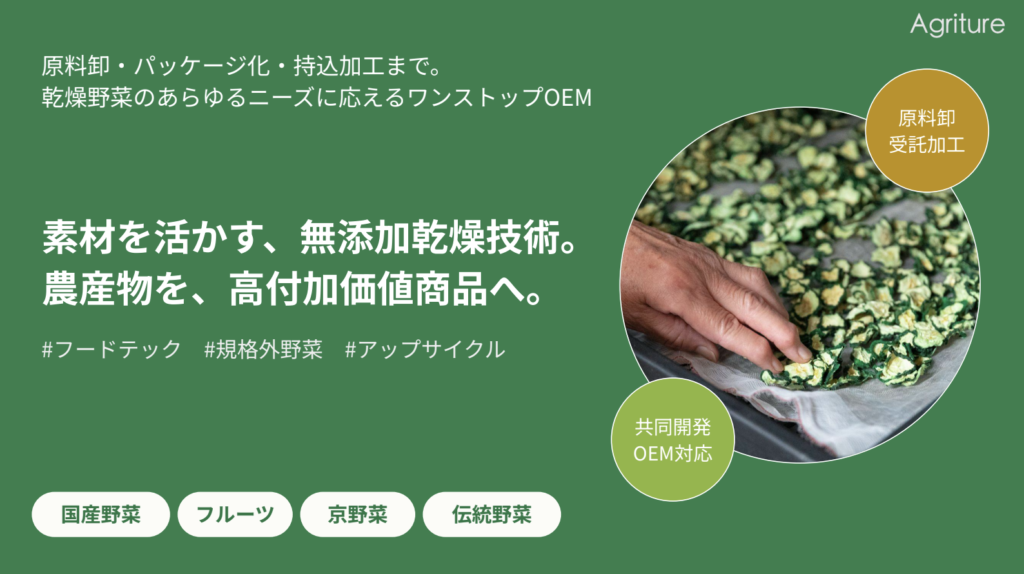
- OEM available from small lots of 10 kg
- Drying of brought-in raw materials also possible
- Support from processing to filling in one place
Summary | Judge a supplier by its "processing know-how by sugar content"
Three-line summary
- Choosing on price alone leads to regret over sugar content, additive-free, shape, and lead time. Judge with the 7 items
- A maker with a drying method matched to the fruit's sugar content (Brix) is the key to quality
- Use specialist makers like Agriture for domestic × additive-free × small-lot, and go via trading firms for large lots
Selecting a commercial dried-fruit supplier is best judged not by price alone but on four axes—"processing know-how by sugar content," "handling of sugar and additives," "small-lot prototypes," and "spec-sheet preparation"—which is the practical gold standard. For Agriture's domestic dried-fruit series lineup, see Domestic dried-fruit specialist maker available for viewing here.
FOR BUSINESS
乾燥野菜のOEM・受託加工を承ります
国産の野菜・果物の乾燥、100メッシュ相当までの粉砕、10g以上の小袋充填までをお受けしています。小ロットの試作から量産までご相談ください。寄せられた相談の実例は OEM・卸のご相談 に掲載しています。
乾燥品の賞味期限は、出荷日から6ヶ月程度を目安にご案内しています。
FAQ
Which is better, overseas or domestic dried fruit?
For cost-focused high-volume consumption, overseas; for brand appeal and clean-label, domestic is suited. Domestic runs 2–5× the price, but scarcity and origin story make it easy to develop into high-value-added products.
Are there makers that handle small lots from 100 g?
Specialist makers like Agriture support small-lot prototypes from 100 g. Major makers standardly set a minimum lot of 10 kg to 100 kg or more, so at the prototype stage always confirm whether small lots are supported.
Can you make no-added-sugar dried fruit?
No-added-sugar dried fruit can be produced with low-temperature drying that makes the most of the fruit's own sugar content. However, since the storage period is shorter than sugar-preserved, the best-before date is designed in combination with packaging (oxygen absorbers, aluminum pouches).
Is there dried fruit that can be used in pet food?
With a maker that can clearly state no use of sugar, salt, antioxidants, or flavorings, it can be used as an ingredient for pet snacks and supplementary foods. Agriture has a track record of jointly developing "leaf-left-on apple sticks" with One's Daily.
In what format are spec sheets issued?
Generally, three items are provided: a food spec sheet, a composition table, and inspection certificates. These include water activity (Aw), the basis for the best-before date, allergen information, residual-pesticide test results, and microbial test results. Always confirm them in commercial sourcing.
Download the OEM contract processing materials
We will send the materials to your email address based on the information you provide.
Recommended reading
→ How to Make Dried Fruit Products via OEM: A Complete Guide from Planning to Manufacturing
→ A Thorough Explanation of the Difference Between Candied Dried Fruit and the Sugar-Free Type
→ The complete guide to choosing commercial fruit powder
→ 7 Criteria for Judging a Commercial Dried Vegetable Supplier
If you are considering product development with off-spec or your own farm's vegetables:From planning to processing, materials, package printing and novelties, you can consult us through a single point of contact. → Learn more about one-stop product development
- A Complete Guide to Choosing Commercial Fruit Powder: Manufacturing Methods, Particle Size, Lot, and Procurement Practice
- Dried Fruit Price Ranges: Types Available at Supermarkets and Online, and How to Choose by Volume
Author of this article
Related articles
-
 How to Use Fruit Powder | Substitution Design for Confectionery and Sweets
 -
 Why high-priced domestic dried fruit is scarce, and its potential in pet and confectionery development
 -
 What is edible tea? The appeal of fruit tea, ideal for gifts and novelties
 -
 7 Criteria for Judging a Commercial Dried Vegetable Supplier
 -
How to Rehydrate Dried Vegetables: Tips for Commercial and Restaurant Use
-
Dried Vegetable Price Ranges: Supermarket and Online Guidelines and How to Choose by Volume
-
Raw Material Risk Management for Food Manufacturers and How to Use Dried Vegetables
-
HACCP Compliance in Food Processing: A Practical Guide to the Necessity by Processing Form and Use