
Why choosing sweet varieties for dried fruit OEM leads to failure

Summary of this article
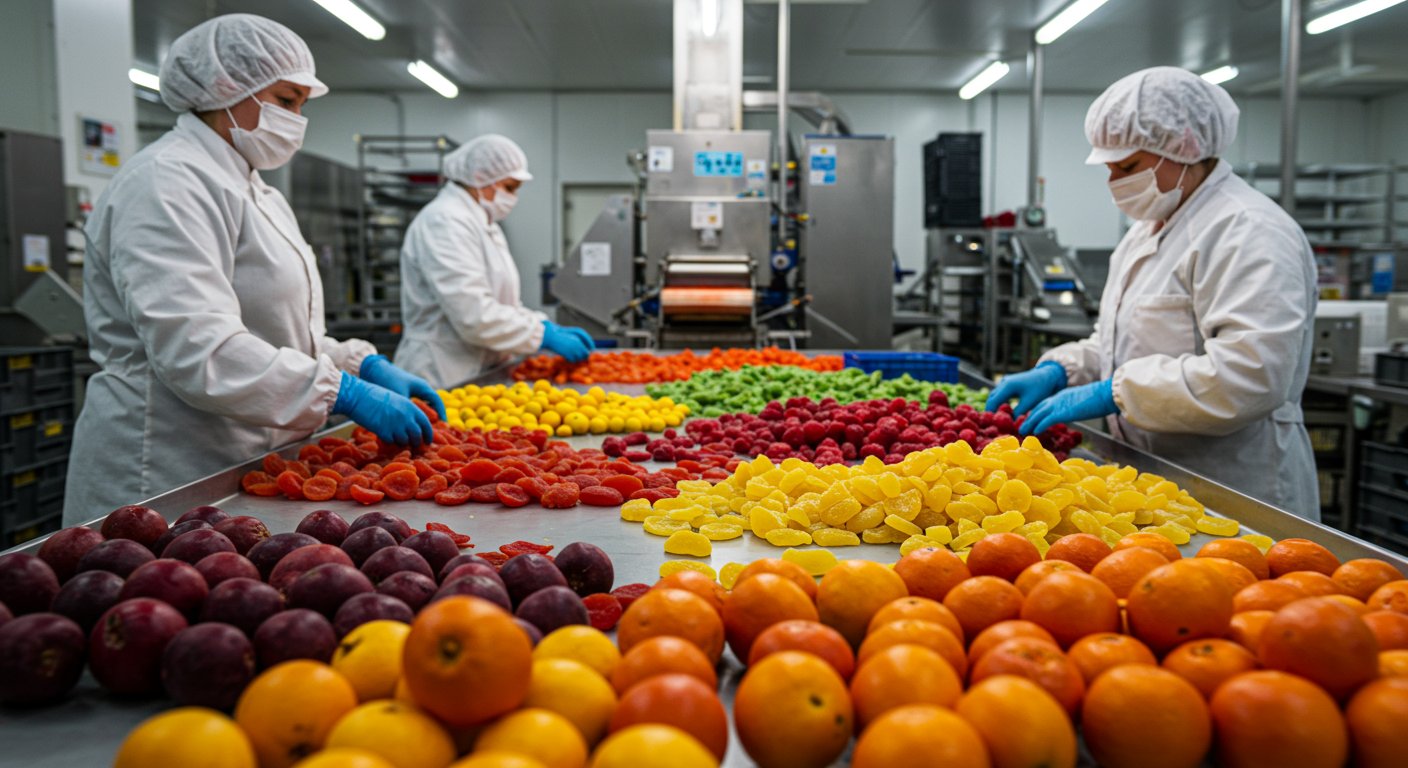
A guide to dried fruit OEM, from how costs are determined to practical operations. Yield is 7-10%, so 1kg of fresh fruit produces 70-100g of product. It drops further with irregular fruit, and citrus loses more because the seeds fall out. Varieties that are too high in sugar develop an astringent off-taste as the sweetness concentrates and also discolor during storage, so the variety matters more than the drying method. The article covers choosing the method by use (hot-air for eating as is, warm-air for tea, and freeze-drying for powder or a shelf life of a year or more), why high sugar content makes fruit hard to powder, the need to start securing raw materials 3-6 months before the season, alternate bearing in citrus, the fact that domestic additive-free products have a best-before date of around 6 months that shortens further with higher sugar content, making them unsuited to export, food labeling and specifications, and three outlets: private brands, corporate novelties and commercial use.
Dried fruit OEM means outsourcing everything from drying the fruit to bagging it, then selling the product under your own brand. It lets you have a product without owning equipment, but costs are determined very differently from dried vegetable or confectionery OEM.
The real difference is yield. Fruit is more than 80% water, and the skin, core and seeds are removed, so 1kg of fresh fruit yields only about 70-100g of product. If you look at a quote without understanding this, the raw material cost will seem far too high.
This article is for anyone who wants to launch dried fruit as their own product. It covers the relationship between yield and cost, choosing a drying method, putting together mixes and assortments, the seasonality of production slots, what actually happens when you make products additive-free, and the practicalities of labeling and testing. Agriture processes nearly 100 kinds of dried vegetables and dried fruit in-house in Kyotango, Kyoto Prefecture, and the content is based on our actual contract manufacturing work.
TOC
How much can you outsource?
The client decides four things: the item, pack size, lot size and sales channel. The manufacturer handles everything from sourcing raw materials to drying, cutting and filling.
Processes you can outsource
| Process | What you can outsource | What the client decides |
|---|---|---|
| Raw-material sourcing | Choosing the origin and variety, coordinating with contract farmers, securing irregular produce | Domestic or imported, and whether to promote the origin |
| Pre-processing | Washing, peeling, coring, seeding, cutting | Whether to leave the skin on; rings or sticks |
| Dried | Hot-air drying, low-temperature drying, freeze-drying | Finished texture and price range |
| Recipe | Blending multiple items, combining with nuts | Single item or mix |
| Filling and packaging | Weighing and filling, applying seals, boxing | Volume and packaging specifications |
| Shipping | Delivery to a designated warehouse, direct shipping to an e-commerce warehouse | Delivery destination and shipping date |
You can also bring your own raw materials and outsource only the drying. This is common when you own an orchard or when the goal is to make use of irregular produce.
What selling point should the product have?
The dried fruit market has grown along two lines: health consciousness and gift demand. When developing a product, first decide which of these you will speak to.
| Appeal axis | Who it appeals to | What the product needs |
|---|---|---|
| Additive-free, no added sugar | Shoppers who read ingredient labels before choosing | Backing for the label claims and an explanation of browning and firmness |
| Superfoods, functionality | Shoppers buying for health reasons | Choice of ingredients. Wording designed not to assert health benefits |
| Domestic, specified origin | Gift use, shoppers who value origin | Traceability through contract farming and similar arrangements |
| Upcycling, sustainability | Corporate giveaways, buyers who value a company's philosophy | A stable supply of irregular fruit |
When promoting functionality, wording that asserts health benefits becomes a problem under the Act against Unjustifiable Premiums and Misleading Representations and the Health Promotion Act. Design the messaging to describe the characteristics of the ingredient and avoid asserting benefits.
Three outlets for the product
Even for the same dried fruit, the required specifications differ completely depending on where it will be sold. Here are the three most common starting points for inquiries.
| Outlet | What's required | Key specifications |
|---|---|---|
| Own brand / private brand | A taste people buy again and a look that gets chosen on the shelf | Best-before date, pack size, labeling, price range |
| Corporate novelties / business gifts | Enough quantity for distribution, and something recipients won't dislike | Small lots, individual packaging, allergen labeling, room-temperature distribution |
| Commercial / wholesale | Stable supply and ease of processing | Consistent specifications, large packs, year-round supply capacity |
Novelties come in small, individually wrapped packs, so even with the same raw material, processing costs make up a larger share of the price per unit. The relationship between distribution quantity and unit price is covered in Food novelty items that can be made from a small lot of 500 units. For how to choose dried fruit as a giveaway, see Dried fruit novelty items is a useful reference.
Yield determines cost
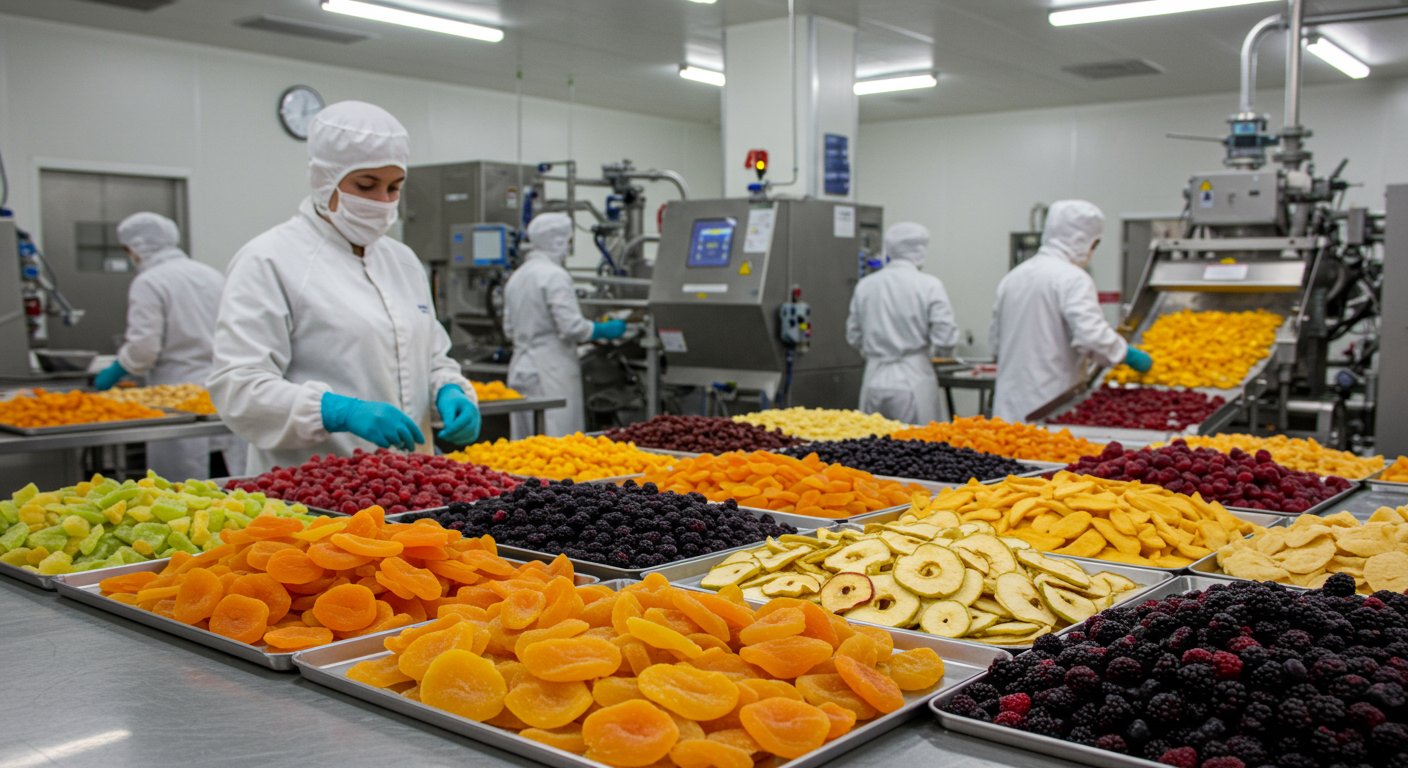
The first stumbling block in dried fruit OEM is cost. If you read a quote with the same expectations as for dried vegetables or confectionery, the raw material cost seems far too high. The reason lies in the water content of fruit.
Yield is around 10%
At our production site, yield for both fruit and vegetables falls within 7〜10%. 1kg of fresh fruit produces 70-100g of product.
| Yield | From 1kg of fresh fruit | Fresh fruit needed for 1kg of product |
|---|---|---|
| 10% (under good conditions) | 100g | 10kg |
| 7% (with high losses) | 70g | About 14kg |
Calculating from water content alone gives a figure of around 17% for apples. In reality, though, losses add up at every stage: removing the skin, core, seeds and stems, plus cutting, drying and sorting. The measured result is around 10%. When reading a quote, base your assumptions on this figure rather than on the theoretical value.
Using irregular fruit lowers it further
Irregular fruit is cheaper to buy, but an extra step is needed to remove damaged or rotten parts. As a result, yield can fall below 7%.
The trade-off is that raw materials are cheaper, but you need more fresh fruit. When estimating cost, you won't get a realistic figure unless you vary both unit price and yield. When using irregular produce for upcycling purposes, we share this point up front as well.
Citrus loses yield as the seeds fall out
With citrus such as yuzu and sudachi, the seeds fall out during drying. This is another factor that pushes yield down.
This can be avoided through product design. Our yuzu chips are designed to be ground whole, seeds and all. Eliminating the removal step means nothing is thrown away and all of the raw material can be used. For use as powder or chips, this format is an option.
Conversely, if the product is sold as whole slices, the seeds must be removed and yield falls. Deciding how to handle the seeds before settling on the cut shape changes the cost.
Price difference compared with dried vegetables
Even among dried products, dried fruit costs 3-6 times as much per unit as dried vegetables. While cabbage and carrots can be sourced for a few thousand yen, domestic apples and mandarins cost from over 10,000 yen to over 20,000 yen.
There is room to reduce costs in four areas: raw materials, lot size, packaging and processing.
- Source in bulk during the season, when market prices are most stable
- Use irregular produce. Simply relaxing appearance standards widens your sourcing options
- Optimize lot size. Small lots keep initial costs down but raise the unit price
- Avoid excessive packaging. A clear pouch with a label avoids printing plate costs
- Fix the cutting and drying conditions to reduce process variation
This difference feeds directly into product design. A dried vegetable mix works at 200g, but a dried fruit product of the same size ends up with a much higher retail price. The basic approach for dried fruit is either a small 40-100g pack or uses that can absorb a higher unit price, such as gifts and novelties. Market prices by item are covered in Dried fruit market prices.
The reason domestic dried fruit is rarely seen on the market is that this heavy yield loss drives up the unit price. For details, see Why there are so few high-priced Japanese-grown dried fruits.
FOR BUSINESS
乾燥野菜のOEM・受託加工を承ります
国産の野菜・果物の乾燥、100メッシュ相当までの粉砕、10g以上の小袋充填までをお受けしています。小ロットの試作から量産までご相談ください。寄せられた相談の実例は OEM・卸のご相談 に掲載しています。
乾燥品の賞味期限は、出荷日から6ヶ月程度を目安にご案内しています。
Variety matters more than drying method
Drying fruit concentrates its sweetness. This leads people to assume that choosing a high-sugar variety will make it taste better, but in practice the opposite happens.
Too much sugar leads to failure
As water is removed, the sugar becomes concentrated, so fruit that starts out high in sugar ends up overly sweet. Once it goes past the right range, it leaves an unpleasant aftertaste. At our production site, we call this egumi (an astringent off-taste).
| If the sugar content is too high | When you find out | Can it be fixed later? |
|---|---|---|
| Sweetness becomes too concentrated and an astringent off-taste develops | Apparent when tasting the prototype | Cannot be reversed through drying conditions. Change the variety |
| Color changes during storage | Appears some time after shipping | Packaging can't fully prevent it. Go back to variety selection |
Discoloration is the trickier problem. Because the color can change during storage even when the prototype was fine, you may only notice after the product is on sale. There is a limit to what drying methods or packaging can do, and in the end you have to go back to choosing the raw material.
Choose varieties where neither sweetness nor acidity stands out
The criterion is that the fruit is neither too sweet nor too sour. With varieties that lean heavily one way, only that element stands out after drying. A variety that tastes great fresh won't necessarily taste great dried.
Our dried pears use Nijisseiki pears grown in Kyotango, Kyoto Prefecture. This variety is relatively mild in sweetness, so no astringent off-taste develops even when concentrated. Our dried mandarins follow the same thinking, using varieties that are neither too sweet nor too sour.
When clients bring their own raw materials and outsource only the drying, we carry out this check first as well. If you tell us the variety and sugar content of your fruit, we can assess whether it is suited to drying before making a prototype.
Additive-free keeps the aroma
Japanese fruit is naturally sweet, so it tastes pleasantly sweet without added sugar. For uses where the fruit is rehydrated, such as fruit tea, this characteristic comes through as is.
The difference is clear with highly aromatic fruit such as citrus. Dried naturally without sugar, citrus keeps its fresh aroma well. Adding sugar brings the sweetness of the sugar to the fore and buries the aroma. Additive-free is a disadvantage for shelf life but an advantage for aroma.
The drying method determines texture and price range
There are three methods, and you choose by working backward from your target price range. Because the finished texture differs, changing the method later turns it into a different product.
Comparison of the three methods
| What you want to make | Suitable method | Reason |
|---|---|---|
| Dried fruit eaten as is | Hot-air drying | Good balance of texture and price |
| For use in tea | hot-air drying | Good balance of retained aroma and rehydration |
| Powder | Freeze-dried | High sugar content makes fruit hard to powder. Freeze-dried fruit, with its moisture removed, can be ground |
| Needs a best-before date of a year or more | Freeze-dried | Lowest moisture and best storage stability |
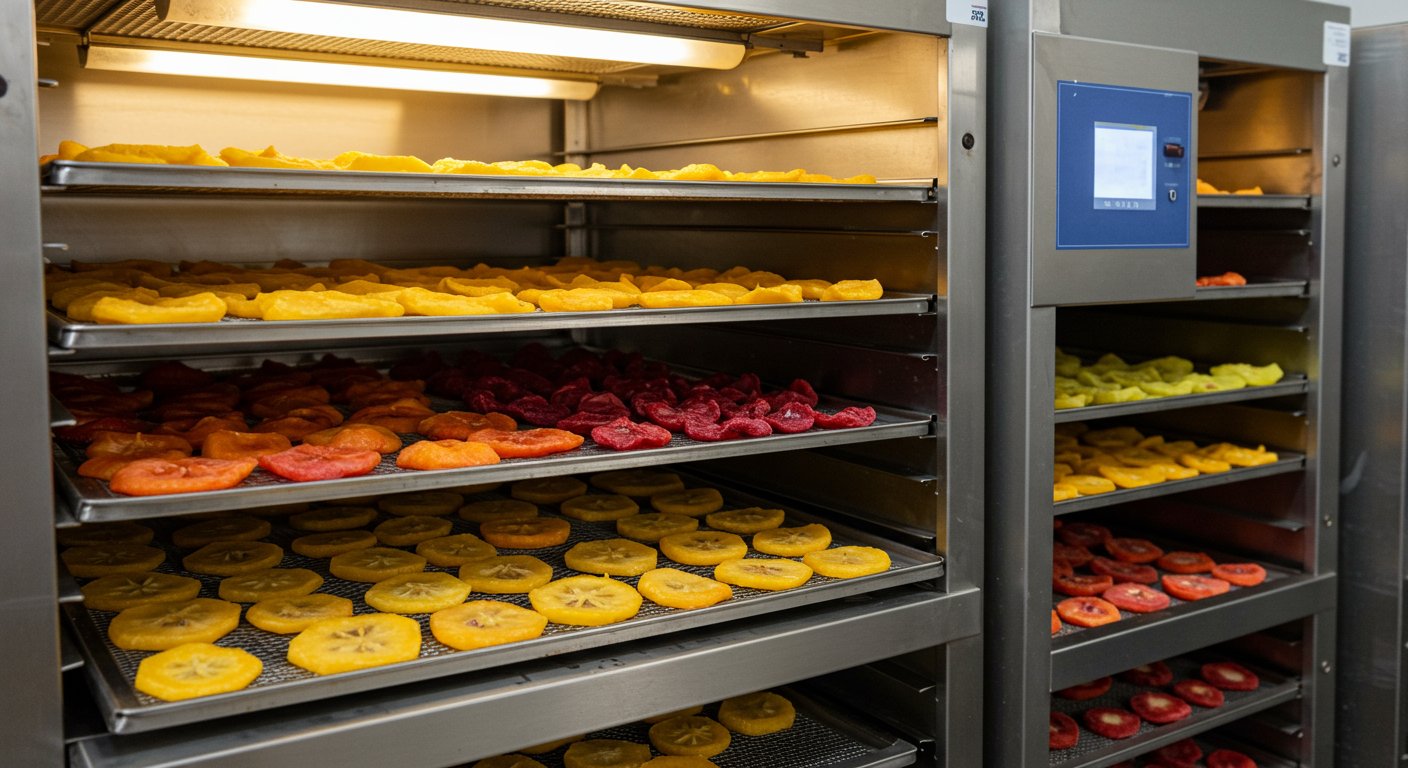
It's also worth understanding how the finish differs by method. Hot-air drying tends to retain texture and keeps prices down. Warm-air drying retains aroma, making it suitable for tea and drinks. Freeze-drying almost fully preserves color and shape, but processing costs are higher and the product absorbs moisture easily, so individual packaging and oxygen absorbers are a given.
Powder requires freeze-drying
A little-known fact is how difficult it is to turn fruit into powder. Because of its high sugar content, fruit is hard to reduce to powder. Even if you try to grind fruit dried with hot or warm air, the sugar makes it sticky and it won't become powder.
This is where freeze-drying is effective. Because the moisture is thoroughly removed, it can be ground into a fine powder depending on the grinding method. When we receive inquiries about fruit powder, we quote on the assumption of freeze-drying.
The same applies if you want a longer best-before date. Additive-free dried fruit keeps for about 6 months, but freeze-drying can achieve a year or more. For projects where shelf life is a requirement, the choice of method can sometimes solve the problem.
Differences between methods are also covered in The Difference Between Dried Vegetables and Freeze-Dried. Even if the use hasn't been decided yet, just tell us whether it will be eaten as is, used in tea or turned into powder, and we can propose a method.
Semi-dried or crisp?
Where you set the final moisture level changes both the product's appeal and how hard it is to manage.
| Type | Impression when eaten | Best-before date | Points to note |
|---|---|---|---|
| Semi-dried | Soft and close to fresh fruit. Very satisfying | Tends to be shorter | Remaining moisture means mold risk has to be managed |
| Dried (crisp) | Light. Keeps well | Can be long | Firmness is sometimes criticized in reviews |
Semi-dried is preferred for gifts and department stores, while fully dried suits novelties and uses that assume long-term storage. Both can be made from the same item, so the order is to decide the outlet first and then the moisture level.
How to put together mixes and assortments
Mixes and assortments offer more room to adjust costs than single items and stand out visually as well. But if they are put together wrongly, quality deteriorates after opening.
When to use single items or mixes
| Single-ingredient | Mixes and assortments | |
|---|---|---|
| Appeal | You can state the variety and origin definitively | Can showcase many colors and types |
| Cost | Directly tied to that item's market price | Can be adjusted by mixing in cheaper items |
| Inventory | Easier to manage since it's focused on one item | Minimum lots for each item add up |
| Suitable outlets | Regional gifts, commercial use, confectionery ingredients | Novelties, gifts, e-commerce |
The more items you add, the more the minimum lots for each item pile up and inventory stagnates. If you simply want a range of colors, 3-5 kinds are often enough, keeping both cost and inventory under control.
How to allocate the contents of an assortment
Looking at assortments on the market, the cheaper the set, the more it relies on particular items to bulk it out. Imported sugared fruit such as pineapple, papaya and raisins has a low unit price, so adding a lot of it doesn't raise costs.
If you're putting one together as your own product, first decide where to place the high-cost items.
| Role | Guideline ratio | Items to choose |
|---|---|---|
| Lead | 30-40% | High-priced items with a nameable origin or variety. Use them in the product name |
| Adding color | 30-40% | Items that bring orange, red and yellow. They make the product photogenic |
| Supporting volume | 20 to 30% | Items with good yield. They keep costs down |
Including two or more star items makes costs jump. Narrowing it to one and using the rest for color and volume makes it easier to balance price and appearance.
Points to watch when combining with nuts
More and more products put dried fruit and nuts in the same bag, but from the manufacturer's point of view this is harder. The reason is that moisture moves from the fruit to the nuts.
- The nuts go stale and lose their texture. The toasty roasted aroma disappears first
- The fruit dries out and hardens. The difference is greater with semi-dried types
- Oil from the nuts transfers to the fruit, and the flavors mix
- The best-before date is dictated not by the moister component but by whichever deteriorates faster
Mixed products on the market come in small individual packs precisely to stop this transfer. If you want to combine them in one large bag, realistic options are to finish the fruit at a lower moisture level or to pack them separately and sell them together in a box.
Designing giveaways that use nuts is covered in How to use nuts for corporate novelty items. For how to think about combinations from the eater's perspective, see How to combine dried fruit and nuts for a summary.
We have materials available to help you understand dried processing OEM
Agriture OEM, flexibly handling everything from small lots to large lots
- OEM available from small lots of 10 kg
- Drying of brought-in raw materials also possible
- Support from processing to filling in one place
The process from request to delivery
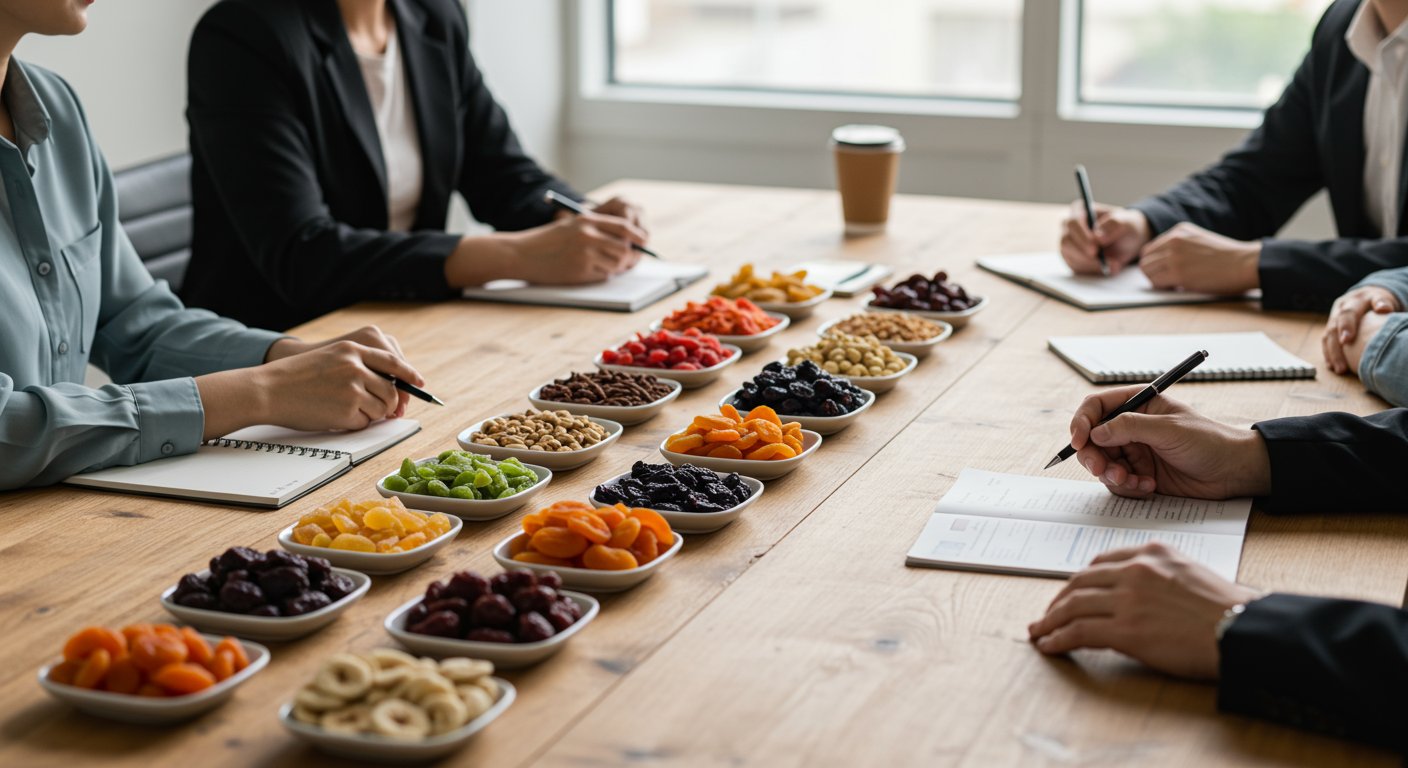
We often hear from people making a product through OEM for the first time who don't know what to decide and in what order. Because dried fruit is constrained by the harvest season, the upstream stages take longer than in typical food OEM.
| Stage | What to decide | Common stumbling blocks |
|---|---|---|
| 1. Target and outlet | Who you'll sell to and through which channel | If this is vague, neither pack size nor packaging can be decided |
| 2. Concept design | Item, drying method, texture, pack size, packaging | The method changes depending on whether color is a selling point |
| 3. Choosing a manufacturer | Check which items they can handle and when they can secure fresh produce | Missing the season while approaching multiple companies |
| 4. Prototype | Try 2-3 variations and evaluate texture and color | Trying to decide in one go and having to backtrack |
| 5. Finalizing specifications | Raw materials, process, moisture, packaging, labeling | Leaving the label check until later and having to reprint |
| 6. Contract | Quantity, delivery date, price, quality standards, handling of intellectual property | Proceeding without setting out rights to the formulation |
| 7. Production | Release a small lot and see how it's received | Building up too much inventory from the first run |
We recommend not skipping the prototype stage. It's the only point where the gap between the ideal and the real product can be closed. If you build the product from items already in stock, no prototype from the drying stage is needed, so this process becomes much shorter.
If new fruit has to be sourced fresh, the harvest-season constraints described next also apply. Allow six months to a year from first inquiry to launch.
Production slots are seasonal
Order timing is often overlooked in dried fruit OEM. Fruit has a limited harvest season, so the period when it can be processed is limited too.
Processing slots are concentrated in the harvest season
The most common misconception when we receive inquiries is "it's in season, so you should be able to make it now." In reality it's the opposite: once the season has started, it's too late to act.
To produce a certain quantity, the manufacturer needs to have secured fresh fruit in advance. Strawberries are in season in spring, but to lock in that volume you have to move during winter. You need to think back not only to drying equipment slots but to the raw material sourcing that comes before them.
For both fruit and vegetables, it's best to consult us 3-6 months before the season.
| Item | Season (when processing is possible) | When to consult |
|---|---|---|
| strawberry | Spring | Autumn to winter of the previous year |
| Peach | Summer | Winter to early spring |
| pear | Early autumn | Spring to early summer |
| apples | Autumn | Early summer to summer |
| Citrus (mandarins, yuzu) | Late autumn to winter | Early summer to early autumn |
The time to consult is 3-6 months before the season. If the items and quantities are settled within that window, fresh produce can be secured in time. Note that the table shows processing periods, not sales periods. Dried products can be stored at room temperature, so they are prepared in bulk during the harvest season and shipped throughout the year.
Stock up on citrus in bumper-crop years
Citrus such as yuzu and sudachi bear fruit differently from year to year. In growing regions, years with lower yields are called off years. Purchase prices rise in off years, so rushing to stock up then makes costs jump.
Dried products keep longer than fresh fruit, so it makes sense to dry in bulk in years when yield and price are favorable and draw on that inventory. This is why an annual production plan matters. Looking at two years as a unit rather than one stabilizes costs.
Work backward from the launch date
When launching a new item, preparation takes longer because it spans a harvest season. Work backward in this order.
- Set the launch date
- Subtract the time needed for distribution and inventory
- Subtract the time needed for filling and testing
- Secure a drying slot. This is fixed to the harvest season
- Finalize raw material sourcing before the harvest season
Miss one harvest season and you'll wait a year. If you want a product out this year, it's safest to finalize the items during spring or summer. If you build it from items already in stock, this constraint doesn't apply and the launch can be much faster.
What happens when you make it additive-free with no added sugar
Many manufacturers say they can make additive-free products, but little information explains what happens after production. In practice, there are differences in both the finished product and how it has to be managed.
Changes in appearance and texture
| What happens | Cause | How to respond |
|---|---|---|
| The color turns dull brown | Browning of the fruit. Common in apples, pears and bananas | Design the product so color isn't a selling point, or shorten the time from cutting to drying |
| Hardens over time | Without added sugar, it doesn't retain moisture | Finish at a slightly higher moisture level and protect it with packaging |
| A white powder appears | Sugar from the fruit rising to the surface | State on the product page that this is not a defect |
| Color and sweetness vary between lots | Differences in raw material due to harvest timing and crop conditions | Fix the origin and timing in the specifications and reject outliers through sensory evaluation |
Placed next to sugared or bleached imports, additive-free products can look less appealing. This is something the product page wording has to absorb; manufacturing alone can't solve it. The differences from sugared types are covered in Differences between candied dried fruit and no-added-sugar types.
Head off common complaints in advance
- The white powder is mistaken for mold. Explain it up front on the product page and label
- Complaints about firmness. State the intended way to eat it (as is or rehydrated)
- Color variation. Make photos match the real product and state clearly that it is a processed product
- Moisture after opening. Decide between a resealable zip bag and individual packs based on pack size
Storage guidance for purchasers is also covered in How to store dried fruit. Linking to it from the product page reduces inquiries.
We have materials available to help you understand dried processing OEM
Agriture OEM, flexibly handling everything from small lots to large lots
- OEM available from small lots of 10 kg
- Drying of brought-in raw materials also possible
- Support from processing to filling in one place
Practical matters: labeling, best-before dates and testing
If you're selling at retail and get tripped up by labeling after the product is made, you won't be able to list it. Decide who will produce what before placing the order.
Items to include on the label
| Item | Points specific to dried fruit |
|---|---|
| Name | Use a common name that makes the contents clear, such as "dried fruit" |
| Ingredient name | In descending order of weight. If sugar, vegetable oil or antioxidants are used, list them all |
| Country or region of origin of ingredients | Origin of the raw material with the highest proportion by weight. If sourcing from multiple prefectures, the labeling needs to be planned |
| Net content | Weight after drying. Show any fresh-fruit equivalent separately |
| Best-before date | Set after actual measurement through testing |
| Storage method | State that it should be kept away from direct sunlight, heat and humidity. Also describe handling after opening |
| Nutrition facts | Energy, protein, fat, carbohydrates and salt equivalent |
Country-of-origin labeling for raw materials becomes complicated if the same item may be sourced from multiple prefectures. Checking the rules at the design stage avoids reprinting later. For details, see Origin labeling rules for ingredients in processed foods.
Labeling obligations don't change when the product is given away as a novelty. Issues specific to giveaways are covered in Best-before dates and food labeling for food novelty items for more.
Set the best-before date after actual testing
The shelf life of dried fruit depends on the final moisture level and packaging. Semi-dried types are shorter because moisture remains, while crisp types can be given a longer date. The premise is to set it based on actual storage tests, not estimates.
As a guide, domestic, additive-free products with no added sugar have a best-before date of about 6 months. For high-sugar items and varieties, it becomes even shorter. Imported candied fruit keeps for a long time because the sugar binds water and improves preservation. Additive-free products are at a disadvantage here.
This short shelf life is a constraint when considering export. Once you subtract the time needed for shipping and distribution overseas, there aren't enough days left. Our experience is that domestic additive-free dried fruit is not well suited to export. If overseas expansion is a premise, you would need to add sugar or consider another processed form with a longer best-before date.
The key management indicator is water activity. It expresses the proportion of free water in a food that microorganisms can use, and it is different from total moisture content. Even at the same 15% moisture, if sugar binds the water, water activity is lower and mold is less likely to grow. Additive-free products with no added sugar lack the water-binding effect of sugar, so they need to be designed with lower total moisture.
- Decide the target shelf life first. Packaging choices differ for 3 months versus 6 months
- Run storage tests over that period. Results aren't available until the period ends
- Clear bags accelerate fading, so if color is a selling point, consider light-blocking packaging
- If using oxygen absorbers or desiccants, decide on them together with the packaging design
If you forget to work backward from the shelf life, the launch date slips while you wait for testing to finish. If you want a 6-month best-before date, build those 6 months into the schedule.
Who issues the specification sheet?
In negotiations with retailers and online marketplaces, you will almost always be asked to submit a specification sheet. It contains allergens, the ingredient formulation and a manufacturing process flow chart. Negotiations stall if the manufacturer can't issue one, so confirm this at your first inquiry.
For products that also contain nuts, how allergens are handled is especially important. Whether other allergens are handled on the same line is also part of what goes on the specification sheet.
How to secure raw materials
Fruit is strongly affected by weather and crop conditions. Even for the same item, lot size, price and traceable information differ depending on how it is sourced.
Differences between sourcing routes
| Route | Price | Predictability of quantity | What can go on the label |
|---|---|---|---|
| Contract farming / direct from farmers | Can be fixed by prior agreement | Depends on the harvest, but planning is possible | Origin, variety and even the grower |
| Market purchasing | Moves with market prices | Depends on what's arriving at the time | Origin only |
| Using irregular produce | Kept low | Hard to predict what will be available | Can present an upcycling story |
If you want a product that names the variety and grower, contract farming is a prerequisite. The more a product sells on its story, the more sourcing design has to come first.
Keep supply from being interrupted
Fruit is heavily affected by crop conditions, and relying on a single region or farm means the product stops in a poor harvest year. The longer you intend to keep selling a product, the more redundancy you need in sourcing.
- Have multiple suppliers. Make sure the same variety can also be sourced from another region
- Secure fruit frozen during the harvest season, then thaw and dry it to fit processing slots
- Work backward from your annual sales plan and prepare in bulk during the harvest season
- Hold 1 to 2 months' worth as safety stock so you do not run out in the off-season
Frozen raw materials are a realistic option when the harvest season and processing slots don't line up. Even fruit that can't be kept fresh can be processed at a different time if it is frozen in between.
Using irregular produce helps with both cost and sustainability. Upcycling irregular vegetables and fruit is at the core of Agriture's business, and we also take inquiries in this context. For how to approach sourcing for commercial use, see 7 Criteria for Judging a Commercial Dried Fruit Supplier for a summary.
Reconfigure specifications for each outlet
Even with the same raw material, pack size and packaging change when the outlet changes. Here's how to think about expanding sideways after launching your first product.
Selling as your own brand or private brand
Because the product has to succeed on repeat purchases, the balance between pack size and price is key. Dried fruit has a high unit price, so a two-tier approach is easy to set up: offer a 40-60g trial size first, and around 100g for repeat customers.
Starting with clear pouches and label stickers lets you roll out multiple items without paying for printing plates. Switching to printed pouches once you see which products sell keeps initial investment down. For the process from planning to sales, see The complete guide to making original private-brand foods for more.
Distributing as corporate novelties or business gifts
With giveaways, the priority is not to burden the recipient. The requirements are individual packaging, room-temperature storage, a comfortable margin on the best-before date and clear allergen labeling.
- Keep the amount per pack small. 20-40g is easy to handle
- Use individual packaging. Large bags aren't suited to distribution
- Work backward from the distribution date to ensure enough remaining shelf life
- If nuts are included, place the allergen labeling in a prominent position
- Putting the company logo on a backing card or sticker rather than the package lowers costs
Besides handing out dried fruit on its own, turning it into secondary products that make use of the fruit's sweetness broadens planning options. We have so far made prototypes of coffee using apples and ice cream using mandarin chips. Because the fruit's sweetness comes through without added sugar, you can expand into tea, confectionery and frozen desserts while keeping the additive-free claim.
Domestic dried fruit gets a good reaction when given as a gift. The difference from imports is easy to see, and being able to talk about the origin makes an impression.
Novelties made from irregular fruit can also convey the giver's values. For how to choose them, see How to choose dried fruit for corporate novelty items; for the overall planning process, see The complete guide to making original novelties; and for choosing from a branding perspective, see How to choose novelties that work for corporate branding.
Wholesaling for commercial use or as a raw material
When used as an ingredient for confectionery, baking or beverages, consistent specifications are what's required. Uniform cut size, moisture and particle size determine whether it can be used on the customer's line.
This use prioritizes large volumes and cost, so the specifications differ from those for retail. Even for the same item, having two specifications, one for retail and one for commercial use, is the realistic approach.
How to open up sales channels
| Sales channel | Well-suited products | What to prepare |
|---|---|---|
| Own e-commerce / D2C | High-value products with a story about origin and variety | Photos and product descriptions. Customer acquisition must be planned separately |
| Online marketplaces | Products that can reach a viable price through pack size and sets | Specification sheet, best-before date, review management |
| Department stores, specialty shops | Semi-dried products and assortments for gifts | Remaining days until the best-before date, gift boxes, noshi wrapping |
| Hometown tax donation | Single items and assortments with a clear origin | Whether the raw materials and processing location meet the municipality's requirements |
| Trade shows and business meetings | Proposals for commercial use and as raw materials | Prepare samples and specification sheets in advance |
With furusato nozei, each municipality sets requirements for where raw materials are grown and where they are processed. A setup that processes Kyoto Prefecture fruit in Kyotango easily meets the requirements, and because dried products can be distributed at room temperature over long periods, they are a category well suited to thank-you gifts.
Social media is a channel that suits products whose appearance and usage scenes can be shown. Dried fruit is colorful, so it is among the products that come across well in photos. For developing gift products, see Why dried vegetable gifts are so well received; for sustainability-focused gifts, see SDGs gift.
Which manufacturer to use
With dried fruit, the upper limit is set less by formulation freedom than by the raw materials and equipment the manufacturer has. In practice, it's more useful to look at the items they handle and how they secure harvest-season supply than at their equipment.
7 points to check
| Item | What to check |
|---|---|
| Items handled | Whether they have actually processed the fruit you want |
| Drying method | Which of hot-air, low-temperature and freeze-drying they support |
| Raw-material sourcing | Whether they can source it themselves or require you to bring it |
| Minimum lot | Check both the per-product and per-item minimums |
| Filling and packaging | Whether they can handle everything through to individual packaging and boxing |
| Specification sheet | Whether they can issue allergen information, formulation tables and process flow charts |
| Production slots | By when harvest-season slots need to be booked |
Note that minimum lots have a two-layer structure. Even if a product is listed as "from 50 units," the fruit used has a minimum purchase unit, so the lot you can actually produce may be larger. For how to approach starting with small lots, see Why dried vegetables and dried fruit suit OEM for sole proprietors for more.
We have materials available to help you understand dried processing OEM
Agriture OEM, flexibly handling everything from small lots to large lots
- OEM available from small lots of 10 kg
- Drying of brought-in raw materials also possible
- Support from processing to filling in one place
FOR BUSINESS
乾燥野菜のOEM・受託加工を承ります
国産の野菜・果物の乾燥、100メッシュ相当までの粉砕、10g以上の小袋充填までをお受けしています。小ロットの試作から量産までご相談ください。寄せられた相談の実例は OEM・卸のご相談 に掲載しています。
乾燥品の賞味期限は、出荷日から6ヶ月程度を目安にご案内しています。
Summary
Dried fruit OEM determines costs differently from dried vegetable or confectionery OEM. Yield is 7-10%, so 1kg of fresh fruit produces about 70-100g of product. Using irregular produce lowers it further. Understanding these figures changes how you read a quote.
The design sequence is: decide the outlet, decide the drying method and moisture level, decide the raw material sourcing route, and place the order working backward from the harvest season. Securing raw materials in particular requires action 3-6 months before the season. Starting once the season has begun is too late, so if you want a product out this year, settle the items during spring or summer.
Agriture provides contract drying of domestic fruit in Kyotango, Kyoto Prefecture. With upcycling of irregular fruit at our core, we handle everything from sourcing raw materials to drying, blending and filling. We can support any outlet: your own brand, corporate novelties or commercial use. Tell us the item, quantity and when you want it on the market, and we'll provide a schedule and unit price that take the harvest season into account.
Related article: Dried fruit market prices・7 Criteria for Judging a Commercial Dried Fruit Supplier・Dried vegetable mix OEM. Items we handle are listed in A specialist manufacturer of domestically grown dried fruit.
Download the OEM contract processing materials
We will send the materials to your email address based on the information you provide.
If you are considering product development with off-spec or your own farm's vegetables:From planning to processing, materials, package printing and novelties, you can consult us through a single point of contact. → Learn more about one-stop product development
- Where Can You Buy Dried Fruit? A Thorough Explanation of the Characteristics of Each Source and How to Choose
- Why Dried Vegetables Now? 5 Benefits Beyond Just Convenient and Nutrient-Concentrated
Author of this article
Related articles
-
 Original coffee marketing strategy | Ways to grow sales
 -
 ベジタリアンとは?国の規格が分けている4つの区分と食べられないもの
 -
 長ねぎと白ねぎは同じもの?ねぎの種類と呼び名を国の資料で確かめる
 -
 柚子の種類は何種類あるのか、公の資料で名前が残る系統を数えた
 -
 ゆずの時期は年に二度、青ゆずは7月から黄ゆずは10月から
 -
 ゆずの産地は高知が半分を占め、二位は徳島から愛媛に変わった
 -
 Preventing Food OEM Failures: Common Failure Cases and Countermeasures for Success
 -
 How to find a food OEM | How to efficiently find the best manufacturing partner