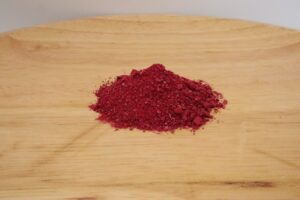
Celery powder

Celery powder is an ingredient made by drying and finely powdering celery, spreading celery's distinctive greenness and richness evenly into the bouillon base of Western-style soups, the flavoring of processed meats, dressings, and seasonings. The aromatic components contained in celery's stalks and leaves are finished at a size easy to disperse into liquids and powders. At Agriture, using the same raw material as dried celery, we powder it by adding a fine-powdering step.
Whereas raw-material-form celery is suited to "soups, pickles, and stewed ingredients where you want to keep texture and a sense of ingredient presence," celery powder is suited to uses where you want to "spread aroma and richness evenly." In the Western processed-food industry, celery powder has long been used as a classic raw material for the aromatic-vegetable base (mirepoix), and adoption is increasing domestically too in OEM for bouillon, sauces, and processed meats.
TOC
Agriture's celery powder: three commitments
Celery powder's distinctive aroma is the deciding factor of quality. At Agriture, we manage everything from pretreatment to grinding and packaging at our own processing facility, aiming for a finish with little lot-to-lot difference.
1. Low-temperature drying that does not let the aromatic components escape
Celery's characteristic aroma is due to essential-oil components (such as phthalides), which are heat-sensitive and readily volatile. By taking time to remove moisture at a low temperature and curbing heat generation in the grinding step too, we aim for a finish where a celery-like aroma rises the moment you open the bag.
2. Adjusting the proportion of stems and leaves
Celery differs in the quality of aroma between stems and leaves. Stem-based gives a mild, rich aroma, while blending in more leaves brings out a sharp, herbal aroma strongly. You can specify the stem-to-leaf proportion according to the use, enabling aroma design for Western-style bouillon bases and processed-meat seasonings.
3. A design partner for aromatic-vegetable blends
Onion, carrot, and celery are the basic composition of Western-style bouillon. Because Agriture also handles onion powder and cabbage powder on the same line, you can design an aromatic-vegetable-base (mirepoix mix) blend all together from a single raw-material supplier.
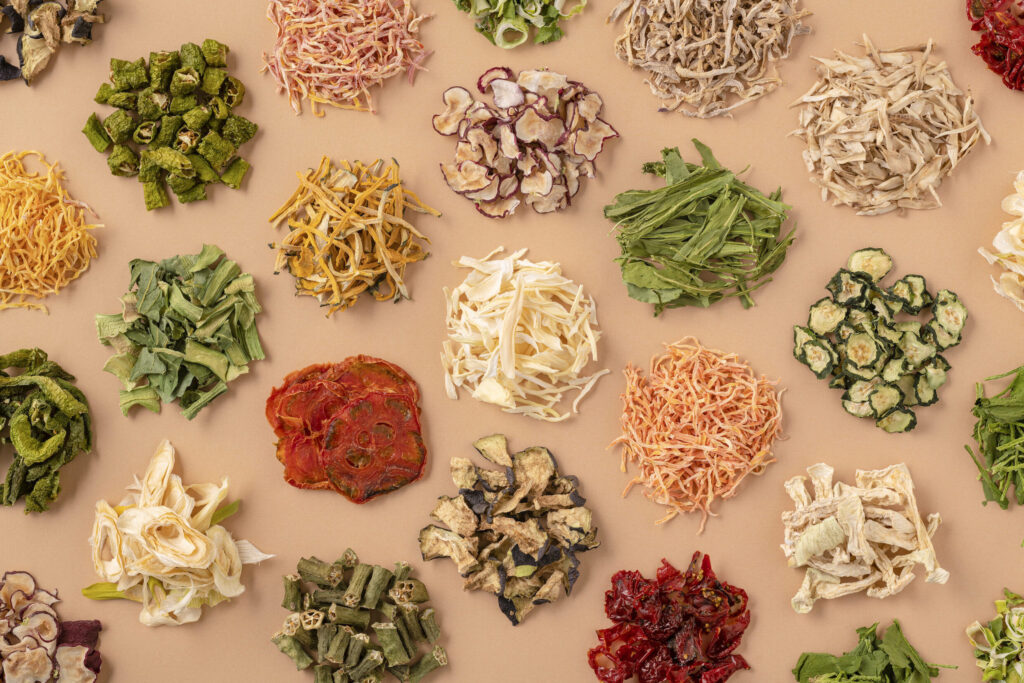
Product catalog showing the items we handle
Flexible support from small lots to large lots
- Sold in small lots from 1 kg
- Handling heirloom vegetables from across Japan
- Dried fruits and herbs also supported
Characteristics of commercial celery powder
Distinctive aroma and richness
Concentrates celery's characteristic phthalide-type aromatic components. It functions as an accent raw material that gives depth and spread to Western-style bouillon, sauces, and processed meats.
A base for Western-style bouillon
By powdering the celery part of mirepoix (onion, carrot, celery), it is suited to bases for consomme, bouillon, stew, and simmered dishes.
Dispersibility in liquids and powders
Even dissolved in soups or sauces, the graininess is hard to notice, and it disperses evenly in powder mixes. It can be used as is, with no reconstitution needed.
Choice of aroma type
Selectable from stem-based (mild, rich) or leaf-based (sharp, herbal). You can specify the stem-to-leaf proportion according to the use.
A classic for processed-meat seasoning
In Western-style processed meats such as sausages, ham, and pate, celery powder is a long-used aromatic base. It is also suited to formulation on mass-production lines.
Use together with the ingredient-shape version
By using it together with dried celery, you can combine aroma (powder) and texture (raw-material form).
Product specifications (commercial)
Basic specifications at the prototype stage are as follows. Purchase lot, lead time, and packaging format are worked out through individual consultation.
| Item | Details |
|---|---|
| Product name | Celery powder |
| Raw material | Celery (domestically grown) |
| Shape | Fine powder (dried celery ground) |
| Appearance | A pale yellow-green to light-green fine powder |
| Aroma | Celery's characteristic phthalide-type aroma, a fragrance accompanied by greenness and richness |
| Net content | Individual quote according to use and lot |
| Best-before date | About 6 months from the shipping date |
| Storage method | Avoid high temperature, high humidity, and direct sunlight; after opening, seal and store in a cool, dark place |
| Processing plant | Our own processing plant within Kyoto Prefecture |
| Minimum prototype lot | From 1 kg of raw material |
Customization support
| Item | What we support |
|---|---|
| Proportion adjustment | Stem-based (mild, rich) / leaf-based (sharp, herbal) / a stem-leaf balanced type |
| Pre-blending | Premix-compatible with mirepoix-type materials such as onion, carrot, parsley, and thyme |
| Blend design | Composite recipes with herbs (thyme, bay leaf, parsley) and spices (black pepper, nutmeg) |
| Packaging form | Commercial bulk, large bags for processed-meat factories, small bags and sticks, spice jars |
| OEM productization | Extension to bouillon, consomme, sausages, ham, sauces, and dressings |
For uses where you want to keep texture and a sense of ingredient presence, the raw-material form is recommended
For pickles, marinades, soup ingredients, simmered dishes, and the like—uses where you want to make the most of celery's texture dried celery (raw-material form) is suited. A strength is that it can be reconstituted and used directly as an ingredient.
Commitments to variety, grower, and growing region
Celery is an Apiaceae aromatic vegetable that has long been used as an aromatic base in the West. As a powder raw material, you can select varieties to suit the use—Cornell-type and Top Seller-type with thick stems and strong aroma, the celeriac lineage that is leaf-based with a delicate aroma, and the soup-celery lineage with soft leaf stalks.
Main growing region
| Growing region | Features |
|---|---|
| Nagano Prefecture | Top in the nation for celery production. The cool climate grows raw material with a strong aroma |
| Shizuoka Prefecture | The main production area of winter-and-spring celery. Quality with thick stems suited to processing |
| Fukuoka Prefecture | A main production area of western Japan. Stable year-round supply is possible |
| Aichi Prefecture | A production area of summer-and-autumn celery. Used as a leaf-based raw material |
Using varieties and lineages differently
The Cornell type (the mainstream of general distribution) has thick stems and a strong aroma and is suited as a general-purpose commercial raw material. Leaf-based soup celery (kinsai / Chinese celery) has a sharp aroma and is suited to the seasoning of Asian dishes and processed meats. You can also consult us on variety specification and blend formulation.
Powdering technology and quality control
Retaining aroma with low-temperature drying
Celery's aromatic components readily volatilize with heat, and raising the temperature results in an aroma-less powder. We slowly remove moisture at a low temperature, retaining a celery-like aroma in the powder.
Separate management of stems and leaves
We pretreat the stems and leaves separately and blend and grind them at a proportion suited to the use. Keeping lot records of the blend ratio curbs the flavor difference between prototyping and mass production.
Maintaining quality with light-blocking packaging
Because celery powder fades with light, we promptly transfer the finished powder to light-blocking packaging. For commercial bulk we use light-blocking bags, and for small bags and sticks we use light-blocking film.
TIPS: formulation of a Western-style bouillon base
When designing a Western-style bouillon base, a mirepoix base of 50% onion powder, 25% carrot powder, 15% celery powder, and 10% salt is the classic. Adding flour or yeast extract to this increases the depth of umami. For a processed-meat seasoning, 30% celery powder, 25% salt, 15% black pepper, and 30% herbs such as nutmeg, thyme, and bay leaf makes a Western-style sausage formulation. In mass production, delivery as a premix simplifies operations.
Use cases and adoption examples
Celery powder has become established for adoption as a base raw material for Western-style processed foods. We organize the uses we are often consulted about into five categories.
1. Western-style soups and bouillon
- A powder base for consomme and bouillon cubes
- A soup mix for minestrone and pot-au-feu
- A base for cream soups and chowders
- Commercial soup granules
2. Processed meats and sausages
- Flavoring for sausages and frankfurters
- Seasoning for ham, bacon, and pate
- Formulation into hamburg steak and meatloaf
- A rub spice for smoking
3. Sauces and dressings
- Adding richness to demi-glace and tomato sauces
- Caesar dressing and blue-cheese dressing
- Barbecue sauce and steak sauce
- A seasoning mix for Bloody Mary
4. Seasonings and spice mixes
- Celery salt (blended with salt)
- Cajun seasoning and Old Bay-type
- For potato seasoning and fried chicken
- A flavor for popcorn and nuts
5. Confectionery and bakery
- Vegetable crackers and grissini
- Formulation into savory bread and quiche dough
- Flavoring for savory cookies
- A spread for sandwiches
For mirepoix-type blend design, Onion powder the combination with is classic. For combinations with Japanese-style vegetables, Cabbage powder・Mizuna powder is also a helpful reference.
How to use the powder and design blends
The raw-material form requires a reconstitution step, but the powder's advantage is that it can be formulated directly into powdered goods. We organize the operational points specific to powders.
Basics of use
- Bouillon: dissolve 0.5–1.5g per 200ml
- Processed meat: knead 0.5–1.5g into 100g of ground meat
- Sauce: add 0.5–1g per 100g
- Dressing: 0.3–0.8g per 100g
- Celery salt: 100g salt + 15–25g celery powder
Example blend formulas
- Mirepoix base: onion 50% + carrot 25% + celery 15% + salt 10%
- Sausage mix: celery 30% + salt 25% + black pepper 15% + herbs 30%
- Cajun seasoning: paprika 30% + celery 15% + salt 15% + garlic 10% + spices 30%
- Celery salt: salt 80% + celery powder 20%
How to store
- Before opening: store in a cool, dark place at room temperature, away from heat, humidity, and direct sunlight
- After opening: because it readily absorbs moisture, transfer it to a resealable bag or airtight container; refrigerated storage is also fine
- The best-before date is roughly 6 months from the shipping date. After opening, use it up within 1–2 months as a guide
- If lumps form, sift through a tea strainer before use to disperse it evenly
Related articles and other aromatic vegetable ingredients
These are the aromatic vegetable powders and related ingredients that Agriture handles. Use them when formulating bouillons, processed meats, and seasonings.
- dried celery: ingredient form for pickles and soup ingredients
- Onion powder: the main ingredient for a mirepoix base
- Cabbage powder: for powdered soups and okonomiyaki flour
- Mizuna powder: a Kyoto vegetable green
- Cucumber powder: for chilled sauces and bath additives
Product catalog showing the items we handle
Flexible support from small lots to large lots
- Sold in small lots from 1 kg
- Handling heirloom vegetables from across Japan
- Dried fruits and herbs also supported
Frequently asked questions
How do dried celery (ingredient form) and celery powder differ in use?
The ingredient form is suited to uses where you want to keep texture and a sense of the vegetable itself—pickles, marinades, soup ingredients, and simmered dishes. Powder is suited to uses where you want to spread aroma and depth evenly—bouillons, sausages, sauces, and dressings. In some cases both are used together in the same recipe to achieve both aromatic depth and texture.
What is the difference between stem-based and leaf-based products?
A stem-based finish has a mild, rich aroma and suits the base of Western-style soups, bouillons, and processed meats. A leaf-based product gives off a sharper, more herbal aroma, making it suited as an accent ingredient in seasonings, sauces, and dressings. A balanced stem-and-leaf type is also available, and you can specify the blend ratio according to your use.
How far can you accommodate premixes for processed meats?
As seasoning mixes for sausages, ham, and bacon, we can blend celery powder, salt, black pepper, nutmeg, thyme, bay leaf, garlic, and more to your specified formula, delivering the product in a state close to the final form. This is a common request from processed-meat manufacturers, and it lets you skip the weighing and mixing steps on your mass-production line. After hearing the specifications, formula, lot size, and schedule of your intended final product, we provide an individual quote and lead time. You can consult us all the way through to finished products such as bouillons, processed meats, sauces, and dressings.
Please tell me the best-before date and how to store it.
The best-before date is roughly 6 months from the shipping date. While unopened, store it in a cool, dark place at room temperature, away from heat, humidity, and direct sunlight. Celery powder degrades easily with light and moisture, so we recommend transferring it to a light-blocking, airtight container. After opening, we recommend using it up within 1–2 months as a guide.
Are there any points to note regarding allergen labeling?
In the EU, celery is a mandatory allergen-labeling item. In Japan it is not among the items treated as equivalent to designated raw materials, but if you are designing export products or overseas OEM products, please consult us in advance about allergen-labeling rules and production-line management. We can also discuss processing on a dedicated line to avoid cross-contamination with other ingredients.