Dried onion


Uses spring new onions grown at partner farms in Kyoto Prefecture that have overwintered to store up sweetness. Slow low-temperature drying gently mellows the pungency, finishing them with a fluffy sweetness and a meltingly soft texture. When moisture is added, a freshness like just-cut new onions returns, and the melt-in-the-mouth, fluffy texture unique to dried onions. They're prized as a differentiating material for businesses that need softness and sweetness—soups, simmered dishes, frozen prepared foods, bread, quiche, and more.
TOC
Three points of pride in Agriture's dried onion
01 Uses overwintered spring new onions
We insist on tender, juicy spring new onions that have stored up plenty of sweetness in the cold winter field. Overwintering naturally raises the sugar content, and the onions—now mellow in pungency—are so sweet you won't shed tears even eating them raw. By locking in this sweetness through drying, we finish it into a commercial raw material that lets you enjoy the taste of spring new onions year-round.
02 A meltingly soft, fluffy texture through low-temperature drying
Agriture's dried onion, dried slowly at low temperature, achieves a distinctive "melting, fluffy" texture after rehydration. Rather than the crisp texture of ordinary dried onions, its gentle texture that unravels in the mouth creates differentiation unmatched elsewhere in businesses like soups, simmered dishes, and bread.
03 The appeal of a "soft-soft, sweet-sweet" quality unlike raw onion
Compared with raw onion, dried onion has a "soft-soft, sweet-sweet" appeal. Softer than fresh new onion, when moisture is added a freshness like new onion returns, and a sweet umami unravels in the mouth. Its texture, usable in a wide range of cooking, has it adopted as a material for frozen prepared foods and Western-style prepared foods too.
Product catalog showing the items we handle
Flexible support from small lots to large lots
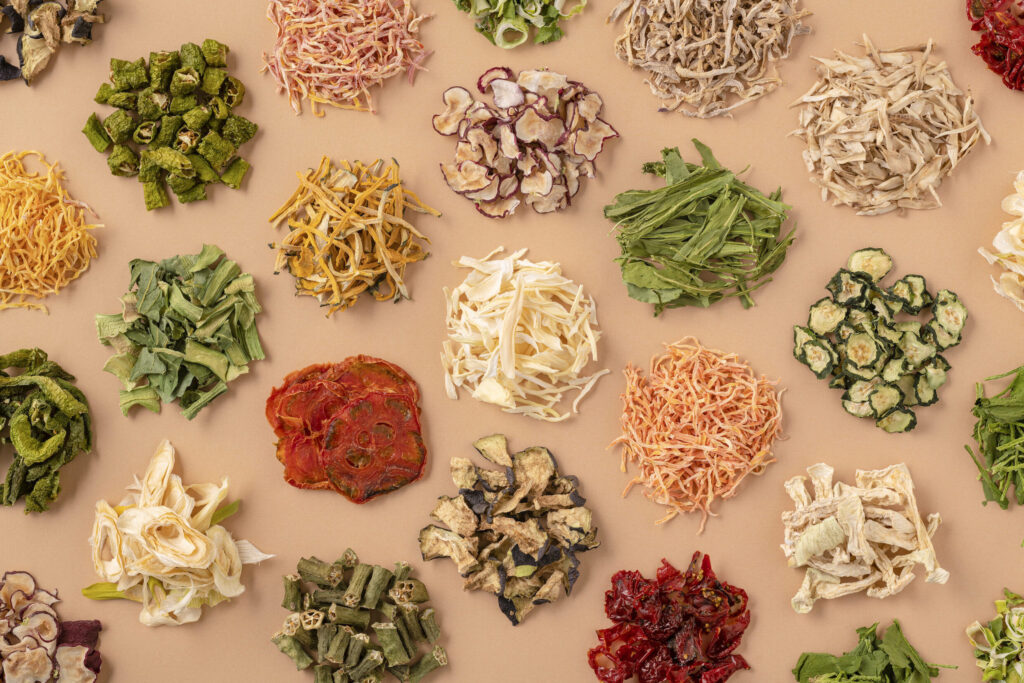
- Sold in small lots from 1 kg
- Handling heirloom vegetables from across Japan
- Dried fruits and herbs also supported
Features of commercial dried onion
Spring new onions as the raw material
Uses tender spring new onions that have overwintered to store up sweetness. With a sugar content different from ordinary stored onions, you can taste the sweetness unique to spring new onions even after drying and processing.
A melting, fluffy texture
Rehydration revives a freshness like new onion, softly melting and fluffily dissolving in the mouth. A distinctive texture unlike ordinary dried onions becomes a differentiation point on commercial menus.
Mild pungency and easy to handle
The combination of spring new onions and low-temperature drying makes it an easy-to-handle material with the pungency gently mellowed. Prep for raw onions (soaking in water and the like) is unnecessary, contributing to time savings in commercial kitchens too.
No glucose added
We use no sugar coating or additives, processing the material just as it is. It's a raw-material design that can be adopted as is in product development that wants to promote additive-free, domestic ingredients.
High sugar content makes powdering impossible
Because of the high sugar content, powdering isn't possible, but uses in slice form are wide-ranging. We can propose it as a raw material for processed goods that make use of the sugar content, such as paste and sauce bases.
Six-month storage at room temperature
It can be stored at room temperature for 6 months from the shipping date, letting you offer the taste of spring new onions year-round. Compared with fresh goods that require refrigeration or freezing, it offers major advantages in inventory management and logistics costs.
Product specifications
|
Item |
Details |
|---|---|
|
Raw material growing region |
Kyoto Prefecture (partner farm) |
|
Specification |
Shredded slices |
|
Storage method |
Room temperature (store away from high heat and humidity) |
|
Best-before date |
6 months from the shipping date |
|
Minimum lot |
From 10 bags / 100 g |
|
Powder |
Not possible due to the sugar content |
|
Manufacturing period |
July |
Customization support
At Agriture, cooperation with partner farms and our own processing facility achieve a stable raw material supply and high-quality manufacturing. We can flexibly handle OEM manufacturing and welcome consultations on specification changes and packaging. Custom-size handling (cut-thickness change, shape adjustment) is available for consultation from orders of 10 kg or more, and for large-lot manufacturing please consult us three months before the manufacturing period.
POWDER
For those looking for other vegetable powders
Because dried onion has a high sugar content and isn't suited to powdering, we offer an abundant lineup of other dried-vegetable powder products. If you're looking for powder raw materials—soup bases, seasoning ingredients, drink mixes, and the like—please see here.
Commitments to variety, grower, and growing region
The raw material used in our dried onion is the Melon Onion grown at a partner farm in Kyotango, Kyoto. It's a popular item at the partner farm, distinctive for a sweetness so pronounced you won't shed tears even when prepping it raw—so popular that people who've tried it once go all the way to the field to buy it. At Agriture, we offer a special commercial raw material that locks this sweetness in through drying.
BRAND
Variety: Melon Onion. A popular item at the partner farm, distinctive for a sweetness so pronounced you won't shed tears even when prepping it raw. As a spring new onion that overwinters to gain sugar content, it's a special variety a cut above ordinary onions.
PRODUCER
Producer: A partner farm. A farm that aims for agriculture kind to the environment and to people, cultivating produce using its own homemade compost. The Melon Onion is the farm's signature product, so popular that repeat customers come directly to the field to buy it.
REGION
Growing region: Kyotango City, Kyoto Prefecture. In a climate where winter cold draws out sweetness, they're cultivated slowly in the field until the spring harvest time. The temperature swings characteristic of the Sea of Japan-side climate naturally raise the onions' sugar content.
CULTIVATION
Cultivation method: Eco-conscious cultivation using homemade compost, with an emphasis on the nutritional balance of the soil. Through farming methods that curb the use of chemical fertilizers and pesticides, it's a cultivation policy that draws out the onion's natural sweetness to the fullest.
*Reference: OYAOYA product page
Low-temperature drying technology and quality control
Drying and processing onions is a high-difficulty task because of the high sugar content. Since ordinary high-temperature drying scorches the sugar, producing a caramel smell or leaving the surface sticky, at Agriture we operate a low-temperature drying program dedicated to onions. By taking time to remove moisture slowly, we achieve the distinctive "melting, fluffy" texture while retaining the sugar.
💡 TIPS | Drying-processing trivia
For high-sugar vegetables like onions, humidity management is especially essential in the drying step. Drying in a high-humidity environment causes the sugar to draw moisture from the air and become sticky, so at Agriture we rigorously manage the humidity inside the drying room.
Use cases and adoption examples
As a base for soups, stews, and simmered dishes
It has an abundant adoption track record at food makers and on retort- and frozen-food production lines as a base raw material in place of fried onions or sautéed onions. The process of sautéing raw onions until amber requires heat management and time, but with dried onion, room-temperature storage and stable supply are possible, greatly cutting prep labor. Because we can provide it in cut shapes to match the application—slice, mince, flake, and more—it can accommodate a wide range of product designs, such as soup bases, sauces, and curry roux.
As a filling for bread, quiche, and gratin
A case adopted at bakeries, confectionery makers, and deli makers in quiche and gratin products for the purpose of stable filling sourcing and reduced prep labor. With raw onions, peeling, cutting, and sautéing become a burden on-site as prep volume increases, but with dried slices, you can take out just the amount needed while keeping it at room temperature and knead it into the dough, and a moist texture and sweetness remain even after baking. Because the shape can be chosen from several—slice, mince, and more—to match your request, we can discuss specs suited to the product concept and production method.
As a material for frozen and Western-style prepared foods
A use where adoption is advancing at chilled and frozen-food makers and on deli and prepared-food OEM lines. With raw onions, waste loss occurs easily due to fluctuations in prep volume, and cutting prep labor is an on-site challenge, but with dried slices, you can keep it in bulk at room temperature, use just the amount needed, and easily adjust the formulation. Because it maintains a viscous texture even after reheating, a spec that can be added directly to Western-style prepared foods like hamburg steak, curry, and gratin without rehydrating contributes to production-line efficiency.
OEM product raw material and sauce base
A use you can make the most of as a base material for a secret depth of flavor, at food makers producing commercial seasonings and sauces and at deli OEMs. With raw onions, quality unevenness at lot sourcing and the time and equipment cost of the sautéing step become a burden, but with dried onion, bulk sourcing at room temperature and fixed-quantity dosing are possible, suiting stable blending into demi-glace sauce, curry sauce, onion paste, and the like. Because grinding grade and shapes like flake and slice can also be discussed to match the application, you can achieve labor-saving prep and flavor stabilization at once.
As an ingredient for instant noodles and instant foods
A usage method aimed at cup-noodle and instant-soup makers and OEM makers handling freeze-dried foods. With raw onions, processing the tear-inducing compounds and hygiene management of the cutting line take labor, but with dried slice and dice, it can be stably stored at room temperature and fed smoothly into the production line. The fluffy texture and sweetness after rehydration pair well with premium-line instant products, so you can make use of it as a differentiating material for high-value-added lines.
Commercial usage and rehydration
Dried onion can also be used as is, without rehydrating, sprinkled on salads or added to soups. Regardless of Japanese, Western, or Chinese cuisine, it can be used in a wide range—soups, takikomi rice, pickles, dressed dishes, and more—a versatile commercial raw material usable in a variety of dishes without a knife.
When rehydrating with water, about 5–10 minutes is the guide. For simmered dishes, it can be added directly without rehydrating, and letting it soak up the dashi lets the onion's sweetness dissolve through the whole dish. When kneading it into bakery dough, mixing it with the flour after a light rehydration keeps the texture and sweetness cleanly intact even after baking.
Related cases and articles
- Vegetable Broth × Dried Vegetables to Boost Umami: Pro Tips on Use and Selection (OEM article)
- How to Make Vegetable Broth | Straight from the Pros: Basics and Tips for Drawing Out Maximum Umami (OEM article)
- Vegetable Dashi [Commercial] Complete Selection Guide|The secret to elevating your restaurant's flavor (OEM article)
Product catalog showing the items we handle
Flexible support from small lots to large lots
- Sold in small lots from 1 kg
- Handling heirloom vegetables from across Japan
- Dried fruits and herbs also supported
Frequently asked questions
Q. What is the minimum lot and prototype handling?
A. Orderable from 10 bags (in 100g units). OEM prototyping can be discussed from 10kg and up. For large orders for soup makers and bakeries, cut spec, packaging, shipping units, and the like can be customized to the project.
Q. What is the price range?
A. Because we use the special variety Melon Onion, the unit price is higher compared with ordinary distributed dried onions. However, it's a raw material whose distinctive sweetness and fluffy texture make it easy to raise the product's selling price. Please consult us via the inquiry form for a specific quote.
Q. What is the lead time?
A. Stock items can be shipped 1–2 weeks after order. The onion production period is July, with batch processing timed to the spring-to-early-summer harvest. For large lots, please consult us 3 months before the production period.
Q. Can you issue a raw-material origin certificate?
A. We can issue a certificate of origin stating the raw material is grown in Kyotango, Kyoto. We can also accommodate labeling such as "uses Kyoto-grown onions" or "uses domestically grown onions" on product packaging. We also support compliance with the Food Labeling Act.
Q. Can you submit pesticide residue results or analysis tables?
A. We can submit quality-result documents such as microbiological testing and general compositional analysis. Our partner farms work on cultivation that curbs chemical-pesticide use, and we have a framework able to meet quality requirements on OEM projects too. Please consult us in advance on the items you need.
Q. Can you handle HACCP and export?
A. Our own factory can submit HACCP-compliant documentation. Export projects are handled case by case, but we have a track record of overseas OEM product development as Kyoto-grown dried vegetables.
Q. Please tell me the OEM consultation flow
A. We proceed in the flow of inquiry → concept hearing → sample dispatch → paid prototyping → spec finalization → main production. For soup, bakery, and frozen-prepared-food projects, we provide hands-on support that includes heating tests and flavor evaluation from the prototype stage.
RETAIL
For those looking to purchase in small packs
For prototype use or personal consumption, small-quantity packs can also be purchased at the online shop of our sister brand OYAOYA. It is recommended for those who want to check the flavor and texture with a small quantity before commercial use.
Medicinal-food (yakuzen) benefits (in the case of fresh onion)
In the world of yakuzen, onions are positioned as "an ingredient that warms the body and promotes blood flow." As a dependable vegetable that warms the body from within and replenishes energy when added to stir-fries and soups, they appear frequently in yakuzen recipes.
Spring new onions are juicy and strongly sweet, and because they're low in pungency, they suit raw eating too. Storage onions, on the other hand, have solid pungency, and heating increases their sweetness and brings out a rich flavor. Their taste changes through the year, making it a versatile vegetable easy to use in any season.
💡 TIPS | Yakuzen trivia
In yakuzen, onion is considered an ingredient with pungency and sweetness and a warming nature. As an ingredient that warms the body and helps blood circulation, it's a vegetable easy to incorporate when you feel chilly or tired. Simmering or stir-frying it slowly brings out the sweetness for a dish that's also gentle on the body.
Dried onion, with less moisture than raw onion, brings out even more flavor when simmered slowly in cooking. We also receive inquiries from commercial users who choose ingredients from a yakuzen perspective, as a supporting raw material for warming soups and menus that warm the body.
YAKUZEN
For those who want to know more about onion from a yakuzen perspective
On our sister site Yasai Yakuzen, which introduces recommended ingredients by constitution and yakuzen recipes, we explain onion's benefits and how to incorporate it in more detail. We also introduce ways to eat it by season and tips for combinations.
Recommended reading
- Vegetable Broth × Dried Vegetables to Boost Umami: Pro Tips on Use and Selection (OEM article)
- How to Make Vegetable Broth | Straight from the Pros: Basics and Tips for Drawing Out Maximum Umami (OEM article)
- Vegetable Dashi [Commercial] Complete Selection Guide|The secret to elevating your restaurant's flavor (OEM article)
- Onion powder
Download the product catalog
We will send the materials to your email address based on the information you provide.