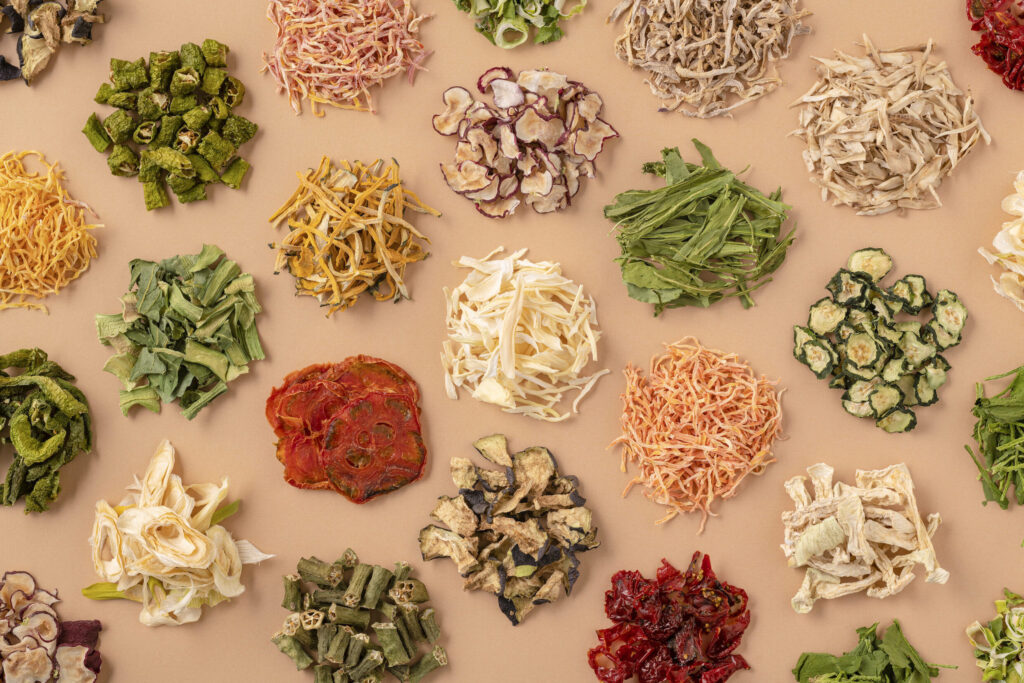
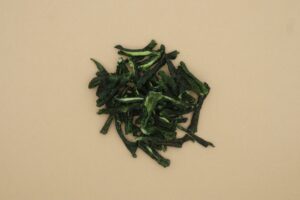
Nameko is a mushroom characterized by its distinctive slipperiness and aroma, an essential ingredient for miso soup and simmered dishes. Our dried nameko dries Japanese-grown nameko at low temperature, reproducing its characteristic slipperiness and umami when rehydrated. Easy to handle and long-keeping, it is ideal for commercial soups, prepared foods, retort foods, and the like.
TOC
Three Commitments Behind Our Dried Nameko
Agriture's dried nameko is built with thorough quality design so it can be adopted as a commercial ingredient. Here we introduce three points we regard as particular strengths.
01 In-house management of Japanese-grown nameko through primary processing
Using Japanese-grown sawdust-cultivated nameko as raw material, we minimize the lead time from harvest to primary processing. As a specialist plant handling nameko, which is high in moisture and viscosity, we arrange the processing steps with quality stability as the top priority.
02 A drying design that lets the slipperiness come back
The slipperiness and umami characteristic of nameko will not return if the drying conditions are wrong. At Agriture, through low-temperature hot-air drying with finely adjusted temperature, airflow, and time, we achieve a finish where the viscosity and umami firmly return upon hot-water rehydration.
03 Additive- and glucose-free for easy handling
The only raw material is nameko. It is processed using no bleaching agents, sugars, or preservatives. The specification is easy to adopt even for retort, prepared-food, and care-food makers who require transparency in ingredient declarations.
We summarize, from six perspectives, what advantages there are in choosing dried nameko as an OEM ingredient. Use it as a reference both for replacing existing materials and for new-product development.
Nameko whose viscosity revives when rehydrated
Hot-water rehydration reproduces a viscosity and texture close to raw nameko. It is a material that can take a leading role in Japanese cuisine such as miso soup, soba, and udon.
A staple ingredient for miso soup and prepared foods
Rehydrated nameko is ideal for prepared dishes and soups with real ingredient presence. It is widely adopted as an ingredient for retort miso soup and packaged rice.
Long-term storage enables year-round supply
Room-temperature storage with a best-before period of six months. Drying short-season fresh nameko makes inventory planning and cost management much easier.
Powdering develops it into stock and umami materials
Powder-processed, it can also be applied to mushroom dashi, soup bases, seasonings, and more, letting a single ingredient handle multiple formats.
Clean-label compatible
Additive-free with a simple ingredient declaration. It is a raw material that can be built as-is into natural, health-conscious OEM product development.
One-stop from prototype to volume production
We can handle everything from 1 kg prototypes to 10 kg or more in full production. Individual adjustment of cut specification and packaging is also covered on our own line in Kyoto.
Product specifications (commercial)
The product's basic specs are as follows. Cut specifications and packaging specs can be individually adjusted on a contract basis, so please consult us to match your OEM requirements. We have organized raw-material origin, best-before date, production method, and minimum lot so they can be checked at a glance.
Item
Details
Raw material
Nameko (domestically grown)
Net content
100g (commercial unit)
Production method
Low-temperature hot-air drying
Best-before date
About 6 months from production
Annual supply volume
About 100kg (varies by season)
Processing plant
Factory in Kyoto Prefecture
Shipping unit
100g〜
Minimum-lot OEM
Prototype from 1kg / full production from 10kg
Customization support
For each OEM project, we respond flexibly to changes in cut shape, powdering, small-lot prototyping, blending, and packaging specs. In addition to the response table below, please consult us about individual adjustments to match your requirements.
Item
Available
Details
Size change
◎
Whole, sliced, ground, and more available
Powdering
◎
Fine-powder processing available
Small-lot OEM prototyping
◎
Available from 2kg
Mixed materials and blends
◎
Blending with other raw materials available
Packaging changes
◎
Both commercial and individual packaging available
POWDER
We also offer powder products
At Agriture, we also handle powder processing of dried nameko. From the vegetable powder list, you can also check combinations with other ingredients and processing examples.
Agriture's dried nameko keeps quality stable through procurement from partner farmers and contract regions. Please also refer to this when you want to make use of origin information at the product-planning stage.
BRAND
Variety: Japanese-grown sawdust-cultivated nameko. We select lots with strong slipperiness and aroma.
PRODUCER
Producer: We work with domestic partner farmers as cultivation partners. We have built a system for direct-from-farm shipping that advances to primary processing in a short time.
REGION
Growing region: Domestic growing regions (multiple prefectures). We procure from multiple cultivation sites, prioritizing stable supply.
CULTIVATION
Cultivation method: Sawdust cultivation is central. We use nameko of consistent grade grown in a managed cultivation environment.
Low-temperature drying to protect the ingredient's natural flavor
At Agriture, to protect nameko's aroma, color, and umami, we use low-temperature hot-air drying with finely controlled temperature and airflow. Our strength lies in retaining components easily lost in high-temperature drying, through process design matched to the material's nature.
Because we manage the whole process—from raw-material receipt to sorting, cutting, drying, and inspection—integrally at our own processing facility in Kyoto, we can keep lot-to-lot quality variation to a minimum. Combining procurement from partner farmers and contract regions lets us enter the drying process while the raw material is highly fresh, which also directly bears on the quality of the finish.
Commercial use cases
Because dried nameko has ample aroma, texture, and umami even on its own, it can develop into multipurpose product development with a single ingredient. Here we introduce five representative scenarios.
Miso soup and soup ingredient
As an ingredient for nameko miso soup, mushroom soup, soba broth, and the like. Because the viscosity and slipperiness firmly remain after rehydration, it is prized as a commercial soup ingredient.
Prepared-food and simmered-dish ingredient
A staple ingredient in Japanese prepared dishes such as mushroom ankake, dressed nameko with grated daikon, and ingredients for soba and udon.
Retort and freeze-dried foods
As an ingredient for retort miso soup, freeze-dried soups, and packaged rice. Its long-keeping quality and ease of rehydration are valued.
Seasoning and stock material
Powdered, it can be developed into mushroom dashi, umami seasonings, mentsuyu bases, and the like, offering the convenience of a single ingredient usable across multiple product lines.
Functional foods and health foods
A mushroom ingredient that's easy to develop into health-conscious foods and drinks.
Staple prep at Japanese-cuisine businesses and hotel kitchens
It is also used at inns and Japanese restaurants as a prep material for standard menu items such as "nameko oroshi" and "kenchin-jiru." Long-keeping and stable yield are its strengths.
As an ingredient for vegetable teas and blend teas
Because dried vegetables produce flavor even when extracted on their own, they are adopted in many products as ingredients for blend teas and Japanese herbal teas. At Agriture, we support everything from OEM ingredient supply to recipe design for tea brands.
See details of our tea OEM service here
As an ingredient for flavored coffee and Kyoto-vegetable coffee
Adding Kyoto-vegetable dried material to drip bags or canned coffee lets you develop distinctive flavored coffee that no other company has. At Agriture, coffee OEM built around Kyoto-grown ingredients can also be discussed.
See details of our coffee OEM service here
Commercial usage and case examples
For commercial use, we can handle everything from 1 kg prototypes to 10 kg or more in full production. We have a track record of adoption as an OEM ingredient by miso-soup makers, retort-food makers, and prepared-food makers.
At Agriture, we provide seamless support on our own line in Kyoto, from raw-material selection through primary processing, cutting, powdering, blending, and portioned packaging. Because we can accommodate spec adjustments to OEM clients' specification sheets and recipe design for new brand launches, you can entrust everything to us with confidence, from the prototyping stage through mass production and continuous supply.
First-time inquiries and consideration of switching from existing materials are also welcome. For sample provision, quotes, and technical questions about the manufacturing process, please feel free to contact us via the inquiry form.
Related initiative cases and reference articles:
We have gathered the questions we are asked most often about OEM and commercial dried nameko. Please use them as a reference for your decision before contracting.
Q. About what are the minimum lot and unit price?
A. Prototyping starts from 1 kg, and full production from 10 kg as a guide. Unit price varies with the processing format—whole, sliced, or powder—and packaging specification. Please request a quote via the inquiry form.
Q. When is the price / unit price determined?
A. It varies each time with the nameko market rate and contract quantity. For annual contracts, the unit price at the time of contracting is the basis; for spot transactions, we present pricing each time.
Q. About how long are the delivery time and lead time?
A. Around two weeks for stocked items, and three to six weeks for full production as a guide. If there are additional steps such as blending or powdering, we will advise a separate lead time.
Q. Can you provide raw-material origin certification or origin information?
A. We can prepare origin information certifying that it is Japanese-grown. It can be used as-is for explanatory materials for OEM clients and buyers. Please specify inspection items at the time of consultation.
Q. Can you handle HACCP and export requirements?
A. Our production line complies with HACCP. We also handle preparation of English-language documents and hygiene certificates.
Q. What is the flow for an OEM consultation?
A. We proceed in the flow of (1) inquiry, (2) requirement hearing, (3) sample provision, (4) quote and contract, (5) prototype, (6) full production, and (7) delivery.
CEO of Agriture Inc. Runs a contract processing and OEM business centered on dried vegetables and dried fruit. In partnership with farmers within Kyoto Prefecture, he pursues “sustainable food distribution” through the use of non-standard vegetables and support for sixth-industrialization. Drawing on extensive hands-on experience at manufacturing sites, he provides support that walks alongside every business considering OEM—from product planning and prototyping to small-lot handling, packaging design, and sales-channel development.