
How to choose commercial vegetable dashi: comparing across three axes of ingredient, format, and scope

Summary of this article
Covering the selection axes for commercial vegetable dashi (ingredient, form, scope of support), design that balances cost and quality with dried vegetables, a design matrix by business type, Agriture's Kyotango and Momotaro dashi-use dried-tomato example, and the commercial OEM lineup.
Commercial vegetable dashi has become an essential ingredient for restaurants and processed-food makers to maintain flavor reproducibility while meeting "vegan / halal support," "salt-reduction appeal," and "designs that avoid chemical seasonings." When selecting, the basics are to compare along 3 axes: ingredient grade (growing region, variety, drying method), form (powder / concentrated liquid / dashi pack / granule), and scope of support (plant-based / halal / no five pungent roots / salt reduction).
This article organizes the selection axes for commercial vegetable dashi, balancing cost and quality, meeting the diversification of inbound tourism, and actual examples of the commercial supply Agriture handles with Kyotango-grown ingredients (dashi-use dried tomato, dried Kujo negi). For the basics, Introduction to plant-based dashi; for how to make the home version, How to make vegetable dashi; for making use of dried vegetables, How to make use of vegetable dashi × dried vegetables please also refer to.

TOC
The selection axes for commercial vegetable dashi
When choosing commercial vegetable dashi, compare along 3 axes: "ingredient," "form," and "scope of support." If any of the 3 axes is vague, it tends to become an ingredient that's hard to use on-site or whose appeal weakens.
The list of the 3 selection axes
When reading this table, the shortcut is to fix the "scope of support" first, then drill down into "ingredient" and "form." Trying to widen the scope of support later requires rebuilding the ingredients, certification, and lot management.
| Axis | Check item | Points of judgment |
|---|---|---|
| Material | Growing region, variety, drying method, certification | Whether lot-to-lot flavor variation can be held down |
| Form | Powder / granule bouillon / concentrated liquid / dashi pack | Whether it suits the kitchen or factory operation |
| Scope of support | Plant-based / halal / no five pungent roots / salt reduction | Whether it meshes with the store's or product's appeal axis |
Ingredient axis: quality determined by growing region, variety, and drying method
In commercial use, going beyond just "which vegetable" to "which variety" and "what drying method" holds down lot variation. Agriture specifies the Momotaro variety (large fruit) for its Kyotango dashi-use dried tomato because the gel portion of large-fruit types is high in glutamic acid, suited to dashi-oriented umami design.
- Fixing the growing region: because flavor changes with climate and soil, narrowing the growing region reduces lot variation
- Fixing the variety: guarantee reproducibility with variety specification—Momotaro for large-fruit tomato, Kujo negi for leaf negi, and so on
- Low-temperature drying: a process that suppresses volatilization of taste and aroma, so flavor survives well after rehydration
- Certification: choose a factory that meets certifications needed for processed-food OEM and export, such as HACCP, FSSC22000, and ISO
Form axis: match it to on-site operation
Commercial vegetable dashi changes greatly in usability by shipping form. Narrowing by whether it suits the kitchen or factory operation lets you read whether the site will run smoothly.
| Form | Features | Suitable site |
|---|---|---|
| Dried vegetable ingredients | Brew it yourself in-house. Lets you highlight the ingredients | Restaurants, ramen shops, premium menu items |
| Dashi pack (powder) | Non-woven pouches filled with vegetable powder plus dried ingredients | Batch cooking, seasoned rice, miso soup |
| Granular bouillon | Complete with salt, sugar, and amino acids included | Speed-focused, chain restaurants, home use |
| Concentrated liquid | Vacuum-concentrated brewing liquid (processed by a partner plant) | Processed foods, plant-based ramen factories |
Scope axis: match it to your positioning
Plant-based, halal, gogun-free, and reduced-salt each require different conditions depending on how far your shop or product needs to cover. Deciding your positioning first and then locking in ingredients keeps the selection from drifting.
- Plant-based / vegan: excludes animal-derived ingredients and honey
- Halal: no pork-derived ingredients or alcohol. Certification depends on the plant's lot management
- Gogun-free (shojin, Taiwanese vegetarian): fully excludes garlic chives, green onion, garlic, wild rocambole, and shallot
- Reduced-salt positioning: designed to bring out the amino acids in the ingredients to cut back on salt. An ingredient-led approach works better than granulated bouillon here
Using dried vegetables to balance cost and quality
When you run vegetable dashi in a commercial kitchen, making dried vegetables the lead ingredient makes it easier to balance cost, quality, and shelf life. It curbs the seasonal swings and waste that come with buying fresh vegetables while keeping flavor consistent.
Why dried vegetables improve operational efficiency
- Shelf life: 6 months to 1 year at room temperature. Doesn't crowd your fridge
- Portioning: you take out only what you need, so there's less waste than with fresh vegetables
- Faster prep: brew dashi just by rehydrating, without pulling out a knife or cutting board
- Stability in the off-season: even when fresh vegetables are scarce or expensive, you can secure consistent quality and cost year-round
Lot management that prevents flavor drift
In commercial use, keeping flavor from drifting across seasons directly drives repeat customers. Choosing dried vegetables with fixed origin, variety, and drying method reduces flavor drift compared with fresh vegetables and keeps the quality of your shop or processed product consistent. In its commercial OEM work, Agriture records raw-material data for each lot and supplies with a system that lets you trace the source of any flavor drift.
The ingredients include Celery・Carrot・Onion・Tomato staples like these, along with additive-free raw materials and small-lot supply in dashi-pack formats. This article also lays out recommended combinations and uses by business type.
- Origin (e.g. Kyotango-grown)
- Variety (e.g. Momotaro / Kujo green onion)
- Drying conditions (temperature range, drying time)
- Harvest timing, sourcing farm
Design examples by business type
As inbound visitors' eating habits diversify, restaurants gain more from keeping an animal-free dashi on hand. But no single type covers everything: vegan, halal, and shojin each carry different raw-material restrictions and certification conditions depending on the scope. The practical approach is to separate what a shared base can cover from what needs a different formulation.
Quick-reference chart of designs by business type
The essential requirements and recommended composition change with each business type. A workable structure is to keep dried vegetables plus kombu plus dried shiitake as a shared base, then add restrictions or certifications as needed.
| Scenario | Requirements | Selection point |
|---|---|---|
| Vegan ramen shops | Rich broth with no animal ingredients | Dried large tomato plus dried shiitake plus dried onion |
| Halal restaurants | No pork or alcohol, certification required | Supply from a halal-certified plant |
| Shojin cuisine / vegetarian | Gogun-free, no animal ingredients | A gogun-free composition such as kombu plus dried shiitake plus dried carrot |
| Reduced-salt hospital and care meals | Cut the salt while keeping satisfaction | Dashi packs and powders that draw on the amino acids in the ingredients |
Flexibility in menu development
Keeping vegetable dashi as a base lets you reuse it as a foundation for new menu development. But some dishes work from the shared base and others need a separate formulation, so you have to draw the line on how far one type can carry you.
| Works from the shared base | Needs a separate formulation |
|---|---|
| Miso soup, simmered dishes (Japanese cuisine) | Plant-based ramen (rich broth) |
| Potage, cream soups | Halal-compliant products (certified line) |
| Base for risotto and pasta | Gogun-free shojin cuisine |
| Seasoned rice, rice porridge | Processed foods using concentrated liquid |
Agriture's commercial vegetable dashi OEM
Agriture supplies commercial dried vegetables, vegetable powders, and dashi ingredients through its production sites in Kyotango, Kyoto and in Nagano, Mie, Ehime, and Okinawa, together with partner plants. From restaurant counter use to processed-food OEM, it can build the whole chain from ingredients through formulation to filling (projects requiring a certified plant, or concentrated liquid, are handled on the partner-plant side).
Main commercial lineup
In dashi design, you build around ingredients that supply glutamate (tomato, onion, kombu) and one that supplies guanylate (dried shiitake). Agriture's lineup is assembled to make it easy to choose which element you reinforce and where.
| Material | Origin and characteristics | Suited use |
|---|---|---|
| Dashi dried tomato (Momotaro) | Kyotango, Taniyoshi Farm / off-spec ripe fruit, low-temperature dried | Plant-based ramen / Western-style soups / pasta |
| Dried Kujo green onion | Kyoto-grown leaf onion / aroma plus sweetness | Chinese soups / ramen / hot pot |
| Dried onion | Domestically grown / toasty notes and sweetness | Bouillon / curry / worked into hamburg steak |
| Dried carrot | Domestically grown / sweetness and depth | Miso soup / simmered dishes / seasoned rice |
| Vegetable powder (30-plus kinds) | Domestic blend / original formulation available | Dashi packs / granulated bouillon / fish-paste products |
A dashi dried-tomato case study
Released by Agriture in 2024 and supplied as a staple line ever since, dashi dried tomato is not just a dried tomato but an ingredient whose variety and drying conditions were locked in as a dashi-specific design. We break it down across three angles: raw material, drying, and use.
Raw-material conditions
Large tomatoes (Momotaro) from Taniyoshi Farm in Kyotango. We source fully ripe fruit that rises in sugar content but can't ship to market, achieving both food-loss reduction and a supply of dashi-suited ingredients. Large tomatoes carry a lot of glutamate in the jelly portion; whereas small varieties (cherry tomatoes) lead with flesh sugar, large varieties suit an umami design geared to dashi.
Drying conditions
Low-temperature drying (in the 50-60°C range), designed to curb the loss of taste and aroma compounds. Variety traits and drying temperature are aligned so the balance of glutamate umami and acidity survives rehydration.
Suited use
Rich broth for plant-based ramen / a base for Western-style soups and minestrone / a foundation for pasta sauces. Used where you want a glutamate-led richness without animal ingredients.
Information worth sharing at the OEM consultation
- Product concept (plant-based / halal / reduced-salt, etc.)
- Intended sales channel (restaurant counter / processed-food OEM / e-commerce) and lot size
- Preferred format (ingredient / dashi pack / granule / concentrated liquid)
- Certification requirements (HACCP, FSSC 22000, halal, etc.)
- Schedule worked back from your planned launch date
We have materials available to help you understand dried processing OEM
Agriture OEM, flexibly handling everything from small lots to large lots
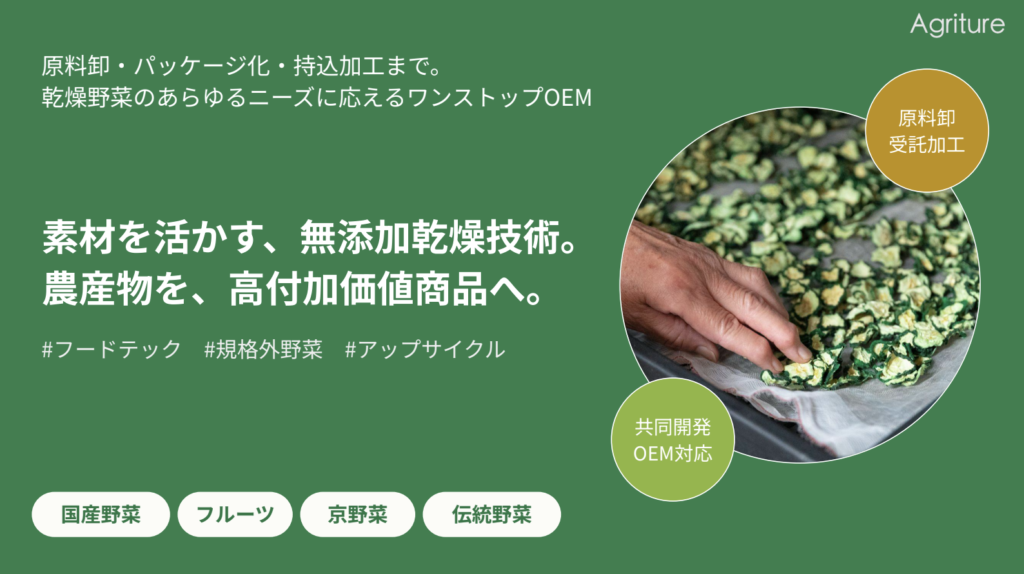
- OEM available from small lots of 10 kg
- Drying of brought-in raw materials also possible
- Support from processing to filling in one place
FAQ
What should you look at first when choosing a commercial vegetable dashi?
The shortcut is to decide your positioning scope first (vegan / halal / reduced-salt, etc.), then narrow down ingredients and format. Trying to widen the scope later means re-selecting ingredients, which balloons time and cost.
How do you choose between the concentrated type and the instant (granule) type?
The concentrated type is diluted before use, so it's cost-effective for batch cooking and suits processed-food factories and ramen shops. The granule type is finished with salt, sugar, and seasonings included, so it suits speed-focused chains and home-use products. If you want to lead with an ingredient story, self-extraction from dried vegetable ingredients becomes the point of differentiation.
Is halal certification required?
It's required if you want to formally promote a product as "halal-certified." On the other hand, if you're simply being considerate of raw materials for Muslim customers, one option is to work without certification by confirming a line free of pork-derived ingredients and alcohol preparations and by disclosing that information. Requirements shift with how far you push the positioning, so deciding the line at the planning stage makes selection smoother. Agriture handles projects requiring certification through its partner plants.
What's the benefit of using vegetable dashi in reduced-salt menus?
The glutamate in vegetable dashi works together with saltiness to raise satisfaction, so you can design a dish that doesn't feel lacking even with less salt. It's used as a base ingredient that keeps satisfaction up despite reduced salt in hospital meals, care meals, and health-conscious chains.
Can we consult about commercial OEM starting from small lots?
Yes. Agriture combines small-lot Small-pouch filling OEM with formulation design for vegetable dashi and dried-vegetable blends, supporting the path from test-sale scale to full commercialization. It's a hybrid operation, switching between in-house handling from 10 bags and mass-production lines at partner plants. Food OEM no Madoguchi (Agriture) Please consult us.
Summary
Choosing a commercial vegetable dashi comes down to three axes: ingredients (origin, variety, drying method), format (ingredient / dashi pack / granule / concentrate), and scope (plant-based / halal / gogun-free / reduced-salt). Making dried vegetables the lead ingredient makes costs easier to project even in the off-season, and gives you an ingredient that slots readily into reduced-salt or vegan formulation design.
The fundamentals are laid out in Introduction to plant-based dashi, and for how to make it, see How to make vegetable dashi, and using dried vegetables in Vegetable dashi × dried vegetables. For OEM inquiries, Food OEM no Madoguchi (Agriture).
Download the OEM contract processing materials
We will send the materials to your email address based on the information you provide.
If you are considering product development with off-spec or your own farm's vegetables:From planning to processing, materials, package printing and novelties, you can consult us through a single point of contact. → Learn more about one-stop product development
FOR BUSINESS
乾燥野菜のOEM・受託加工を承ります
国産の野菜・果物の乾燥、100メッシュ相当までの粉砕、10g以上の小袋充填までをお受けしています。小ロットの試作から量産までご相談ください。寄せられた相談の実例は OEM・卸のご相談 に掲載しています。
乾燥品の賞味期限は、出荷日から6ヶ月程度を目安にご案内しています。
Author of this article
Related articles
-
 Original coffee marketing strategy | Ways to grow sales
 -
 ベジタリアンとは?国の規格が分けている4つの区分と食べられないもの
 -
 長ねぎと白ねぎは同じもの?ねぎの種類と呼び名を国の資料で確かめる
 -
 柚子の種類は何種類あるのか、公の資料で名前が残る系統を数えた
 -
 ゆずの時期は年に二度、青ゆずは7月から黄ゆずは10月から
 -
 ゆずの産地は高知が半分を占め、二位は徳島から愛媛に変わった
 -
 Preventing Food OEM Failures: Common Failure Cases and Countermeasures for Success
 -
 How to find a food OEM | How to efficiently find the best manufacturing partner