Dried Tamogitake

Dried tamogitake is a commercial ingredient made by turning the edible mushroom "tamogitake (Pleurotus cornucopiae var. citrinopileatus)"—distinctive for its vivid yellow color—into a raw material by drying. Known as a mushroom that yields deep umami and dashi, its flavor is locked in through low-temperature drying. At Agriture, we also develop it into slices, crushed pieces, and powder (made to order) according to the application, proposing a division of use: dried tamogitake for applications where you want to retain the shape as an ingredient, and crushed pieces or powder for dashi and powder blending.
Compared with other dried mushrooms such as enoki and nameko, tamogitake can distinguish itself with its "vivid yellow appearance," its "deep umami and dashi," and its "rarity, with low distribution volume that makes differentiation easy." It's a material we get many prototype inquiries about—as an ingredient for miso soup, soup, hot pot, dashi packs, takikomi rice, and processed mushroom products.
TOC
Three points of pride in Agriture's dried tamogitake
1. Low-temperature drying that makes the most of umami and aroma
The appeal of tamogitake is the deep umami that comes out in the rehydrating liquid and its mushroom-like aroma. At Agriture, we design the process to hold down the drying temperature and remove moisture in a short time, keeping as much of the umami and aroma in the finished product as possible. The way rich dashi comes out when rehydrated is a factor that shapes the quality of the final miso soup, soup, and hot pot.
2. A shape from which dashi comes out easily
Tamogitake is trimmed into slices or crushed pieces to match the application before drying. Slices suit use as an ingredient in miso soup, hot pot, and takikomi rice, while crushed pieces and powder suit dashi packs, soup bases, and powder blending. By switching shapes, you can use it for different purposes—a sense of the ingredient, or ease of extracting dashi.
3. Choosing domestically grown tamogitake for ingredient production
At Agriture, we use domestically grown tamogitake and turn it into an ingredient by assessing its color, cap uniformity, and freshness. Precisely because it's a material with low distribution volume, a raw material with a visible growing region makes traceability easy to design—one of the reasons it's chosen in the prototypes of dashi and mushroom-product makers.
Product catalog showing the items we handle
Flexible support from small lots to large lots
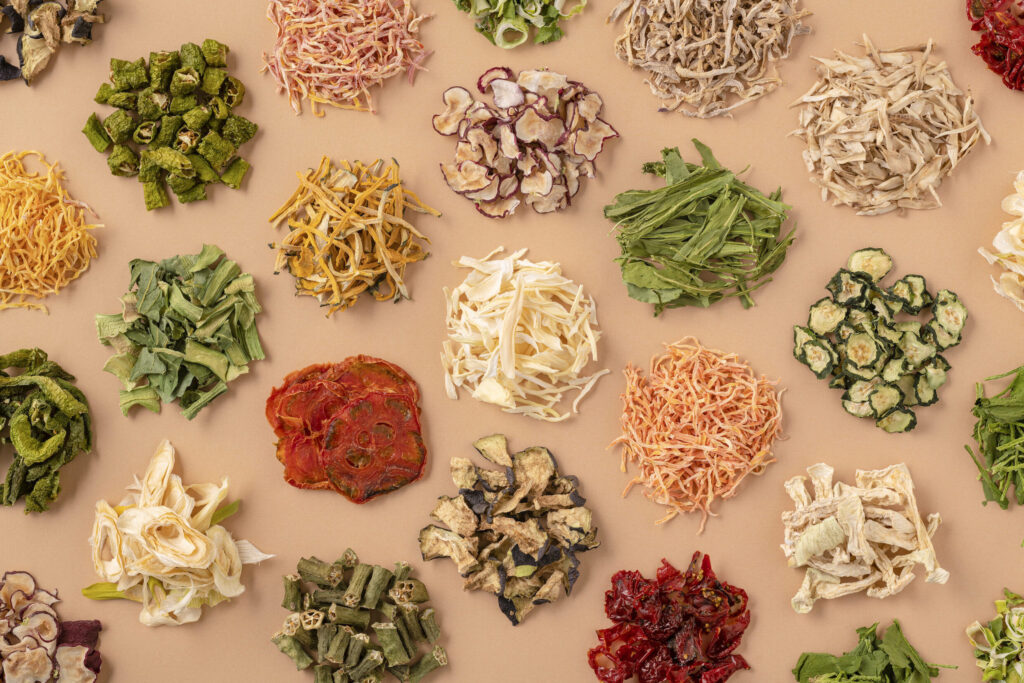
- Sold in small lots from 1 kg
- Handling heirloom vegetables from across Japan
- Dried fruits and herbs also supported
Features of commercial dried tamogitake
Even among mushroom-type dried materials, tamogitake holds a distinctive position with its yellow appearance, rich dashi, and rarity. We organize the strengths of dried tamogitake across six perspectives.
A vivid yellow appearance
Tamogitake is a rare mushroom with a vividly yellow cap. It can add color and presence unlike other mushrooms within soups, hot pots, and mushroom mixes.
Deep umami and dashi
Tamogitake is known as a mushroom that yields deep umami in the rehydrating liquid. It suits umami-driven product designs—dashi packs, soup bases, hot-pot broths, and more.
The rehydrating liquid can be used too
Because umami comes out in the rehydrating liquid, it can be used as is in miso soup, soup, and takikomi rice without discarding it. Using the ingredient without waste is also valued in commercial use.
Low-temperature drying that retains the aroma
A mushroom whose aroma escapes easily under high-temperature drying is dried slowly in a low-temperature range to retain aroma and umami. When rehydrated, a mushroom-like flavor rises.
Differentiation as a rare material
Tamogitake has low distribution volume and isn't a mushroom that lines supermarket shelves daily. Adding it to a mushroom-product or dashi-product line lets you differentiate from competitors.
Use together with crushed pieces and powder
By using it together with crushed pieces or powder (made to order), you can design recipes that deliver both a sense of the ingredient (slices) and blending into dashi and powder (crushed pieces, powder).
Product specifications (commercial)
Basic specifications at the prototype stage are as follows. Purchase lot, lead time, and packaging format are worked out through individual consultation.
| Item | Details |
|---|---|
| Product name | Dried Tamogitake |
| Raw material | Tamogitake (domestically grown) |
| Shape | Slices / whole. Processing into crushed pieces and powder also available |
| Appearance | The cap is yellow to pale yellow, deepening in color through drying |
| Aroma | A mushroom-like, umami-rich aroma |
| Net content | Individual quote according to use and lot |
| Best-before date | About 6 months from the shipping date |
| Storage method | Avoid high temperature, high humidity, and direct sunlight; after opening, seal and store in a cool, dark place |
| Minimum prototype lot | Inquire (prototyping from small quantities also negotiable) |
Customization support
You can consult us from the prototype stage about shape, cut size, packaging, and final commercialization. Because we nail down the recipe while keeping records, it is a setup where specifications don't drift between prototype and mass production.
| Item | Available | Details |
|---|---|---|
| Shape adjustment | Slices / whole / crushed pieces | Designed to match the application—retaining shape for ingredients, crushed for dashi |
| Powdering | Fine powder (made to order) | Suited to dashi, soup bases, and powder blending |
| Blend design | Combining with other mushrooms and vegetables | Mushroom mixes with enoki, nameko, and the like; blending with dashi materials |
| Packaging form | Commercial bulk / small bag / individual wrapping | From bulk for dashi packs to packs for ingredients |
| OEM productization | End-to-end support through the finished product | From planning to production of dashi, soup, hot-pot broth, and processed mushroom products |
For those considering the fine-powder type
For applications where you want to spread tamogitake's umami uniformly—such as blending into dashi and soup bases and powder design—the finely powdered tamogitake powder (made to order) is well suited. Please also see the list of powder raw materials.
Commitments to variety, grower, and growing region
Tamogitake is a mushroom of the Pleurotus family, an edible mushroom distinctive for its yellow cap. Enjoyed in cold regions such as Hokkaido and Tohoku, it's also cultivated. At Agriture, we make the growing region, freshness, and cap condition the axes of our ingredient design.
BRAND|The position of tamogitake as an ingredient
Tamogitake is the yellow mushroom used in umami-driven washoku and regional cuisine—miso soup, hot pot, dashi, mushroom dishes, and more. At Agriture, we translate this rich dashi and rarity into a commercial ingredient, offering it as a material usable across a wide range of final products—from dashi and soup to processed mushroom products.
PRODUCER | Basic policy for sourcing and coordination
We select lots with vivid color, uniform caps, and good freshness by coordinating directly with the growing region. At the prototype stage we source small amounts, evaluate the color retention during drying and the ease of yielding dashi, and then set up the supply line for mass-production lots.
REGION|Features of the growing region
Tamogitake is a mushroom long enjoyed mainly in Hokkaido and Tohoku, and facility cultivation has spread in recent years. Because distribution volume is low, coordination with growing regions is important for stable sourcing. At Agriture, we assess domestically grown ones by a freshness and condition suited to drying and turn them into an ingredient.
CULTIVATION|Harvest and freshness
Because tamogitake is a mushroom that loses freshness easily, sending it promptly to drying after harvest determines quality. At Agriture, we move it to the drying step swiftly after intake, striving to retain umami and color.
Low-temperature drying technology and quality control
Prompt drying after intake
Tamogitake is a mushroom whose freshness drops quickly. By moving it to the drying step swiftly after intake, we finish it under conditions that retain color and umami.
Retention of umami and color through low-temperature drying
High-temperature drying drives off aroma and dulls the color easily. By removing moisture slowly in a low-temperature range, we produce a finish in which a mushroom-like aroma and umami and the yellow color remain when rehydrated. When using it for dashi, rehydrating from cold water and heating it as is draws out the umami along with the rehydrating liquid. In miso soup and hot pot, adding rehydrated slices as an ingredient keeps the shape and texture while still letting the dashi work.
Use cases
We organize the applications we get prototype inquiries about at Agriture into six categories. Each is an example of recipe design that takes advantage of tamogitake's umami, yellow appearance, and rarity.
1. Miso soup and soup
It can be used as an ingredient-cum-dashi material for miso soup and soup. Using it along with the rehydrating liquid makes the umami work, and it can be developed into instant miso soup, soup bases, and ingredients for cup soups. It can be held as room-temperature stock, and the way it cuts prep labor is also valued in commercial use.
2. Hot pot and mushroom hot pot
It can be used as an ingredient for hot-pot broths and mushroom hot pots. The yellow appearance adds color to the pot, and the rehydrating liquid makes the dashi work. As a mushroom material for hot-pot sets and meal kits, it also suits mixing with other mushrooms.
3. Dashi and dashi packs
Processed into crushed pieces or powder, it can be used as a raw material for dashi packs and soup bases. Making use of tamogitake's deep umami, it suits umami-driven product designs as a material for mushroom dashi, vegetable broth, and Japanese-style dashi.
4. Takikomi rice and prepared side dishes
It can be used as an ingredient for takikomi rice, mushroom rice, and Japanese-style side dishes. Cooking rehydrated slices together with rice transfers the umami and aroma to the rice. It can also be developed as a material for takikomi-rice seasoning mixes and side-dish kits.
5. Retort, frozen foods, and prepared dishes
It can be built in as a mushroom material for retort soups, frozen hot pots, and meal kits. It can be stably held as room-temperature stock, and because it's pre-prepped, it cuts labor on the production line. Its short rehydration time also suits products requiring instant convenience.
6. Health-conscious and vegetable-based products
It can be used as a material for vegan and vegetarian meals and vegetable broth. Mushroom umami makes it easy to bring satisfaction even to designs that use no meat or animal-based dashi, suiting the addition of richness to vegetable soups and vegetable hot pots.
Commercial usage and rehydration
Rehydration basics
- For ingredient use: rehydrate in water for 10–15 minutes, or in hot water for 5–8 minutes. For miso soup, hot pot, and takikomi rice
- For dashi use: rehydrate from cold water and heat as is, drawing out umami along with the rehydrating liquid
- Crushed pieces and powder: use as is in dashi packs and soup bases without rehydrating
- The rehydrating liquid carries umami, so use it in soups and takikomi rather than discarding it
Blending guide
- Miso soup: rehydrate and use 2–4g of dried product per serving (180ml)
- Hot pot: a rehydration amount of 5–8g of dried product per serving
- Dashi: simmer 10–15g of dried product per 1 liter of water as a guide
- Mixed rice: add about 6 to 10g of dried per 2 cups (go) of rice as a guide
How to store
- Before opening: store in a cool, dark place at room temperature, away from heat, humidity, and direct sunlight
- After opening: transfer to a zip bag or airtight container and use up within 1 to 2 months
- The best-before date is roughly 6 months from the shipping date. Take care, as moisture absorption diminishes the flavor
- Refrigerated storage is possible. Because condensation forms right after taking it out, return it to room temperature before opening
Related cases and articles
- Dried enoki – a material of the same mushroom family
- Dried nameko – a mushroom for washoku
- List of dried vegetable raw materials
- List of powder raw materials
- Consult us on food OEM and raw material supply
Product catalog showing the items we handle
Flexible support from small lots to large lots
- Sold in small lots from 1 kg
- Handling heirloom vegetables from across Japan
- Dried fruits and herbs also supported
Frequently asked questions
What's the difference from enoki and nameko?
Tamogitake is a rare mushroom with a vividly yellow cap, characterized by deep umami that comes out in the rehydrating liquid. Compared with enoki and nameko, it has low distribution volume and can be differentiated by its visual color and the depth of its dashi. It's a material suited to adding variation to a mushroom-product or dashi-product line.
Can it be used as a material for dashi?
It's one of the applications we get the most inquiries about. Because tamogitake yields deep umami in the rehydrating liquid, rehydrating it from cold water and heating it as is lets you use it as mushroom dashi. There's also a method of crushing it or powdering it and blending it into dashi packs and soup bases, which suits umami-driven product design.
Can I use the soaking liquid?
Because umami comes out in the rehydrating liquid, we recommend using it as is in miso soup, soup, and takikomi rice rather than discarding it. Since the ingredient can be used without waste, it works on both the cost and flavor fronts in the design of dashi and soup products.
How does it differ in use from the powder?
Dried tamogitake (slices, whole) is for "applications where you want to retain a sense of the ingredient and its appearance," while crushed pieces and powder are for "dashi, soup bases, and powder blending"—that's the division of use. Miso soup, hot pot, and takikomi rice suit the dried product; dashi packs and soup bases suit the powder. Using them together lets you design recipes that deliver both a sense of the ingredient and uniform blending of the umami.
What is the minimum prototype lot?
Because tamogitake is a material with low distribution volume, prototype lots are consulted individually according to stock availability. Prototyping under multiple conditions is also possible—comparing slice, crushed, and powder shapes, or comparing blends with other mushrooms, for example. Including main production and OEM finished-product development, we'll propose after hearing your intended specs, lot, and schedule.
Please tell me the best-before date and how to store it.
The best-before date is roughly 6 months from the shipping date. Before opening, store it in a cool, dark place at room temperature, away from high heat, high humidity, and direct sunlight. Because mushrooms lose flavor easily through moisture absorption, after opening we recommend transferring it to a zip-lock bag or airtight container and using it up within a guideline of 1–2 months. Refrigeration is also possible, but watch for condensation right after taking it out, and bring it back to room temperature before opening.
Recommended reading
- Dried enoki – a mushroom-family material
- Dried nameko – a mushroom for washoku
- List of dried vegetables
- List of powders
- Consult us on food OEM and raw material supply
Download the product catalog
We will send the materials to your email address based on the information you provide.