We explain the difference between freeze-drying and hot-air drying from the perspective of Agriture, a company that dries domestic vegetables. Freeze-drying rehydrates quickly and can even dry liquids like miso soup into single-serving shapes, but production lots are around 300–1,000 kg of pre-drying raw material as a guide, making small prototypes hard to arrange. We've summarized why high-sugar fruit doesn't dry completely with hot air, why we choose hot-air drying for powders and kneading into products, and our answer as a manufacturer to the claim that freeze-dried food is "bad for you."
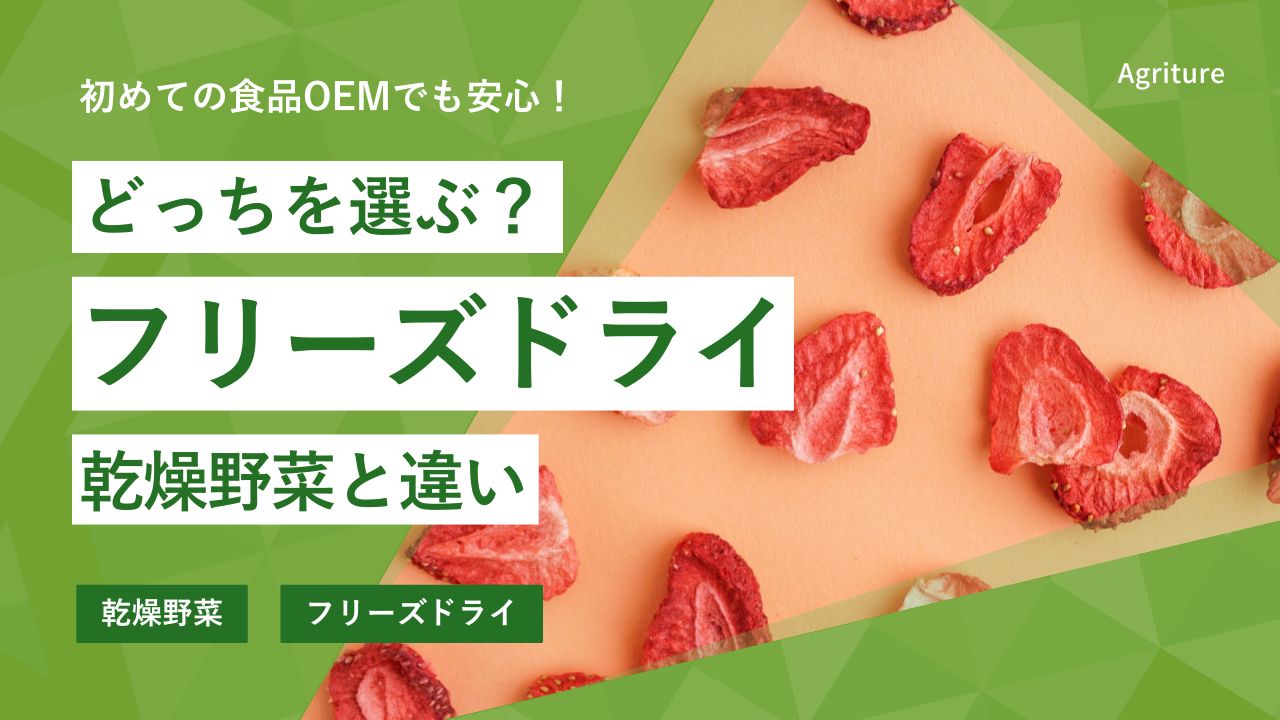
Chocolate-coated strawberry sweets are a common sight in online shops and souvenir stores. They're popular thanks in part to inbound tourism, and those light, crisp strawberries are made by Freeze-dried.
Freeze-drying is a drying technology used widely, not only for emergency food and outdoor use but also for instant miso soup, snacks and confectionery ingredients. However, even though both are "drying," hot-air drying (air drying) works in a completely different way and suits completely different products. As a manufacturer that dries domestic vegetables and fruit, Agriture decides every day which method a product should be made with.
What you will learn from this article
How freeze-drying and hot-air drying work, and how the results differ
Which method suits which use, from miso soup to vegetables and strawberries
Our answer as a manufacturer to "freeze-dried food is bad for you"
A constraint that matters in product development: freeze-drying has large production units
TOC
How Does Freeze-Drying Work?
Freeze-drying is a processing method in which food is first frozen and then placed under vacuum to remove water. It uses sublimation, turning ice directly into gas without letting it melt back into liquid water. Because the water isn't driven off by heat, the cell structure of the ingredient is less likely to break down.
The spaces where the cells were remain as hollows, so when you add water or hot water it quickly returns to its original shape. This Speed of rehydration is the greatest strength of freeze-drying.
Comparing three drying methods
Here's how it differs from other common drying methods. The question isn't which is better; the answer depends on the product you want to make.
Comparison item
Freeze-dried
Hot-air drying (air-drying)
Vacuum drying
How it dries
Frozen, then sublimated under vacuum
Water evaporated with warm air
Pressure reduced and water evaporated at a lower temperature
Temperature range
Dried while frozen
Roughly 40–70℃ (varies in low-temperature ranges and during finishing)
About 40–80℃
Speed of rehydration
Fast (from a few seconds after adding hot water)
Rehydrates slowly (by simmering or soaking)
Depends on the product
Texture
Crisp / fluffy when rehydrated in hot water
Retains a firm bite
Softer
How the flavor comes out
The ingredient's flavor stays as it is
Releases umami and absorbs flavor
Depends on the product
Production unit per run
Large
Can be small
Depends on the equipment
Main product examples
Instant miso soup, strawberry sweets, space food
Kiriboshi daikon, dried tomatoes, noodle toppings
Pastes, seasoning powders
The row to note here is "how flavor comes through." Freeze-drying seals in the ingredient just as it is, whereas hot-air drying Releases flavor when simmered and blends easily into dishes. This difference determines which uses each is suited to.
A familiar example is the dried toppings in instant noodles. According to an industry association's explanation, hot-air drying accounts for the largest production volume among drying methods and is used mainly for vegetables. Freeze-drying, on the other hand, is used for protein-rich ingredients and aromatic vegetables. Rather than choosing by price, manufacturers change the method to suit the nature of the ingredient.
If you'd like to know more about how it differs from dried vegetables, see the following article as well.
Specialist manufacturer of domestic dried vegetables | Corp.…
The most familiar freeze-dried food is miso soup. Just add hot water and you have a bowl in which even the texture of the ingredients has come back. It needs no refrigeration and keeps for a long time at room temperature, so it has become a staple for stocking at home and in the office and as emergency food.
This is something unique to freeze-drying. Drying something liquid like miso soup directly into single-serving shapes is something hot-air drying can't do. The process goes as follows.
Process
What happens
1. Cooking
Miso soup is made in a large kettle
2. Dispensing
Poured into trays one serving at a time
3. Freezing
Frozen at around minus 30℃ for 8 hours or more
4. Drying
Placed in a vacuum freeze dryer, and water is sublimated over 24 hours or more
The key is Step 3, freezing. Because the block keeps its shape once frozen, drying it as is produces a single-serving block. Nothing is mixed in to make it set. When you put it in a bowl and add hot water, the shape loosens and spreads out.
Just add hot water and even the texture of the ingredients comes back
Keeps long-term at room temperature, suited to stockpiling and keeping in the office
Liquids can be made into single-serving shapes, widening the scope of product design
In terms of being able to dry liquids into single-serving shapes, freeze-drying has the edge in the range of processing applications. There is also a method of drying the miso and the ingredients separately and combining them, and designs vary by manufacturer.
Freeze-Dry Processing That Seals in Vegetables As-Is
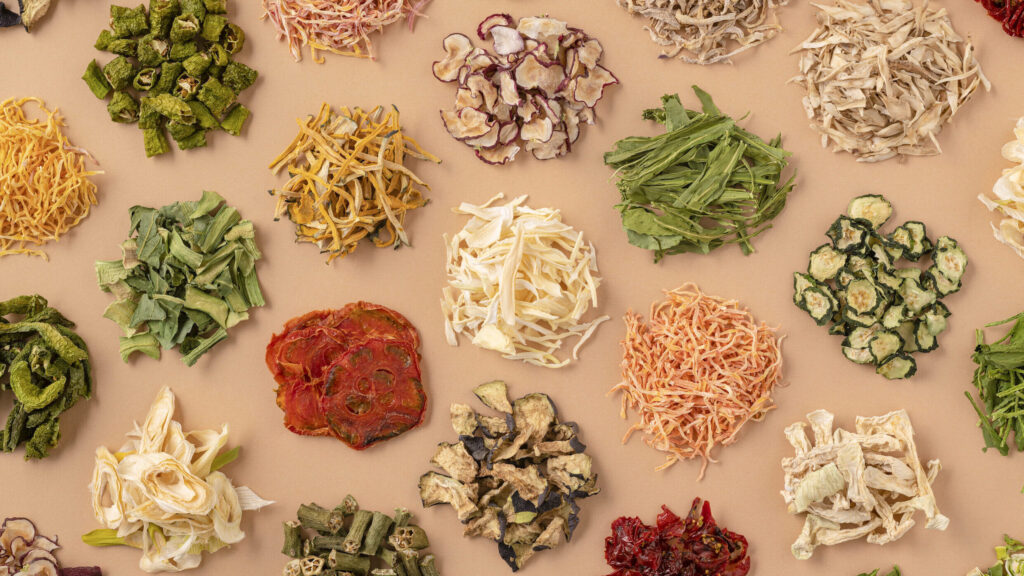
Freeze-dried vegetables are used as miso soup ingredients. Because they're dried while frozen, changes in color and shape from heat are less likely, and even leafy greens like Spinach,and Komatsuna return to a state close to freshly boiled when rehydrated in hot water. burdock and root vegetables like carrots can be used as is in soups and simmered dishes.
However, freeze-drying isn't the right answer for every vegetable. In fact, from our standpoint as a company that dries food every day, there are many situations where hot-air drying is better suited to vegetables.
What you want to make
Suitable method
Reason
Miso soup and soup ingredients
Freeze-dried
Needs to rehydrate quickly with just hot water
Ingredients for simmered dishes and stir-fries
Hot-air drying
Absorbs flavor and keeps its texture
Ingredients for making dashi
Hot-air drying
Releases umami when simmered
Vegetable powder (for kneading into products)
Hot-air drying
Freeze-dried powder releases less flavor
Ingredients dissolved into drinks
Hot-air drying
Same as above. For uses where you want the flavor to stand out
It may come as a surprise, but for uses such as kneading vegetable powder into sweets or dissolving it into drinks, we find that freeze-dried powder doesn't release much flavor. The strength of keeping the ingredient as it is works against it here, making the flavor fall flat. This comes from our experience in processing, and it's also why we choose hot-air drying for powders. The items we handle are Vegetable powder list.
Freeze-drying is often assumed to be "the superior technology," but in reality it depends on the use. For products where you want flavor to come through, we choose hot-air drying.
When using our in-house stock of raw material: from 100g
Agriture's drying services, flexibly available from 10 kg
Among freeze-dried products, one of the most popular is strawberry. The sweet-tart flavor and aroma are concentrated, and it's finished with a light, crisp texture. Because the bright red color is retained, it's widely used in chocolate- or matcha-coated sweets and gift products.
High-sugar fruit is exactly what freeze-drying is suited to
The reason for freeze-drying fruit isn't just appearance or texture. High-sugar fruit sometimes never dries completely with hot-air drying, and that's the main reason.
High sugar content makes water hard to remove, so even after drying, the fruit stops at a semi-dried state. The sweetness is concentrated and the flavor itself turns out delicious, but the remaining moisture shortens shelf life. From a manufacturer's standpoint, this leads to the judgment that it becomes difficult in terms of best-before dates when considering export.
The higher the sugar content, the harder it is to remove water, and the longer drying takes
If it stops at semi-dried, designing for shelf life becomes that much harder
For export products that require a long best-before date, this difference decides whether it's adopted
With freeze-drying, by contrast, water can be thoroughly removed even from high-sugar fruit, so it can even be processed into powder. This method is also what makes chocolate-coated strawberries possible.
Dried fruit to eat as is → hot-air drying tastes better
Want high-sugar fruit to keep for a long time → freeze-drying
While freeze-drying is strong for ingredients used in processed foods, if you're eating it simply as dried fruit, hot-air drying gives a better-tasting result. Our experience on the production floor is that freeze-drying doesn't automatically make something better.
Is Freeze-Drying Bad for You?
We sometimes see people ask, "Isn't freeze-dried food bad for you?" Answering as a company whose business is drying food:freeze-drying is a physical process that simply removes water, and the method itself poses no health problems.
Why can it be stored for a long time?
It doesn't keep because preservatives are added. Food needs water to spoil, and removing that water makes it less likely to spoil; that's all there is to it. It's the same principle that lets dried shiitake mushrooms and kiriboshi daikon be kept at room temperature.
Common concern
The reality
Doesn't it contain preservatives?
Shelf life comes from removing water; no preservatives are used in the drying process
Doesn't heating degrade the quality?
Freeze-drying dries food while it's frozen, so changes from heat are less likely
It's a processed food, so I'm uneasy
Drying is a physical process that removes water. Seasonings and additives are a separate matter from drying
What to look at when choosing
Check the ingredient label. The seasoning content, not the drying method, is what to judge by
What deserves attention isn't the drying itself but what has been added to the ingredient before drying. Some products are dried after sugar, fats or flavorings have been added. If you want to judge, the reliable way is to look at the ingredient label rather than the method.
Check the ingredient label for seasonings and additives
Eaten as is, it can get stuck in the throat, so rehydrate it in hot water for small children and older people
After opening it absorbs moisture, so use it up soon
If anything, we consider it an easy food to handle, since it can be kept at room temperature without refrigeration or preservatives.
A Processing Technology Drawing Attention in Commercial and OEM Use Too
Freeze-dried products are also used as commercial raw materials. The range of applications is growing, including instant soups and zosui, confectionery ingredients, and shelf-stable products for export.
The first obstacle in product development is lot size
This is the point we most want to convey to anyone planning to make a product with freeze-drying.Freeze-drying equipment is large, and each production run requires a substantial volume. The production lots contract manufacturers quote are generally around 300–1,000 kg in terms of pre-drying raw material.Because the equipment runs in large units, it's a method that makes it hard to prototype just a small amount. In fact, commercial operations use large machines that process tens of thousands of servings at a time.
Hot-air drying, on the other hand, ranges from small to large equipment. Because it can be run from around 1 kg of fresh raw material, you can test a small amount first and see the response. The differences between the two can be summarized as follows.
Freeze-dried
Hot-air drying
Guideline production lot
Roughly 300–1,000 kg of pre-drying raw material
Can be small (from around 1 kg of fresh produce)
Small-quantity prototypes
Hard to arrange
Easy to arrange
Equipment cost
High
Relatively low
Suitable approach
After forecasting quantities
Test small and grow
In other words, If you're making a product with freeze-drying, you need to move with a certain sales volume in view. At the stage of "just wanting to test 100 units first," it's more realistic to lean toward a product design that can be made with hot-air drying. If you build your business plan around freeze-drying, you may find yourself stuck because the lot sizes don't fit.
Our approach to small-lot product development is explained in detail in the following article.
Specialist manufacturer of domestic dried vegetables | Corp.…
Agriture works with hot-air drying and low-temperature drying
At Agriture, we process domestic vegetables and fruit with hot-air drying in a low-temperature range. We set the drying temperature at around 45℃, aiming for a finish that retains the flavor of the ingredient itself. We can also handle powder processing and specified cut shapes, and we accept processing of raw materials you bring in.
are as follows.
Drying of client-supplied raw materials: from 1 kg
Dry processing with supplied raw material: from 1kg of raw material
Freeze-drying is a technology that goes beyond "drying = preservation": it can turn soup into a single-serving shape and transform high-sugar fruit into confectionery ingredients. Fast rehydration and the ability to dry liquids into solids are strengths no other method has.
On the other hand, hot-air drying suits products where you want flavor to come through and products you want to test in small quantities. It isn't a question of which is better; deciding the method by working backward from the product you want to make is the way to avoid detours.
What you want to do
Method to choose
Make a product that can be eaten right after adding hot water
Freeze-dried
Turn soups or fruit juice into single-serving shapes
Freeze-dried
Turn high-sugar fruit into confectionery ingredients
Freeze-dried
Make ingredients for simmered dishes, dashi and cooking
Hot-air drying
Make powder for kneading into products or using in drinks
Hot-air drying
Test a small amount first before deciding
Hot-air drying
As a drying manufacturer, Agriture takes consultations from the stage of deciding which method suits your product. Tell us the product you want to make and your expected quantities, and we'll help from choosing the method onward. For details, see our Drying OEM and contract processing page.
Download the OEM contract processing materials
We will send the materials to your email address based on the information you provide.
If you are considering product development with off-spec or your own farm's vegetables:From planning to processing, materials, package printing and novelties, you can consult us through a single point of contact. → Learn more about one-stop product development
CEO of Agriture Inc. Runs a contract processing and OEM business centered on dried vegetables and dried fruit. In partnership with farmers within Kyoto Prefecture, he pursues “sustainable food distribution” through the use of non-standard vegetables and support for sixth-industrialization. Drawing on extensive hands-on experience at manufacturing sites, he provides support that walks alongside every business considering OEM—from product planning and prototyping to small-lot handling, packaging design, and sales-channel development.








 Original coffee marketing strategy | Ways to grow sales
 ベジタリアンとは?国の規格が分けている4つの区分と食べられないもの
 長ねぎと白ねぎは同じもの?ねぎの種類と呼び名を国の資料で確かめる
 柚子の種類は何種類あるのか、公の資料で名前が残る系統を数えた
 ゆずの時期は年に二度、青ゆずは7月から黄ゆずは10月から
 ゆずの産地は高知が半分を占め、二位は徳島から愛媛に変わった
 Preventing Food OEM Failures: Common Failure Cases and Countermeasures for Success
 How to find a food OEM | How to efficiently find the best manufacturing partner