
The Cut Face of a Vegetable. The Difference the Cut Makes.

Summary of this article
Mibuna | A Kyoto Vegetable That Comes Into Season in Spring
A column in which chef Yu Yoneyama explains the changes in a dish that the way you cut a Kyoto vegetable brings about. It covers thick slices of Shogoin turnip (15 cm or more in diameter) versus 2–3 mm thin slices for senmaizuke; 2 cm rounds, lengthwise quarters, and 2 cm dice of Kamo eggplant; small rounds, diagonal cuts, and shiraga negi of Kujo negi; whole-grilled Manganji togarashi; and cylinder cuts, sasagaki shavings, and rangiri of Horikawa gobo — introducing how to choose cuts to match the cooking method and the breathing of a dish.
TOC
The fascination of cooking, I think, actually hides in very small details. Take “the cut,” for instance. With the same vegetable, a single stroke of the knife can turn it into an entirely different dish. How you listen for the vegetable's voice — in that moment the chef's work reveals itself.
Shogoin Turnip | The Story That Thickness Changes
The Way Thick Slices Take in Dashi
Shogoin kabura Working with Kyoto vegetables, I feel this keenly. Shogoin kabura Picture
. Cut thick and simmered, it keeps a plump texture while taking in dashi all the way through.
is a large turnip that can reach 15 cm or more in diameter, and the fineness of its flesh comes alive precisely in thick slices.
The Change in Melt-in-the-Mouth Texture from Thin Slices
But sliced thin, as if shaving it, it becomes as soft as cloth, dissolving on the tongue. A difference in thickness changes not only the texture but the “story of the dish.” The technique of slicing thin and even, as in senmaizuke, is known as the cut that best draws out the delicate sweetness of Shogoin turnip.
Kamo eggplant Kamo Eggplant | The Art of Rounds, Lengthwise Cuts, and Dice
The Presence of Rounds That Shine in Dengaku
is another vegetable that lets you feel the artistry of the cut.
Cut into rounds for dengaku, the grilled surface takes on a glaze, making a dish lavish even to the eye. Kamo eggplant's round, large shape gives a beautiful cross-section when cut into rounds, and in Kyoto cuisine dengaku is the classic cooking method as a “cut that shows off.”
The Distinct Character Drawn Out by Lengthwise Cuts and Dice
But split lengthwise into large pieces, the cut face reveals the juiciness of the flesh, adding presence when simmered. Diced finer and stir-fried, it soaks up oil and takes on an entirely different flavor. A single stroke of the knife transforms Kamo eggplant's character in countless ways.
How to Choose the Cut to Match the Dish
When choosing how to cut Kamo eggplant, deciding the cooking method first cuts down on hesitation. For grilled dishes or dengaku, 2 cm rounds; for simmered dishes, lengthwise quarters; for stir-fries or mabo-nasu, 2 cm dice are the basics. Scoring the skin in a lattice pattern makes the heat penetrate evenly and helps the flavor soak in.
Kujo green onion Kujo Negi | The “Tone of Voice” That the Cut Changes
Its Role as a Condiment When Cut Into Small Rounds
It's the same when cutting
. Cut delicately into small rounds, a fresh green fragrance rises, and it plays the role of supporting a dish as a condiment. Unlike the white negi of the Kanto region, Kujo negi has a long, tender green part, and the way the fragrance rises when cut into small rounds is exceptional. A Seasonal Calendar Kujo Negi That Becomes the Star with Diagonal Cuts
But cut on a large diagonal, it draws out its sweetness strongly in stir-fries and hot pots and can even become the star. Cut fine and even into shiraga negi, it produces a light crispness the moment it enters the mouth, and its fragrance spreads freshly as well. The cut is like an instrument for changing negi's “tone of voice.”
, you'll see that Kujo negi is sweetest in winter, the time to let it play the star with diagonal cuts in hot pots.
Manganji togarashi Manganji Togarashi | Changing the Season with a Single Cut
The Essence of Sweetness Tasted in Whole-Grilling
too greatly changes its expression depending on the cut.
Grilled whole, the sweetness of the flesh stands out, and you can simply enjoy its “Manganji character.” The trick is to remove only the stem and grill it seeds and all; grilling it in one go over high heat lightly chars the skin while the flesh inside becomes as if steamed. dry processing Wider Uses Through Chopping and Drying
But chopped fine and stir-fried, the bitterness works as an accent, taking on the role of tightening the whole dish. Cut after drying, an even more concentrated fragrance rises, adding depth to winter simmered assortments. A single stroke of the knife decides how the seasonal flavor is delivered.
Combined with
Horikawa gobo, the ways to enjoy Manganji togarashi expand even further.
Horikawa Gobo | The “Breathing of a Dish” That Shape Creates Horikawa gobo The Star-Worthy Presence of Cylinder Cuts
Root vegetables like
are an even deeper presence.
Cut into large cylinders and simmered until the flavor sinks in, umami seeps to the very center, making it a dignified star.
is more than three times the thickness of ordinary gobo, so the impact of the cross-section when cut into cylinders is overwhelming.
Using Sasagaki and Rangiri Differently
But shaved thin into sasagaki, its fragrance is drawn out all at once, gracing a small plate as kinpira. Cut into rangiri, it brings rhythm to a simmered dish and offers variety in the mouth as well. The cut is not merely a difference in shape but something that decides the whole dish's “breathing.”
The “Voice of the Vegetable” That the Knife Teaches
The Information the Blade Conveys About the Ingredient Kyoto vegetables Holding the knife day after day as a chef, I've come to realize that this very moment of “cutting” is when you truly hear the vegetable's voice.
Its firmness, its moisture, the way its fragrance rises. The sensation that comes through the moment the blade enters tells me, “Today, let's cut it thick,” or “This one is better shaved thin.”
Enjoying the Cut That Has No Right Answer
So there is no single correct way to cut; the shape settles naturally in dialogue with that day's vegetable.
differs in shape and size by variety, so a uniform way of cutting cannot fully draw out its appeal. Even the same Shogoin turnip differs in firmness by harvest time and field. Reading that difference by the feel of the hand and deciding the ideal thickness is the chef's craft.
The Cut Is the Dish's “First Scene”
How the Beauty of the Cross-Section Whets the Appetite Shogoin daikon What's even more interesting is that the cut is also the “first scene” that connects chef and diner.
When plated, the beauty of the cross-section and the balance of thickness whet the appetite through the eyes before the flavor is even tasted. The glaze of Kamo eggplant, the whiteness of Shogoin turnip, the green of Kujo negi. The cut is like a brush painting a “picture of the season” within the vessel.
The Relationship Between Plating and the Cut
Kyoto cuisine has the idea of “eating with the eyes,” and the cut and the plating are considered as one.
cut decoratively into a flower shape adds elegance to a soup bowl, and Kujo negi made into shiraga produces a cooling touch as a garnish for sashimi. The cut itself is a pillar supporting the expressive power of a dish. In Closing | Trusting the Sensibility of a Single Cut When I think about how to cut, I always imagine “what face I want this vegetable to meet the guest with.”
Whether I want to show a bold presence or a role that lightly accompanies. Depending on that, the thickness and shape change. And the accumulation of those small choices decides the breathing of the whole course, leading to a dish that stays in the diner's heart.
Recommended reading
List of Kyoto vegetable varieties / Kyoto vegetable calendar / Commercial dried vegetables / Manganji Togarashi: The Large, Thick-Fleshed King of Kyoto Vegetables / Mibuna: The Characteristics and History of a Kyoto Vegetable with Little Heat
We have materials available to help you understand dried processing OEM
Agriture OEM, flexibly handling everything from small lots to large lots
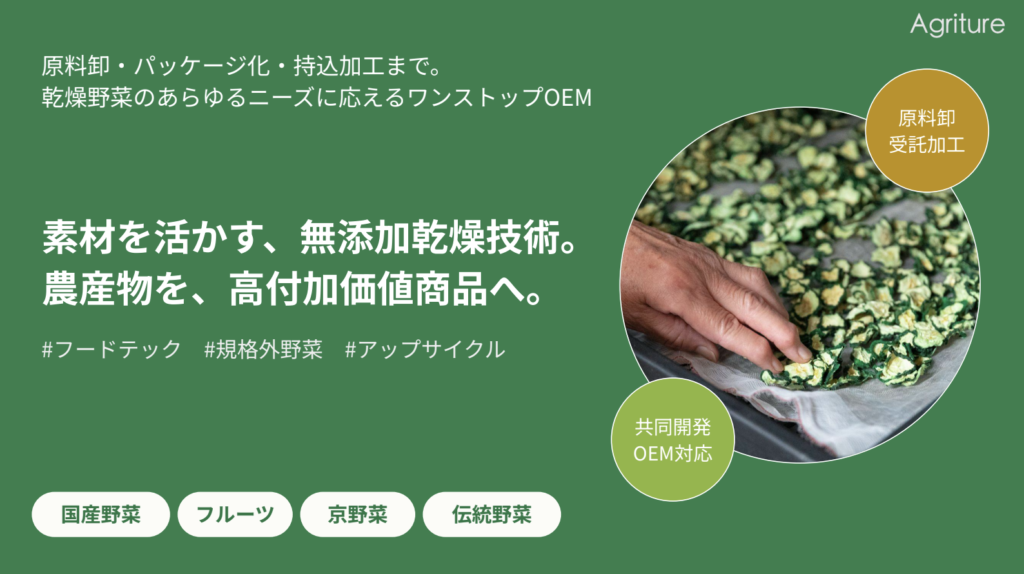
- OEM available from small lots of 10 kg
- Drying of brought-in raw materials also possible
- Support from processing to filling in one place
Download the OEM contract processing materials
We will send the materials to your email address based on the information you provide.
- Tasting Kyoto Vegetables by Aroma. The Pleasure of Cooking That Begins at the Tip of the Nose
- The Technology to Lock In the Season. The Seasonal Story Dried Vegetables Connect.
Author of this article
Related articles
-
 京野菜は何品目あるのか、読み方の一覧と認定の枠組みから確かめる
 -
 Drying Is Another Kind of Cooking
 -
 The Technology to Lock In the Season. The Seasonal Story Dried Vegetables Connect.
 -
 Tasting Kyoto Vegetables by Aroma. The Pleasure of Cooking That Begins at the Tip of the Nose
 -
 Vessels and Kyoto Vegetables. Creating the Scenery of Plating.
 -
 Vegetables and Heat Control. Between High and Low Flame
 -
 Kyoto Vegetables and Sake. The Happy Relationship of a Dish and a Cup.
 -
 Kyoto Vegetables and Dashi —The Resonance Between the Ingredient's Voice and the Dashi—