
Kyoto Vegetables and Sake. The Happy Relationship of a Dish and a Cup.

Summary of this article
A column in which chef Yu Yoneyama explains the pairing of Kyoto vegetables with alcohol. With Kamo eggplant dengaku, pair junmai sake with a rice-polishing ratio of 60-70%, such as Fushimi's Tamanohikari or Gekkeikan, at room temperature to warm (40°C); with simmered Horikawa gobo, a Koshu or Chardonnay at 10-12°C; with duck hot pot of Kujo negi, a dry ginjo sake. It also introduces the three principles of harmony, contrast, and complement, a season-by-season quick-reference table, and non-alcoholic pairings such as Kyoto Tamba wine, Kyoto bancha, and genmaicha.
As a chef, the time spent thinking about what drink to accompany a dish is in fact very enjoyable. As much as finishing the dish itself, what sways the customer's expression is pairing. What glass to match with a dish that centers on Kyoto vegetables. The harmony that arrives in that moment holds a joy almost beyond words.
TOC
The harmony of Kamo eggplant dengaku and junmai sake
For example, Kamo eggplant dengaku.
The plump, round Kamo eggplant is slowly grilled in oil and finished with a topping of sweet white miso. What I want to pair with it is, after all, sake. In particular, junmai sake that lets you feel the sweetness of the rice fits well. When the richness of the miso and the umami of the sake overlap, the tender flesh of the eggplant feels even more full-bodied.
When I actually serve this combination in front of a customer, the moment they take a bite and then a sip, their expression softly changes. A face mixing surprise and calm. Perhaps it is because I want to see that moment that I keep combining dishes and sake.
How to choose sake that suits Kamo eggplant dengaku
Kamo eggplant For dengaku, junmai sake in which the sweetness of the rice can be firmly felt is a good match. A full-bodied type with a rice-polishing ratio of 60-70% is recommended. The richness of the white miso and the amino acids of the sake overlap, making the eggplant's flesh feel even mellower.
Among Kyoto's breweries, Fushimi's Tamanohikari and Gekkeikan are standards. Sake brewed with local water (Fushimi's Gokosui) pairs superbly with Kyoto vegetables. The best temperature is room temperature to warm (around 40°C).
The unexpected encounter of Horikawa gobo and white wine
Horikawa gobo For simmered gobo, it may be a little unexpected, but pairing it with a Kyoto white wine is also interesting. When the acidity and faint fruitiness of the white wine draw close to the earthy aroma and sweetness of the gobo, it feels markedly lighter. In particular, if you choose a heavy sake such as one made by the yamahai method, the delicate nuances of the gobo can get hidden. That is exactly why you deliberately take balance with wine. In the moment where Japanese and Western meet, the table softly takes on fresh color.
Matching the temperature of white wine with simmered Horikawa gobo
Horikawa gobo When pairing white wine with simmered gobo, a wine temperature of 10-12°C is recommended. Chilled too much, the acidity stands out too far; too warm, the fruitiness blurs. Choosing a type with restrained oak, such as Koshu or Chardonnay, does not interfere with the gobo's earthy aroma.
Wineries within Kyoto Prefecture, such as Kyoto Tamba Wine and Amanohashidate Winery, are also drawing attention. Terroir pairing, matching local ingredients with local drinks, is also meaningful from the perspective of sustainable food.
FOR BUSINESS
乾燥野菜を業務用でお探しですか
国産の野菜・果物を乾燥し、必要に応じて粉砕してお出ししています。扱っている品目は100種前後で、規格は 乾燥品の一覧・パウダーの一覧 に掲載しています。
少量でのご購入は、姉妹ブランドの通販サイト OYAOYA で承っています。
The deep relationship between Kyoto vegetables and sake
Of course, the combination of sake and Kyoto vegetables is profound.
For example, a duck hot pot topped generously with Kujo negi. To the pot where the umami of the fat and the sweetness of the negi melt together, add a crisp, dry ginjo sake. The aroma of the negi is tightened, and the duck fat unravels smoothly. Conversely, for a simmered dish where the sticky-textured Shogoin kabura is steeped in dashi, junmai sake served warm suits it. Tasted at a temperature that is neither too hot nor too cold, just close to body temperature, the sweetness of the turnip stands out all the more. I truly feel that even the temperature of the sake is part of the dish.
A single glass as part of the dish
What I value as a chef is thinking of the sake as one of the dishes. In other words, the dish is not complete on the plate alone. Including the motion of tilting the glass, it becomes a single experience. So rather than a simple formula of red for meat, white for fish, I choose the sake as if listening closely to the breathing of that one dish.
Three basic principles of pairing
There are three principles to keep in mind in pairing Kyoto vegetables with alcohol. (1) Harmony: match a sweet drink to the ingredient's sweetness. (2) Contrast: wash a fatty dish with a crisp drink. (3) Complement: use the drink to supply an element (acidity, bitterness) the ingredient lacks.
Just keeping these three in mind lets you enjoy pairing Kyoto vegetables with alcohol at home too. Aroma The compatibility of is also an important element.
The face of Kyoto vegetables and sake that changes with the seasons
What is interesting about Kyoto vegetables is that their flavor changes completely with the season.
June's Manganji pepper is fresh and green, with a crispness you want to pair with beer or a sparkling sake. But August's has thicker flesh and more sweetness, so an aged yamahai junmai or an oaky white wine comes to suit it. Even with the same vegetable, the answer to pairing changes with each season. As a chef, this is a truly enjoyable question.
Conveying the reason for a dish and a glass
When serving customers, I try to convey the reason for the combination lightly. A single remark like, this gobo actually opens up its aroma when paired with white wine, or, today I warmed this sake to draw out the sweetness of the turnip. Then the customer, saying I see, brings the glass to their lips, actually tastes it, and widens their eyes. Sharing that moment is an irreplaceable reward for a chef.
Cooking is a harmony connected by human hands
Thinking about the relationship between sake and Kyoto vegetables, I suddenly feel that cooking is something you cannot complete alone. There are farmers who grow the ingredients, brewers who brew the sake, and craftsmen who fire the vessels. It comes together only when many hands overlap. We chefs are merely bridging them. Yet there is a scene born only when a dish and a glass resonate on that bridge. I think it is because I want to show that scene that I stand in the kitchen again today.
FOR BUSINESS
乾燥野菜を業務用でお探しですか
国産の野菜・果物を乾燥し、必要に応じて粉砕してお出ししています。扱っている品目は100種前後で、規格は 乾燥品の一覧・パウダーの一覧 に掲載しています。
少量でのご購入は、姉妹ブランドの通販サイト OYAOYA で承っています。
In closing | The flavor that dwells where three things meet
Finishing a dish and accompanying it with a glass. The quiet elation that arrives in that moment. The customer's smile and surprise spread like the lingering resonance of music. Pairing Kyoto vegetables with alcohol is by no means a difficult theory. It is exactly where three things meet, the ingredient, the sake, and people, that the true appeal of cooking dwells.
Season-by-season Kyoto vegetable pairing quick reference
Spring: Fushimi togarashi tempura × sparkling sake. Summer: Manganji togarashi charcoal-grilled × beer or sparkling sake. Autumn: Shishigatani kabocha simmered × aged junmai sake. Winter: Horikawa gobo steeped-simmered × warm yamahai junmai.
Kyoto vegetable calendar Cross-reference with and try choosing a glass to match that month's season.
Enjoying Kyoto vegetable pairing without alcohol
For those who do not drink and for drivers, non-alcoholic pairing is also recommended. With Kamo eggplant dengaku, the roasted note of Kyoto bancha (a hojicha type) suits it, and with duck hot pot of Kujo negi, the grain feel of genmaicha harmonizes.
Dried Kyoto vegetables Having a vegetable broth made with before the meal is also a new style being adopted in restaurants recently. It is an idea that extends the relationship between dashi and Kyoto vegetables even to drinks.
Kyoto vegetable columns to read together
To deepen pairing further, change the finish of the dish with heat control and Kyoto vegetables, and add visual presentation with vessels and plating. subtractive cooking How to choose sake to match is also an interesting theme.
We have materials available to help you understand dried processing OEM
Agriture OEM, flexibly handling everything from small lots to large lots
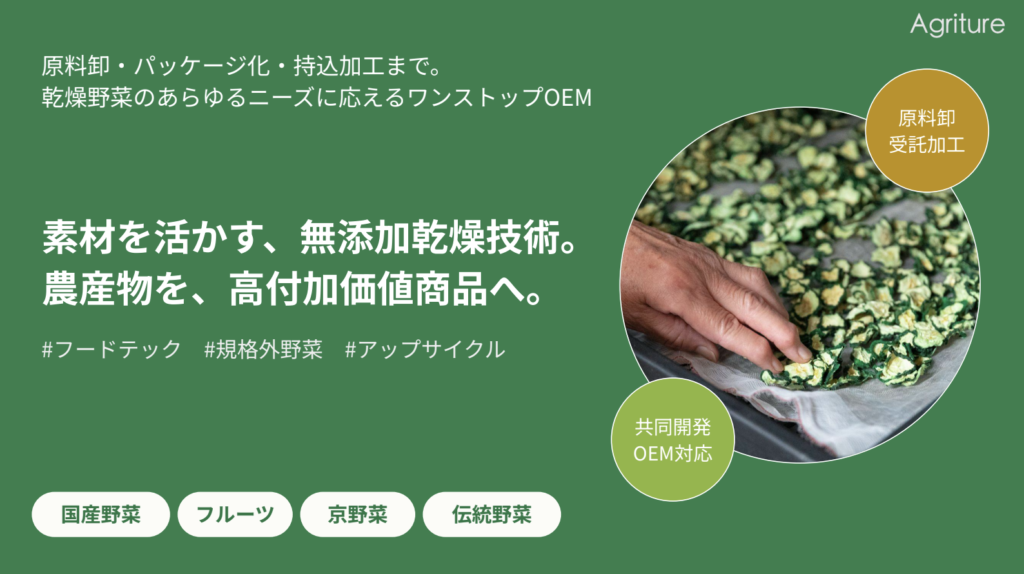
- OEM available from small lots of 10 kg
- Drying of brought-in raw materials also possible
- Support from processing to filling in one place
Download the OEM contract processing materials
We will send the materials to your email address based on the information you provide.
- Kyoto Vegetables and Dashi —The Resonance Between the Ingredient's Voice and the Dashi—
- Vegetables and Heat Control. Between High and Low Flame
Author of this article
Related articles
-
 京野菜は何品目あるのか、読み方の一覧と認定の枠組みから確かめる
 -
 Drying Is Another Kind of Cooking
 -
 The Technology to Lock In the Season. The Seasonal Story Dried Vegetables Connect.
 -
 The Cut Face of a Vegetable. The Difference the Cut Makes.
 -
 Tasting Kyoto Vegetables by Aroma. The Pleasure of Cooking That Begins at the Tip of the Nose
 -
 Vessels and Kyoto Vegetables. Creating the Scenery of Plating.
 -
 Vegetables and Heat Control. Between High and Low Flame
 -
 Kyoto Vegetables and Dashi —The Resonance Between the Ingredient's Voice and the Dashi—