
The Real Reason Chefs Use Kyoto Vegetables

Summary of this article
A column by Yu Yoneyama, the Michelin Bib Gourmand chef of "Potsura Potsura" and "Utsura Utsura" in Shinsen, Tokyo, on the real reason chefs use Kyoto vegetables. Touching on the farmers' labor and devotion behind the price of Kyoto's heirloom vegetables, from a cold grilled-and-steeped Kamo eggplant to the one-by-one hand-picking of a farmer growing Fushimi peppers and harvesting on the eve of a typhoon, he explains a chef's pride and responsibility, the advantages of using commercial dried Kyoto vegetables, and how to secure a stable supply.
A column by Yu Yoneyama, who runs "Potsura Potsura" and "Utsura Utsura" in Shinsen, Tokyo, and earned a Michelin Bib Gourmand at both. He shares the power of ingredients and the devotion of producers that he feels working with Kyoto vegetables in the kitchen every day.
TOC
How a single dish changes a guest's expression
There are moments when just one dish softens a guest's face.
The instant they taste it, their eyes widen, and with the next bite a quiet smile breaks out.
That, I believe, is the power of Kyoto vegetables.
One summer day, I served a cold grilled-and-steeped Kamo eggplant. The cooked flesh was meltingly soft, roastiness and sweetness mingling, and with just one slice a guest was astonished: "I've never had an eggplant like this." That was not my skill but a reaction brought on by the ingredient itself.
"It's expensive, but Kyoto vegetables really are different" -- there truly are moments that make a chef feel that way.

The "difference" made by a farmer's extra effort
Yet behind that "difference" lies a daily accumulation of work that backs it up.
When I heard one farmer's story, I was left at a loss for words. This was someone growing "Fushimi pepper," one of Kyoto's heirloom vegetables.
Out in the field from early morning, they check the condition every day even while the plants are still in bud. When flowers bloom, they pick them off one by one to ease the burden on the branch so the fruit grows beautiful and even.
It is precisely because of that extra effort that the Fushimi peppers arriving at the restaurant are straight and crisply shaped. The skin is thin, and when cooked they turn astonishingly tender, with little bitterness from the seeds.
It is only natural that a guest would say, "You can't buy peppers like this anywhere."
Risk and effort born of delicacy
It is precisely because of that delicacy that the risk is extremely high.
One summer, the day before a typhoon drew near, a call came from the farmer.
"Tomorrow I probably won't be able to ship any more. This morning I harvested everything and sent it," they said.
Fields toppling one after another, branches snapping, fruit falling. A single typhoon turns months of hard work to nothing.
That is exactly why they pick by hand, desperately, before the wind blows. It is thanks to such effort that vegetables reach our kitchen.
The story dwelling in the price of Kyoto vegetables
Of course, Kyoto vegetables are expensive. They can cost more than double other vegetables on the market.
But there is a reason for it.
Not just the taste, but the labor behind it, the grower's devotion, and the measure of "time that has been protected and passed down" -- that value dwells within them.
I want to convey that through my cooking.
When you chop Kujo green onion, the knife's blade slides in as if drawn. The mucilage clings thick and glossy like seaweed, and cooking it lets the sweetness seep gently out.
Such a dish turns from a mere "condiment" into the "star."
Learn that behind that transformation lies the work of farmers carried on over many generations, and anyone would feel a deeper layer of emotion in that taste.
A chef's pride and responsibility
"Behind the price is an unseen story."
That is what I believe.
Rather than simply working the vegetable as a chef, I have come to focus on how to deliver that story without breaking it.
It is not special because it is expensive.
Something special is, rightly, distributed at a "high" price.
That is proof that an ingredient is not a thing but a life carrying "the warmth of someone's hands."
That is exactly why I use Kyoto vegetables.
It is a chef's pride, and I feel it as a responsibility to the work I do each day.
Building a seasonal course with Kyoto vegetables
In season, vegetables become most themselves
The subtractive work of bringing out Kyoto vegetables
FOR BUSINESS
乾燥野菜を業務用でお探しですか
国産の野菜・果物を乾燥し、必要に応じて粉砕してお出ししています。扱っている品目は100種前後で、規格は 乾燥品の一覧・パウダーの一覧 に掲載しています。
少量でのご購入は、姉妹ブランドの通販サイト OYAOYA で承っています。
Related articles
- How to Build a Seasonal Course Woven with Kyoto Vegetables
- Kamo eggplant | The queen of Kyoto vegetables: features and how to eat it
- The Work of "Subtraction" That Makes the Most of Kyoto Vegetables
Recommended reading
List of Kyoto vegetable varieties / Kyoto vegetable calendar / Commercial dried vegetables / sustainable / dry processing
We have materials available to help you understand dried processing OEM
Agriture OEM, flexibly handling everything from small lots to large lots
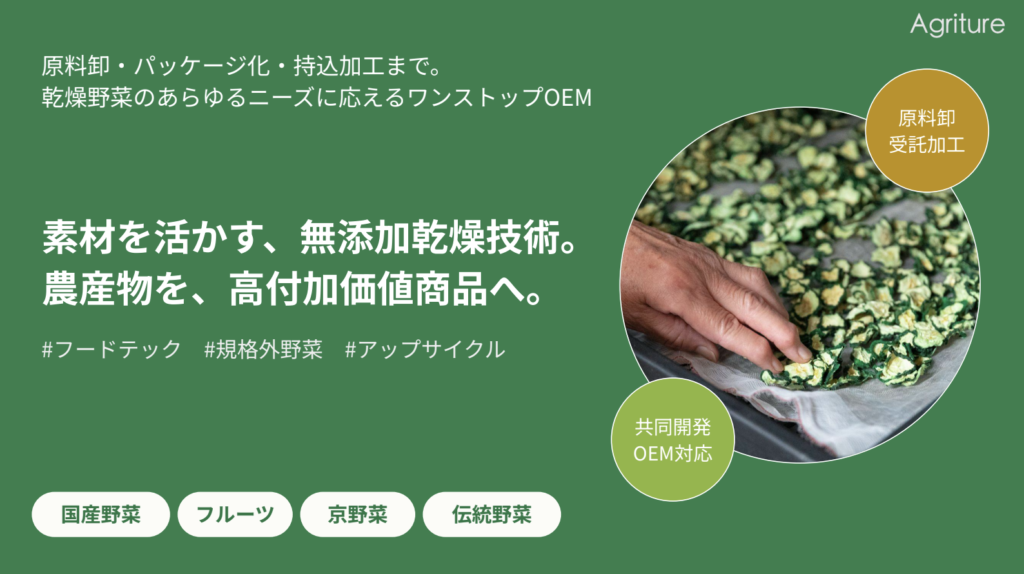
- OEM available from small lots of 10 kg
- Drying of brought-in raw materials also possible
- Support from processing to filling in one place
Download the OEM contract processing materials
We will send the materials to your email address based on the information you provide.
- Manganji Togarashi: The Large, Thick-Fleshed King of Kyoto Vegetables
- Kyoto Vegetables and Dashi —The Resonance Between the Ingredient's Voice and the Dashi—
Author of this article
Related articles
-
 京野菜は何品目あるのか、読み方の一覧と認定の枠組みから確かめる
 -
 Drying Is Another Kind of Cooking
 -
 The Technology to Lock In the Season. The Seasonal Story Dried Vegetables Connect.
 -
 The Cut Face of a Vegetable. The Difference the Cut Makes.
 -
 Tasting Kyoto Vegetables by Aroma. The Pleasure of Cooking That Begins at the Tip of the Nose
 -
 Vessels and Kyoto Vegetables. Creating the Scenery of Plating.
 -
 Vegetables and Heat Control. Between High and Low Flame
 -
 Kyoto Vegetables and Sake. The Happy Relationship of a Dish and a Cup.