
Summer Kyoto Vegetables: The Season of Fushimi Togarashi and Shishigatani Kabocha

Summary of this article
We introduce four summer Kyoto vegetables along with their characteristics and how to cook them. Manganji togarashi, the sweet “king of peppers” born in Maizuru, Kyoto during the Taisho era; Kamo eggplant, a summer icon known as the “queen of eggplants”; the long, tender Fushimi togarashi; and Shishigatani squash, a gourd-shaped variety mainly grown in Ayabe City, Kyoto. All are in season from June to September, and we explain recommended dishes for each — such as plain-grilled, dengaku, deep-fried and marinated, simmered, and steamed — as well as year-round use through dried processing.
Every vegetable has its own “season,” and eating it at that time lets you enjoy its character at its best. Kyoto's traditional “Kyoto vegetables” include some that come into season in summer, brightening the summer table with their freshness and bold flavor. Here we introduce representative summer Kyoto vegetables — Manganji togarashi, Kamo eggplant, Fushimi togarashi, and Shishigatani kabocha— along with their characteristics and recommended ways to eat them.
TOC
Seasonal Calendar of Summer Kyoto Vegetables
Most summer Kyoto vegetables come into season from June through September. We've summarized the seasons, growing regions, and ways to eat the representative varieties in a table. For the full seasonal range of Kyoto vegetables, Kyoto vegetable calendar The Flavor and Texture of Manganji Togarashi
| Kyoto vegetables | Peak period | Main growing region | Representative ways to eat |
|---|---|---|---|
| Manganji togarashi | June–August | Maizuru City and various parts of Kyoto Prefecture | Plain-grilled, stir-fried with chirimen-jako, tempura |
| Kamo eggplant | May–August | Kamigamo, Kyoto City | Dengaku, agedashi, steak |
| Fushimi togarashi | June–September | Fushimi Ward, Kyoto City | Grilled and marinated, tempura, simmered |
| Shishigatani kabocha | July–August | Kyoto City and Ayabe City | Simmered, steamed |
Manganji togarashi
Manganji togarashi is a sweet chili pepper, as large and thick-fleshed as a bell pepper. Bred in Maizuru, Kyoto during the Taisho era, it is called the “king of peppers” for its size and “Manganji amato” for its sweetness. With almost no heat and tender flesh, it is easy to use in grilled dishes, stir-fries, and simmered dishes, and even simply grilled with a sprinkle of salt, its sweetness stands out. Cultivation has spread among farmers within Kyoto Prefecture, and it is beloved as a signature summer Kyoto vegetable.
- Plain-grilled (with katsuobushi and soy sauce)
- Stir-fried with chirimen-jako
- Tempura, simmered
Kamo eggplant
Kamo eggplant is a leading summer Kyoto vegetable, distinguished by its round, plump shape. Its flesh is dense and its skin thick, so it holds its shape well even when cooked, making it perfect for dengaku, grilled eggplant, and deep-fried and marinated dishes. It pairs well with oil and has a satisfying bite, earning it the name “queen of eggplants.” A whitish area below the stem cap is another mark of Kamo eggplant, a traditional Kyoto vegetable grown mainly in Kamigamo.
- Kamo eggplant dengaku
- Grilled eggplant
- Deep-fried and marinated, eggplant steak
Fushimi togarashi
Fushimi togarashi is a sweet chili pepper distinguished by its long, slender shape and tender flesh. A “traditional Kyoto vegetable” cultivated in Kyoto since the Edo period, it has almost no heat, and lightly grilling or deep-frying it brings out its sweetness. Because both skin and flesh are thin, it cooks quickly and can be enjoyed in a wide range of dishes — grilled and marinated, tempura, simmered — making it a versatile Kyoto vegetable.
- Deep-fried Fushimi togarashi
- Grilled and marinated, tempura
- Stir-fried with jako as a standing side dish
Shishigatani kabocha
Shishigatani squash, whose distinctive gourd-like shape catches the eye kabocha. Low in moisture with smooth flesh and modest sweetness, its mild flavor goes well with simmered and steamed dishes. It is said to have arisen when kiku squash, brought back from Tsugaru in the Edo period, changed in Kyoto's climate; today its main growing regions are Kyoto City and Ayabe City. At Anrakuji temple in Shishigatani, Kyoto, the “squash memorial service,” some 300 years old, is held every July and is cherished as a summer tradition.
- Simmered, slow-simmered
- Steamed dishes
- Stir-fry
Enjoying Summer Kyoto Vegetables Year-Round Through Drying
Summer Kyoto vegetables have a short season, and quite a few varieties have concentrated shipping periods. Drying concentrates their umami and makes them keep well, so summer flavors can be brought to the table regardless of season. Agriture works with producers within Kyoto Prefecture, wasting nothing — even fruit that doesn't meet shipping standards — by drying summer Kyoto vegetables at low temperature and delivering them in a form that can be used after their season has passed. For example, Commercial dried Fushimi togarashi can be rehydrated and used as an ingredient in stir-fries and standing side dishes. Kyoto-grown dried vegetables are OYAOYA.
FOR BUSINESS
乾燥野菜を業務用でお探しですか
国産の野菜・果物を乾燥し、必要に応じて粉砕してお出ししています。扱っている品目は100種前後で、規格は 乾燥品の一覧・パウダーの一覧 に掲載しています。
少量でのご購入は、姉妹ブランドの通販サイト OYAOYA で承っています。
Frequently Asked Questions About Summer Kyoto Vegetables
We have materials available to help you understand dried processing OEM
Agriture OEM, flexibly handling everything from small lots to large lots
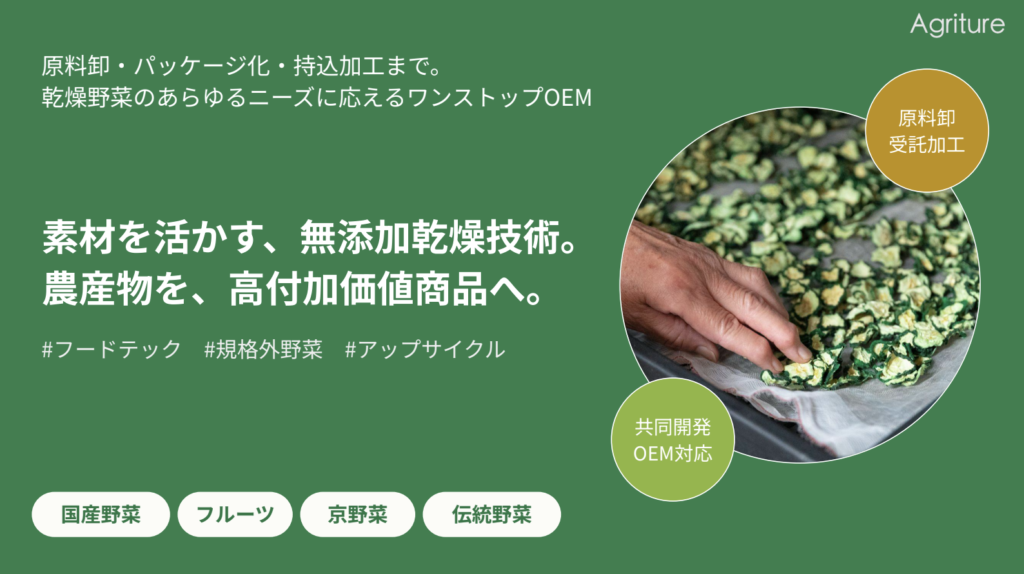
- OEM available from small lots of 10 kg
- Drying of brought-in raw materials also possible
- Support from processing to filling in one place
Related articles
- Spring Kyoto vegetables | The season of Kyoto bamboo shoots and hanana
- Autumn Kyoto Vegetables | Shogoin Turnip and Kintoki Carrot
- Winter Kyoto vegetables | Shogoin daikon and Kujo scallion
- A list of Kyoto vegetable varieties — famous heirloom vegetables and their characteristics
- Kyoto vegetable calendar — check the seasons of the four seasons at a glance
Download the OEM contract processing materials
We will send the materials to your email address based on the information you provide.
- Mibuna: The Characteristics and History of a Kyoto Vegetable with Little Heat
- Kamo Eggplant: A Kyoto Vegetable Prized for Its Round Shape and Rich Flavor
Author of this article
Related articles
-
 京野菜は何品目あるのか、読み方の一覧と認定の枠組みから確かめる
 -
 Drying Is Another Kind of Cooking
 -
 The Technology to Lock In the Season. The Seasonal Story Dried Vegetables Connect.
 -
 The Cut Face of a Vegetable. The Difference the Cut Makes.
 -
 Tasting Kyoto Vegetables by Aroma. The Pleasure of Cooking That Begins at the Tip of the Nose
 -
 Vessels and Kyoto Vegetables. Creating the Scenery of Plating.
 -
 Vegetables and Heat Control. Between High and Low Flame
 -
 Kyoto Vegetables and Sake. The Happy Relationship of a Dish and a Cup.