
Dried Kujo green onion powder | Usage ideas and how to choose it as a food OEM raw material
Tea
Raw materials & ingredients
Powder
Dried vegetables
Recipes & uses
Kyoto vegetables
Heirloom vegetables
Food OEM
Product development

Summary of this article
A guide to using dried Kujo negi powder in food OEM. Made from Kujo negi, a Kyoto heirloom vegetable, that is low-temperature dried and finely milled, this commercial ingredient gives products a vivid green color and sweet aroma without synthetic colorings or flavorings. We cover how it differs from Shimonita negi, white leeks and wakegi, nine application ideas including instant noodles, furikake, bread and hometown tax donation gifts, the case of Agriture being adopted for Nissin Foods' "Nissin Raoh," checkpoints when ordering OEM, and our small-bag filling service starting from 500 bags.
Dried Kujo green onion powder is a commercial material made by drying and finely powdering the Kyoto heirloom vegetable "Kujo green onion." Compared with the white-green-onion type, it has a gentler aroma and stronger sweetness, and is characterized by vivid green remaining all the way to the leaf tips. It's a material widely adopted in food OEM—as a topping for instant noodles, furikake, and for adding color and aroma to baked-goods dough.
This article organizes, for food manufacturers, confectionery workshops, and D2C brands adopting dried Kujo green onion powder in OEM, the decision-making material—from differentiation from other green-onion types, quality specs, and use-based selection to checks when ordering and failure patterns. For the overall picture of the items handled and specifications, please also see the product page for commercial vegetable powder.

TOC
Features of dried Kujo green onion powder
Kujo green onion is a Kyoto heirloom vegetable, characterized by deep green all the way to the leaf tips and sweetness that rises with heating. By making it into dried powder, you can put its color and aroma onto products while keeping room-temperature storage. Below, we organize "characteristics as a raw material," "the standard specifications of Agriture's ready-made products," and "items adjustable in OEM" separately.
Characteristics as a material
- Color: Vivid green all the way to the leaf tips (rich in chlorophyll and folate)
- Aroma: Gentler and sweeter than white green onion (sweetness rises further with heating)
- Flavor: Aftertaste doesn't linger easily, doesn't clash with other ingredients
- Nutrition: β-carotene, vitamin K, folate, calcium
- Origin brand: Strong story value as a Kyoto heirloom vegetable
Standard specifications of Agriture's ready-made products
| Item | Standard specification |
|---|---|
| Raw materials | Kyoto-grown / domestic Kujo green onion (upcycling of off-spec goods also supported) |
| Drying method | Low-temperature hot-air drying (a temperature range that suppresses the fading of chlorophyll) |
| Particle size | 40–60 mesh (general purpose) |
| Moisture content | About 5–8% (specified in the product specification document) |
| Shelf stability | 6–12 months at room temperature (when unopened, depending on the packaging) |
| Additives | No glucose or dextrin (100% vegetable) |
| Microbial standards | Standard values for general viable bacteria and coliforms set on a specification-document basis |
Items adjustable in OEM
| Item | Adjustable range |
|---|---|
| Particle size | 20–100 mesh (from coarse for texture emphasis to fine powder for beverages) |
| Drying method | Selection of hot-air, vacuum, or freeze-drying (chosen by the degree of color and aroma retention) |
| Raw-material origin specification | Limited to Kyoto Prefecture, designated contract farmers, harvest-time specification, and the like |
| Packaging | Commercial large bags, small bags, sticks and individual packs (from 500 bags) |
| Blend | Combination with other dried vegetables (a lineup of over 30 kinds) |
| Labeling / certification | Condition specification of Organic JAS, HACCP, FSSC22000 |
The difference from other green-onion powders
What you'll learn in this section
- A comparison of Shimonita green onion, white green onion, and wakegi with Kujo green onion
- Differences in components, flavor, and color
- Situations where Kujo green onion is advantageous and unsuited
Besides Kujo green onion, commercial green-onion powders include Shimonita green onion,・white green onion,・wakegi,and chives. Selecting by use to match the product concept is practical, and there are also cases of blending multiple varieties in one product.
Performance comparison by variety
| Variety | Color | Aroma | Pungency | Suited use |
|---|---|---|---|---|
| Kujo green onion | Vivid green | Sweet and gentle | Weak | Instant noodles, furikake, bread, Kyoto-style products |
| Shimonita green onion, | White to pale green | Melting and sweet with heating | Weak | Hot pot, grilled dishes, premium products |
| White green onion (deep-rooted green onion) | White | Strong pungency / becomes sweet with heating | Strong | Chinese cuisine, dashi, commercial soup |
| wakegi, | Deep green | Delicate and sweet | Medium | Seasoning, furikake, Japanese cuisine |
| Chives | Deep green | Strong aroma | Strong | Seasoning, condiment |
Situations where Kujo green onion is more advantageous than other varieties
- When you want to put green color on white dough (bread, cookies) → the chlorophyll color develops more vividly than wakegi
- Products for children or with a light-flavor orientation → the pungency is weak and the aroma is gentle, so it's easy to accept
- When you want to raise the unit price with a Kyoto-vegetable brand → the name Kyoto-grown Kujo green onion works for gifts and tourist souvenirs
- Instant noodles and cup soups where you want a clean aftertaste → strong stimulation like the white-green-onion type doesn't come out
Situations where Kujo green onion is unsuited
- Chinese-style seasonings where you want to bring out strong pungency and aroma → white green onion and chives are suited
- High-sugar heated dishes (the lead ingredient in hot pots and grilled dishes) → Shimonita green onion is suited
- Baked goods with a baking temperature exceeding 200°C → because color fading advances, freeze-dried particle size sprinkled on the surface is safer
FOR BUSINESS
乾燥九条ねぎを、原料としてお探しですか
国産の九条ねぎを乾燥・粉砕してお出ししています。カット形状や粒度の指定、継続してのお取引もご相談ください。規格は Dried Kujo green onion・Kujo green onion powder に掲載しています。
少量でのご購入は、姉妹ブランドの通販サイト OYAOYA で承っています。
OEM use by application
What you'll learn in this section
- Use ideas by application, such as instant noodles, furikake, and bread
- Sales channels where Kyoto-vegetable appeal works, such as hometown-tax-donation return gifts
- Points on blend position and processing steps
Kujo green onion powder's recommended particle size and blend position change by use. Select by the process it's blended in (kneaded into dough or as a topping), the presence of heating, and the strength of the color appeal.
| Category | Blending position | Recommended particle size | Points to note |
|---|---|---|---|
| Instant noodles / cup noodles | Soup powder / dried topping ingredient | 20–60 mesh | Designed to release aroma when reconstituted with boiling water |
| Powdered soup / dashi | Blended into the dashi base | 40–80 mesh | Check compatibility with emulsifiers in prototype testing |
| Furikake / rice balls | Mixed in as a dried ingredient | 20–60 mesh | Blending ratio with salt |
| Bread / bagels | Kneaded into dough / dusted on the surface | 60–100 mesh (kneading) / 20–40 (surface) | Color fades easily above a baking temperature of 180°C |
| Baked goods / crackers | Kneaded into dough | 80–100 mesh | Powder tends to settle when mixed with butter and eggs |
| Okonomiyaki / takoyaki mix | Powder blending | 40–80 mesh | Uniformity of dough color |
| Gyoza / shumai fillings | Ingredient mixing | 40–80 mesh | Adjust the powder amount so moisture transfer does not cause clumping |
| Hometown tax (furusato nozei) return gifts | Furikake, mixed seasonings, etc. | By application | Comply with the labeling guidelines for the country of origin of raw materials |
The advantage of usability without coloring agents or flavorings
💡 POINT | The advantage of natural pigment
Dried Kujo negi powder adds a natural green color and aroma to products without using synthetic coloring agents or artificial flavorings. It is ideal for developing additive-free, clean-label products.
Kujo negi powder is one of the few ingredients that can add green color and aroma to products without synthetic coloring agents or flavorings. Because the ingredient label can be kept to just "Kujo negi (domestically grown)," it is easy to adopt in the development of additive-free, clean-label products.
Organizing the ingredient label
- Standard case: complete in a single line, "Kujo negi (domestically grown)"
- When blended: list as "Kujo negi, onion, shiitake (in descending order of weight)"
- Additive-free labeling: can be claimed if the formulation uses no excipients (dextrin, etc.)
- Kyoto heirloom vegetable: confirm the Kyoto Prefecture certification criteria before labeling
Processes prone to color and aroma loss, and countermeasures
| Process | Type of degradation that occurs | Countermeasure |
|---|---|---|
| Prolonged heating | Chlorophyll breakdown turns green to yellowish-brown | Short cooking times; add an extra sprinkle at the finish |
| Contact with strong acidity | Fading of color development | Design the formulation for a neutral pH range |
| Light / UV | Fading | Aluminum-vapor-deposited, light-blocking packaging |
| Moisture absorption | Aroma loss / clumping | Enclose a desiccant; aluminum-laminate packaging |
Checks when placing an OEM order
Here we organize the items to agree on at the specification stage when adopting dried Kujo negi powder for OEM. The key to avoiding failure is not leaving color, aroma reproducibility, and quality control standards ambiguous.
Items to lock down in the quality specifications
| Item | Details to confirm |
|---|---|
| Moisture content | Specify a concrete value such as 8% or below (directly tied to shelf life) |
| Total viable bacterial count | Set an upper limit in the specification sheet (linked to whether heat treatment is applied) |
| Coliform bacteria | Negative (meets the requirements of the Food Sanitation Act) |
| Color difference | Tolerance range measured with a colorimeter (agree on lot-to-lot variation in advance) |
| Particle size distribution | Specify the sieving mesh and tolerance range |
| Allergens | Confirm the absence of designated allergenic ingredients; manage cross-contamination |
| Radioactivity testing | May be required for exports or hometown tax return gifts |
| Best-before date | Set based on packaging, moisture content, and storage temperature |
The flow of starting from a small prototype lot
- Request a sample (100–500 g) and check color, particle size, and aroma
- Make small prototype batches with your own recipe and gather monitor feedback
- Review sales data and shift gradually to a mass-production lot
- Agriture also supports Small-bag filling from 500 bags, and can accompany you from sales testing through to mass production
Sales channels and products where Kyoto-vegetable appeal works
The Kyoto-vegetable branding of Kujo negi can significantly change unit-price design depending on the sales channel. Below are the channels where the Kyoto name lifts unit price, along with well-suited product examples.
| Sales channel | Well-suited products | Unit-price effect |
|---|---|---|
| Hometown tax (furusato nozei) return gifts | Furikake, mixed seasonings, soup sets | Advantageous when selected as a return gift under the Kyoto-vegetable name |
| Tourist souvenirs (Kyoto Station, department store events) | Single-item mini pouches, Kyoto-style gifts | Easy to add a premium to the tourist price point |
| Specialty stores / ryotei B2B | Dashi, seasonings, commercial-use large bags | Ingredient value over price appeal |
| D2C (own EC) | Subscription / gift sets | Storytelling boosts the repeat-purchase rate |
| Collaborations / novelties | Corporate campaign giveaways, regional co-creation products | Sustainability and regional-brand effect |
We have materials available to help you understand dried processing OEM
Agriture OEM, flexibly handling everything from small lots to large lots
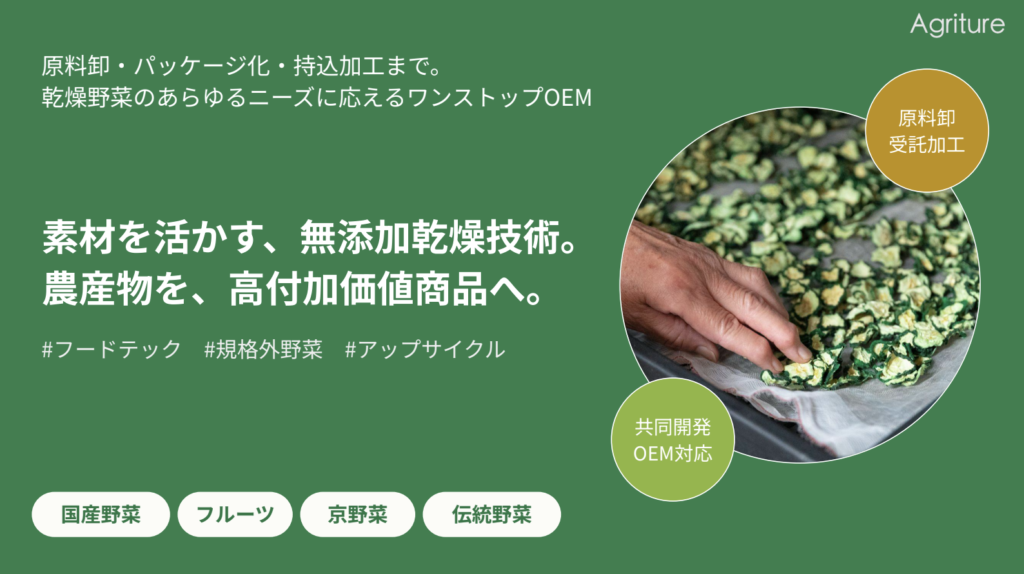
- OEM available from small lots of 10 kg
- Drying of brought-in raw materials also possible
- Support from processing to filling in one place
FOR BUSINESS
乾燥九条ねぎを、原料としてお探しですか
国産の九条ねぎを乾燥・粉砕してお出ししています。カット形状や粒度の指定、継続してのお取引もご相談ください。規格は Dried Kujo green onion・Kujo green onion powder に掲載しています。
少量でのご購入は、姉妹ブランドの通販サイト OYAOYA で承っています。
FAQ
Summary
Other commercial-use vegetable powder items are also Agriture's commercial-use vegetable powders (30+ items) available for viewing here.
Dried Kujo negi powder is an ingredient that can add color, aroma, and Kyoto-vegetable branding to a product all at once. By distinguishing its use from white-negi types, taking countermeasures against baking, acidity, and light, and nailing down the quality specifications (moisture content, microbial standards, particle size) at the specification stage, you can launch a differentiated product while avoiding pitfalls.
Based in Kyoto, Agriture supplies Kyoto-vegetable powders such as Kujo negi, Manganji togarashi, and Shogoin daikon. For the lineup of items, the product page for commercial vegetable powder, and for OEM inquiries, please contact us via Agriture's page on Food OEM no Madoguchi.
Download the OEM contract processing materials
We will send the materials to your email address based on the information you provide.
If you are considering product development with off-spec or your own farm's vegetables:From planning to processing, materials, package printing and novelties, you can consult us through a single point of contact. → Learn more about one-stop product development
- Kyoto ingredient processing OEM | How to make the most of Kyoto vegetables and quality control
- How to Choose Commercial Kujo Negi: Comparing Fresh, Frozen, and Dried
Author of this article
Related articles
-
 Original coffee marketing strategy | Ways to grow sales
 -
 ベジタリアンとは?国の規格が分けている4つの区分と食べられないもの
 -
 長ねぎと白ねぎは同じもの?ねぎの種類と呼び名を国の資料で確かめる
 -
 柚子の種類は何種類あるのか、公の資料で名前が残る系統を数えた
 -
 柚子の皮の使い道は干すと広がる、果汁と種まで使い切る手順
 -
 ゆずの時期は年に二度、青ゆずは7月から黄ゆずは10月から
 -
 ゆずの産地は高知が半分を占め、二位は徳島から愛媛に変わった
 -
 Preventing Food OEM Failures: Common Failure Cases and Countermeasures for Success