
If You Dry and Sell Your Lettuce, How Much Do You Get from 10kg?

Summary of this article
For those who want to dry or powder lettuce and other leafy vegetables they grow and sell them. A manufacturer that handles drying explains its actual terms: lettuce can drop to 5-7% of its fresh weight, so 10kg fresh yields roughly 500-700g; how cutting and drying conditions change depending on whether you sell it dried or as powder; that milling goes down to about 100 mesh at the finest; the five things to tell us for a quote, plus prototype and testing fees; the process for contract processing from 10kg of fresh produce; and the fact that drying turns it into a processed food, along with how to handle bag labeling, ingredient origin labeling and nutrition facts.
Could you dry the lettuce from your field and turn it into a product? Drying is possible. But the first thing to know is that leafy vegetables become surprisingly light when dried. 10kg fresh can end up as just 500-something grams.
In this article, based on the terms we actually offer through our OEM & contract processing: based on the terms we actually offer there, this article walks step by step through what it takes to dry or powder leafy vegetables and sell them.
| Item | What we offer |
|---|---|
| Items we handle | Leafy vegetables such as lettuce, komatsuna and spinach. We handle drying and powdering |
| Finished quantity | Lettuce can drop to 5-7% of its fresh weight. Confirmed by actual measurement in a prototype |
| Minimum processing lot | From 10kg of fresh produce |
| Powder fineness | About 100 mesh (approx. 150 microns) at the finest |
| Lead time | Allow about 2 weeks for a prototype and 3-4 weeks for full production |
| How processing fees are set | Based on the weight of the fresh produce you bring in: a flat 55,000 yen under 40kg, a flat 75,000 yen for 40-100kg, and 750 yen per kg for 100kg or more (excl. tax) |
| Later steps | We can continue on to small-bag filling and label application |
TOC
How many grams does 10kg of fresh lettuce become when dried?
You cannot work out cost, number of bags or retail price until this is settled. Getting a feel for the numbers first keeps your later decisions steady.
Lettuce can drop to 5-7%
When we take on lettuce drying, we work on the assumption that the yield will be around 5-7%. From 10kg fresh, the finished product is about 500-700g. If you pack 10g per bag, that works out to 50-70 bags.
| Fresh weight | Estimated finished weight (5-7%) | In 10g bags |
|---|---|---|
| 10kg | 500〜700g | 50-70 bags |
| 30kg | 1.5〜2.1kg | 150-210 bags |
| 100kg | 5〜7kg | 500-700 bags |
Dried products weigh about 10% of the raw material; leafy vegetables less
Across all items, the dried product generally weighs about 10% of the raw material. Leafy vegetables tend to yield even less, and lettuce is on the low end among them.
Theoretical values calculated from moisture content do not match the actual finished weight. Removing the core and outer leaves, and losses during processing, all add up. We give figures based on actual measurements from processing.
It varies with the amount of outer leaves and the cut, so confirm with a prototype
Even with the same lettuce, the result shifts depending on how much of the outer leaves you use, what size you cut it to and how many days have passed since harvest. With off-grade vegetables, yield drops further because damaged parts are removed.
For this reason, we recommend making a prototype first, measuring the actual yield, and then moving to full production. Ordering bags and labels before the numbers are settled leads to remakes.
Sell it dried or as powder?
Leafy vegetables can be sold either dried or powdered. We set the drying temperature and time for each item, so we cannot set the conditions until you decide which. Please decide the use first.
Keep it dried for soups and furikake
Products that are rehydrated in hot water use the dried pieces as they are. The visible leaf shape is itself part of how the product looks, so the cut size is decided at the prototype stage.
Powder for confectionery and kneading into dough, down to 100 mesh
For uses such as kneading into bread, noodles or baked goods, or dissolving into drinks, the vegetables are powdered. Our milling goes down to about 100 mesh (approx. 150 microns) at the finest; we do not offer finer micro-milling. If you want a texture that does not linger on the tongue, confirm in a prototype whether this fineness is enough.
| Form | Suitable sales channels | What to decide |
|---|---|---|
| Dried as is | Soups, furikake, ochazuke, commercial ingredients | Cut size, fill weight per bag |
| Powder | Confectionery, noodle making, drinks, pet food ingredients | Powder fineness, ingredients it will be mixed with |
Five things to tell us to get a quote
Once the following five points are in place, the basis for the quote is settled on the spot.
Give the fresh weight, not the finished weight, for a quote
Contract manufacturing fees are based on the weight of the produce you send (in its fresh state): a flat 55,000 yen under 40kg, a flat 75,000 yen for 40-100kg, and 750 yen per kg for 100kg or more (excl. tax). If powdered, the powdering work costs 350 yen per 100g. For leafy vegetables with a 5-7% yield, discussing in terms of finished weight will throw your sense of the quote far off.
- Item (lettuce, komatsuna, etc., plus the variety if decided)
- Fresh weight you can send at one time, and the expected annual volume
- Dried as is or powdered
- What it will be used for (soup ingredient, confectionery ingredient, commercial use, etc.)
- When you want to start selling, and the harvest season
Prototype and testing fees are separate from processing fees
On our price list, the prototype fee is 30,000 yen per item per run (excl. tax, paid in advance), using 500g/1kg of fresh raw material. Anything over 1kg is treated as full production. Microbiological (E. coli) testing is 6,000 yen (excl. tax) per test. For products sold at retail, we ask clients to have the testing done. When looking at the total, add these two and material costs such as bags, not just the processing fee.
The contract process: from 10kg fresh, 3-4 weeks for full production
Our minimum processing lot is 10kg of fresh produce. That is 500-700g finished, so the plan is a prototype first, then the batch for sale.
Steps from harvest to shipping
Leafy vegetables spoil quickly, so decide the harvest date and shipping date first. By the day before shipping, please tell us the shipping date, carrier and tracking number. Raw material that arrives without prior notice may not be processed. If there is a lot of mud or soil, removing it before shipping reduces the work accordingly.
Make a prototype before full production
For items we have not processed before, we check the yield and color in a prototype before full production. If we have processed the same item before, we may skip the prototype. The steps from inquiry through prototype to full production are explained in order in our article on turning molokhia into powder. The process is the same for leafy vegetables, so we will not repeat it here.
You can have bagging done as well
After drying or milling, you can go straight on to Small-pouch filling and label application. This cuts out the step of collecting the processed material and sending it to another company. The minimum filling lot and bag specifications are set by the filling side, so please ask about those at the same time. For points to watch when bagging after powdering, see A contract-manufacturing guide to vegetable-powder filling.
What to put on the bag when you sell
Even vegetables you grew yourself are treated as a processed food, not a fresh food, once they are dried. If you sell at a direct sales stand or online, the bag needs a label.
Items to put on the bag as a processed food
| Field | Example |
|---|---|
| Name | Dried lettuce (a common name that describes the contents) |
| Ingredient name | Lettuce (domestic) |
| Net content | 10g |
| Best-before date | Year, month and day, or year and month |
| Storage method | Store at room temperature away from heat and humidity, etc. |
| Manufacturer | Name and address |
For a product made under contract, the business responsible for the label (the party selling it under its own name) and the manufacturing site that actually processed it are different. In that case, write the name and address of the seller plus the address and name of the manufacturing site. Nutrition facts are also required in principle. The conditions for omitting them are explained in How to Turn Your Homegrown Molokhia into Powder and Sell It. The same thinking applies to lettuce.
The best-before date is set by the seller based on scientific and rational grounds. We take on processing only and do not conduct tests for setting dates.
For domestic lettuce, "Lettuce (domestic)"
Processed foods manufactured in Japan require ingredient origin labeling, showing the origin of the ingredient with the highest share by weight. For dried lettuce made from a single ingredient, the basic form is to write "domestic" in parentheses after the ingredient name. If the ingredients field is omitted, another option is to add an ingredient origin field and write "Domestic (lettuce)." For labeling methods, including when mixing with other ingredients, see Origin labeling rules for ingredients in processed foods.
If you make the product in your own processing facility and sell it on the spot (so-called in-store processing), or sell it without a container or packaging, the ingredient list and ingredient origin labeling are not required at all. This treatment does not apply when you take home and sell a product made under contract at an outside processor such as ours. If the labelable area is about 30 square centimeters or less, the ingredient origin can be omitted.
Flaking or powdering changes the ingredient origin category
Under the Food Labeling Standards, "dried mushrooms, dried vegetables and dried fruits" is one of the 22 food groups with specific rules, but a parenthetical note excludes those made into flakes or powder. If you powder the product, apply the general rule of labeling the origin of the top ingredient by weight rather than the 22 food group rules. Either way, the wording does not change if the product is domestic lettuce only, but if you mix it with other ingredients, the ingredient that the rule applies to changes.
We have materials available to help you understand dried processing OEM
Agriture OEM, flexibly handling everything from small lots to large lots
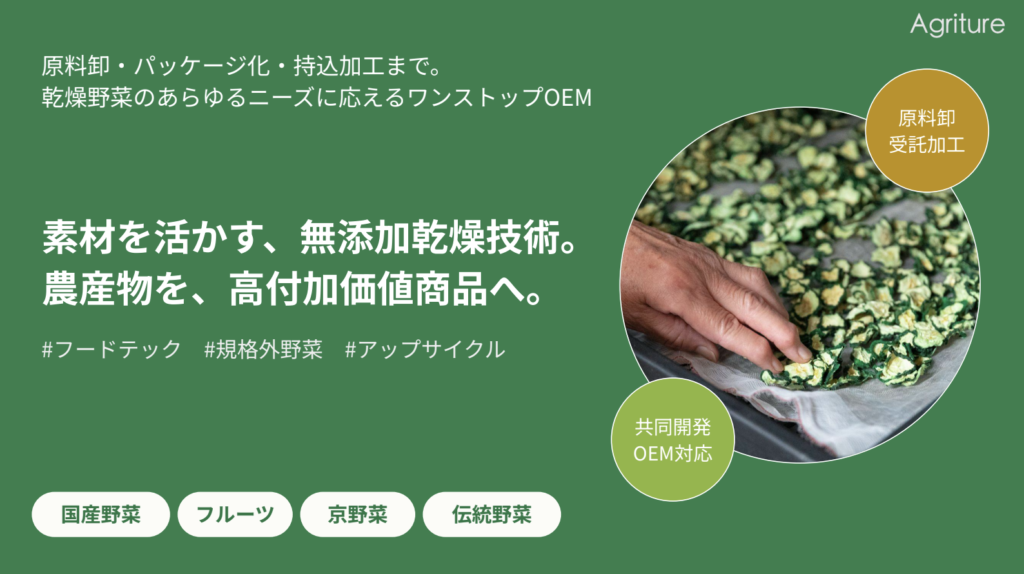
- OEM available from small lots of 10 kg
- Drying of brought-in raw materials also possible
- Support from processing to filling in one place
FAQ
Summary
When drying and selling leafy vegetables, deciding three things first — finished quantity, use and labeling — helps you avoid remaking bags and labels. Here are the key points if we take on the job.
- Lettuce can drop to 5-7% of its fresh weight: 500-700g from 10kg
- Processing fees are based on the weight of the raw material you bring in, not the finished weight
- Cutting and drying conditions change depending on whether you sell it dried or powdered. Powder fineness goes down to about 100 mesh at the finest
- The minimum processing lot is 10kg fresh. Full production follows after measuring the yield in a prototype
- Once dried, it is a processed food. The seller decides the bag labeling and best-before date
If you know which items you grow and how much you can send at one time, you can consult us starting from the prototype.
Recommended reading
How to Turn Your Homegrown Molokhia into Powder and Sell It
A contract-manufacturing guide to vegetable-powder filling
Shiso Powder (Green Shiso and Red Shiso) for Commercial Use and OEM
Download the OEM contract processing materials
We will send the materials to your email address based on the information you provide.
- How to Outsource Only the Filling of Your Home-Roasted Drip Bags
- When Repackaging Imported Dried Fruit in Japan, How Do You Label the Country of Origin and Processor?
Author of this article
Related articles
-
 How to Outsource Only the Filling of Your Home-Roasted Drip Bags
 -
How to Turn Your Homegrown Molokhia into Powder and Sell It
-
What to Decide Before Outsourcing Small Rice Packs
-
When Repackaging Imported Dried Fruit in Japan, How Do You Label the Country of Origin and Processor?
-
 Dried Kujo green onion powder | Usage ideas and how to choose it as a food OEM raw material
 -
 How to Achieve Stand Pouch Filling in Small Lots | Tips for Cost Reduction and Quality Control
 -
 A complete explanation of how to request a filling quote | Necessary information and a comparison checklist
 -
 5 Points for Selecting Packaging Materials | The Best Fit for Your Filling Method and Product Characteristics