
When Repackaging Imported Dried Fruit in Japan, How Do You Label the Country of Origin and Processor?

Summary of this article
For those who want to divide dried fruit imported from overseas (such as dried berries) into small bags in Japan and sell them. A manufacturer that handles small-bag filling explains, based on the Consumer Affairs Agency's Food Labeling Standards Q&A and its actual contract terms: if only repackaged, the country of origin is the country where the dried fruit was manufactured and ingredient origin labeling is not required; the repackaging facility is written as the "processor"; how to approach making the seller the responsible party; the points on best-before dates and business notification to confirm with the public health center; contract terms of 10g or more per bag and from 500 bags; the specification sheet, composition table and import documents needed when consulting; and how costs are calculated and the order proceeds.
You want to divide dried berries purchased from overseas into small bags in Japan and sell them. You have no filling equipment, so you want to hand off just the bagging. We receive inquiries like this about repackaging imported dried fruit.
When outsourcing repackaging, the bag label is easy to overlook. Even if the product is packed in Japan, the country of origin does not become Japan, and the name of the packing facility must also be shown. This article walks through the points in order, based on the Consumer Affairs Agency's Food Labeling Standards Q&A and the terms we actually offer through Small-bag filling OEM service.
| Item | Rule / our service |
|---|---|
| Country of origin | If it is only repackaged, write the country where the dried fruit was manufactured |
| Ingredient origin labeling | Not required, as it is treated as an imported product |
| Repackaging facility | Shown as the "processor" |
| Work you can request | From filling bags through label application (your own bags or ours) |
| Fill weight per bag | 10g or more. We do not take on 1-5g stick packs |
| Minimum lot | From 500 bags |
| Documents needed when consulting | Raw material specification sheet and composition table. Please also share import notification documents if you have them |
TOC
Country of origin and processor on repackaged bags
Even if the product is repacked into bags in Japan, the contents remain a food manufactured overseas. The country of origin and business fields are determined on this basis.
If it is only repackaged, the country of origin is where the dried fruit was manufactured
The Consumer Affairs Agency's Food Labeling Standards Q&A states that simple repackaging or assortment does not count as "an act that brings about a substantial change in the content of the product." Therefore, as with products imported as finished goods, the country where the substantial change took place, that is, the country where the dried fruit was manufactured, is labeled as the country of origin.
The country of origin here is not necessarily the country of the trading company you bought from or the country of shipment. For example, if fruit dried in Country A is bought from a trading company in Country B, you write Country A, where it was manufactured. Even if it is bagged in Japan, you do not write Japan in the country of origin field.
On the other hand, the same Q&A gives the example that seasoning imported dried shrimp in Japan counts as a substantial change, making Japan the country of origin. If the product is treated as manufactured in Japan, you then need to consider ingredient origin labeling instead of the country of origin. Whether adding steps other than repackaging, such as recoating with sugar or oil, falls on one side or the other is judged product by product, so check with a labeling advisory service in advance.
Ingredient origin labeling is not required
Processed foods manufactured in Japan require ingredient origin labeling, showing the origin of the ingredient with the highest share by weight. However, products whose domestic processing after import does not bring about a substantial change are treated as imported products, and if the "country of origin" is written, ingredient origin labeling is not required. The rules for processed foods manufactured in Japan are covered in Origin labeling rules for ingredients in processed foods.
Write the repackaging facility as the "processor"
The Q&A states that repackaging counts as processing, so even for imported products, the business that did the bagging must be shown as the "processor." If the repackaging business is the party responsible for the label, the importer does not need to be listed as the responsible party.
If the selling company wants to take responsibility for the label, it can become the responsible party under the heading "seller" by agreement with the manufacturer, processor and importer. Even in that case, the repackaging facility is listed separately as the processor.
| Field | How to approach it |
|---|---|
| Name | A common name that describes the contents |
| Ingredient name | In descending order by weight, as on the imported raw material's specification sheet |
| Net content | Weight per bag after repackaging |
| Country of origin | Country where the dried fruit was manufactured |
| Party responsible for the label | "Processor" if the repackaging facility takes responsibility; "seller" if the selling company does so by agreement |
| Processor | Even if the responsible party is the seller, write the name and address of the repackaging facility |
For peace of mind, have the public health center or a labeling specialist review your draft label before ordering.
Check with the public health center before deciding on the best-before date and business notification
The Consumer Affairs Agency's guidelines state that the date is set by the party responsible for the label on scientific and rational grounds, and that for imported foods it is in principle set by the importer. However, the Q&A does not say whether the original date can be used as is on the bags after repackaging. Since the bags are opened and repacked, check whether the date needs to be reset.
The "food repackaging business" that requires a business license covers only foods manufactured in business categories specified by Cabinet Order, such as confectionery and prepared dishes. Treatment may differ for products such as sugar-preserved fruit, so check with the public health center for the location of the repackaging facility whether a license or a notification is needed.
How much can you hand off when outsourcing only repackaging?
What we take on is weighing the dried fruit you entrust to us, filling it into bags, sealing them and applying labels. Import procedures and decisions about which bags to use and how to sell are up to you.
Your own bags or ours: from filling through label application
We accept jobs where you send your own bags and we fill them and apply labels. You can also choose from the bags we stock. If you use your own bags, a materials handling fee of 5,000 yen (packaging and labels) applies.
From 10g per bag; we do not do 1-5g stick packs
We accept fill weights of 10g or more per bag. We do not take on stick packs of about 1-5g due to our production conditions. If you are considering very small sample packs, you will need to either use small bags of 10g or more or find a contractor that can do stick packs.
Whether we can take the job depends on the raw material specifications and form
Dried fruit is within the scope of our filling, but dried berries vary from product to product in size, surface stickiness and how much powder they shed. So we tell you whether we can handle them after reviewing the raw material specifications and form.
Documents and quantity to prepare before consulting
Because we are handling imported raw material, we confirm what the contents are through documents before starting work. Having the following three items ready speeds up our decision.
Raw material specification sheet and composition table
For contract filling, we ask you to provide the raw material specification sheet and composition table. These let us confirm the ingredients and storage conditions, and they also serve as the basis for the bag label.
Import notification documents
Under the Food Sanitation Act (Article 27), anyone importing food for sale must notify the quarantine station for each import. The importer submits the notification, not us. That said, to make confirmation smoother, we ask you to share documents related to the import notification as well. Reviewing these documents does not mean we examine or guarantee the import procedures or the legal compliance of the labeling.
Quantities from 500 bags; if supplying bags, send actual samples first
The minimum lot is 500 bags. We do not accept smaller quantities because the setup work for filling does not justify the volume.
If you use your own bags, we check with actual samples whether the material can be firmly heat sealed. Please send samples of the bags you will use in production before ordering. How we check is also explained in our article on outsourcing only drip bag filling.
How costs are calculated and how the order proceeds
The price depends on the bag type, quantity and options added. Getting a rough estimate with the quote form before consulting us makes it more likely everything can be settled in one exchange.
Total = (materials + filling + options per bag) × number of bags
The total is "materials + filling work + selected options" multiplied by the number of bags. You are not charged for options you do not use. Shipping work (300 yen per shipment) and shipping costs are added, and filling-only orders carry an initial fee of 15,000 yen on the first order. Small-pouch filling OEM service page quote form: choose the filling method, item, bag, quantity and options to see a rough estimate.
Desiccants for moisture and oxygen absorbers for oxidation can be included free of charge
Dried berries become sticky or clump when they absorb moisture. A desiccant for moisture and an oxygen absorber for oxidation can be put in the bag free of charge. If you want to block light, you can choose aluminum bags.
The flow from consultation to delivery
| Step | What to do | What gets decided |
|---|---|---|
| 1 | Consultation (item, fill weight per bag, number of bags, bag specifications) | Basis for the quote |
| 2 | Share the specification sheet, composition table and import documents | Whether we can take the job, based on the raw material specifications and form |
| 3 | Checking actual samples of supplied bags | Whether they can be sealed |
| 4 | Shipping raw material and materials; filling and label application | Delivery date |
We have prepared materials that explain small-pouch filling
Agriture, flexibly handling everything from small lots to large lots
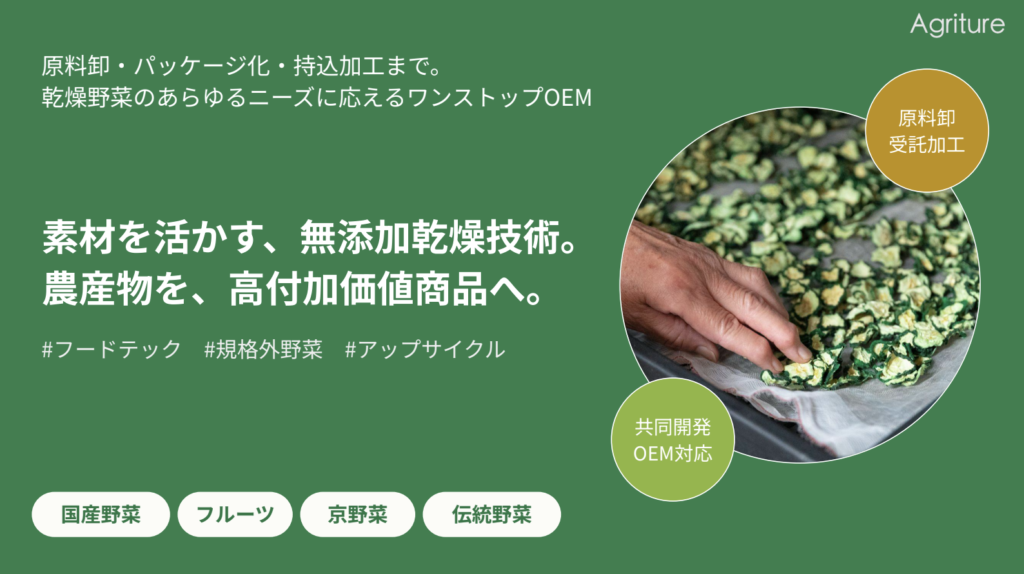
- Small-bag filling from 500 bags
- Tea and coffee also supported
- Sealing carried out in a single seamless flow
FAQ
Summary
When repackaging imported dried fruit for sale in Japan, it is easier to proceed if you first understand the labeling approach and then prepare the documents and bags.
- Write the country where the dried fruit was manufactured as the country of origin; ingredient origin labeling is not required
- Show the repackaging facility as the "processor"
- Check with the public health center before deciding the best-before date after repackaging and any business notification
- Before consulting, prepare the specification sheet, composition table and samples of the bags you want to use
We take on filling and label application from 10g per bag and from 500 bags. Please include the specification sheet and bag specifications when you contact us.
Recommended reading
Practical Guide to Importing Dried Vegetables: Tariffs, HS Codes, and Quarantine Explained
Rules for Labeling the Origin of Raw Materials in Processed Foods: 4 Labeling Methods and Penalties for Violations
How to Outsource Only the Filling of Your Home-Roasted Drip Bags
Download the small-pouch filling materials
We will send the materials to your email address based on the information you provide.
Author of this article
Related articles
-
 How to Outsource Only the Filling of Your Home-Roasted Drip Bags
 -
How to Turn Your Homegrown Molokhia into Powder and Sell It
-
What to Decide Before Outsourcing Small Rice Packs
-
If You Dry and Sell Your Lettuce, How Much Do You Get from 10kg?
-
 Dried Kujo green onion powder | Usage ideas and how to choose it as a food OEM raw material
 -
 How to Achieve Stand Pouch Filling in Small Lots | Tips for Cost Reduction and Quality Control
 -
 A complete explanation of how to request a filling quote | Necessary information and a comparison checklist
 -
 5 Points for Selecting Packaging Materials | The Best Fit for Your Filling Method and Product Characteristics