
Before pursuing sixth-industrialization certification, decide whether to do the processing yourself or outsource it

Every year we get inquiries from people who want to process and sell what they grow in their fields. The first fork in the road then is not whether you can get a subsidy. It's whether you take on the processing equipment and staff yourself, or send the processing itself outside. If you start from the discussion of programs without deciding this, you may be able to write the plan but the numbers won't add up.
From our position drying and milling raw materials entrusted to us by farmers in Kyoto, we lay out what you can use under the Sixth Industrialization and Local Production for Local Consumption Act, along with the conditions that actually matter on the ground. If you only want to confirm the meaning of the terms, The meaning of sixth industrialization.
| What you'll learn in this article | Key points |
|---|---|
| What certification involves | What gets certified is not the business operator but the "Comprehensive Business Plan" |
| What you can use with certification | Exceptions under four laws. If you don't have facilities, the one that counts is interest-free financing |
| The legal dividing line | While you dry what you grew yourself, it's a "gathering business." No business license or notification is required |
| Labeling on the bag | Even if you outsource, responsibility stays with the seller, and the contractor's factory name also appears |
| How to decide between in-house and outsourcing | It's decided by annual operating volume and the number of items. You can also take the order of running on outsourcing for a few years before judging |
TOC
Sixth industrialization certification attaches to the plan, not the business operator
What is called "sixth industrialization certification" is really certification of a business plan. Rather than certifying the business operator, the government certifies a plan describing what you will do within the next five years.
What gets certified is the "Comprehensive Business Plan"
The underlying law is the "Act on Promotion of New Business Creation by Agriculture, Forestry and Fishery Operators Utilizing Local Resources and on Promotion of the Use of Local Agricultural, Forestry and Fishery Products,"Sixth Industrialization and Local Production for Local Consumption Act is how it's abbreviated. It was promulgated on December 3, 2010. What is certified based on this law is the "Comprehensive Business Plan," and this is what farmers generally call sixth industrialization certification.
There is also another category, the "Research, Development and Results Utilization Business Plan," but it is small in number, with 29 cases cumulatively. Initiatives that make and sell processed products almost all fall under the Comprehensive Business Plan.
There are four conditions. The ones with numbers are sales and income
The certification requirements published by the Ministry of Agriculture, Forestry and Fisheries are four items extracted from the basic policy. You need to meet all of them.
| Item | Details |
|---|---|
| Business entity | Carried out by agriculture, forestry, and fishery operators and the like. In addition to individuals and corporations, organizations such as agricultural cooperatives and community-based farming groups are eligible, and voluntary organizations are also acceptable |
| Business content | Any of the following: development, production, or demand cultivation of new products using one's own agricultural, forestry, or fishery products as an essential raw material; introduction or improvement of new sales methods; or improvement of the production methods needed for them |
| Management improvement | Sales of agricultural, forestry, and fishery products and new products increase by 5% or more over five years. In addition, the income from agriculture, forestry, fishery, and related businesses improves from the start to the end, and the final year is in the black |
| Plan period | Within five years. Three to five years is considered preferable |
The business content field in both cases carries the conditions "not previously done" and "not previously used." Even if you write into the plan a processed product you have already been making and selling for years, it does not count as a new product or a new sales method.
You can obtain certification even if you outsource the processing
What the requirements bind is the business entity, not doing the processing at your own factory. Positioning machinery makers, food manufacturers, retailers, IT companies, and the like as "promotion operators" in the plan is permitted, and it is explicitly stated that business scale is not questioned. A plan premised on sending the processing to a contractor still holds up as an application.
You apply to the Regional Agricultural Administration Office. For Kyoto Prefecture, that's the Kinki Regional Agricultural Administration Office
The application contacts are each Regional Agricultural Administration Office, the Hokkaido Regional Agricultural Administration Office, and the Okinawa General Bureau. It is not the prefectural government. The one responsible for Shiga, Kyoto, Osaka, Hyogo, Nara, and Wakayama is the Urban-Rural Exchange Division of the Rural Development Department at the Kinki Regional Agricultural Administration Office, located in Kamigyo-ku, Kyoto. The prefectural regional bases also accept consultations.
Among the appended tables attached to the application, the one you must always create is Appended Table 3, which states the amount of funds and the method of procurement. If you don't develop facilities or don't use legal exceptions, you write "not applicable" in the facilities table and the exceptions table. If you send the processing outside, these two become not applicable.
What you can use once you obtain certification. No subsidy comes with it
It is not a system where a subsidy is granted simply for receiving certification. What is tied to certification is the exceptions under four laws. Subsidy programs are applied for through their respective public calls, separately from certification.
There are four exceptions: funds, farmland, city planning, and vegetable shipment
| Exception | Relevant situation |
|---|---|
| Exception under the Agricultural Improvement Fund Financing Act and related laws | When borrowing interest-free funds |
| Exception under the Agricultural Land Act (Article 12, Paragraphs 1 and 2) | When building a processing facility or direct-sales facility on farmland |
| Exception under the City Planning Act | When building a sales facility in an urbanization control area |
| Exception under the Vegetable Production and Shipment Stabilization Act | When involved in the shipment of designated vegetables |
Of the four, the two under the Agricultural Land Act and the City Planning Act are exceptions involving land and facilities. If you send the processing to a contractor and hold no facilities yourself, these two have no occasion to be used. What remains centers on the funding exception. This is why the value of obtaining certification differs greatly from person to person.
The Agricultural Improvement Fund is interest-free, with a repayment period within 12 years
The Agricultural Improvement Fund that certified farmers and the like can borrow has a lending rate of zero interest. The repayment period is within 12 years, including a grace period within 3 to 5 years. The lending limit is 50 million yen for individuals and 150 million yen for corporations and organizations. The contacts are JA, branches of the Japan Finance Corporation, and branches of the Okinawa Development Finance Corporation.
For forestry, the Forestry and Wood Industry Improvement Fund, and for fishery, the Coastal Fishery Improvement Fund, are provided in the same position. Having a grace period means you can get through the few years until sales begin without repaying principal. For plans involving capital investment, these few years count.
Discontinued support measures keep lingering in explanatory articles
Sixth industrialization is a field where the programs have been reorganized again and again. The three that are easy to trip over when considering an application are the following, and we see each of them presented as a current support measure in some cases.
| What is often written | Current status |
|---|---|
| Investment from the Agriculture, Forestry and Fisheries Growth Industrialization Fund (A-FIVE) | The Agriculture, Forestry and Fisheries Growth Industrialization Support Organization was dissolved as of March 31, 2026 |
| Food Industry and Sixth Industrialization Grant | Organized by the Ministry of Agriculture, Forestry and Fisheries as "past budgets, etc." Listed only through fiscal 2021 |
| Sixth Industrialization Support Program (dispatch of sixth industrialization planners) | Likewise listed under "past budgets, etc." The implementation guidelines run through fiscal 2021 |
The framework for consulting experts has not disappeared. Its name has changed twice.
| Fiscal year | Name of the support framework |
|---|---|
| Through fiscal 2021 | Food Industry and Sixth Industrialization Grant, Sixth Industrialization Support Program |
| From fiscal 2022 through fiscal 2024 | Rural Innovation (Nosanson-hatsu Innovation) |
| From fiscal 2025 | Local Resource Utilization Value Creation |
Current consultations and expert dispatch are handled by the central support program and the prefectural support program for local resource utilization and regional collaboration. Searching by program name tends to surface older information first, so going directly to the Regional Agricultural Administration Office is quicker than hunting by name.
FOR BUSINESS
We take on OEM and contract processing of dried vegetables
We handle drying of domestically grown vegetables and fruits, grinding down to around 100 mesh, and small-pack filling from 10g. We welcome everything from small-lot prototypes to mass production. Real examples of inquiries we've received are OEM and wholesale inquiries listed at.
We guide the best-before date of dried products as a rough 6 months from the shipping date.
Of the 2,654 certified cases, 96% involve processing
Before looking for success stories, seeing what the people who obtained certification are actually doing tells you where your own plan sits. The Ministry of Agriculture, Forestry and Fisheries publishes the cumulative breakdown.
Seventy percent is "processing and direct sales." Restaurants don't reach ten percent
As of the end of July 2026, the cumulative number of certified cases is 2,654. The proportions by business content are as follows.
| Business content | Proportion |
|---|---|
| Processing and direct sales | 68.9% |
| Processing | 18.2% |
| Processing, direct sales, and restaurant | 7.0% |
| Direct sales | 2.9% |
| Processing, direct sales, and export | 2.2% |
| Export | 0.4% |
| Restaurant | 0.4% |
Adding the four types that include processing comes to 96.3%. Although the program is often talked about with images of tourist farms and farm restaurants, the types that include a restaurant come to only 7.4% combined. The question of how to arrange processing is one that nearly everyone taking on sixth industrialization goes through first. Turning vegetables you grew yourself into powder and selling it is also a common inquiry, which overlaps with this distribution.
Vegetables are the most common target. By region, they cluster in Kyushu and Kanto
| Category | Top |
|---|---|
| Target agricultural, forestry, and fishery products | Vegetables 31.6%, fruit trees 18.7%, livestock products 12.6%, rice 11.7% (plans targeting multiple items count all of them) |
| Number of certified cases by region | Kyushu 471, Kanto 464, Kinki 390, Tohoku 382, Chugoku-Shikoku 335 |
| By prefecture, in descending order | Hokkaido 163, Hyogo 119, Miyazaki 113, Nagano 100, Okayama 100 |
Vegetables account for 30%. Vegetable inquiries are also the most common at our company, and the many processing options—drying, powder, paste—and the ease of diverting out-of-spec produce seem to be factors. Making use of off-spec vegetables Plans that start from this fall into this group.
Where does agriculture end and the food business begin?
What matters before the discussion of programs is the dividing line under the Food Sanitation Act. Many people uniformly assume that you need a business license once you start processing, but the line is not drawn at the point you start processing.
While you dry and sell what you grew yourself, it's a "gathering business"
Article 4, Paragraph 7 of the Food Sanitation Act provides that the business of gathering food in agriculture and fishery is not included in "business." As long as it qualifies as a gathering business, HACCP-based sanitation management, a business license, and a business notification are all out of scope.
How far the gathering business extends is shown by the Ministry of Health, Labour and Welfare in notifications for each individual act. Extracting the part relating to drying gives the following.
| Act | Gathering business? |
|---|---|
| Drying harvested produce in a dryer | Qualifies |
| Sun-drying and drying of produce (vegetables, herbs, fruit, etc.) (rack drying, whole-dried daikon) | Qualifies |
| Preparation of vegetables and the like (peeling, root trimming, stem removal, washing, bagging, refrigeration, freezing, drying, and other shipping preparation that does not involve a change in shape) | Qualifies |
| Production of dried mushrooms | Qualifies |
| Cooking or cutting done for consumption convenience (boiled vegetables, cut vegetables, shredding, etc.) | Does not qualify |
| Manufacture of dried shredded daikon, dried persimmons, dried apricots, and dried sweet potatoes, and processing of dried mushrooms (slicing, etc.) | Does not qualify. However, excluding cases where a farmer (including producer groups) uses produce they grew themselves as the raw material |
The last row needs care in how it's read. Manufacturing dried shredded daikon qualifies as a business in principle, but a farmer who uses daikon they grew themselves as the raw material is excluded. Even making the same product, if the raw material is your own, you are excluded.
Even within the same notification, there are acts to which the farmer exclusion is not attached
The processing of dried persimmons, dried apricots, dried sweet potatoes, dried shredded daikon, and dried mushrooms carries the proviso "excluding cases where a farmer uses produce they grew themselves as the raw material." On the other hand, milling (rice flour, buckwheat flour) in the same list has no such proviso. The notification is organized individually for each act, and the treatment of acts not on the list is not written. If the process you intend to carry out is not listed, confirm with the health center that has jurisdiction before deciding on equipment and how to sell.
Once you start handling others' raw materials, you cross the line
You fall outside the gathering business when you reach beyond your own fields. Buying raw materials from neighboring farmers to process, taking on the processing itself, purchasing and selling processed products. From around here it becomes a business, and depending on the type of business you need a business license or a business notification.
This line lines up exactly with the direction in which a sixth industrialization plan expands. You start with only your own fields' produce, and the moment volume grows and you begin gathering from neighbors, a sanitation management obligation arises. When you write the third year of the plan and beyond, whether or not you've anticipated this changes how realistic it is.
Once it becomes a business, a license or notification and HACCP come with it
The types of business requiring a business license were revised in the 2018 amendment to the Food Sanitation Act. After consolidating types of business that share raw materials and production processes, new ones such as pickle manufacturing and liquid egg manufacturing were added, and overall the count went from 34 types to 32. A business that does not fall under a licensed type requires a notification to the health center, which has no facility standards and no renewal. Both took effect on June 1, 2021.
HACCP-based sanitation management was also fully implemented on the same June 1, 2021. If the number of people engaged in handling food and the like is fewer than 50, "sanitation management incorporating HACCP principles" is sufficient, and you can build a sanitation management plan using guides prepared by industry associations. The headcount is counted for the business site as a whole, not per licensed type of business, and does not include people not directly engaged in manufacturing, such as those in HR, accounting, sales, and facility maintenance.
Even in a gathering business, the duty to ensure safety remains
The Ministry of Health, Labour and Welfare's Q&A collection states that a person running a gathering business is still a food business operator, and is required to endeavor to take the measures necessary to ensure the safety of the food they handle, centered on general sanitation management. Not needing a license or notification is a different matter from being free to do nothing.
What are you obligated to write on a processed product's bag?
Separately from the sanitation dividing line, a labeling obligation applies. The Food Labeling Act and the Food Labeling Standards collectively call manufacturers, processors, importers, and sellers food-related business operators and the like, and require compliance with the standards.
When you have it made under contract, the contractor's factory name also appears on the bag
Even if you send the processing outside, responsibility for what's written on the bag doesn't disappear. In the field for "the name and address of the food-related business operator," you write the party responsible for the labeling content. The field name is determined by the position of the party bearing responsibility.
| Who bears responsibility for the labeling | Field name |
|---|---|
| Made at your own processing facility, and you bear responsibility | Manufacturer (processor, if processing) |
| Agreed with the contractor, the seller does the labeling on their behalf | Seller |
Separately from this, processed foods have an obligation to display "the location of the manufacturing or processing site and the name of the manufacturer or processor." This can be omitted only when the labeling-responsible party's address and name are the same as the manufacturing site's location and name. When you have it made under contract, these two become separate, so on the bag your own name appears as the "seller" alongside the location and name of the contractor's factory as the manufacturing site.
You can't always replace the contractor's factory name with a symbol
The manufacturer-specific symbol that replaces the manufacturing site's location and the manufacturer's name with a symbol is a system you register and use when the same product is manufactured at two or more manufacturing sites. In principle it cannot be used for a product made by only one contractor. It is not a method you can choose simply because you don't want to show the factory name, so before creating the label plate, confirm with the contractor which name will appear.
For the ingredient names, the allergens, and the best-before date alike, the one responsible for what is written is the seller. The contractor makes it to the conditions requested, but deciding how many days the product keeps when sold is the seller's job.
On setting the expiration date, the Consumer Affairs Agency amended the "Guidelines for Setting Food Expiration Date Labeling" on March 28, 2025. If you handle dried products, assume you'll need a step where you decide it yourself based on test results.
How much you write differs between selling at a direct-sales outlet and wholesaling to stores
One more thing: the labeling burden differs by where you sell. The Food Labeling Standards state that when you sell food at the place where it was manufactured or processed, some labeling items are unnecessary.
| Place of sale | What to write on the container and packaging |
|---|---|
| Selling at the place of manufacture or processing (your own processing facility or an attached direct-sales outlet) | The ingredient names, net content, nutrient amounts and calories, the food-related business operator's name and address, country of origin, and the origin of raw materials, among others, are unnecessary. However, labeling items derived from the Food Sanitation Act cannot be omitted |
| Wholesaling to retail stores or e-commerce | All items of the collective labeling are required |
While you sell next to your own processing facility, simplified labeling suffices, and the moment you wholesale to a supermarket or e-commerce, all items of the collective labeling are required—there's a step change here. If your plan is to widen your sales outlets, making the labeling on a wholesale premise from the start avoids having to remake the labels.
Business operators who can omit nutrition labeling
As for nutrient amounts and calories, items sold by business operators exempt from the obligation to pay consumption tax may omit them. For the time being, this applies to business operators with taxable sales of 10 million yen or less, or small-scale enterprises under the Small and Medium-sized Enterprise Basic Act (roughly 20 or fewer regular employees, or 5 or fewer in commerce and services). When sales grow and you are no longer a tax-exempt operator, the labeling obligation arises, so check at the point your scale changes.
Whether to have your own processing facility or send it out for contract processing
Even selling the same product, which of the equipment, staff, and sanitation management you hold yourself changes both the funds needed and the speed at which you can move.
If you hold them yourself, costs ride even on idle time
What's easy to overlook in a plan to build a processing facility is the cost of idle time. Even a dryer that runs only in the harvest season carries depreciation year-round. If you assign people to processing, someone has to cover the farm work in the meantime.
A hygiene management plan is not finished the moment you draw it up. You are expected to keep records, review them periodically, and revise the plan as needed. What you show a health center during an inspection is the records, not the plan document.
| Item | Do it in-house | Outsource to contract processing |
|---|---|---|
| Initial investment | Requires buildings, machinery, and drainage facilities | No capital investment required |
| Nature of the cost | Fixed cost. It continues even through the off-season | Variable cost. None incurred unless you place an order |
| Business license / notification | You obtain it yourself according to what you make | Made under the contractor's facilities and licenses |
| Hygiene management | You draw up your own plan and keep records | The contractor bears the manufacturing process |
| Batch size | You can freely test from small quantities | You match the contractor's minimum lot |
| Recipe changes | You can make adjustments at any time | You renegotiate the terms each time |
| Labeling on the bag | Both the responsibility and the manufacturing site name are yours | The responsibility is yours. The manufacturing site is the contractor's name |
| Special exemptions under certification | The Agricultural Land Act and City Planning Act apply | No occasion to use them |
Run the first few years on contract processing, and decide after looking at the numbers
The hardest part of deciding on capital investment is that you cannot predict how much you will sell. The plan requires you to write five years of sales figures, but if you fix the capacity of your dryer before you have first-year results, it ends up either too large or too small.
Running on contract processing first gives you real figures for yield, how much you can produce per batch, how well it sells, and the return rate. If you then switch to in-house, you can choose machinery with the required capacity already settled. Since the certified plan period is within five years, you can also structure it as contract processing for the first half and facility development in the second half.
Which to choose is decided by volume and number of items
- If you have enough volume to run the same equipment throughout the year and can narrow down your items, lean toward in-house
- If volume concentrates at harvest time, you have many items, or you are at a stage where sales are hard to predict, lean toward contract processing
- If your plan involves building facilities on farmland, the certification's special exemptions under the Agricultural Land Act and City Planning Act come into play
- As long as you run on raw materials from your own fields only, it is a gathering business. Once you start collecting from nearby growers, you need to prepare for business operation
Search for subsidies across three tiers: national, prefectural, and municipal
The programs available for sixth-industrialization fall into three tiers, and the scale of the amounts and the weight of the application differ by tier.
If you are building a processing facility, use national grants
What links directly to new product development using agricultural, forestry, and fishery products and to the development of processing and sales facilities is Grant for Promoting Agricultural, Mountain and Fishing Villages (Measures for Creating Value from Local Resources). The budget for "Creating Value through Regional Resource Utilization" mentioned in the previous chapter corresponds to this. If you are building a processing system on a growing-region basis, Comprehensive Support Grant for Building Strong Agriculture and Growing Region Production Base Power-Up Program is also a candidate. Both are programs administered via the prefectures.
At the stage where you start small, such as prototypes, packaging, trade shows, and e-commerce, the Small Business Sustainability Subsidy is easy to use, and sole proprietors and farmers can also be eligible. For product development involving capital investment, the New Business Expansion / Monozukuri, Commerce and Services Subsidy is a candidate.
For prefectures and municipalities, start from the region where your base is located
In the regions where our manufacturing sites are located, the following programs are in place.
Municipal programs have smaller amounts but looser requirements, making them well suited to the first prototypes and packaging work. the list of subsidies to narrow down by region and amount scale.
Always verify public application information against the original source
Amounts, requirements, and application periods change. Always check the official, latest application guidelines for each program.
What Agriture can do to get you to a product without building a processing facility
Based in Kyoto, we take on the drying and grinding of raw materials entrusted to us by farmers and agricultural corporations, through to filling into small packs. We are used as a receiving point for those who want to progress to commercialization without building a processing facility.
You may send it unwashed. We handle washing and preprocessing
As a rule, raw materials should be sent to us in their fresh state. We handle washing and preprocessing, then proceed to drying and, if needed, grinding. Drying is hot-air drying, which produces a different finish from freeze-drying.
| Process | Details |
|---|---|
| Receiving / washing | We take delivery of the produce while fresh and carry out washing and preprocessing |
| Dried | Hot-air drying. Temperature and time are set for each item |
| Grinding | Down to the equivalent of 100 mesh (approx. 150 microns). We do not accept finer micro-grinding than this |
| Filling / label application | We can continue through to filling into small packs and applying labels |
| Testing | We handle microbial testing and best-before date testing |
| Best-before date | For dried products, roughly 6 months from the shipping date is the guideline |
The finished dried product can be turned directly into Vegetable powder, or sold keeping its dried form. Which one determines the cut size at the time of drying, so if you decide the intended use first, the prototype can be done in a single round. Small-pouch filling If you have us handle the full run through to this, the bag specifications and the minimum filling lot are decided separately.
Mugwort comes out fuzzy, and high-sugar fruits cannot be made into powder
There are two caveats we share before prototyping. Both are things we learned from actual processing.
- Leaves with strong fibers, like mugwort, do not become a fine powder even when ground, and come out with a fuzzy finish
- High-sugar items like grapes and persimmons can be dried but cannot be turned into powder. If they do not dry out completely, we may be unable to accept the main production
Yield also varies greatly by item. Leafy vegetables can come in under 10% of their fresh weight, so the number of bags and the selling-price calculation end up not matching your assumptions. The finished quantity when leafy vegetables are dried is summarized with actual measurements in a separate article.
We cannot take on freeze-drying, retort, or vegetable chips
Since it is quicker to tell you up front, we list what falls outside our scope.
- Freeze-drying (we are currently suspending acceptance of new requests)
- Coffee roasting, extraction, and concentration
- Retort
- Vegetable chips
- Stick filling of 1 to 5 g
- Grinding finer than 100 mesh
If you need processing beyond this scope, Food OEM Directory you can search for a manufacturer who can handle it.
We have materials available to help you understand dried processing OEM
Agriture OEM, flexibly handling everything from small lots to large lots
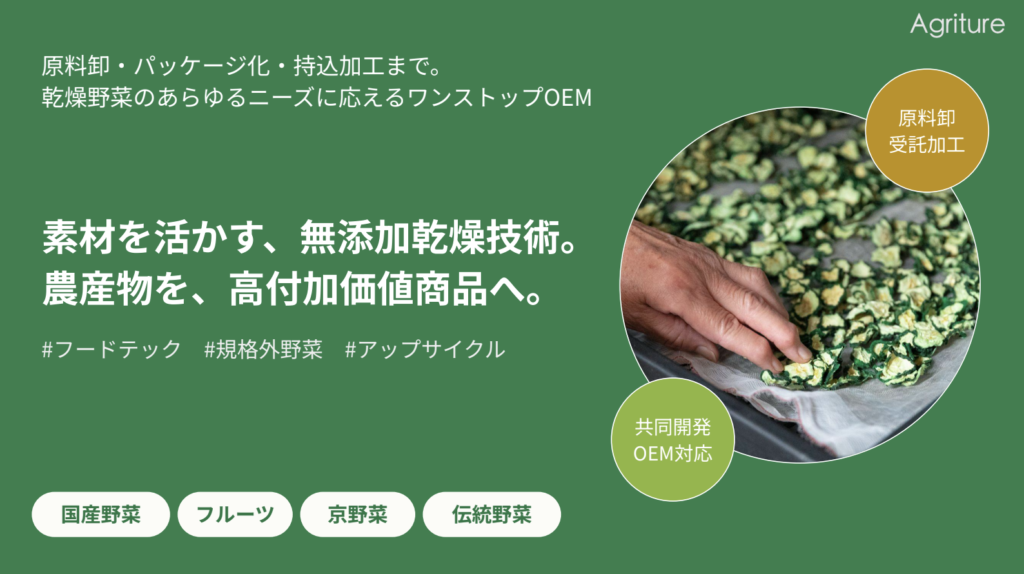
- OEM available from small lots of 10 kg
- Drying of brought-in raw materials also possible
- Support from processing to filling in one place
FOR BUSINESS
We take on OEM and contract processing of dried vegetables
We handle drying of domestically grown vegetables and fruits, grinding down to around 100 mesh, and small-pack filling from 10g. We welcome everything from small-lot prototypes to mass production. Real examples of inquiries we've received are OEM and wholesale inquiries listed at.
We guide the best-before date of dried products as a rough 6 months from the shipping date.
FAQ
Summary
Read as a matter of the system, sixth-industrialization makes whether to obtain certification look like the issue. When it comes to actually getting to work, the issue shifts to who does the processing.
- What is certified is not the business but a business plan of within five years. The conditions are a 5% sales increase and a profit in the final year
- What you can use under certification are the special exemptions of four laws. If you hold no facilities, what works is mainly the interest-free funds
- If you have the volume to keep equipment running throughout the year and items you can narrow down, go in-house. If volume concentrates at harvest, you have many items, or sales are hard to predict, outsource
- You can also take the order of running on contract processing for the first few years to pin down yield and sales in real figures, then decide on capital investment on that basis
- While drying raw materials from your own fields, it is a gathering business. Once you start collecting from nearby growers it becomes business operation, and a license or notification plus HACCP come with it
- Even if you outsource, responsibility for the bag labeling and best-before date stays with the selling side, and the contractor's factory name appears as the manufacturing site
If the items you make, the amount you can produce per batch, and your sales prospects are decided, you can consult us starting from prototyping.
Recommended reading
If You Dry and Sell Your Lettuce, How Much Do You Get from 10kg?
How to Turn Your Homegrown Molokhia into Powder and Sell It
When Repackaging Imported Dried Fruit in Japan, How Do You Label the Country of Origin and Processor?
Download the OEM contract processing materials
We will send the materials to your email address based on the information you provide.
- When Repackaging Imported Dried Fruit in Japan, How Do You Label the Country of Origin and Processor?
- The nine allergen-labeling items — now including cashew nuts — that cannot be omitted even on small packs
Author of this article
Related articles
-
 How to Make Dried Tomatoes: Drying Tips, and How Cherry and Large Tomatoes Turn Out Differently
-
 Kansai Food OEM: 6 Steps to Making a New Product and Subsidies
-
 Practical Guide to Importing Dried Vegetables: Tariffs, HS Codes, and Quarantine Explained
-
How to choose retirement gifts | A collection of food gift ideas that convey gratitude
-
 How to choose commercial vegetable dashi: comparing across three axes of ingredient, format, and scope
-
 A guide to preparing for a trade show | Schedule, costs, and checklist
-
 Peace of mind even for first-time food OEM! Tips for choosing a manufacturer and ordering without going wrong
-
 How to source commercial vegetable powder in small lots, and how to use it