
How to Turn Your Homegrown Molokhia into Powder and Sell It

Summary of this article
For those who want to turn molokhia they grow into powder and sell it, a manufacturer that handles drying and powder processing explains, based on its actual terms: harvesting precautions such as keeping seeds, pods and young sprouts, which contain toxic compounds (cardiac glycosides), out of the raw material and picking before pods form (Ministry of Agriculture, Forestry and Fisheries); expected yield after drying; the difference between a home mill and outsourcing; the process from a prototype of 500g/1kg fresh to full production from 10kg fresh, and how washing is handled; labeling for direct sales stands and the conditions for omitting nutrition facts; and the specifications to confirm when supplying other businesses.
When you want to turn molokhia you grew into powder and sell it, the first stumbling block is preparing the raw material. Molokhia has parts that must not go into the raw material, so you can't simply send the leaves as picked.
At Agriture, we receive raw materials from growers and take on drying and powder processing of leafy vegetables. In this article, based on the terms we actually offer through our contract drying service, we walk through the steps from harvest and contract processing to preparation for each way of selling. First, here is a summary of the terms we can accept.
| Item | What we offer |
|---|---|
| Prototyping | One run with 500g/1kg of fresh raw material (30,000 yen, excl. tax, paid in advance) |
| Full production | From 10 kg of fresh raw material |
| Washing | You can leave it to us. Additional charges may apply if there is a lot of soil or other debris |
| Particle fineness | Please discuss according to your use. As a guide, our equipment can grind down to about 150 microns (equivalent to 100 mesh); anything finer needs to be checked with a partner |
| Estimated time | About 2 weeks for a prototype and 3-4 weeks for full production |
| Testing | Products sold at retail undergo microbial (E. coli) testing (6,000 yen per test, excluding tax) |
| Bagging | We can deliver in commercial bags. Filling into small bags can be discussed once there is enough powder for the number of bags |
TOC
Seeds and pods can cause poisoning: which parts to use and when to pick
Answering the question "I heard molokhia seeds are poisonous. Is that true?", the Ministry of Agriculture, Forestry and Fisheries explains that parts of molokhia contain cardiac glycosides (compounds that act on the heart). Ingesting them by mistake is said to cause poisoning symptoms such as dizziness and vomiting, and a case has been reported in Nagasaki Prefecture in which cattle died after eating molokhia plants bearing fruit.
On the other hand, these compounds have reportedly not been detected in molokhia sold as a vegetable, molokhia health foods or molokhia tea, and eating molokhia distributed as a vegetable is not considered to cause health problems. When you grow and process it yourself, what to watch is when you harvest and what goes into the raw material.
Parts that contain the toxic compounds, and parts that don't
The parts that do and do not contain cardiac glycosides are as follows (Ministry of Agriculture, Forestry and Fisheries, "I heard molokhia seeds are poisonous. Is that true?").
| Parts containing cardiac glycosides | Parts not containing them |
|---|---|
| Mature seeds (highest content) Ripening seeds Pods of mature seeds Young leaves from germination through the early growth stage | Leaves, stems and roots at harvest time Leaves, stems, roots and buds at the bud stage |
Once ground into powder, seeds or pods mixed in cannot be distinguished by sight. The basic rule is to keep them out at the raw material stage.
Pick before pods form: 4 things to check before sending
The Ministry of Agriculture, Forestry and Fisheries lists leaves and stems at harvest time and at the bud stage as not containing cardiac glycosides. Do not take raw material from plants with pods (fruit), and finish picking before that stage. Before sending raw material, check the following.
- You have not picked from plants bearing seeds or pods
- No seeds or pods are mixed in with the picked leaves (remove any you find)
- No young sprouts that have just germinated (such as thinned seedlings) are included
- Hard, woody stems have been removed
Is a home mill enough? Yield after drying and how contracting differs
You can make small amounts of powder with a home dryer and mill. But when it comes to making enough to sell, differences appear in effort and finish.
10kg fresh yields about 1kg of powder or less
Fresh leaves are high in moisture and turn into a paste if ground as is, so they are dried first. Once the moisture is removed, the finished amount is roughly 10% of the raw material weight as a guide, and leafy vegetables can fall below 10% (FAQ on yield)。
- From 10kg fresh, expect about 1kg of powder or less
- Work backward from the amount of powder you want to find how much raw material you need
- Decide exact amounts after seeing how much a prototype actually produces
Home mill vs. contract processing: differences in volume, effort and selling
| Making it with a home dryer and mill | Contract processing | |
|---|---|---|
| Volume you can handle | Small amounts, made over many batches | Production from 10 kg of fresh raw material |
| Particle fineness | Depends on the mill you use | Can be discussed to suit your use |
| Effort | You do all the washing, drying and grinding yourself | You can leave everything from washing to grinding to us |
| Points to note when selling | If you manufacture and sell it yourself, you need to check with the public health center | The contractor manufactures, and the seller decides the label content |
If you want to sell larger volumes, get a consistent particle size or cut down on labor, contracting it out is easier.
FOR BUSINESS
乾燥野菜を業務用でお探しですか
国産の野菜・果物を乾燥し、必要に応じて粉砕してお出ししています。扱っている品目は100種前後で、規格は 乾燥品の一覧・パウダーの一覧 に掲載しています。
少量でのご購入は、姉妹ブランドの通販サイト OYAOYA で承っています。
How contract processing works, from consultation and prototyping to delivery
With contract processing, we don't go straight into production. We first check the finish with a small prototype.
Prototypes from 500g/1kg fresh, full production from 10kg fresh
| Step | Details | Estimated time |
|---|---|---|
| 1. Consultation | Tell us the quantity, use, desired fineness and whether you need bagging | ― |
| 2. Prototyping | Dry and mill 500g/1kg of fresh raw material | About 2 weeks |
| 3. Review | Check the color, aroma, particle fineness and amount produced | ― |
| 4. Production | We produce from 10 kg of fresh raw material | 3–4 weeks |
| 5. Delivery | Delivered in commercial bags (filling into small bags can be discussed depending on volume) | ― |
Timeframes are only a guide, and we adjust schedules to suit you (FAQ on the process from prototyping to delivery). Prototyping costs are explained in advance, and production costs vary with the amount of raw material, how much soil is attached, particle fineness and whether bagging is needed.
Can you send it unwashed? Heavy soil may mean extra charges
We can include washing. However, additional charges may apply if there is a lot of soil or other debris attached. Raw material is sent by courier or similar service on a date agreed in advance.
- Agree on the shipping date in advance and harvest to match that date
- Letting us know how much soil is attached, for example with photos, makes the quote more accurate
- General information about processing supplied raw materials is covered in our FAQ on supplying raw materials as well
What to tell us when requesting a quote
- Amount of raw material (fresh weight) and when it can be harvested
- How much soil is attached
- Intended use and desired particle fineness
- Whether you want bagging too (net contents per bag and bag type)
- Delivery destination
Preparation differs depending on whether you sell at a farm stand or wholesale
Even for the same molokhia powder, what you need to prepare differs depending on whether you sell directly to consumers or supply it to business partners as a processing ingredient.
Labeling for small bags sold at a farm stand
If you pack it into small bags to sell, we can also bag the powder. However, small-bag filling requires enough powder for the number of bags, so please check the terms on the Small-bag filling OEM service page. While volumes are small, you can also receive it in commercial bags and pack it yourself.
Molokhia powder is a processed food, so the bag must display the following items (Tokyo Metropolitan Government Bureau of Public Health, "Processed Foods (Overview of General Processed Foods)"). If you sell under your own name and contract out manufacturing, list both the business responsible for the labeling and the manufacturer.
- Name, ingredients and origin of raw materials
- Net contents, best-before date and storage method
- Name and address of the business responsible for the labeling
- Location of the manufacturing facility and name of the manufacturer
- Nutrient content and calories (cases where these can be omitted are explained in the next section)
The best-before date is set, on a reasonable basis, by the business responsible for the labeling. How to state the origin of raw materials is explained in detail in Origin labeling rules for ingredients in processed foods. Note that for products sold at retail, our policy is to carry out microbial (E. coli) testing.
Can nutrition labeling be omitted? It depends on consignment vs. outright purchase
Processed foods generally require nutrition labeling, but it can be omitted when sold by a small business. A small business here means one exempt from paying consumption tax, or one that generally employs 20 or fewer regular employees (5 or fewer in commerce and services) (Consumer Affairs Agency, "Omission of Nutrition Labeling by Small Businesses").
The key is who is selling the product, which is determined by from whom to whom ownership of the product passes. Applied to selling at a farm stand, it works out as follows.
| How you sell | Who is selling | Nutrition facts |
|---|---|---|
| The farm stand displays it, and the product remains yours until sold (consignment) | You | Can be omitted if you qualify as a small business |
| The farm stand or store buys it and resells it | The farm stand or store that bought it | Labeling is required unless the seller is a small business (the seller may add the labeling) |
| Nutrient names such as "protein" or "minerals" are written on the bag | ― | Cannot be omitted regardless of how you sell |
If nutrient names are written on the bag, nutrition labeling cannot be omitted
You may be tempted to mention nutrition in the description on the bag, but note that as soon as you write a nutrient name, the labeling can no longer be omitted.
If you wholesale to business partners, check particle-size specifications
When supplying it as an ingredient to be kneaded into noodles or bread, business partners may ask about specifications such as particle fineness. Our grinding goes down to about 150 microns (equivalent to 100 mesh) as a guide, so if finer powder is needed, we start by checking with a partner. Commercial products for business partners follow different labeling rules from consumer products, so confirm the necessary information with your partner as well.
- Required particle fineness
- Bag size for delivery
- Whether specification sheets or test results are needed (we arrange testing at the partner's request)
- How much is needed each month, and whether it can be made all at once when harvestable
Making powder with specified particle fineness or color is also covered on our Commercial vegetable powder page.
If you have photos showing the expected harvest amount, timing and how much soil is attached, we can send you prototype details right away.
We have materials available to help you understand dried processing OEM
Agriture OEM, flexibly handling everything from small lots to large lots
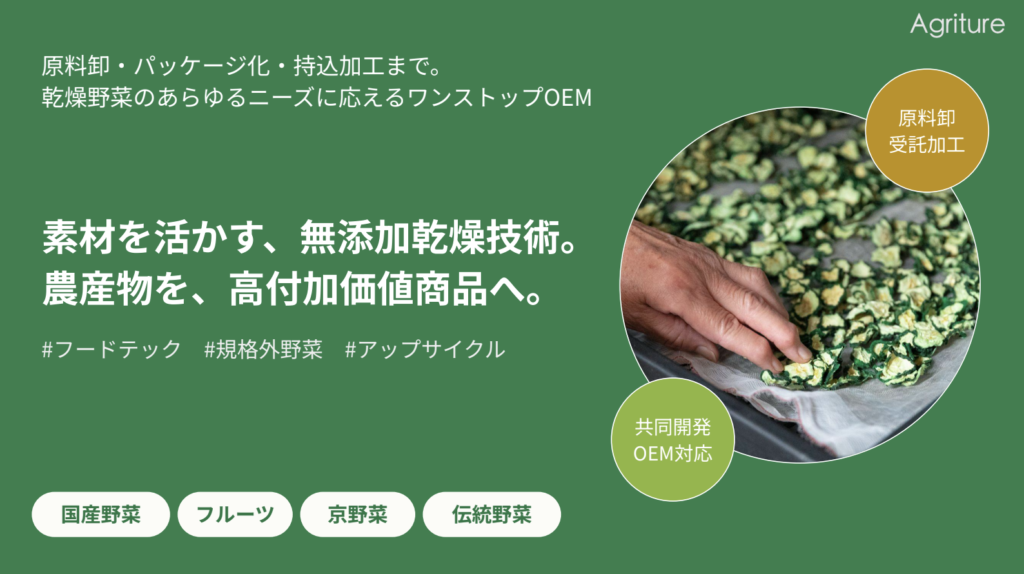
- OEM available from small lots of 10 kg
- Drying of brought-in raw materials also possible
- Support from processing to filling in one place
FOR BUSINESS
乾燥野菜を業務用でお探しですか
国産の野菜・果物を乾燥し、必要に応じて粉砕してお出ししています。扱っている品目は100種前後で、規格は 乾燥品の一覧・パウダーの一覧 に掲載しています。
少量でのご購入は、姉妹ブランドの通販サイト OYAOYA で承っています。
FAQ
Summary
Here are the key points for turning molokhia into powder and selling it.
- Use only leaves and soft stems as raw material. Leave out seeds, pods and young leaves soon after germination, and finish picking before pods form
- Drying reduces weight to roughly 10%, and leafy vegetables can fall below that, so work backward from the amount you want to find how much raw material you need
- Contract work starts with a prototype of 500g/1kg fresh and moves to full production with 10kg of raw material
- If selling at a farm stand, check labeling and how nutrition labeling applies first; if wholesaling to business partners, check the required specifications first
How much powder your molokhia will make can be confirmed with a prototype. Start by asking us about a prototype.
Recommended reading
The Complete Guide to Successful Private-Label Development with Vegetable Powder
A complete guide to choosing vegetable powder
Download the OEM contract processing materials
We will send the materials to your email address based on the information you provide.
- What to Decide Before Outsourcing Small Rice Packs
- How to Outsource Only the Filling of Your Home-Roasted Drip Bags
Author of this article
Related articles
-
 Flavored Tea Development: Differentiating Aroma with 3 Elements × 4 Axes
-
 Original coffee marketing strategy | Ways to grow sales
-
 ベジタリアンとは?国の規格が分けている4つの区分と食べられないもの
-
 長ねぎと白ねぎは同じもの?ねぎの種類と呼び名を国の資料で確かめる
-
 柚子の種類は何種類あるのか、公の資料で名前が残る系統を数えた
-
 ゆずの時期は年に二度、青ゆずは7月から黄ゆずは10月から
-
 ゆずの産地は高知が半分を占め、二位は徳島から愛媛に変わった
-
 Preventing Food OEM Failures: Common Failure Cases and Countermeasures for Success