
Additive-free design with vegetable powder | How to choose natural colorants for use as coloring food

Summary of this article
A design guide for using vegetable powder as a natural coloring. It covers the difference from synthetic colorants and food dye (vegetable powder is treated as a coloring food), recommended vegetable powders by color (red, yellow, green, purple, black, orange), the mechanism of color fading, labeling rules for additive-free and no-added-colorant, blend amounts and processes by product category, cautions on "additive-free" labeling, common OEM failures, and Agriture's handled ingredients, 45°C low-temperature drying, and Takii Phytorich cases.
Using vegetable powder as a natural coloring lets you put color and flavor into a product with just the ingredient name, without adding food dye or food colorant. The crimson of beet, kabocha the yellow of Spinach,, the green of Beet powder, the magenta of purple sweet potato, and more, being able to write "
" or "kabocha powder" in the product's ingredient column is the greatest strength. Uses widen across sweets, confectionery, drinks, noodles, and prepared foods, and adoption is advancing at food makers and D2C brands that want to make additive-free-positioned products.

TOC
Agriture processes nearly 100 dried vegetables and vegetable powders by 45°C low-temperature drying, supplying ingredients for confectionery, baking, drink, and noodle OEM. This article compiles how to choose vegetable-powder colorings, the properties and discoloration measures by pigment component, additive-free labeling rules, and blend examples for sweets and confectionery.
Recommended vegetable powders by color (Agriture handled ranking)
| Color | When designing natural coloring with vegetable powder, which ingredient to choose for a vivid finish by color follows a trend set by adoption track record. We've organized the recommended colorings by color that Agriture actually proposes on the ground in food OEM and confectionery OEM, in ranking form. Use it as a reference for substituting synthetic colorants or food dye, designing additive-free products, and developing new products for mail-order and stores. | 2nd place | 3rd place | Recommended ingredient (1st) |
|---|---|---|---|---|
| Red / pink | Main materials and uses | Purple sweet potato powder | Beet (Echie Farm) | Strawberry powder |
| Yellow | Kabocha squash powder | Carrot powder | Color accents for gummies, macarons, lattes, baby food | Turmeric powder |
| Green | Spinach powder | Kale powder | Baked goods, bread, pasta, curry ingredients | Vegetables for matcha blends |
| Cookies, steamed bread, green juice, reassurance-oriented drinks | Purple sweet potato powder | Purple, magenta | Red shiso powder | Purple cabbage powder |
| Japanese-style color staging for wagashi and sweets | Black | Black soybean powder | Black sesame blend | Bamboo-charcoal blend |
| Orange | Carrot powder | Kabocha squash powder | Black baked goods, granola, bread | Persimmon powder |
Drinks, smoothies, baby food[Latest 2025] A thorough comparison of 7 recommended vegetable powders.
Ingredients are sourced from a network of contract farmers in Kyoto, Kyotango, Nagano, Mie, Ehime, and Okinawa, and we can handle packaged products for mail-order and marketplaces, and commercial bag-unit orders (from 100g). Stock, lot, and shipping conditions change with the product scale, so a quote consultation at the product-development stage is efficient. For details,
The benefits of using vegetable powder as a coloring
For convenience this article calls it "natural coloring," but under the labeling system, vegetable powder is treated as a "coloring food," not a "colorant additive." The options for coloring food fall into three broad categories: ①synthetic colorants, ②naturally derived colorant additives (food dye, food colorant), and ③coloring foods (vegetable powder); which you choose changes the labeling, cost, and positioning.
| Category | Examples | Ingredient labeling | Well-suited products |
|---|---|---|---|
| Comparing the three options | Synthetic colorants (food additives) | Red No. 40, Blue No. 1, etc. | "Colorant (Red 40)" |
| Mass-produced, inexpensive commodity products | Naturally derived colorant additives | Food dye, food colorant (safflower colorant, turmeric colorant, etc.) | "Food colorant," "safflower colorant," etc. |
| Processed foods and home baking where you want vivid color from a small amount | Coloring food (vegetable powder) | Beet, kabocha, purple-sweet-potato powder, etc. | Ingredient name such as "beet powder" |
Additive-free, premium, D2C, commercial OEM
Because vegetable powder is classified as a "coloring food" rather than a colorant additive, it can be listed in the ingredient column by the ingredient name, such as "beet powder." It's positioned to be readily chosen for products that pair it with clean-label and additive-free positioning.
When to choose vegetable powder
- As a coloring food, vegetable powder splits from synthetic colorants and food dye on three points: labeling, positioning, and supply stability. The representative adoption scenes are as follows.
- Working into sweet or baked-goods dough where you want to avoid synthetic colorants
- Wanting to put color and a nutrition angle on a drink or smoothie at once
- Needing a coloring raw material with a stable commercial supply, rather than a food-dye set
Wanting to keep the ingredient label simple to pitch children's products, gifts, and health foods
Vegetable powders by color and their ingredient traits Tomato The basics are to work back from the color you want and choose the ingredient. Even the same red finishes as a different thing between beet's magenta-leaning and
's vermilion-leaning, so decide together with the product image.
| Color | Recommended ingredients by color (from Agriture's handled items) | Recommended ingredient | Pigment component |
|---|---|---|---|
| Coloring traits | Red, pink, magenta | Beet (Echie Farm, Kyotango) | Betalain |
| Crimson. The soaking liquid is red too | Vermilion, orange | Lycopene | Tomato (Momotaro, Taniyoshi Farm) |
| Oil-soluble. Warm-tone depth | Yellow, deep yellow | Kabocha, carrot | Carotenoid |
| Heat-resistant, suited to baked goods | Purple, pinkish purple | Anthocyanin | Purple sweet potato, purple cabbage |
| Color changes with pH | Green, deep green | Spinach (Bentenmaru, Takii), broccoli | Chlorophyll |
| Fades easily with acid | Red-orange (with functionality) | Kyo-kurenai carrot (Takii Phytorich) | Lycopene + β-carotene |
Combines functional positioning and color
Which color you aim for decides the ingredient and pigment component, and that becomes the starting point for the "discoloration measures" covered in the next section. Reading the table as beet, purple sweet potato, and spinach being color-mobile, and kabocha, carrot, and Kyo-kurenai carrot being relatively stable, makes the blend design easier to organize.
Pigment components and ingredient science (raw-material-level properties)
- Pigments fall broadly into four systems, and their properties at the raw-material stage are the foundation of blend design.
- Betalain (beet): water-soluble. Makes a deep crimson-to-magenta color
- Carotenoid (kabocha, carrot, tomato): between oil-soluble and water-soluble. Lycopene = red-type, β-carotene = orange-type, lutein = yellow-type
- Chlorophyll (spinach): a green pigment with a porphyrin ring. Colors by binding with metal ions
Anthocyanin (purple sweet potato, purple cabbage): a flavonoid-type whose structure changes with pH
- The ingredient traits of Echie Farm's beet Grower
- Recommended ingredient: Echie Farm in Kyotango (environmentally conscious farming using homemade compost)
- Features: betalain. A crimson containing polyphenols
- Cooking suitability: the soaking liquid comes out red too = the color itself can be used in the dish
: soups, marinades, stews, mousse, sauces
Tips for keeping color with natural coloring
The biggest weakness of vegetable-powder coloring is "the color moves easily." Because the color changes with heat, light, pH, and oxygen, you need a design that protects the color at three points: when it's blended, packaging, and storage.
| Behind Japan being chosen as the "first in Asia" are the following factors. | Impact | Discoloration factors and on-the-ground measures |
|---|---|---|
| On-the-ground measures | Baking (150-180°C) | Betalain and chlorophyll fade |
| Top after baking. Prioritize heat-resistant carotenoids | Acid / alkali | Anthocyanin shifts to red / purple / blue |
| Adjust the amount of citric acid / baking soda in prototyping | Light (UV) | Pigment breakdown, overall fading |
| Aluminum-laminate light-blocking packaging / cool, dark storage | Oxygen | Fades from oxidation |
| Oxygen absorber, vacuum packaging | Passage of time | Gradually loses color |
A design that balances best-before date and color retention
Pigment weaknesses often stack up (baking + light / pH + oxygen, etc.), so the shortcut at the prototype stage is to check one factor at a time by varying the conditions.
Agriture's 45°C low-temperature drying
- For vegetable powder used as coloring, the temperature of the drying step changes the vividness of the finished color. Agriture adopts a design based on 45°C low-temperature drying, a processing condition that makes it easier to curb the volatilization and breakdown of pigment components. Standard temperature
- Source: around 45°C (lower than the 70-100°C range of hot-air drying)
- : introduced in Takii Seed Phytorich coverage episode 13 (published October 2025) Where it works
- : the difference shows most with heat-sensitive pigments like chlorophyll, betalain, and anthocyanin Adopting genres
: there are adoption cases in premium confectionery, gifts, and D2C products
- How to decide the blend timing
- OK to work in before baking: kabocha, carrot, tomato (carotenoid types)
- Recommended to top after baking: beet, spinach, purple sweet potato
- Frozen sweets, drinks, creams: with no heat step, every ingredient colors vividly
pH staging in drinks: use citric acid to turn purple cabbage red, baking soda to turn it blue
Rules for labeling additive-free and no-added-colorant "Additive-free" and "no added colorant" run afoul of the Act against Unjustifiable Premiums and Misleading Representations and the Food Labeling Act if you word them wrong. When positioning a product colored with vegetable powder, you need to make the labeling consistent with the actual formulation. For primary sources on the system, you can check the latest color-labeling rules in published materials from the、Consumer Affairs Agency, Food Labeling Division and the Ministry of Health, Labour and Welfare, Food Additives
Labeling basics
The labeling of a product using a coloring food is decided by two things: how it's written in the ingredient column and the consistency of the claim wording.
- Ingredient column: list by the ingredient name, such as "beet powder" or "kabocha powder" (don't put it in the colorant slot)
- "No synthetic colorants": can be labeled on the premise of using no synthetic colorants at all
- "No added colorant": only when using none of any colorant additives, including food dye and food colorant
- "Additive-free": specify the target (e.g. "No added colorant, preservative, or flavoring")
Pitfalls to watch for
- Writing "no added colorant" while using food dye or synthetic colorant in part is a violation
- Using "natural" requires a clear definition and grounds (the guidelines call for caution)
- Using the Organic JAS mark presumes obtaining certification (95% or more of the blend being organic raw materials)
- Always do a final check of the actual formulation and the claim wording as a set
Blend amounts and processes by product category
The suited ingredient, blend amount, and process change by product category. We've compiled blend guides for using it as coloring in representative categories.
Blend guides by category
| Category | Blend amount (guide) | Suitable material |
|---|---|---|
| Baked goods (cookies, muffins) | 3-8% of the flour | Kabocha, carrot (carotenoid types are heat-resistant) |
| Macarons, meringues | 2-4% of the flour | Beet, purple sweet potato (baking temperature around 150°C) |
| Frozen sweets, sorbet, ice cream | 0.5-3% of the base | All pigments stable |
| Cream, mousse | 1-2% of the base | All pigments stable, suited to appearance-focused uses |
| Drinks, smoothies | 0.5-2g per cup | Spinach, purple sweet potato, beet |
| Pasta, udon, bread | 2-8% of the flour | Spinach, beet, tomato, kabocha |
If you want "to add color from a small amount," frozen sweets and cream are the starting point; if you want "to add flavor too without affecting the texture," baked goods, pasta, and bread are. The flour-percentage figures are based on the powder weight (flour, almond flour, etc.) and set as starting values for initial prototyping. Adjustment is needed depending on whether it's baked and on the moisture content.
Patterns prone to failure in baking
- Baking soda in purple-sweet-potato-powder cookies → turns green. Use in a neutral-to-acidic recipe
- Boiling spinach-powder pasta a long time → color drops out. Design for a short boil time
- Beet-powder macarons baked above 180°C → the pink dulls. Keep it to around 150°C
- Displaying a drink in a PET bottle at the storefront → fades with light. Aluminum cans or light-blocking bottles recommended
Understanding the color-fading mechanism from structure
Understanding the reason for fading by pigment at the molecular-structure level makes the blend timing, packaging, and storage rules in product design "a design with reasons" rather than "a hunch." The following is organized based on general food-chemistry knowledge.
How the four systems' fading reactions work
- Betalain (beet): a nitrogen-containing water-soluble pigment. The molecule cleaves easily with heat and fades. Relatively stable in the acidic range; tends to shift in tone under alkali
- Carotenoid (kabocha, carrot, tomato): a fat-soluble conjugated-double-bond pigment. Relatively strong against heat, but isomerizes and oxidatively fades with light and oxygen
- Chlorophyll (spinach, broccoli): the magnesium at the center of the porphyrin ring detaches with acid, changing to pheophytin (the tone darkens). Fades with heat and acid
- Anthocyanin (purple sweet potato, purple cabbage): the structure changes with pH. The tone shifts to red-type in acid, purple-type at neutral, and yellow-type at strong alkali
Where structural understanding pays off in product design
- To keep green in a chlorophyll product → avoid blending strong acid, and design the pH toward neutral
- Color retention in a carotenoid product → light-blocking packaging and an oxygen barrier work well
- Anthocyanin products → adjust to the target color tone with pH design using citric acid and baking soda
- Betalain products → lower the baking temperature, or switch to adding it after baking
Cautions on "additive-free" labeling
When labeling "additive-free" or "no added colorant" on a product using vegetable powder, there are points to watch under the food-labeling system, the Act against Unjustifiable Premiums and Misleading Representations, and Consumer Affairs Agency guidelines. Since the systems and guidelines are amended and updated, checking the latest information before sale is necessary.
Representative patterns that get caught in labeling
- The target of "additive-free" is ambiguous: writing only "additive-free" leaves it unclear what is additive-free, and easily misleads the reader
- Writing additive-free while some additives are included: labeling without ensuring the consistency of the whole formulation carries a risk of violating the Act against Unjustifiable Premiums and Misleading Representations
- Casual use of "natural": under the "Guidelines on Non-Use Labeling of Food Additives" and the like, expressions that mislead call for cautious handling
- A gap between emphasized claims and reality: when a package's emphasized claim diverges from the actual formulation, it can become a target of misleading representation
The basics of safe labeling design
- List the ingredient name accurately in the ingredient column and match the actual formulation to the labeling wording
- When using "additive-free," specify the target (e.g. no synthetic colorant or synthetic preservative)
- Check that claims you want to emphasize are consistent with Consumer Affairs Agency and related guidelines
- Use the consultation desks of local governments and industry bodies to check the label wording before sale
Common failures in vegetable-powder-coloring OEM
We've organized, by stage, the failures that commonly occur in OEM development adopting vegetable powder as coloring. Anticipating them before prototyping reduces the places you stumble.
Five failure patterns
- ① Overexpecting the substitution rate for synthetic colorants: synthetic colorants color vividly in a minute amount, so demanding the same coloring from vegetable powder raises the blend amount and changes the texture and flavor
- ② Deciding on the post-baking color change in one prototype: judging on freshly baked alone without accounting for color change during storage, so fading complaints occur after mass production
- ③ Underestimating the ingredient flavor: even in a blend meant only for color, the vegetable-derived flavor affects the whole product and drifts from the original concept
- ④ Unit mistakes in the blend amount: the definition of "flour" in "% of the flour" differs between makers, so the intended blend amount doesn't get across
- ⑤ Putting off packaging selection: choosing clear packaging without considering light and oxygen resistance, so it fades during storefront display
Prototype design that avoids failure
- At prototyping, vary the blend amount across three levels (0.5x / 1x / 2x) and compare
- Record the color right after production, after one week, and after one month, and use it as the basis for the mass-production storage design
- State the unit definition of the blend amount in the specification (e.g. "% of the flour = % of the total of wheat flour + almond flour")
- Evaluate the packaging's light and oxygen transmission, and if using clear packaging, check whether it has light-blocking UV treatment
Agriture's handled ingredients and processing background
From its base in Kyoto and Kyotango, Agriture keeps a lineup of nearly 100 items of dried vegetables and vegetable powders, with plenty of ingredients chosen for coloring use too. Built on upcycling off-spec vegetables and color retention through 45°C low-temperature drying, it supports the product development of food makers and D2C brands. Consultation is possible from a minimum lot of 100g, and it can respond in stages from small-lot prototyping to mass production.
Agriture ingredients chosen for coloring
- Taniyoshi Farm's dashi dried tomato (Momotaro, Kyotango): lycopene, vermilion
- Takii Seed Phytorich, Kyo-kurenai carrot: lycopene + β-carotene
- Takii Seed Phytorich, Bentenmaru spinach: chlorophyll, deep green
- Dried Kujo green onion (Kyoto): the leaf green survives well, for green coloring in Chinese soups and ramen
- Powders of purple sweet potato, purple cabbage, kabocha, and broccoli
Beet is covered in the ingredient-traits section above, so it's omitted from this list. Since commercial powder-coloring supply is handled on a consultation basis, the basic flow is to tell us the use and then proceed with an individual quote.
Processing background and sourcing setup
- Upcycling of off-spec vegetables: drying and powdering vegetables that don't reach the market because their shape is off-spec. Color and flavor are on par with standard produce, so it can combine with food-loss-reduction positioning
- Contract-farmer partnerships: contracts with specific Kyotango farmers (Echie Farm, Taniyoshi Farm, etc.) allow ingredient sourcing with a fixed variety and origin
- The partnership with Takii Seed Phytorich: has a processing track record of drying and powdering-for-drinks vegetable varieties containing functional components (7 items including Kyo-kurenai carrot, Bentenmaru spinach, and Healthier okra) (coloring use is a separate consultation)
- low-temperature drying at 45°C: the processing conditions introduced in Phytorich coverage episode 13 (published October 2025). A design that curbs the volatilization and breakdown of heat-sensitive pigments
* The ingredients and processing background in this article are organized as "a raw-material lineup that may be applicable to coloring uses." Individual coloring-use OEM proceeds from prototyping according to the product concept.
Information that helps at an OEM consultation
To make a quote or prototype concrete, organizing and sharing five pieces of information, color, use, process, positioning, and lot, makes the decision smoother.
- The color direction you aim for (red / pink / orange / yellow / green / purple)
- Product category (sweets, baked goods, drinks, cream, noodles, prepared foods)
- Blend process (baked or not / pH environment / moisture content)
- Positioning axis (additive-free, no added colorant, functionality, origin)
- Expected lot and price point
We have materials available to help you understand dried processing OEM
Agriture OEM, flexibly handling everything from small lots to large lots
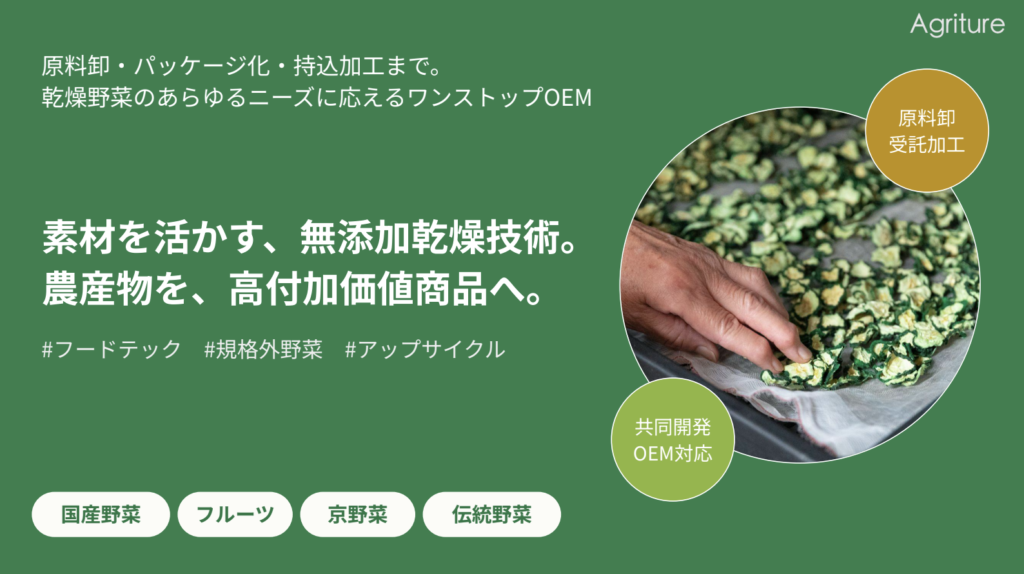
- OEM available from small lots of 10 kg
- Drying of brought-in raw materials also possible
- Support from processing to filling in one place
FAQ before adopting vegetable-powder coloring
Can vegetable powder be used instead of food dye or food colorant?
Yes. In the same sense as adding a little powder from a food-dye set, blending 1-5% of beet, kabocha, or purple-sweet-potato powder lets you add color without synthetic dye or food colorant. The ingredient-derived flavor rides along too, so it suits uses that include staging the taste, not just the color.
What are the tips for getting a vivid color in baking?
For working in before baking, carotenoid types (kabocha, carrot); for topping after baking, beet, purple sweet potato, and spinach are the combinations that keep color well. Baking macarons at a low temperature around 150°C, and choosing a potassium-bitartrate-type leavening agent over baking soda for cookies, curb the color change.
Is it OK to write "no added colorant" on the product?
It's labelable on the premise that no food dye, food colorant, or synthetic colorant is used at all across all ingredients. Since vegetable powder is treated as a food rather than a food additive (colorant), you can list it in the ingredient column by an ingredient name like "beet powder" and run "no added colorant." Just do a final check of the consistency between the actual formulation and the labeling.
Won't it cost more than a food-dye set?
Compared per unit weight, vegetable powder tends to be more expensive. But vegetable powder comes as a set with flavor, a nutrition angle, an ingredient-name listing, and additive-free positioning, not just color, so you can add product value that a cheap food dye can't deliver. The commercial-OEM price sense differs across the stages from prototype lot to mass production, so checking the quote breakdown at consultation is practical.
Can I consult about OEM?
Yes. Agriture handles nearly 100 dried vegetables and vegetable powders from a minimum lot of 100g, and can supply ingredients from Kyoto and Kyotango contract farmers (Echie Farm, Taniyoshi Farm, etc.) and the Takii Seed Phytorich series for coloring and functional-positioning uses. The base design is 45°C low-temperature drying to retain color and taste. Food OEM no Madoguchi (Agriture) Please consult us.
Summary of vegetable-powder-coloring selection and design points
Using vegetable powder as a natural coloring lets you make additive-free-positioned sweets, drinks, and foods that use no food dye, food colorant, or synthetic colorant. Understand the properties of the pigment components (resistance to heat, pH, and light) and the blend timing, and follow the labeling rules, and you can design to put color and flavor in with just the ingredient name. Agriture processes nearly 100 dried vegetables and vegetable powders by 45°C low-temperature drying and handles blend-design consultation for coloring uses. You can proceed on a prototype basis from a minimum lot of 100g.
Related article: Using vegetable powder in sweets・Using fruit powder・Vegetable powder filling OEM. For OEM consultations, Food OEM no Madoguchi (Agriture).
Download the OEM contract processing materials
We will send the materials to your email address based on the information you provide.
If you are considering product development with off-spec or your own farm's vegetables:From planning to processing, materials, package printing and novelties, you can consult us through a single point of contact. → Learn more about one-stop product development
- The complete guide to choosing vegetable powder: also explaining the difference between commercial and household use
- How to use commercial vegetable powder | Uses at restaurants and storage
Author of this article
Related articles
-
 Food OEM Market Trends 2026: A Growth Strategy Seen Through Small-Lot and Domestic-Ingredient Needs
 -
 How to proceed with hometown-tax product development | OEM techniques that make the most of local ingredients
 -
 Creating a regional brand with a Kyoto-vegetable OEM | The complete flow from planning to sales
 -
 Kyoto ingredient processing OEM | How to make the most of Kyoto vegetables and quality control
 -
 How to source commercial vegetable powder in small lots, and how to use it
 -
 Heirloom vegetable OEM | A commercialization case guide using Kyoto vegetables and local ingredients
 -
 What Is Vegetable Powder? Features, Shelf Life, Uses and a Guide to OEM
 -
 What is vegetable paste? The difference from powder, dried vegetables, purée, and extract