
The complete guide to succeeding at PB development with vegetable powder | Small lots supported

Summary of this article
A complete guide to succeeding at PB (private-brand) development with vegetable powder. It covers PB design that differentiates on raw materials (origin, variety, cultivation method), differentiation with vegetables containing functional components (lycopene, lutein, GABA, anthocyanin, β-carotene, dietary fiber), formulating functional ingredients like DHA, EPA, probiotics, and protein and the OEM companies that handle them, blend ratios and scientific evidence (Foods with Function Claims notification), product categories easy to turn into PB, the practical steps of small-lot PB development, Agriture's cases, and representative companies.
Vegetable powder is an ingredient made by drying and powdering vegetables, combining shelf life with nutritional concentration. This trait is a strong weapon for food makers, retailers, and D2C operators who want to launch a private-brand (PB) product from small lots. Fresh vegetables have large swings in disposal loss, purchasing, and seasonality, making it hard to keep PB quality consistent; vegetable powder, on the other hand, comes with uniform specs by supplier lot and is easy to fill and blend mechanically, so you can make a differentiated product while holding down the risks of small-lot production.
This article explains, based on knowledge from Agriture's contract-processing floor, everything for launching a PB product using vegetable powder in small lots, the manufacturing method, lot design, choosing an OEM maker, and sales-channel design. The handled items and specs are at the product page for commercial vegetable powder.

TOC
The benefits of vegetable-powder PB development
When planning a PB product, placing vegetable powder as the main ingredient lets you achieve spec uniformity, long-term storage, and flexible small-lot support that are hard with a fresh-vegetable-based PB.
| Challenge | Fresh-vegetable-based PB | Vegetable-powder PB |
|---|---|---|
| Spec stability | Varies with weather and region | Spec unified by lot |
| Storage period | A few days to a few weeks | 6–12 months at room temperature |
| small-lot support | Hard to secure the raw material | Possible from 100-1,000 units |
| Logistics cost | Refrigerated transport required | Compact at room temperature |
| Cost management | Large seasonal swings | Stable at the contract price |
The PB-development options that small-lot support opens up
Conventional OEM often has minimum lots of thousands to tens of thousands of units, which was a barrier to entry for small and mid-size operators. OEM using vegetable powder separates the drying, grinding, and filling steps readily, so it can handle a wide range, from a light commission that just adds packaging and flavor to an off-the-shelf powder, to a full commission spanning raw-material selection through a completely original formulation. A realistic strategy is to test the market with an initial 100-500 units and raise the production volume in stages as you watch the response.
PB design that differentiates on raw materials
The success or failure of a PB product is how you choose the raw material, which decides 80% of it. Using an off-the-shelf vegetable powder as is leaves you unable to create differentiation from competitors and prone to getting dragged into price competition. Designing the angle at the raw-material level governs the lifespan of a PB brand.
Differentiate on origin, variety, and cultivation method
Even the same "Spinach,powder" varies greatly in value by origin, variety, and cultivation method. Kyoto-grown, organic, rare variety and other combinations let it sell as a product in a separate category from commodity powder.
| Angle | Examples | Appeal point |
|---|---|---|
| Growing region | Kyotango, Nagano, Organic JAS-certified farms | Traceability, regional brand |
| Variety | Kyo-kurenai carrot, Takii Phytorich | Variety-specific functional components |
| Cultivation method | Pesticide-free, reduced-pesticide, special cultivation | Safety, health-conscious positioning |
| Off-spec utilization | Food-loss reduction, SDGs | Ethical, sustainability |
Differentiate with vegetables containing functional components
vegetables containing functional components Products using them can be sold on a clear positioning axis. Vegetables containing components like lycopene, lutein, GABA, anthocyanin, β-carotene, and dietary fiber pair superbly with health positioning.
| Component | Main vegetables | Positioning context |
|---|---|---|
| Lycopene | Tomato, red carrot | Antioxidant, beauty |
| Lutein | Spinach / kale | Eye health, blue-light care |
| GABA | Specific tomato varieties, sprouted vegetables | Relaxation, sleep support |
| Anthocyanin | Beet, purple sweet potato, red cabbage | Antioxidant, eye care |
| Beta-carotene | Carrot / kabocha | Immunity, skin health |
| Dietary fiber | Burdock, lotus root, cabbage | Gut health, regularity support |
Formulating functional ingredients like DHA, EPA, and probiotics
Rather than vegetable powder alone, combining functional ingredients like DHA, EPA, vitamin D, probiotics, and protein creates a stronger functional positioning. However, these components often can't be handled unless an OEM company specialized in them, so partner selection matters.
| Functional ingredient | Traits of a capable OEM company | Example uses |
|---|---|---|
| DHA, EPA | A company with know-how in powdering fish oil or algae | Powdered drinks for children, furikake |
| Probiotics | A company strong in stabilizing live lactic-acid bacteria and bifidobacteria | Gut-health powders, soup bases |
| Example minimum lots | A company good at blend design for plant and animal protein | Protein-fortified vegetable soups |
| Vitamin D, B group | Supplement OEM operators | Dietary supplements, Foods with Function Claims |
| Collagen | Food OEM companies that formulate peptides | Beauty-oriented powders and soups |
💡 POINT | for functional ingredients, pair with a specialized OEM
Functional ingredients like DHA and probiotics need specialized equipment to secure stability during formulation, uniform dispersion, and shelf life. A vegetable-powder-specialized OEM often can't fully handle it, so combining with a supplement or Foods-with-Function-Claims OEM operator as a design premise makes prototyping through mass production go smoothly.
Blend ratios and scientific evidence
When positioning on functional ingredients, preparing the blend ratio and scientific evidence in advance widens what you can state in ad claims and on the package. If you aim for a Foods with Function Claims notification, verifying the notifiable components and the supporting papers is essential.
| Formulation level | Statable expressions | Need for notification / evidence |
|---|---|---|
| Ordinary food | "Contains," "uses" | Ingredient table only is OK |
| Nutritional-function foods | Nutrient-function claims for specified components | The prescribed standards |
| Foods with function claims | "Helps with ~," etc. | Consumer Affairs Agency notification, papers |
| Foods for Specified Health Uses | "For those concerned about ~" | Clinical trials, government approval |
Product categories easy to turn into PB
Vegetable powder is highly versatile, and the required particle size and formulation differ by PB category. Which category you launch in changes the minimum lot, the equipment needed, and the OEM contractor.
| Category | Main items | Suited sales channel | Minimum-lot guide |
|---|---|---|---|
| Soups, dashi, furikake | Kabocha, onion, carrot, shiitake | Supermarkets, D2C, offices | 500-1,000 units |
| Confectionery and bakery (coloring use) | Spinach, beet, kabocha | Confectioners, bakeries, gifts | 200-500 units |
| Baby food and nursing-care food | Spinach, carrot, kabocha, lotus root | D2C, drugstores | 500-1,000 units |
| Smoothies, green juice, functional beverages | Kale, spinach, beetroot | D2C, subscription | 1,000-3,000 units |
| Supplements, tablets, capsules | Beet, kale, green papaya | D2C, mail-order, pharmacies | 3,000-5,000 units |
| Pet food and treats | Kabocha, carrot, green papaya | D2C, pet shops | 500-2,000 units |
The minimum lot is set by the raw-material unit price, the material, and the operating unit of the filling machine. Categories with heavy safety management and testing, like supplements, baby food, and pet food, tend to swing higher in both lot and timeline, while uses that only require bagging, like furikake and bakery, are easier to keep to a low lot.
The practical steps of small-lot PB development
From planning to sale takes 4-6 months as a standard. The realistic flow is to spend time on prototyping and market testing at first, then expand the production lot from the second round on.
| Step | Details | Guideline period |
|---|---|---|
| 1. Concept design | Organizing the target, price point, and positioning axis, and competitor research | 2–4 weeks |
| 2. Choosing a maker and taking competing quotes | Request quotes from 3-5 companies, comparing lot, unit price, and prototyping cost | 2–3 weeks |
| 3. Deciding raw material, blend, and particle size | Single or compound, mesh specification, additive-free or with additives | 2–3 weeks |
| 4. Prototyping and tasting | Prototype 3-5 patterns, monitor evaluation | 3–4 weeks |
| 5. Finalizing the spec, packaging, and labeling | Mass-production spec, package design, statutory-labeling check | 2–3 weeks |
| 6. Mass production, inspection, delivery | An initial 100-1,000-unit production run, quality testing, delivery | 3 to 6 weeks |
Ballpark initial costs
- Prototyping cost: 50,000-200,000 yen (for 3-5 patterns)
- Initial mass-production cost: product unit price × lot count + package plate cost
- Package design: 50,000-300,000 yen up front (the range depends on using a template versus a fully original design)
- Statutory-labeling check (nutritional components, origin, allergens): free to tens of thousands of yen (depends on the commission format)
When starting from small lots, the reliable playbook for reducing failure is to keep the packaging simple, narrow the prototypes to 2-3 patterns, sell an initial 100-500-unit verification lot, and move to a full lot only after gauging the response.
Checks for choosing an OEM maker
The success or failure of PB development is said to be more than half decided by the choice of manufacturing partner. For small-lot PB in particular, fine-grained responsiveness and flexibility are required.
| Item | Details to confirm |
|---|---|
| A match in areas of strength | Does it have a manufacturing track record in the target category (soups, confectionery, supplements, etc.)? |
| Flexibility of minimum lot | Will it accept a 100-500-unit small-lot prototype? |
| Bring-in raw material accepted | Can it powder vegetable raw materials you source yourself and bring in? |
| Raw-material sourcing power | Does the maker itself have contract farmers or import routes? |
| Particle-size and blend customization | Can it do mesh specification and original blend formulations? |
| Quality control system | Certifications like HACCP, FSSC 22000, and Organic JAS, and issuance of test reports |
| Legal-compliance capability | A check setup for nutritional labeling, allergen labeling, and the Act against Unjustifiable Premiums and Misleading Representations |
| Equipment capability | Do the drying method (hot-air, freeze-dry) and machine specs meet the requirements? |
The manufacturing model (OEM / ODM / contract manufacturing) and the scope of the commission
PB is about the brand form of "a product sold under your own brand," while OEM, ODM, and contract manufacturing are about the manufacturing model of "how much you leave to the maker." As a means of realizing a PB, you choose one of these manufacturing models.
| Manufacturing model | Planning and formulation | Manufacturing | Where it fits in PB development |
|---|---|---|---|
| OEM | Led by the client (including arranging an existing formulation) | Contract maker | Operators who want to launch quickly / can organize the formulation themselves |
| ODM | The contract maker leads the design (joint development) | Contract maker | D2C brands with little in-house food-design knowledge |
| Contract Manufacturing | The client has finalized everything | Contract maker | Operators whose formulation and material are already set and who just want to outsource manufacturing |
Agriture's small-lot PB development cases
From its base in Kyoto, Agriture does contract processing of dried vegetables and powder. Below are cases where it actually handled small-lot, PB-oriented processing.
Case 1: Turning Sakura lotus root (Chiba) into powder
Grown with organic fertilizer only, Lotus root was powdered via low-temperature drying plus particle-size adjustment, the collaboration with Sakura lotus root. A pattern where an agricultural corporation launches a powder product under its own brand; we contracted the whole chain, from bring-in raw material through drying, grinding, and packaging. Drawing on the property of thickening when dissolved in water, it also became possible to roll out to the baby-food and care-food markets.
Case 2: Launching Agriture's own D2C brand "OYAOYA"
"OYAOYA," the D2C PB Agriture itself launched in March 2021, OYAOYA is a brand that upcycles off-spec vegetables from northern Kyoto and sells dried vegetables, dried fruit, and vegetable powder directly. Launched at a few-SKU, few-hundred-unit scale in the sole-proprietor days, it centered on its own e-commerce via Shopify and has since expanded overseas to Germany, New York, Hong Kong, and Taiwan. It's a case of executing, in-house, the PB-growth pattern of starting from small lots, adding SKUs based on customer feedback, and widening all the way overseas. The formulation conditions of no glucose, additive-free, and low-temperature drying are the same specs Agriture provides in its contract processing.
Case 3: Buddy’s Farm's green-papaya pet-supplement raw material
The Kanagawa agricultural corporation Buddy’s Farm grows pesticide-free Buddy's Farm in Odawara, Kanagawa uses, which is being dried and ground in a project to process it as papain, in progress. This form of PB development, redefining an ingredient hard to sell through general distribution for a pet-supplement use, is an effective strategy for operators who want to take an exclusive position in a niche market.
Main companies that handle small-lot PB development
From the companies listed on the Food OEM Portal, we've organized the main makers that can handle small-lot vegetable-powder PB development.
| Company name | Base | Area of strength | Features |
|---|---|---|---|
| Agriture Inc.(Product page) | Kyoto | Dried-vegetable and powder OEM | 100% domestic vegetables, off-spec utilization, no glucose, bring-in raw materials accepted, original design possible from small lots |
| Okisu Co., Ltd. | Kanoya City, Kagoshima Prefecture | Vegetable drying and powder manufacturing | 20ha of own farmland plus 100ha+ of contract farmers, integrated manufacturing from raw material via a sixth-industrialization model |
| Nikka Foods Co., Ltd. | — | Integrated hot-air drying and milling | 50+ years of hot-air drying track record, 40+ drying-machine units, one-stop from prototype to mass production |
| Yasai Yakuzen | Kyoto | Powders of vegetables x medicinal-diet ingredients | Supervised by a yakuzen specialist; can develop powdered dashi, non-caffeine teas, furikake, and more |
If you'd like to widen the candidates, Food OEM Directory you can search by specifying conditions (small-lot support, Organic JAS, powder processing).
Sales channels and brand strategy
For a PB product, the design of the sales channel and brand story changes sales significantly. When starting from small lots, the most efficient approach is to center on your own e-commerce and collect customer response directly.
Channel fit
| Channel | Suited stage | Point |
|---|---|---|
| Own e-commerce | Initial 100-1,000 units | Collect customer feedback directly, pitch value via an LP |
| Amazon, Rakuten, Yahoo! | 1,000–5,000 units | Building awareness, gaining reviews, linkage with hometown-tax donations |
| Physical stores (natural-food shops, specialty stores) | 500-2,000 units | Physical contact, gift demand, shelf-space negotiation needed |
| Wholesale / distributors | 5,000+ units | Wide distribution, strong price pressure |
| Hometown-tax donations, corporate gifts | 500–3,000 units | Seasonal concentration, return-gift registration screening needed |
Brand-design points for winning with a small-lot PB
- Carefully disclose the ingredient's story (who makes it, where it's made)
- Differentiate with numbers (sugar content, cultivation history, additive-free, Organic JAS, etc.)
- Keep posting "how to use" and "recipes" on social media to drive search traffic
- Raise the repeat rate with follow-up to first-time buyers (thank-you cards, a usage guide)
- Use seasonal limited SKUs to create a hook beside your staple products
We have materials available to help you understand dried processing OEM
Agriture OEM, flexibly handling everything from small lots to large lots
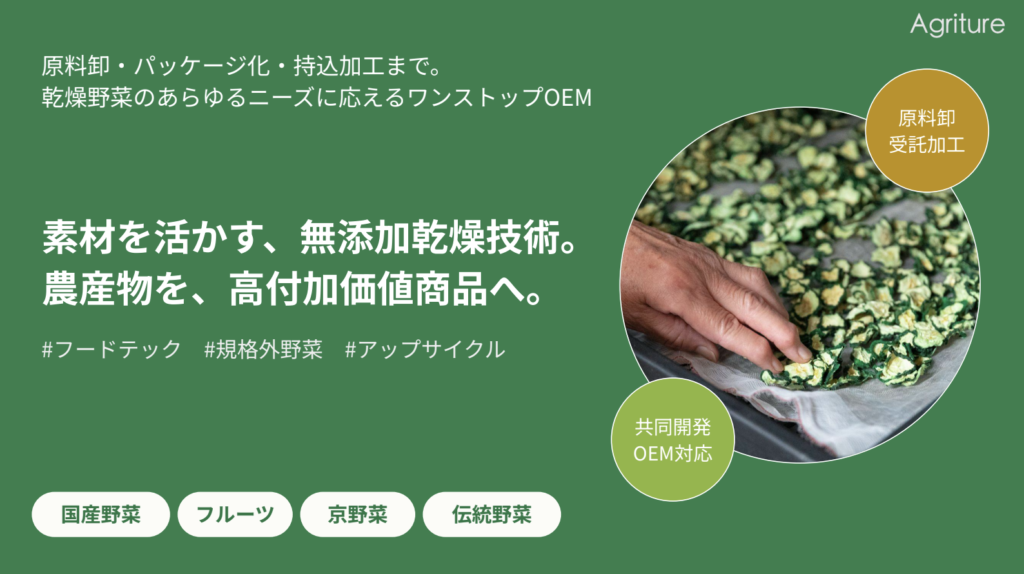
- OEM available from small lots of 10 kg
- Drying of brought-in raw materials also possible
- Support from processing to filling in one place
FAQ
From how many units are small lots supported?
For OEM that puts your own brand on an off-the-shelf blend, some makers support from 100-500 units. For a fully original formulation (ODM), the minimum is often 1,000-3,000 units, and supplements, tablets, and capsule types run around 3,000-5,000 units.
Can you powder vegetables from our own farm or contract farmers?
Yes, with a maker that accepts bring-in raw materials. Agriture has collaboration track records with agricultural corporations and seed companies such as Sakura lotus root, Takii Seed, and Buddy’s Farm. If you discuss the raw-material volume, drying conditions, particle size, and packaging format in advance, PB design is possible from about 100kg of raw material.
How long does PB development take?
Figure 4-6 months from planning to delivery. The flow is concept design 2-4 weeks, maker selection 2-3 weeks, prototyping 2-3 weeks, finalizing the spec 2-3 weeks, and mass production, inspection, and delivery 3-6 weeks. It takes longer when special raw materials or a Foods with Function Claims notification are needed.
Can you handle package design too?
It depends on the maker. Some handle only manufacturing, and others can handle everything one-stop, from package design to small-pouch filling and outer-box printing. A staged approach also works well: hold down cost with a template at first, then switch to a fully original design once you have a sales record.
Can you make an Organic JAS or additive-free PB?
More makers can now handle manufacturing at an Organic JAS-certified plant, or an additive-free formulation with no dextrin or glucose. Obtaining certification adds lot-management and testing costs, so the smaller the lot, the larger the impact on unit price. Confirm this in a quote beforehand.
Summary | small-lot PB in three stages: prototype → verify → expand
Small-lot PB development using vegetable powder, advanced in three stages, prototype, verify, expand, lets you launch a differentiated product into the market while holding down the initial investment. The realistic success pattern is not to aim for perfection from the start, but to gauge customer response with an initial 100-500-unit verification lot, and raise the lot in stages while improving the formulation and packaging.
From its base in Kyoto, Agriture handles the whole chain one-stop, from bring-in raw materials, small-lot prototyping, and particle-size adjustment to filling and packaging. You can check the handled items and specs at the product page for commercial vegetable powder. For inquiries about powdering vegetables from your own farm or contract farmers, or PB development, Agriture's page on Food OEM no Madoguchi.
Download the OEM contract processing materials
We will send the materials to your email address based on the information you provide.
If you are considering product development with off-spec or your own farm's vegetables:From planning to processing, materials, package printing and novelties, you can consult us through a single point of contact. → Learn more about one-stop product development
FOR BUSINESS
乾燥野菜のOEM・受託加工を承ります
国産の野菜・果物の乾燥、100メッシュ相当までの粉砕、10g以上の小袋充填までをお受けしています。小ロットの試作から量産までご相談ください。寄せられた相談の実例は OEM・卸のご相談 に掲載しています。
乾燥品の賞味期限は、出荷日から6ヶ月程度を目安にご案内しています。
- The complete guide to powder-processing OEM in Kansai | Strengths by area and how to choose small-lot-friendly manufacturers
- Vegetable sweets OEM | The complete guide to designing color, flavor, and nutrition with vegetable powder
Author of this article
Related articles
-
 Original coffee marketing strategy | Ways to grow sales
 -
 ベジタリアンとは?国の規格が分けている4つの区分と食べられないもの
 -
 長ねぎと白ねぎは同じもの?ねぎの種類と呼び名を国の資料で確かめる
 -
 柚子の種類は何種類あるのか、公の資料で名前が残る系統を数えた
 -
 ゆずの時期は年に二度、青ゆずは7月から黄ゆずは10月から
 -
 ゆずの産地は高知が半分を占め、二位は徳島から愛媛に変わった
 -
 Preventing Food OEM Failures: Common Failure Cases and Countermeasures for Success
 -
 How to find a food OEM | How to efficiently find the best manufacturing partner