
How to start a health tea OEM | How to build a brand chosen for functional beverages

Summary of this article
We explain how to start a health-tea OEM from the perspective of the foods-with-function-claims market, which reached 600 billion yen in 2024. We systematically introduce points on raw material selection and blend design; confirming HACCP, FSSC 22000, and Organic JAS certification; small-lot support from around 1,000 units; differentiation with vegetable teas and medicinal (yakuzen) teas; selecting an OEM partner; specification design; using health-food GMP-certified factories; and sales and marketing strategy including SEO and EC strategy.
With health consciousness rising today, the functional-beverage market continues to expand rapidly.
Health tea in particular is supported by many consumers as a healthy habit that is easy to incorporate into daily life, and the foods-with-function-claims market in 2024 is projected to surpass 600 billion yen. In such a huge market, it is a natural trend that more companies want to develop their own brand of health tea. However, for companies without manufacturing facilities, the path to developing an original product is hard to see.
This is where the option of a "health-tea OEM" is drawing attention. OEM refers to a mechanism that lets you bring a product under your own brand to market by outsourcing manufacturing to a specialist maker. Because you can create high-quality products by leveraging specialist know-how while curbing the risk of investing in manufacturing equipment, many companies adopt it.

TOC
What is a health-tea OEM? Understanding the basic mechanism
Let's get a grasp of the basics of a health-tea OEM.
OEM (Original Equipment Manufacturer) refers to a form in which a product sold under your own brand is entrusted to another maker for everything from raw material procurement to manufacturing and packaging. In the tea industry, there is a growing trend of developing original tea products by using an OEM manufacturing partner without growing tea leaves or owning a production line yourself. There are also many examples where the manufacturing side supports everything from raw material selection and blending to package design in one stop.
The benefits of OEM are clear. The brand side can introduce new products with reduced risk without owning manufacturing equipment, and by partnering with a contractor that has manufacturing know-how, cost and quality can be optimized. On the other hand, because manufacturing and quality depend on the contractor, there is also a risk that the intended product won't come out unless the brand side sufficiently understands market needs.
The typical flow of a health-tea OEM is as follows.
| Step | Details |
|---|---|
| 1. Concept design | Firm up what kind of tea you want, the target, and the packaging image |
| 2. Specification meeting | Decide raw material selection, blending, manufacturing method, and packaging format with the OEM maker |
| 3. Prototyping and adjustment | Repeat prototyping with raw material samples and adjust the taste, aroma, and packaging specifications |
| 4. Quotation and contract | Finalize the mass-production specifications and conclude a quotation and contract |
| 5. Manufacturing and inspection | Raw material procurement → manufacturing → quality control → packaging → inspection |
| 6. Delivery and sales launch | Deliver the finished products and begin sales via EC, storefronts, and wholesale |
Raw material selection determines the product's quality
Raw material selection is the single most important point that determines the quality of health tea. The variety, growing region, cultivation and picking timing, and processing (steaming, roasting, fermentation) of the tea leaves greatly affect a tea's taste, aroma, and quality. Because the processing steps (degree of oxidation, rolling, drying, etc.) differ among green tea, oolong tea, and black tea, it is important to confirm whether the OEM partner can handle blending and processing design as well.
When developing a differentiated product such as a vegetable tea or medicinal (yakuzen) tea, you can establish uniqueness by making a blended tea from vegetables or vegetable-derived ingredients (dried vegetables, vegetable powder, vegetable extract). By drying and powdering spinach, kale,, carrot, beetroot, and the like and blending them with tea leaves, you can design a "vegetable + tea leaf" hybrid product that is easy to appeal to health-conscious and function-conscious markets.
Packaging and quality control create trust
The choice of packaging and format is also essential. Specifications suited to the sales channel and target—tea bags, leaf (tea leaves), gift boxes, outer bags—become necessary. For quality control and certification, if you are looking ahead to safety (HACCP, FSSC 22000, Organic JAS, HALAL/KOSHER, etc.) and export support, you should confirm the OEM partner's systems.
Advance confirmation of the minimum order quantity (MOQ) and lead time is also essential. Because OEM manufacturing requires a certain volume and delivery time, if you want to expand from a small scale, it is essential to confirm whether prototyping and small-quantity support are possible. The number of makers that can handle small lots is also increasing, and there are companies that can manufacture from around 1,000 units.
Points of product development that differentiate with vegetable teas and medicinal teas
Differentiation is essential to win in the health-tea market.
Vegetable tea as a concept can strongly appeal to health-conscious and function-conscious consumers. When you make product development centered on vegetables, you can create a clear difference from competitors by making a blended tea from vegetables or vegetable-derived ingredients. By designing a "vegetable + tea leaf" hybrid product through joint development with your OEM partner, you can establish a unique position.
Concrete approaches to vegetable-tea development
Let's look at concrete approaches when developing a vegetable tea. At the prototyping stage, you are required to verify the vegetable ingredient's "flavor," "color," "mouthfeel," and "dissolvability" (especially the powder type) and confirm its compatibility with the tea leaves. You need to adjust the blend ratio and processing so the vegetable powder does not spoil the tea's flavor.
For package design, you consider visuals and materials that can appeal to the vegetable-derived ingredients (for example, kraft paper, zipper bags, gift boxes). Separating the format by sales channel is also effective. Conceivable developments include a 100 g zipper for everyday use and a 50 g × 2-variety set for gifts.
Raising health value with medicinal (yakuzen) tea
Medicinal tea is drawing attention as a health tea based on the ideas of Eastern medicine. Raw material selection matched to constitution and season is possible, allowing differentiation as a more specialized product. For example, conceivable combinations include ginger and cinnamon for improving sensitivity to cold, jujube and goji berries for beautiful skin, and coix seed (hato mugi) and houttuynia (dokudami) for detox.
In developing a medicinal tea, whether the OEM partner is well-versed in handling herbal (kampo) and medicinal ingredients is required. This is because specialist knowledge is required in the quality control of raw materials and the design of the blend balance. If you have your sights on development as a food with function claims, also confirm whether there is a support system for obtaining evidence.
Types of health tea and points of product design
Even in a single phrase, "health tea," there are many types depending on the raw materials and manufacturing method. The first step in product planning is deciding which category to compete in.
| Type | Representative raw materials | Features / appeal points | Target segment |
|---|---|---|---|
| Vegetable tea | Kale, carrot, beetroot, spinach | Vitamin and mineral replenishment. Can be drunk daily as an alternative to green vegetable juice (aojiru) | People in their 30s–50s who feel a vegetable shortfall |
| Medicinal tea | Ginger, jujube, goji berries, cinnamon | Constitutional improvement based on Eastern medicine. Sensitivity to cold, beautiful skin, detox | Women with high beauty and health awareness |
| Herbal tea | Chamomile, rooibos, lemongrass | Caffeine-free. Relaxation and sleep support | Pregnant and nursing people, and those who want to avoid caffeine |
| Grain tea | Coix seed (hato mugi), black soybean, corn | Non-caffeine, so the whole family can drink it. Rich in dietary fiber | Child-rearing households, the elderly |
| Foods-with-function-claims tea | Blended with indigestible dextrin, GABA, etc. | Can label health effects based on scientific evidence | People concerned about their health-checkup numbers |
To win in the market, simply being "good for health" is not enough. Product design that answers the target's specific concerns is required.
Health-tea development using dried vegetables: Agriture's initiatives
At Agriture, we dry and process vegetables sourced from Kyoto farmers in-house and supply them as raw materials for health tea. Kujo green onion、Manganji togarashi, and by powdering Kyoto vegetables such as Shogoin daikon, they become differentiating ingredients that combine the story of the growing region with functionality.
There are three benefits to blending dried vegetables with tea leaves: they can be stored long-term at room temperature; they can be processed into powder or flake form, making mixing with tea leaves easy; and you can add brand stories such as "made with domestically grown vegetables" and "produced in Kyoto."Case studies of vegetable-tea development.
Building the foundation for success in OEM-partner selection
OEM-partner selection becomes the foundation of a brand's success. Confirm the following points.
- Whether it handles vegetable ingredients and medicinal ingredients
- Whether small-lot support and custom blends are possible
- Whether the quality control and certification systems (HACCP, FSSC 22000, Organic JAS, etc.) are in place
- Whether it has a track record of handling package design
- Whether the prototyping speed and feedback system are substantial
In specification design, make the following items concrete.
- The blend ratio of vegetable ingredients and the type of tea leaves
- The processing steps (steaming, roasting, powdering, etc.)
- Flavor design (the number of tasting tests and the evaluation criteria)
- Packaging specifications (tea bags, leaf, gift boxes)
By choosing a manufacturing partner that holds health-food GMP factory certification or FSSC 22000 certification, you can secure trust in quality and safety.
The main sales channels and formats for health tea
The sales channels for health tea are diverse. Choosing a packaging format matched to the sales channel is required.
| Sales channel | Suitable format | Point |
|---|---|---|
| EC (own site / Amazon) | Zipper bags / individually packaged tea bags | A mail-delivery-compatible size keeps shipping costs down |
| Gifts | In a decorative box / a 2–3-variety assortment | Package design directly drives purchase decisions |
| Wholesale to cafés and restaurants | Commercial-use large bags / leaf type | Emphasizes cost performance |
| Novelties / trade shows | Individually packaged tea bags / stick powder | Name-printing and small-lot support are key |
Development into RTD (can / PET) types is also increasing. Depending on the OEM maker, some can handle multiple formats from tea bags to RTD.
FOR BUSINESS
乾燥野菜のOEM・受託加工を承ります
国産の野菜・果物の乾燥、100メッシュ相当までの粉砕、10g以上の小袋充填までをお受けしています。小ロットの試作から量産までご相談ください。寄せられた相談の実例は OEM・卸のご相談 に掲載しています。
乾燥品の賞味期限は、出荷日から6ヶ月程度を目安にご案内しています。
Efficient commercialization achieved through one-stop manufacturing
One-stop manufacturing holds the key.
A major advantage of a health-tea OEM is that you can outsource everything—from raw material procurement to manufacturing, packaging, and quality control—in one integrated flow. This eliminates the trouble of dealing with multiple vendors and achieves cost reduction and speed-up. In particular, by choosing an OEM partner with technologies that add high value—such as bringing out aroma and umami using far-infrared roasting know-how, fermenting tea leaves using patented technology, and coating tea leaves with functional ingredients—you can differentiate from other products.
A quality control system creates trust
The substantiality of the quality control system is directly tied to a brand's reliability. The manufactured health tea needs to be finished speedily—from tea-pack processing to the outer packaging—via a health-tea packaging line so as not to let the aroma and umami escape. Technical capabilities such as the popular string-attached tea packs, tetra packs, and fill adjustment for mail-delivery compatibility make it possible to meet diverse and advanced requests.
When you have your sights on overseas export, by choosing a manufacturing partner that holds the international standard "FSSC 22000," a food-safety management system is built, and an advantage can be expected in expanding overseas sales channels. When packaging, by choosing a company that has introduced the latest equipment—not only metal detectors but also color sorters and foreign-matter removal devices such as X-ray CCD cameras—you can provide safe, reassuring products.
Curbing initial risk with small-lot support
For a company taking on a health-tea OEM for the first time, small-lot support is an important element. There are companies that can manufacture from a minimum of 120 units, and companies that can handle around 1,000 units. By starting small, you can improve the product while watching the market's reaction and expand the scale in stages.
At the prototyping stage, some companies have a system that delivers as fast as five days from a sample request. Because you can carefully confirm the actual flavor and quality while advancing product development to suit your wishes, you can significantly reduce the risk of failure at the initial stage.
FOR BUSINESS
乾燥野菜のOEM・受託加工を承ります
国産の野菜・果物の乾燥、100メッシュ相当までの粉砕、10g以上の小袋充填までをお受けしています。小ロットの試作から量産までご相談ください。寄せられた相談の実例は OEM・卸のご相談 に掲載しています。
乾燥品の賞味期限は、出荷日から6ヶ月程度を目安にご案内しています。
Frequently asked questions about health-tea OEM
We have materials available to help you understand dried processing OEM
Agriture OEM, flexibly handling everything from small lots to large lots
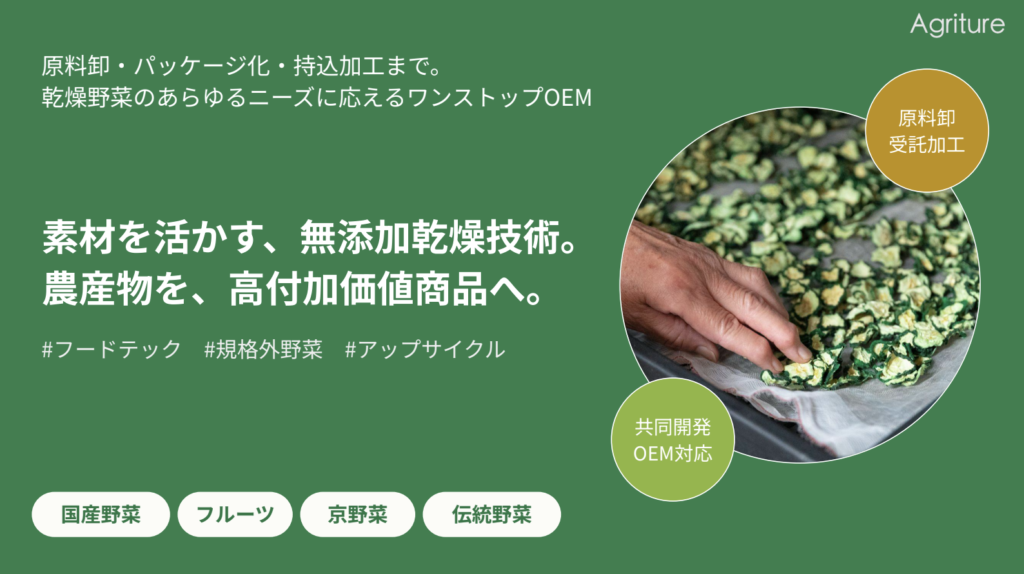
- OEM available from small lots of 10 kg
- Drying of brought-in raw materials also possible
- Support from processing to filling in one place
Summary: Building a brand chosen through health-tea OEM
A health-tea OEM is a powerful means by which even a company without manufacturing equipment can bring high-quality original products to market. By developing differentiated products such as vegetable teas and medicinal teas, you can appeal to health-conscious and function-conscious consumers and create a clear difference from competitors.
The keys to success lie in selecting the right OEM partner, setting a clear product concept, and executing an effective sales and marketing strategy. By working without compromise at each step—from raw material selection to blend design, one-stop manufacturing, and quality control—you can build a brand chosen by consumers.
The functional-beverage market is projected to keep expanding, and now is the perfect time to take on a health-tea OEM. You can choose a strategy that fits your own situation—starting with small-lot support and growing while watching the market's reaction, or developing full-scale from the outset. With a health-tea OEM, let's lead your brand to the next stage.
Download the OEM contract processing materials
We will send the materials to your email address based on the information you provide.
If you are considering product development with off-spec or your own farm's vegetables:From planning to processing, materials, package printing and novelties, you can consult us through a single point of contact. → Learn more about one-stop product development
- A must-read for e-commerce businesses: how to make a dried vegetable mix through OEM
- The Complete Guide to OEM Manufacturing of Domestic Dried Vegetables | A Thorough Explanation from Small-Lot Support to How to Choose
Author of this article
Related articles
-
 Original coffee marketing strategy | Ways to grow sales
 -
 ベジタリアンとは?国の規格が分けている4つの区分と食べられないもの
 -
 長ねぎと白ねぎは同じもの?ねぎの種類と呼び名を国の資料で確かめる
 -
 柚子の種類は何種類あるのか、公の資料で名前が残る系統を数えた
 -
 ゆずの時期は年に二度、青ゆずは7月から黄ゆずは10月から
 -
 ゆずの産地は高知が半分を占め、二位は徳島から愛媛に変わった
 -
 Preventing Food OEM Failures: Common Failure Cases and Countermeasures for Success
 -
 How to find a food OEM | How to efficiently find the best manufacturing partner