
Uses for yuzu peel expand when you dry it: steps to use up even the juice and seeds

Summary of this article
We have organized how to use every part of the yuzu—peel, juice, seeds, and inner membrane—using figures from public materials such as those of Kochi Prefecture and Taito Ward, Tokyo. It covers the parboiling and water-soaking times for removing bitterness, the drying times and storage guidelines for each peel-drying method, the recipes for ponzu and sweet simmered yuzu, and the origin of the winter-solstice yuzu bath.
When you shave off a little peel to finish a hot pot, a single yellow fruit remains. When you squeeze the juice, this time the peel, pith, and seeds remain. Yuzu is a fruit where, every time you use one part, another part is left over.
In the Ministry of Agriculture, Forestry and Fisheries' FY Reiwa 5 survey of specialty fruit-tree production trends, of yuzu's nationwide shipments of 26,734 tons, 21,519 tons were destined for processing. By calculation, 80% of shipments go not to the table as fresh fruit but to processing—squeezing, simmering, drying. The reason households struggle to use up yuzu is not clumsiness, but that this fruit was never designed to be "eaten as is" in the first place.
This page organizes what you can do with each part—peel, juice, seeds, and inner skin—then lays out how to remove the bitterness, the steps for drying peel to use across seasons, how to use up the juice, and even the proportions for simmering it into preserved foods. As much as possible, we include only figures that can be traced to materials published by public institutions, such as Kochi Prefecture, Tsurugi Town in Tokushima, Taito City in Tokyo, the Nerima Ward Recycling Center, and Hiroshima Prefecture. From our position doing contract processing of dried vegetables and dried fruit, we've also noted how home sun-drying differs from factory drying.
TOC
How much of yuzu—peel, juice, seeds, inner skin—can you eat?
Most people who look up "uses for yuzu" are not actually looking for the peel alone. The peel after squeezing the juice, the flesh after shaving off the peel, and the seeds you throw away each time. A single fruit yields four kinds of leftover, and each is suited to a different use.
First, here is a list of each part's distinctive qualities and the uses it suits. Keep this table in mind, and the moment you pick up a yuzu, the order of "where to start" is decided.
| Part | Character | Suitable use | Handling notes |
|---|---|---|---|
| Outer peel (the yellow part) | Strongest aroma | Garnish, clear soup, yuzu salt, drying, powder | Shave thinly. Peel too thick and bitterness comes through |
| White pith (albedo) | Source of bitterness and thickening | Sweet simmer, tsukudani, marmalade | Bitter as is. Needs parboiling and soaking in water |
| Juice | Sharp tartness | Ponzu, vinegar substitute, drinks, seasoned vinegar | Once squeezed, promptly refrigerate or freeze |
| Inner skin and segment membrane | Like the pith, thickening | When simmering jam, add together | Eaten as is, it has a dry texture |
| Seeds | Gives off a sticky gel | Adds thickening to jam | Wrap in cloth and simmer. Remove before use |
| Stem end | No use for it | Remove it | The prep step to cut off first |
Yuzu is not a citrus to eat as is
Peeling it by hand like a mikan and putting it in your mouth isn't impossible. But yuzu has thick outer peel, white pith, and inner skin, with many seeds and almost no sweetness—a fruit of intense acidity. Eat a single segment and your tongue puckers, and the rest goes untouched.
The breakdown of shipments noted at the start is itself the answer. Against nationwide shipments of 26,734 tons, 21,519 tons go to processing. The bulk of yuzu leaving the growing regions is distributed on the premise of being squeezed, simmered, or dried from the start. At home, too, working on the same premise gets it finished faster.
The aroma is concentrated only in the yellow part of the outer peel
Rub the surface of the peel with the pad of your finger and the tiny beads burst, releasing the aroma. Because the aroma is stored in these beads, when you want to transfer aroma to a dish, the basic approach is to shave off only the yellow part thinly.
The recipe for mackerel with yuzu miso published by Tsurugi Town in Tokushima includes the line "at the end, rub in the yuzu's outer peel and mix." Rather than chopping and mixing, it's a technique of rubbing the outer peel against the miso to transfer only the aroma. Shaving, chopping, rubbing, and grating—the same peel finishes completely differently with each.
- Shaving… only the yellow part, thinly, with a peeler. For chopping into a garnish or prepping before drying
- Chopping… the shaved peel into julienne or fine mince. For namasu, pickles, and mixed rice
- Rubbing… rub the surface of the peel to transfer only the aroma. For finishing miso or sauces
- Grating… brings out the aroma most strongly. For clear soup and grilled fish, just before serving
The white pith is bitter, but becomes the star when simmered
For use as a garnish, the white pith is a nuisance. Yet in dishes simmered together with sugar, peel with the pith is used instead. The recipe for yuzu jam published by Kochi Prefecture's Central-East Agricultural Promotion Center explains "because yuzu peel is high in pectin," and it's premised on the pith naturally adding thickness when simmered together.
The same center's yuzu marmalade involves thinly slicing the peel to 5 cm lengths, soaking it in water overnight, simmering until the white part turns amber, then adding sugar in three batches. The cue "when the white part turns amber and it's well simmered" refers to cooking the pith through without discarding it. Remembering that the handling of the pith is the exact opposite between garnish use and sweet simmering will keep you from hesitating.
Seeds and inner skin come back into play when you simmer jam
When you squeeze the juice, seeds, inner skin, and scraps of pith remain in the strainer. Rather than discarding them, a widely used method is to gather them in cloth or a tea bag and put them in the pot together when simmering jam or marmalade. Because a sticky gel comes off around the seeds, it thickens more easily than simmering with sugar alone. Once simmered, take them out and discard them.
If the squeezing day and simmering day differ, put just the seeds and inner skin in a small bag and freeze them, and they'll be ready the next time yuzu gather.
How far should you remove the bitterness from yuzu peel?
The thing people stumble on with uses for yuzu peel is almost always the bitterness. Failures like bitterness lingering in the mouth after adding a lot as a garnish, or jam turning out too bitter to finish, are decided at the prep stage.
A helpful reference here is the set of recipes published by Kochi Prefecture. Using the same yuzu peel, they vary both the parboiling temperature and the soaking time depending on what's being made. The step that home recipe sites tend to settle with the single line "remove the white part" is written out in numbers in the prefecture's materials.
| What you're making | Parboiling | Soaking in water | Handling the pith |
|---|---|---|---|
| Garnish, clear soup (raw) | None | None | Shave off |
| Sweet-simmered yuzu peel (Kochi Prefecture) | In lightly salted hot water, 5–6 minutes | About 3 hours (adjust to taste) | Leave on and simmer |
| Yuzu miso (Kochi Prefecture) | Boil | Overnight | Leave on and simmer |
| Yuzu tsukudani (Kochi Prefecture) | In 70°C water for 15 minutes | In running water for a full day | The inner membrane after removing |
| Yuzu marmalade (Kochi Prefecture) | None | Overnight | Until amber Simmer |
When shaving alone is enough
Floated in clear soup, added to grilled fish, placed on chilled tofu. For these uses, the amount of peel entering the mouth is very small, so you do neither parboiling nor soaking. Just shave off only the yellow part thinly with a peeler, and if the white part is thick, shave it off with a knife.
In this case, managing bitterness means the same as managing thickness. Turn the shaved peel over, and if the white layer is thin enough to show light through, you can chop it as is with no problem. If the white layer is 2 mm or more, lay the knife flat and shave it off.
Parboiling vs. soaking in water—which is more effective?
Kochi's sweet simmer boils the peel in lightly salted water for 5–6 minutes, then soaks it in water for about 3 hours. The tsukudani, meanwhile, boils peel with the stem end and inner membrane removed in 70°C water for 15 minutes, then soaks it in running water for a full day. Since the tsukudani is finished to a richer flavor, its bitterness-removal is correspondingly thorough.
Lining up these two, you can see that the soaking time varies more widely than the boiling time. Three hours versus a full day. The sweet-simmer recipe adds "adjust the soaking to taste," and the prefecture's own materials acknowledge that how much bitterness to leave is up to the person eating.
- To leave bitterness… shorten the boiling time and cut the water-soaking short at about 3 hours
- To remove bitterness… boil longer at 70°C, then soak in running water for a full day
- Taste along the way… biting one strand of the soaking peel gives you a sense of the remaining time
Why only marmalade skips parboiling
Kochi's yuzu marmalade only slices the peel into 5 cm lengths and soaks it in water overnight—there's no parboiling step. Instead, at the stage of simmering with a little added water, it cooks until the white part turns amber. Because the simmering time itself is long, there's no need to set up a separate parboiling step.
The same Kochi Prefecture's yuzu jam has even different steps. It runs frozen peel through a blender and sieves it, adds water and heats it, adds sugar in three batches, and finally adds citric acid. Freezing before crushing is because the fibers loosen and it becomes easier to grind. The habit of keeping peel in the freezer doubles as pre-processing for this.
How should you dry yuzu peel to use it across seasons?
Yuzu has a short season and disappears from stores quickly. If you dry the peel, you can add aroma to clear soup or udon even after the season ends. Even though many people look up "drying yuzu peel" in searches, how the steps are written varies.
Here, we line up only those for which the source of the figures is clear. The core sources are the method for drying mikan peel published by Taito City in Tokyo as a food-loss-reduction recipe, and the materials handed out by the Nerima Ward Recycling Center at its dried-vegetable workshop. Taito City's materials clearly state "the yellow part can likewise be used with other citrus such as lemon and yuzu," so the mikan-peel steps can be applied directly to yuzu.
| How to dry | Prep | Approximate time | Finish | Storage guideline |
|---|---|---|---|---|
| Sun-drying, Semi-dried | Shave thinly and wipe off moisture | 2–3 hours | Soft and the aroma remains | Seal and refrigerate, 4–5 days |
| Sun-drying, Fully dry | 3 minutes in 80°C water, wipe off moisture well | 4–5 days (citrus peel, 4 days) | Crisp and snaps | In a jar at room temperature, About 3 months |
| indoor By a window | Same as above | published No set guideline | than sun-drying takes time | Once fully dried Same as sun-dried |
| Oven and Microwave | Same as above | In public sources No guideline | Scorches easily the aroma escapes | Depends on how it dries |
| hot-air drying (contract processing) | Washing and cutting | by equipment and specifications decide | finishes uniformly | from the shipping date about 6 months |
Dip in 80°C water before drying
Taito Ward's procedure starts by removing the tough parts of the peel, then boiling water and turning off the heat once it reaches about 80°C, adding the peel, and letting it sit for about 3 minutes. The ward's materials explain this step as removing wax. After that, you dry the peel thoroughly with paper towels and move on to drying.
Even at processing sites, it is not unusual to apply a brief heating before drying. The Food Industry Technology Center of the Hiroshima Prefectural Technology Research Institute explains that in producing dried vegetables and dried fruit, blanching (brief heating with boiling water or steam) is often performed as a pretreatment to prevent browning and quality deterioration during and after drying. The 3-minute extra step at home is a small-scale version of what factories do.
Between semi-dried and fully dried, the drying time differs by more than tenfold
The materials from the Nerima Ward Recycling Center divide dried vegetables into two types. Semi-dried takes about 2 to 3 hours of sun-drying, while fully dried takes about 4 to 5 days of sun-drying. Even with the same "drying," the figure shifts by an order of magnitude depending on the state you are aiming for.
For citrus peel, Taito Ward's procedure states "sun-dry for 4 days until crisp." This figure nearly overlaps with Nerima Ward's 4 to 5 days for fully dried. Peel stopped at 2 to 3 hours keeps its aroma but also retains moisture, so it should be refrigerated and used up within 4 to 5 days.
- To use within a few days... dry for just 2 to 3 hours and refrigerate in an airtight container
- To use across seasons... dry until crisp over about 4 days and store at room temperature in a jar
- When in doubt... dry it fully. Leaving it half-dried at room temperature is the most prone to spoiling
When to dry, and how to choose where to place it
Nerima Ward's materials describe the drying spot as "a sunny place with as much airflow as possible," giving examples such as on a drying rack, hung on a clothes pole, on top of an outdoor unit, or on a balcony railing. The best time is from late morning to early evening on a clear, dry day with low humidity.
Living situations where outdoor drying is not possible are also taken into account, and the same materials state, "If you cannot dry outdoors, a sunny spot by a window is OK, but keep the airflow good." Placed in a room with the windows shut, it spoils from trapped humidity before it dries. Spreading the pieces on a colander or drying net without overlapping is common to both approaches.
For ovens and microwaves, no public source gives a time
Phrasings like "microwave for 2 minutes before drying to speed it up" or "30 minutes in a 100°C oven" are common on recipe sites. However, within the range of materials from local governments and public research institutes we searched, none gave a guideline for the time to dry yuzu peel with a heating appliance. This is likely because home ovens and microwaves vary widely by model, so the results do not come out consistent even at the same setting.
Drying with heat is not itself a bad thing. Hiroshima Prefecture's materials cite, as drawbacks of hot-air drying, compositional changes from heating and a tendency to shrink and harden. Conversely, the lower the temperature and the more time you take, the more the aroma remains. If you use an appliance, the realistic approach is to work in short intervals, checking repeatedly, and stop before it scorches.
Check whether it is dry by bending it
Fully dried peel snaps crisply when you bend it with your fingers. If it only bends without snapping, moisture still remains. The "until crisp" in Taito Ward's materials refers to this feel.
The way to think about storage is as the Ministry of Agriculture, Forestry and Fisheries' public newsletter describes dried goods. The moisture contained in food lets bacteria and mold multiply, but because dried goods have had their moisture removed, microbial growth is suppressed and they keep for several months even at room temperature. Put another way, if something still has moisture only partly removed and is left at room temperature, it falls outside these conditions. During storage, avoid places that get hot, places exposed to direct sunlight, and places with high humidity.
What is the difference between home sun-drying and the warm-air drying of contract processing
Hiroshima Prefecture's materials divide food drying into natural drying and artificial drying and lay out the strengths and weaknesses of each. Natural drying is simple to operate and low in cost, but requires time, effort, and space, is affected by the weather, is difficult to control for quality, and tends not to finish uniformly. Hot-air drying has a fast drying speed, finishes uniformly, and because the equipment is simple, has low running costs. The difference between drying at home and drying with equipment comes down to exactly this.
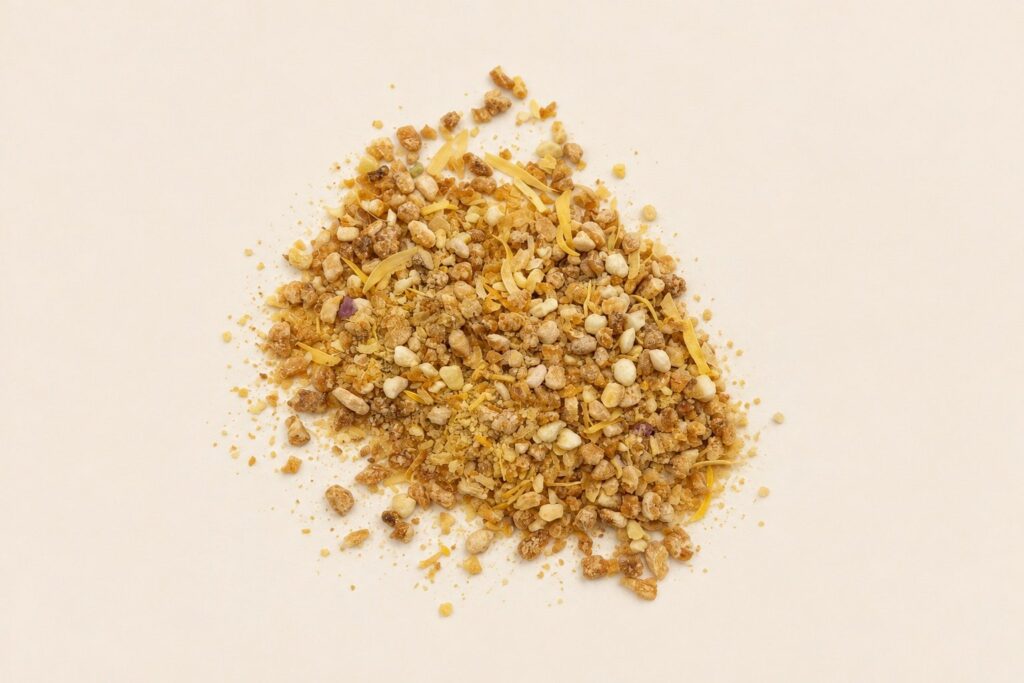
What we handle is also this hot-air (warm-air) drying. We wash and cut domestic yuzu, dry it with warm air, and grind it as needed. The particle size can be made as fine as roughly 100 mesh, or ground coarser to keep the texture of the peel. We set the best-before date of dried products at about 6 months from the shipping date as a guideline. This is not far from the "about 3 months at room temperature" figure cited for home sun-drying, and the shelf life of dried foods generally falls within this range.
In our processing, we also adopt a design that grinds the whole fruit without separating out only the peel. Cutting and removing the seeds lowers the yield, but when grinding is the premise, the entire quantity can be used. The idea is the same as "keeping even the seeds" at home. The specifications we handle are summarized on the Dried yuzu page.
What can dried yuzu peel be used for
You dried it fine, but it ends up sitting in a jar until the next year. This is the most common failure with dried yuzu peel. Deciding on a few uses before you dry it makes a real difference in how fast it goes.
The citrus in shichimi togarashi was originally dried peel
Many shichimi togarashi blends include dried citrus peel. Taito Ward's materials also call dried mandarin peel chinpi, and explain that the yellow part of other citrus such as lemon and yuzu can be used the same way. Finely chop the dried yuzu peel you have on hand and combine it with chili pepper, sesame, aonori, and the like to make your own blended shichimi.
For how to think about blending and combining raw materials, How to start a shichimi OEM organizes it from the manufacturing side. When making it at home, how to bring out the aroma does not change at home either.
Grinding it into powder expands the dishes you can add it to
Peel dried until crisp can be ground into powder with a mortar or mill. Once powdered, it can be used in dishes that were hard to add it to when chopped. For example, mixing it into salt to make yuzu salt, sprinkling it on dressing, or mixing it into cookie dough.
- Mix into salt or sugar... the finer the particles, the more evenly it mixes
- Knead into dough... for baked goods and bread. Lighter on the palate than chopped peel
- Drop into a drink... a small amount in black tea or hot water
- Into sauces and dressings... the aroma lifts when combined with oil
Using different particle sizes is the same idea with commercial citrus ingredients. For how differences in coarseness divide the uses, How citrus powder is made and used.
When rehydrating to use it, soak it in water
Fully dried peel is hard, so when you want to use it at a thicker state in simmered dishes or pickles, rehydrate it with water. As with dried goods in general, soak it in water or lukewarm water to soften it before cooking. The aroma transfers to the soaking liquid too, so do not discard it; add it to the cooking liquid.
If you are scattering it over soup or udon, you may add it dry without rehydrating. It unravels naturally in the hot broth and the aroma lifts. Using rehydration or not as the case requires is the shortcut to using up dried yuzu peel.
FOR BUSINESS
Looking for dried yuzu as a raw material?
We dry and mill Japanese-grown yuzu to order. We welcome inquiries about specified cut shapes and particle sizes, as well as ongoing supply. For specifications, Dried yuzu・yuzu powder listed at.
Small-quantity purchases are handled at our sister brand's online shop, OYAOYA. There are two types: Tokushima-grown yuzu powder (fine) and a coarse type ground whole with the peel.
What is the quickest way to use up yuzu juice
The talk tends to lead with the peel, but by volume it is the juice that is left over more. Squeeze several yuzu and the bottle fills up faster than expected. Deciding in advance where the squeezed juice will go keeps it from being forgotten, sour, at the back of the refrigerator.
Ponzu starts from 3 parts soy sauce, 2 parts juice, 1 part mirin
The yuzu ponzu published by Tsurugi Town, Tokushima Prefecture is simply soy sauce, squeezed yuzu juice, and mirin mixed in a 3 to 2 to 1 ratio. The town's materials add that to soften the acidity, make it about 4 to 2 to 1. Neither heating nor aging is specified.
As for storage, it says to put it straight into a jar and into the refrigerator, where it keeps for about 2 months. It then continues, "It is also delicious made fresh each time." It is a seasoning that works both as a make-ahead batch and mixed only as much as you need each time.
Made into seasoned vinegar, it even works for sushi rice
In Kochi Prefecture's materials, yuzu juice is called "yuzu vinegar." It is a name premised on using it in place of vinegar. Tsurugi Town's yuzu sushi combines 5 tablespoons of yuzu vinegar, 3 tablespoons of sugar, and 2 teaspoons of salt into seasoned vinegar, sprinkles it evenly over cooked rice, and mixes while fanning with a paddle.
5 tablespoons for sushi rice made from 3 cups of rice. Squeezing a few yuzu gets you there. For vinegared dishes and marinades too, replacing part of the rice vinegar with yuzu juice changes the aroma.
Freeze it in an ice cube tray and portion it out
Juice you cannot use up at once can be put into an ice cube tray or silicone cups and frozen, then gathered into a bag once set. One cube is a few teaspoons, so you can take out just the amount you need. You can use one cube for grilled fish or two for a sauce, and it goes faster than keeping it in a bottle.
How long frozen juice can be kept ranges, depending on the source, from about 1 month to 3 months. Since no public guideline can be found, rather than fixing a hard expiry, it is more reliable to divide the amount on the premise of using it up before the aroma fades.
Turning it into drinks uses up a large amount
If a large amount of juice is left over, turning it into drinks handles the volume best. Floating one thin slice of peel lifts the aroma.
- With soda... 1 to 2 tablespoons of juice, adjusting sweetness with honey or sugar
- With hot water... for a cold day. Float a piece of peel
- Dressing... just combine with oil and salt. In place of lemon
- As a marinade... sprinkle on chicken or white fish to suppress the odor
How much sugar to add when simmering or pickling the peel
When you get a large amount of yuzu at once, simmering it or pickling it in sugar is the sure approach. How much sugar you add changes both the finish and the shelf life, and here too, the recipes published by Kochi Prefecture serve as the standard. Using the same yuzu peel, the proportions clearly differ across sweet simmered, tsukudani, miso, marmalade, and jam.
| What you're making | Yuzu peel | Sugar | What to combine |
|---|---|---|---|
| Sweet-simmered yuzu peel | 300g | 90〜100g | Light soy sauce and mirin 1 and 1/2 tablespoons each, 1 red chili pepper |
| Yuzu tsukudani | 1kg (after removing bitterness) | 400g | 400cc dark soy sauce, 2 chili peppers |
| Yuzu miso | 250g | 50g coarse brown sugar + 50g white sugar | 500g miso, 1 tablespoon yuzu vinegar |
| Yuzu marmalade | 1kg | 600g | 200cc yuzu vinegar |
| Yuzu jam | 1kg | 900g | 100g starch syrup, 500cc water, 10g citric acid |
In sweet simmered peel, a third of the peel is sugar
Kochi Prefecture's sweet simmered yuzu peel uses 90 to 100g of sugar for 300g of peel, 1 and 1/2 tablespoons each of light soy sauce and mirin, and 1 ring-sliced red chili pepper. Boil the peel for 5 to 6 minutes in lightly salted water, soak it in water for about 3 hours, cut it into your preferred shape, add the seasonings and chili pepper, and simmer over medium heat until a little moisture remains.
Because the sugar is about a third of the peel, it is far lighter in sweetness than jam, and with the soy sauce and chili pepper it finishes more like a side dish. It suits uses such as serving alongside rice, as a snack with drinks, or chopping it and mixing it into dressed dishes.
In tsukudani, soy sauce and sugar are in equal amounts
Yuzu tsukudani uses, for 1kg of peel with the bitterness removed, 400cc of dark soy sauce, 400g of sugar, and 2 chili peppers. Boiling the peel, with the stem ends and inner membranes removed, in 70°C water for 15 minutes and soaking it in running water for a full day and night is the preparation.
There is also an order to the simmering. Cut the peel into 1cm strips, add all of the soy sauce and only a third of the sugar to start simmering, and once it comes to a boil in about 20 minutes, add the remaining sugar in two portions and simmer down. Remove the seeds from the chili peppers, cut them small, and add them last. Adding the sugar in portions is a technique shared with marmalade and jam.
In yuzu miso, there is more miso than peel
The yuzu miso published as a Kochi Prefecture local dish uses, for 250g of yuzu peel, 500g of miso, 50g of coarse brown sugar and 50g of white sugar, and 1 tablespoon of yuzu vinegar. Boil the peel, soak it in water overnight, slice it thin, simmer it with the coarse brown sugar over low heat, add the miso and simmer while stirring, and finally mix in the yuzu vinegar and turn off the heat.
The prefecture's materials add that "it can be used in various ways, such as to season dressed dishes, spread on grilled fish, or put on rice." Because the amount of peel is modest and miso is the main ingredient, it is positioned as a standing seasoning rather than a preserved food. Tsurugi Town, Tokushima Prefecture's mackerel with yuzu miso introduces a method of combining 120g of white miso with 30g of red miso and finally grating in the yuzu's outer peel and mixing.
Marmalade and jam differ by a wide margin in the amount of sugar
Yuzu marmalade uses 600g of sugar and 200cc of yuzu vinegar for 1kg of peel. Yuzu jam uses, for 1kg of peel, 900g of sugar, 100g of starch syrup, 500cc of water, and 10g of citric acid. Even though they appear side by side in the same prefecture's same materials, the amount of sugar differs by 1.5 times.
The difference shows in the method. Marmalade simmers the peel while keeping its shape, so the peel's own moisture and bitterness remain. Jam puts frozen peel through a blender and strains it, so the whole becomes uniform, with a design that brings out sweetness through sugar and starch syrup. You choose based on whether you want to keep the shape of the peel or take ease of spreading.
Yuzu tea uses rock sugar in equal amount, finishing the top with sugar
When simmering is a hassle, there is a method of simply pickling in sugar. Because it uses no heat, there are fewer failures, and both peel and flesh get dealt with together.
The yuzu tea method introduced on a staff blog of the Tochigi Prefecture Agricultural Administration Department uses just three ingredients: yuzu, rock sugar, and a large empty jar. Wash the yuzu well, cut it into quarters lengthwise and crosswise, separate the peel and the flesh, remove the stem ends and seeds, and chop the peel finely. Everything except the stem ends and seeds is used.
Prepare rock sugar in the same amount as the yuzu, and pack the yuzu and rock sugar into the jar in several portions. The trick is to make the very top rock sugar, and it also notes that if there is too much rock sugar, some will remain undissolved. Place it in the refrigerator, and for the first few days shake the jar and mix well to dissolve the sugar.
According to the same materials, the extract comes out and it becomes jam-like, reaching drinking readiness in roughly half a month to a month. For storage, it is said to be fine in the refrigerator until spring. Once the chopping is done, all that is left is to pack it into the jar and leave it.
Yuzu peel candy is made by letting the peel absorb sugar and then drying it
Simmering the peel in sugar and then drying it makes yuzu peel candy. The flow is to parboil and drain, soak in water to remove the bitterness, simmer with sugar absorbed until the liquid is gone, cut it into thin strips, and then drive off the moisture. It is easy to understand if you think of Kochi Prefecture's sweet simmered peel cut thin and dried further.
For the finishing drying, either the sun or a heating appliance is fine. Stopping while the surface is still slightly moist keeps the softness of the peel when you bite into it. Drying it completely extends the shelf life, but the texture becomes harder.
What to watch for when using it fresh or frozen
When you have time neither to dry nor to simmer, just cutting and freezing it is enough. Frozen yuzu suits different uses than when fresh.
Freeze it whole, or chop it and portion it out
Yuzu frozen whole can be peeled or grated while still frozen. Because the flesh is firm, the peel is easier to handle than when fresh. Let it sit at room temperature a little to half-thaw it, and you can also put a knife in and squeeze out the juice. However, once thawed, it cannot be refrozen, so this is a method for when you plan to use up one fruit.
To use it little by little, separate it into peel and juice from the start. Cut the shaved peel into julienne or mince, wrap it one portion at a time in plastic wrap, and then gather it into a bag. When using it, you only take out one packet, so there is no effort of breaking apart a frozen block. Just as Kochi Prefecture's yuzu jam is premised on frozen peel, freezing also doubles as preparation for processing.
Frozen peel loses its aroma little by little. Deciding the order in which you rotate it, using fresh peel for dishes where you want to bring the aroma forward and frozen peel for simmering or kneading in, keeps the stock moving.
Decorative cutting is worth trying precisely when peel is left over
In Japanese cuisine, the peel is cut into pine-needle shapes, or thinly sliced as hegi-yuzu to garnish a bowl. Shaping it leaves peel over, so it is an effort usually avoided, but on a day when you have a large amount of yuzu you can try it without hesitation. The cut-off ends can be chopped and turned into a condiment, so nothing goes to waste.
Tsurugi Town, Tokushima Prefecture's simmered ebi-imo is finished by plating it, pouring dashi over it, and scattering julienned yuzu. Even as a garnish, it is also a step for adding aroma at the end. Scattering it just before eating lifts the aroma.
Beyond cooking, how has yuzu been used
Looking into uses for yuzu, talk of baths and cleaning always comes up. Here we organize it as custom and procedure.
The winter solstice yuzu bath began from an Edo-period play on words
"Kyoto's Intangible Cultural Heritage Connecting Kyoto," run by the City of Kyoto, explains the winter solstice as the day of the year with the shortest daylight and the longest night, and then writes that there is a way of thinking that treats this day as the extreme point of yin after which yang increases again, and that customs for praying for good health and warding off evil spirits arose from it. Bathing in water with yuzu floating in it is one of those customs.
The same materials also note that it is said to have begun in the Edo period as a way for public bathhouses to draw customers, from a play on words linking "touji" (winter solstice) with "touji" (hot-spring cure), and "yuzu" with "yuzu" (meaning flexibility/accommodation). It is a history of spreading not as a religious rite but as a trick of the trade.
Float it whole, or put the peel in a bag
Floating it whole is the simplest, and cleanup is just scooping it out. If peel remains after squeezing the juice, there is also a method of putting it in a laundry net or cotton bag and sinking it in the water. Putting chopped peel straight in clogs the drain, so putting it in a bag is the premise.
- Whole... float a few as they are. No need to cut slits
- Halved... the aroma comes out easily, but the flesh and seeds scatter
- Peel only... put it in a bag and sink it. A destination for the peel left after squeezing
- Cleanup... for reheating or circulating baths, check the instruction manual's directions
When bathing with someone with sensitive skin or a small child, keep the amount small or limit it to a short time. If you feel irritation on the skin, stop using it.
Wipe away grease with the liquid from boiling the peel
Wiping the area around the stove or the sink with liquid made by simmering citrus peel from cold water has long been known. Put the squeezed-out peel straight into a pot, simmer for about 10 minutes, let it cool, and then soak it into a cloth. It does not remove strong grime, so rather than a substitute for detergent, it is positioned as a finishing wipe.
On painted surfaces and resin parts, test in an inconspicuous spot before using. The simmered liquid does not keep, so use it up the same day.
Fully dried peel can be put in a breathable cloth bag and placed in an entryway or shoe cabinet. The aroma fades over a few weeks, so a use like rotating part of the dried peel is one that lasts. Putting half-dried pieces in a bag spoils them, so always use ones dried until they snap, and avoid humid places.
On the day a large amount of yuzu arrives, in what order to tackle it
Yuzu arrives in a batch at once. Thinking about it one fruit at a time lets spoilage come first, so decide the order before you start.
The first thing to keep in mind is that the drying step is the most affected by the weather. As Nerima Ward's materials show, sun-drying is best from late morning to early evening on a clear, dry day with low humidity. On a sunny day, put the drying task first.
| Step | What to do | Guideline | Destination |
|---|---|---|---|
| 1 | Wash them all and wipe off moisture | 30 minutes | spread on a colander |
| 2 | Shave the peel for the drying portion, 3 minutes in 80°C water | 30 minutes | Colander / drying net (from late morning) |
| 3 | Cut the rest in half and squeeze the juice | 1 hour | Jar and ice cube tray |
| 4 | The seeds and inner membranes sort out | 15 min | Bag it and freeze |
| 5 | The peel for the simmering portion Parboil and soak in water | 3 hours to overnight | In a bowl left soaking in water |
| 6 | Chop the remaining peel and freeze in portions | 30 minutes | Freezer |
| 7 | The next day, the soaked peel Simmer | 1 to 2 hours | pack into a jar and refrigerate |
Separate what to dry from what to simmer, first
Even if the uses diverge, the washing task is common to all. If you wash everything and wipe off the moisture at the start, your hands will not stop in the later steps. Leftover moisture is a source of spoilage both when drying and when freezing. Taito Ward's procedure also stresses, after dipping in the water, to "wipe off the moisture well with paper."
Once washed, for the peel to be dried, shave off only the yellow part thinly. For the peel to be simmered, use it with the white pith left on. Since the way to take the peel is reversed even for the same peel, decide first "how many for drying, how many for simmering" before putting a knife in.
For the drying portion, work backward from the amount you want to store. It shrinks greatly in volume as it dries, and even a colander's worth of fresh peel fits into one small jar, so for most households a few fruits' worth is enough.
The water-soaking step progresses while you sleep
As Kochi Prefecture's tsukudani specifies "running water for a full day and night" and the yuzu miso and marmalade specify "overnight," removing the bitterness is a time-consuming step. If you set this to run overnight, the time it ties you up becomes effectively zero.
If you plan it on the premise of splitting it over two days, day one is washing, shaving, squeezing, starting to dry, and soaking in water, and the next day is simmering. Trying to do it all in one day pushes the simmering-down time into the middle of the night.
When the amount is too large, sending it to processing is also an option
Situations where yuzu gathers beyond the amount a household can handle are not unusual at growing regions and farm stands. Fruit that cannot be shipped because it is off-spec comes out in batches every year.
We take on such domestic fruit with warm-air drying and grinding. We also accommodate specifications for cut shape and particle size, and for 10g or more we also handle filling into small packs. We do not handle freeze-drying or roasting. For initiatives at growing regions and the flow up to turning it into a product, How to approach yuzu product development.
For the growing regions and varieties of yuzu itself, Characteristics of domestic yuzu by growing region, for the harvest timing and how to judge it, The harvest season of yuzu, and for using green yuzu and yellow yuzu differently, Types of yuzu and how to use them for more.
FOR BUSINESS
Looking for dried yuzu as a raw material?
We dry and mill Japanese-grown yuzu to order. We welcome inquiries about specified cut shapes and particle sizes, as well as ongoing supply. For specifications, Dried yuzu・yuzu powder listed at.
Small-quantity purchases are handled at our sister brand's online shop, OYAOYA. There are two types: Tokushima-grown yuzu powder (fine) and a coarse type ground whole with the peel.
FAQ
Summary
Yuzu is a fruit of which 80% of the shipment volume goes to processing. Because it is distributed on the premise of squeezing, simmering, and drying, working your hands in the same order at home gets it dealt with quickly.
Shaving off only the yellow part of the peel thinly makes it a condiment with no preparation, and using it pith and all requires parboiling and water-soaking as Kochi Prefecture's recipes show. Sweet simmered peel is boiled 5 to 6 minutes in lightly salted water and soaked for about 3 hours; tsukudani is boiled 15 minutes at 70°C and soaked in running water for a full day and night. How much bitterness you leave is decided by the soaking time.
干すなら、皮を80℃の湯に3分くぐらせて水気を拭き、セミドライなら2〜3時間、カリカリまで乾かすなら4日前後です。完全に乾かしたものは瓶で常温3か月ほど、半乾きのものは冷蔵で4〜5日。折って確かめて、曲がるだけなら干し足りません。
果汁はポン酢ならしょうゆ3・果汁2・みりん1、寿司飯なら米3カップにゆず酢大さじ5。残りは製氷皿で凍らせておけば、1個ずつ取り出せます。種と薄皮は捨てずに袋へ入れて冷凍し、ジャムを煮る日に鍋へ戻します。
冬至のゆず湯は、江戸時代の言葉あそびから銭湯の客寄せとして広まったとされる風習です。丸ごと浮かべるか、搾ったあとの皮を袋に入れて沈めるか。料理で使いきれなかったぶんの行き先が、ここにもあります。
- Learn from successful trade show cases! Strategies to maximize impact
- Contract Manufacturing Guide for Vegetable Powder Filling | Quality Control and Optimal Package Selection
Author of this article
Related articles
-
 How to Make Dried Tomatoes: Drying Tips, and How Cherry and Large Tomatoes Turn Out Differently
-
 How to source commercial vegetable powder in small lots, and how to use it
-
 How to Make Vegetable Dashi and Vege-Broth: The Difference and Tips for Using Vegetable Scraps
-
 Plant-Based Vegetable Dashi: An Introduction to Umami Compounds and Uses
-
 The Secret to Vegetable Dashi Is Dried Vegetables! Tips for Drawing Out Umami
-
 How many kinds of yuzu are there? We counted the lineages whose names survive in public records
-
 Yuzu has two seasons a year: green yuzu from July, yellow yuzu from October
-
 Kochi accounts for half of yuzu production, and second place has shifted from Tokushima to Ehime