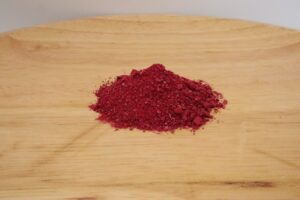
Shogoin Kabu Powder

Shogoin kabu powder is a raw material made by drying and then finely milling Shogoin kabu, a traditional Kyoto vegetable. For applications such as potage bases, Japanese-style seasonings, kneading into dough, and blend powders for pickles, it is intended to spread the gentle sweetness and refined flavor of Shogoin kabu uniformly. Shogoin kabu is a large round turnip of the Brassicaceae family, characterized by dense, fine-grained white flesh. Its fair-skinned surface remains as a pale color tone even after drying and milling, blending naturally into white-family sauces and dough. At Agriture, in the same contract-processing flow as brought-in raw material, Dried Shogoin Kabu we accommodate powdering by adding a milling step.
Shogoin kabu is a variety that has been cherished as a raw material for senmai-zuke since the Tenpo era, characterized by sweetness, fragrance, and a smooth texture. Combined with Onion powder and Garlic powder which pairs well with the same Japanese-cuisine base, you can design the powder formulations of potage bases, Japanese-style dashi powder, and blended seasonings all at once. You can consult us on refining specifications from small quantities.
TOC
Agriture's Shogoin kabu powder: three points of commitment
1. Drying design that preserves the Shogoin-kabu-like sweetness
Because Shogoin kabu has a high moisture content and dense flesh, its sweetness and flavor profile change with drying conditions. At Agriture, we control the temperature range and accommodate contract processing under conditions that preserve the gentle sweetness and refined aroma characteristic of Shogoin kabu. Making use of the fair-skinned flesh, we finish it to a pale color tone that blends into white-family potages and dough as a guide. You can also consult us on blend prototyping across application genres.
2. Custom particle size to match the application
Applications that demand smoothness, like potages and sauces, and applications that keep mouthfeel, like kneading into dough, require different particle sizes. At Agriture, we adjust the milling degree of brought-in raw material to match the application on a made-to-order basis. If you share your image of the finished mouthfeel and ease of dissolving, we align it during prototyping.
3. Proposing use by purpose with raw-material forms
For applications where you want to keep the turnip's texture and appearance, Dried Shogoin Kabu (slices, dices); for applications where you want to spread sweetness and richness uniformly, the powder — we can propose such use by purpose. Even when you want to balance an ingredient-rich feel and base depth in the same recipe, you can design it by combining the form and the powder.
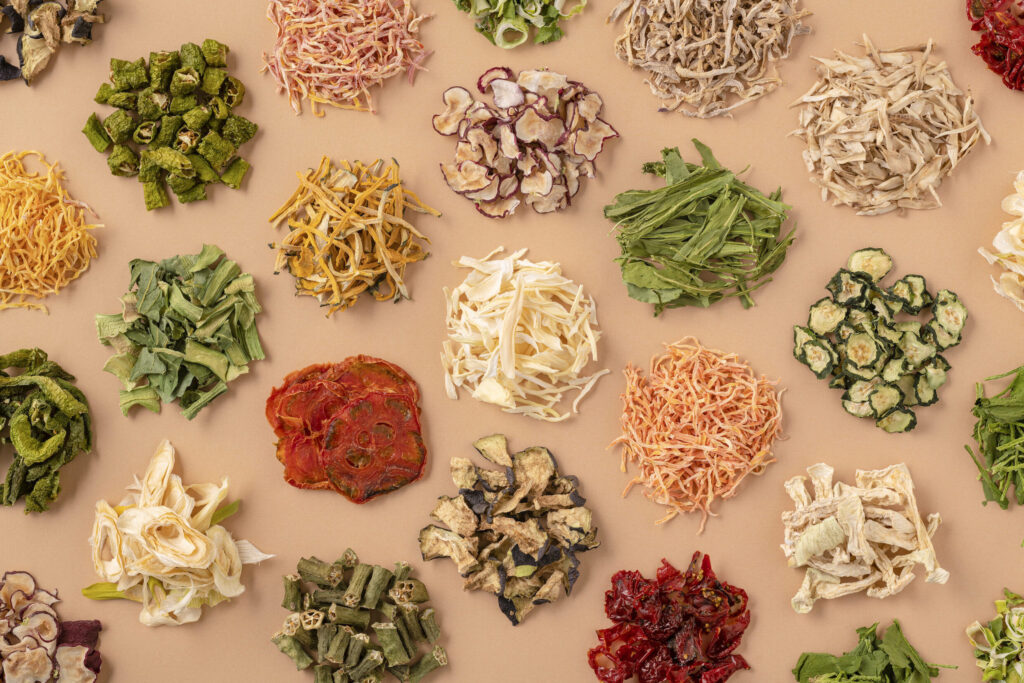
Product catalog showing the items we handle
Flexible support from small lots to large lots
- Sold in small lots from 1 kg
- Handling heirloom vegetables from across Japan
- Dried fruits and herbs also supported
Features of commercial Shogoin kabu powder
Fine milling opens up the application area of "uniform blending into sauces and dough" that slices and dices cannot reach. We organize the strengths unique to Shogoin kabu powder from six perspectives.
Concentrates Shogoin kabu's sweetness
The gentle sweetness and refined flavor of Shogoin kabu are concentrated in the powder. With a small amount blended, you can add turnip-like sweetness and mellowness to a base such as potage, Japanese-style dashi, or simmered-dish powder. It can be used as an ingredient when you want to add depth to white-family dishes.
A pale color tone that makes use of the fair-skinned flesh
Shogoin kabu is a fair-skinned turnip with beautiful skin. Because a pale color tone remains even after drying and milling, it is an ingredient easy to pair with applications where you do not want to muddy the color — potage, white sauces, dough, and the like. It becomes easier to design recipes on the premise of the finished color tone.
Handles Japanese and Western blends
Through pre-blending with Japanese-style bases of onion, garlic, and turnip type, you can design potage, Japanese-style dashi powder, and blended seasonings through a single consultation window. From the refined flavor of Japanese cuisine to Western-style soups, use across application genres is possible.
Use together with the ingredient-shape version
For uses where you want to leave texture, Dried Shogoin Kabu (slices, dices); for applications where you want to spread sweetness uniformly, the powder — you can use them accordingly. An ingredient-rich feel and base depth can both be achieved in the same recipe.
A background as a traditional Kyoto vegetable
Shogoin kabu is positioned as a traditional Kyoto vegetable and brand Kyoto vegetable, and is a variety known as a raw material for senmai-zuke. For product-making where you want to give your product concept the storytelling of Kyoto vegetables, you can make use of it together with the ingredient's background.
Contract milling and small-lot handling
We accommodate drying and milling of brought-in raw material on a contract basis. Because we accept orders from small prototype lots, it is a system easy to use for verifying new recipes and limited-edition products. We refine the particle size and packaging form to match the application on a made-to-order basis.
Product specifications (commercial)
The basic specifications for contract processing are as follows. The purchase lot, delivery timeline, and packaging form for mass production and OEM are refined through individual consultation.
| Item | Details |
|---|---|
| Product name | Shogoin Kabu Powder |
| Raw material | Shogoin turnip |
| Shape | Fine powder (dried and ground) |
| Appearance | A pale cream to white-family fine powder |
| Aroma | The gentle sweetness and mild aroma characteristic of Shogoin kabu |
| Net content | Individual quote according to use and lot |
| Best-before date | About 6 months from the shipping date |
| Storage method | Avoid high temperature, high humidity, and direct sunlight; after opening, seal and store in a cool, dark place |
| Handling form | Contract drying and milling of brought-in raw material |
| Minimum prototype lot | Contract handling (consultation available) |
Customization support
| Item | Available | Details |
|---|---|---|
| Particle-size adjustment | Made-to-order to match the application | Refined through consultation, from fine particle size for potage to kneading into dough |
| Blend design | Pre-mixing of vegetable powders | Mixing at specified ratios with onion, garlic, and turnip types |
| Packaging form | From commercial bulk to small bags | Light-blocking aluminum bags, sticks and small bags, individual wrapping, and the like |
| OEM productization | End-to-end handling through the final product | Potage, Japanese-style dashi powder, blended seasonings, blend powder for pickles, etc. |
| Raw material supply | Accommodates contract processing | Accommodates contract drying and milling of brought-in raw material |
For those who want to make use of texture and shape (ingredient-shape version)
For simmered dishes, kabura-mushi, pickle ingredients, and the like, applications that keep Shogoin kabu's texture and appearance are best served by dried Shogoin kabu (slices, dices). The texture and presence of turnip that powder cannot deliver come through in the recipe.
Commitment to variety and growing region
Shogoin kabu is a large round turnip of the Brassicaceae family, known as one of the largest turnips in Japan. It is said to have been improved from Omi kabu in the Shogoin area of Kyoto, and is positioned as a traditional Kyoto vegetable and brand Kyoto vegetable. Dense, fine-grained white flesh, gentle sweetness, and fragrance are its varietal features. As a powder raw material, we select based on the balance of sweetness and flesh quality.
BRAND
At Agriture, we accommodate powdering Shogoin kabu — which has the food culture of Kyoto as its background — in the form of contract drying and milling of brought-in raw material. Our basic policy is a finish that retains the gentle, turnip-like sweetness and refined flavor.
PRODUCER
We accept raw material after sharing guidelines for variety, harvest timing, and moisture content. In contract processing, we record raw-material lots and use them to reproduce sweetness and color tone in mass production.
REGION
Shogoin kabu is a Kyoto vegetable cultivated mainly around Kyoto, in season from late autumn through winter. The misty basin climate and the winter chill are said to nurture the dense flesh and sweetness.
CULTIVATION
Because it is a variety that grows large, we accept raw material by the guides of the degree of enlargement and moisture content. In the powdering process, we adjust the milling conditions with reproducibility of sweetness and pale color tone in mind.
Powdering technology and quality control
Moisture management and preservation of sweetness
Shogoin kabu has a high moisture content and is an ingredient whose sweetness and flavor change readily during the drying process. We control the temperature range and accommodate contract processing under conditions that remove moisture while preserving the turnip's characteristic sweetness. We also control the frictional heat during milling, aiming for a finish where the powder does not become too hot.
Particle-size and packaging design
For applications that demand smoothness, like potages and sauces, a fine particle size; for kneading into dough, a particle size that keeps mouthfeel — we adjust the milling degree on a made-to-order basis to match the application. Commercial bulk uses light-blocking aluminum bags, and small bags and sticks use moisture-proof, light-blocking film — a specification we propose with in-store and warehouse storage in mind.
TIPS: Guidelines for making the most of Shogoin kabu powder
When using it as a potage base, combining it with onion powder or dairy components lets the turnip's gentle sweetness blend into the soup. In Japanese-style dashi powder, combining it with dashi ingredients and letting the Shogoin kabu sweetness come through faintly gives a foundation of refined flavor. For kneading into dough, we recommend trying a small amount relative to the whole powder and exploring a formulation that makes use of the turnip's flavor and pale color. It can also be used as a blend powder for pickles, as an ingredient that supplements turnip-like sweetness. The optimal formulation value is refined through prototyping for each finished product.
Use cases
Because the powder disperses uniformly in liquids and powders, it opens up applications that slices and dices cannot reach. We organize the anticipated uses for Shogoin kabu powder.
Potage and soup base
As a powder base for potages and soups that make use of the turnip's sweetness and mellowness. The pale color tone derived from the fair-skinned flesh blends naturally into white-family soups.
Japanese-style seasonings and dashi powder
A use that adds a small amount to Japanese-style dashi powder or blended seasonings, letting Shogoin kabu's refined sweetness work as a foundation. It adds depth to the powder formulation of Japanese-cuisine bases.
Kneading into dough
A use kneaded into the dough of bread, baked goods, noodles, and the like, making use of the turnip's flavor and pale color. It can be used as an ingredient for product-making with Kyoto vegetables.
Blend powder for pickles
It is a variety deeply connected to the pickle culture represented by senmai-zuke. A use that adds it to a blend powder for pickles as an ingredient that supplements turnip-like sweetness is conceivable.
Flavoring for confectionery and sweets
A use that makes use of the gentle sweetness to add Kyoto-vegetable flavor to the dough and cream of Japanese and Western sweets. The advantage that the pale color tone does not muddy the finished color is also a benefit.
One ingredient in a blended vegetable powder
A use that pre-blends it with other vegetable powders such as onion and garlic to design potage bases and blended seasonings all at once. We handle everything through to mixing and bagging at specified ratios.
Commercial usage and formulation guidelines
Blending basics
- For potage bases, combine it with onion powder or dairy components to make the turnip's sweetness the foundation
- For Japanese-style dashi powder, combine it with dashi ingredients and let it work from a small amount
- For kneading into dough, try a small amount relative to the whole powder and check the balance of flavor and color
How to store
- Before opening, store in a cool, dark place at room temperature, away from high heat, humidity, and direct sunlight
- After opening, transfer it to a sealed container and use it up promptly
- Commercial bulk uses light-blocking aluminum bags, and small bags use moisture-proof, light-blocking film
Related articles and raw materials
- Dried Shogoin Kabu: Slice and dice raw material
- Shogoin Kabu: A Kyoto Vegetable with a Smooth, Refined Flavor
- Onion powder: Adding richness to sauces and potages
- Food OEM Directory: A consultation window for OEM projects
Product catalog showing the items we handle
Flexible support from small lots to large lots
- Sold in small lots from 1 kg
- Handling heirloom vegetables from across Japan
- Dried fruits and herbs also supported
Frequently asked questions
How do dried Shogoin kabu (with shape) and powder differ in use?
Dried Shogoin kabu is a type that keeps the slice or dice shape, suited to applications where you want to make use of texture and appearance — simmered dishes, kabura-mushi, pickle ingredients. The powder, being finely milled, suits applications where you want to spread the turnip's sweetness uniformly — potage, Japanese-style seasonings, kneading into dough. Using both together lets you achieve both an ingredient-rich feel and base depth.
What happens to the color and flavor?
Because Shogoin kabu is a fair-skinned turnip with beautiful skin, a pale color tone remains even after drying and milling. It finishes with easy compatibility for applications where you do not want to muddy the color — potage, white sauces, dough, and the like. As for flavor, the gentle sweetness and mild aroma characteristic of the turnip remain, usable as a foundation of refined flavor. We refine the particle size and formulation during prototyping to match your image of the finish.
Do you accommodate brought-in raw material?
Yes. At Agriture, we accommodate contract drying and milling of brought-in raw material, and we accept Shogoin kabu powder in this contract flow as well. If you share guidelines for the raw material's variety, harvest timing, and moisture content, we mill it at a particle size to match the application.
Can it be pre-blended with other vegetable powders?
Yes. We accommodate pre-blending with vegetable powders that pair well in Japanese cuisine and Western-style soups, such as onion, garlic, and turnip types. If you share the formulation you are aiming for in the finished product — potage bases, Japanese-style dashi powder, blended seasonings, and so on — we handle everything from mixing to bagging at that ratio.
What is the minimum prototype lot?
Because it is contract handling, the lot can be discussed individually according to the quantity and application of the brought-in raw material. For mass production and OEM, we propose a quote and delivery timeline individually. You can consult us all the way through to finished products such as potage, Japanese-style dashi powder, and blended seasonings.
Please tell me the best-before date and how to store it.
The best-before date is about 6 months from the shipping date. Because Shogoin kabu powder absorbs moisture easily, store the unopened product away from high temperature, high humidity, and direct sunlight, in a cool, dark place at room temperature. After opening, transfer it to a sealed container and use it up as soon as possible.