Dried Benihoshi Mizuna

Dried Benihoshi mizuna is a commercial ingredient made from "Benihoshi," a mizuna variety that develops a reddish-purple color. Unlike ordinary green mizuna, a feature is that a vivid reddish-purple rides from the leaf stalk to the leaf tip, and that color is sealed in through low-temperature drying. At Agriture, we develop it in parallel with Benihoshi mizuna powder (made-to-order), made by finely milling the same Benihoshi mizuna, proposing a division where dried Benihoshi mizuna is for applications where you want to keep the crisp shape and reddish-purple color, and powder for coloring dough, sauces, and powders.
Compared with green mizuna, sunny lettuce, and red-mizuna-type leafy vegetables, Benihoshi mizuna can differentiate on its "anthocyanin-derived reddish-purple color," "mizuna-like thin leaf stalks and crisp texture," and "pop as a salad and coloring ingredient." It is an ingredient we are often consulted about for prototyping as a coloring raw material for salad mixes, colorful prepared dishes, light pickles, aemono, toppings, and veg-type products.
TOC
Agriture's dried Benihoshi mizuna: three points of commitment
1. Low-temperature drying that makes use of the reddish-purple color
The appeal of Benihoshi mizuna is the reddish-purple color that runs into the leaf stalk. This color comes from a pigment called anthocyanin, which changes readily with high-temperature heating or prolonged drying. At Agriture, we suppress the drying temperature and design it to remove moisture in a short time, retaining the reddish-purple color in the finish as much as possible. The color rising when rehydrated becomes a factor that governs the appearance of salads and colorful prepared dishes.
2. Turning it into raw material that makes use of the thin leaf-stalk shape
Benihoshi mizuna's forte is the thinness of the leaf stalks and the crisp texture. After trimming the leaves and leaf stalks to an easy-to-handle length, we dry them, finishing them into a shape usable as-is for salad mixes, light pickles, aemono, and toppings. Length and cut can be adjusted to match the application, so you can select to fit the appearance and texture of the finished product.
3. Selecting domestically grown (Kyoto-grown) Benihoshi mizuna for raw material
At Agriture, using Benihoshi mizuna from domestic growing regions including Kyoto-grown, we turn it into raw material by discerning the way the reddish-purple color rides, the thickness of the leaf stalks, and the freshness. Because Benihoshi is a variety whose reddish-purple color stabilizes when it gets sufficient sunlight, choosing lots with good color development governs the raw material's coloring. Raw material with a visible growing region makes traceability easy to design, and is one reason it is chosen in prototyping by salad-product, prepared-dish, and veg-type makers.
Product catalog showing the items we handle
Flexible support from small lots to large lots
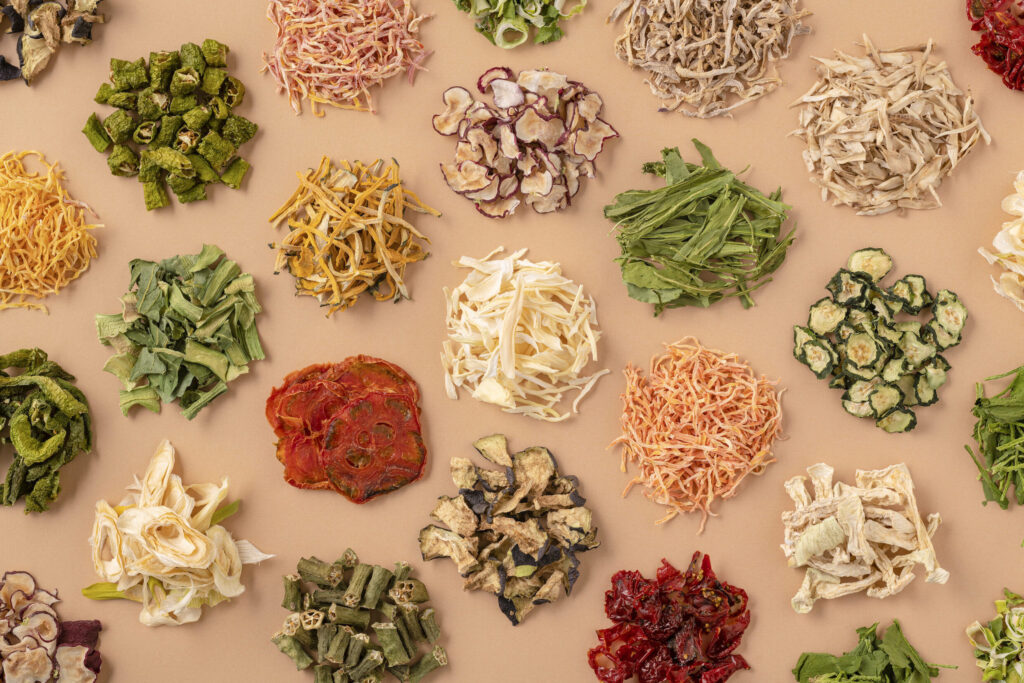
- Sold in small lots from 1 kg
- Handling heirloom vegetables from across Japan
- Dried fruits and herbs also supported
Features of commercial dried Benihoshi mizuna
Even among mizuna-type dried raw materials, Benihoshi mizuna is an ingredient holding a unique position on its reddish-purple color, crisp texture, and pop as a coloring ingredient. We organize its strengths as a leafy vegetable from six perspectives.
Anthocyanin-derived reddish-purple color
Benihoshi mizuna's reddish-purple color comes from the pigment anthocyanin, also contained in blueberries and red shiso. Unlike all-green ordinary mizuna, a deep accent works in the appearance of salads and colorful prepared dishes.
A mizuna-like crisp texture
The light bite that comes through the thin leaf stalks is mizuna's forte. It is finished so this texture can be made use of even when dried, adding a texture accent to salads, aemono, and toppings.
Pop as a salad and coloring ingredient
Just adding one reddish-purple item to a salad mix full of green leaves tightens up the coloring. With a dried product that can be stored at room temperature, you can incorporate Benihoshi mizuna's color into the finished product regardless of season or supply.
A gentle flavor with little off-flavor
Benihoshi mizuna has little of the off-flavor characteristic of mizuna, a light flavor easy to eat even raw. It suits recipe designs where you want to make use of the ingredient's color and texture — salads, light pickles, aemono, and the like.
Well suited to non-heated and lightly heated uses
Because the reddish-purple color changes readily with high-temperature heating, the color can be made use of in non-heated or lightly blanched uses — salads, light pickles, toppings. It can be used as a coloring raw material for product designs where you want to keep the color.
Use in combination with powder
Used together with finely milled Benihoshi mizuna powder (made-to-order), you can design recipes that balance the leafy texture (dried leaf) and coloring of dough and sauces (powder).
Product specifications (commercial)
Basic specifications at the prototype stage are as follows. Purchase lot, lead time, and packaging format are worked out through individual consultation.
| Item | Details |
|---|---|
| Product name | Dried Benihoshi Mizuna |
| Raw material | Benihoshi mizuna (domestically grown) |
| Shape | Cut. Length and size adjusted to match the application |
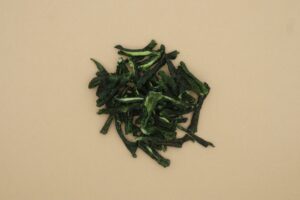
| Appearance | Dried mizuna leaves with a reddish-purple color |
| Aroma | The refreshing, greenish aroma characteristic of mizuna |
| Net content | Individual quote according to use and lot |
| Best-before date | About 6 months from the shipping date |
| Storage method | Avoid high temperature, high humidity, and direct sunlight; after opening, seal and store in a cool, dark place |
| Minimum prototype lot | From 1 kg of raw material |
Customization support
You can consult us from the prototype stage about shape, cut size, packaging, and final commercialization. Because we nail down the recipe while keeping records, it is a setup where specifications don't drift between prototype and mass production.
| Item | Available | Details |
|---|---|---|
| Shape adjustment | Cut length / flake | Design the length and size to match the appearance and texture of the finished product |
| Powdering | Fine powder (made to order) | For coloring confectionery, dough, and sauces, and for powder blending |
| Blend design | Composite with other leafy and other vegetables | Salad mixes and colorful mixes with green mizuna, leafy vegetables, and root vegetables |
| Packaging form | Commercial bulk / small bag / individual wrapping | Handled from prepared-dish bulk to topping packs |
| OEM productization | End-to-end support through the finished product | From planning through production of salad mixes, light-pickle bases, and veg-type products |
For those considering the fine-powder type
For applications where you want to spread Benihoshi mizuna's reddish-purple color uniformly — coloring dough, sauces, and beverages, and powder blending — the finely milled Benihoshi mizuna powder (made-to-order) is well suited. Please also see the list of powder raw materials.
Commitments to variety, grower, and growing region
Benihoshi mizuna is a mizuna variety of the Brassicaceae family, a leafy vegetable cherished as a "red mizuna" whose leaf stalks color reddish-purple. At Agriture, we make the growing region, harvest timing, and reddish-purple color development the axes of raw-material design.
BRAND|The positioning of Benihoshi mizuna raw material
The reddish-purple mizuna used as a leafy vegetable that adds color to salads, light pickles, aemono, toppings, and the like is Benihoshi. At Agriture, we distill this reddish-purple coloring and crisp texture into a commercial raw material, offering it as an ingredient usable across a wide range of finished products — salad products, prepared dishes, and veg-type products.
PRODUCER | Basic policy for sourcing and coordination
We select lots with uniform reddish-purple color development, leaf-stalk thickness, and freshness by aligning directly with the growing region. At the prototype stage, we take small quantities from multiple suppliers and, after evaluating on the color retention during drying and the ease of rehydration, we build the supply line for mass-production lots.
REGION|Features of the growing region
Mizuna is one of the Kyoto vegetables representative of Kyoto, and it is cultivated in various regions nationwide. Coloring varieties like Benihoshi develop color stably in environments with plenty of sunlight. At Agriture, centered on Kyoto-grown, we discern lots with color development and texture suited to drying and turn them into raw material.
CULTIVATION|Cultivation and reddish-purple color development
When Benihoshi is cultivated with wide plant spacing so that light reaches the leaf axis, the reddish-purple color rides stably. Because it is a variety whose color development tends to fade under insufficient light, high temperature, or excess moisture, at Agriture we select ones in a state where color and texture have ridden and turn them into raw material.
Low-temperature drying technology and quality control
Prompt drying after cutting
Because Benihoshi mizuna is a leafy vegetable, if time passes after cutting, the leaf tips wilt and the color tends to dull. By moving quickly from cutting to drying, it is finished under conditions that balance the reddish-purple color and crisp texture.
Retaining the reddish-purple color through low-temperature drying
High-temperature drying dulls the reddish-purple of anthocyanin and readily dissipates the greenish aroma. By removing moisture slowly at a low temperature range, it is finished so the reddish-purple color remains even when rehydrated. As an ingredient for salads and colorful prepared dishes, we aim for raw material that conveys the Benihoshi-mizuna character in appearance. When using it in a salad, drain the rehydrated leaves of water and plate them as-is to make use of the reddish-purple color. When using it in light pickles, rehydrating and then pickling lets the flavor soak in while the color remains.
Use cases
We organize the uses we are consulted about for prototyping at Agriture into six categories. All are examples of recipe designs that make use of Benihoshi mizuna's reddish-purple color and crisp texture.
1. Salads and salad mixes
Usable as a coloring raw material for salad, salad-mix, and baby-leaf-type products. Just adding one reddish-purple item to green leaves tightens up the coloring. Draining the rehydrated leaves of water and plating them lets you make use of the reddish-purple color and crisp texture. That it can be secured as room-temperature stock and is not easily affected by supply is also valued in commercial use.
2. Light pickles and pickles
Usable as a coloring raw material for light pickles, instant pickles, and senmai-zuke-style items. Non-heated pickling makes the reddish-purple color easy to retain, adding color to the appearance of pickles. Because it comes pre-prepped, it also leads to reduced labor in pickle manufacturing.
3. Aemono and side dishes
Usable as a colorful aemono or side dish — ohitashi, sesame aemono, namul, side salads, and the like. With heating only to the level of a light blanch, color loss is easy to suppress, letting you incorporate Benihoshi mizuna's reddish-purple color into the coloring of prepared dishes. It can also be developed into side-dish making for delis and ready-to-eat foods.
4. Topping and plating ingredient
Usable as a topping ingredient for donburi, noodles, soup, pasta, and the like. Just scattering it as a finish adds a reddish-purple accent and tightens up the look of the dish. Because it is a dried product, measuring and portioning are easy, and it can also be developed into small bags and individual packs for toppings.
5. Ready-to-eat, frozen foods, and prepared dishes
It can be built in as a coloring vegetable for salad packs, deli prepared dishes, and meal kits. It can be stably secured as room-temperature stock, and because it comes pre-prepped, it reduces the labor of the production line. It suits salad-type and side-dish-type products where you want to add color.
6. Veg-type products and coloring ingredients
Usable as a vegetable source or coloring ingredient for veg-type meals and salad-type products. Because Benihoshi mizuna has a reddish-purple color and a light texture, it suits as an accent in product designs where you want to bring out color and a veggie feel. Combined with powder, you can balance coloring and texture.
Commercial usage and rehydration
Rehydration basics
- For salad: rehydrate in cold water for 5–10 minutes, drain well, and plate
- For light pickles: rehydrating and then pickling lets the flavor soak in while the reddish-purple color remains
- For aemono: if lightly blanching, keeping it brief makes color loss easier to suppress
- For toppings: it can also be scattered as-is without rehydrating, for use as a finish
Blending guide
- Salad: 3–6 g dried rehydrated per 100 g finished
- Light pickles: 4–8 g dried rehydrated per 100 g finished
- Aemono: 3–5 g dried rehydrated per serving (60–80 g)
- Topping: scatter 1–2 g dried per serving as a guide
How to store
- Before opening: store in a cool, dark place at room temperature, away from heat, humidity, and direct sunlight
- After opening: transfer to a zip bag or airtight container and use up within 1 to 2 months
- The best-before date is about 6 months from the shipping date. Take care, as the reddish-purple color changes with light and moisture absorption
- Refrigerated storage is possible. Because condensation forms right after taking it out, return it to room temperature before opening
Related cases and articles
- Dried mizuna – green mizuna raw material
- List of dried vegetable raw materials
- List of powder raw materials
- Consult us on food OEM and raw material supply
Product catalog showing the items we handle
Flexible support from small lots to large lots
- Sold in small lots from 1 kg
- Handling heirloom vegetables from across Japan
- Dried fruits and herbs also supported
Frequently asked questions
What is the difference from ordinary green mizuna?
Benihoshi is a mizuna variety whose leaf stalks color reddish-purple, differing greatly in color from all-green ordinary mizuna. This reddish-purple color comes from a pigment called anthocyanin, usable for coloring in salads, light pickles, aemono, and the like. The flavor is mizuna's characteristic light quality, so you can use it by purpose with green dried mizuna, distinguished by color and application.
How much reddish-purple color remains?
By moving promptly from cutting to low-temperature drying, it is finished retaining the reddish-purple color. Even after rehydrating, you can confirm the reddish-purple color as coloring for salads, light pickles, and aemono. Because anthocyanin changes readily with high-temperature heating and prolonged storage or moisture absorption, care is needed for the finished product's heating conditions and storage design. It becomes easier to make use of the color in non-heated or lightly blanched uses.
Can it be used in salads?
This is one of the applications we are often consulted about. Rehydrated in cold water and drained well, it can be used as a coloring ingredient for salads and salad mixes. Because the reddish-purple color comes alive when non-heated, it suits uses where you plate it raw. Just adding one item to green leaves tightens up the whole salad's coloring.
How do you use it differently from Benihoshi mizuna powder?
Dried Benihoshi mizuna is for "applications where you want to keep the leaf's texture and color," and the powder is for "coloring dough, sauces, and beverages, and powder blending" — that is the division. Salad, light pickles, and aemono suit the dried product, and uniform coloring of dough and sauces suits the powder. Using both together enables recipe designs that balance texture and uniform coloring.
What is the minimum prototype lot?
Prototyping is accepted from 1 kg of raw material. You can prototype multiple conditions in parallel — comparing cut lengths, comparing salad-use and aemono-use specifications, and so on. Full production is from 10 kg~, and you can consult us including through to OEM finished-product formation. After hearing the specifications, lot, and schedule of your intended finished product, we propose a quote and delivery timeline individually.
Please tell me the best-before date and how to store it.
The best-before date is about 6 months from the shipping date. Store the unopened product away from high temperature, high humidity, and direct sunlight, in a cool, dark place at room temperature. Because Benihoshi mizuna's reddish-purple color changes readily with light and moisture absorption, after opening transfer it to a zip-top bag or light-blocking container and use it up within 1–2 months as a guide. Refrigerated storage is also possible, but take care of condensation just after taking it out, and return it to room temperature before opening.
Recommended reading
- Dried mizuna – green mizuna
- List of dried vegetables
- List of powders
- Consult us on food OEM and raw material supply
Download the product catalog
We will send the materials to your email address based on the information you provide.