Assembling domestically grown yakuzen ingredients: the difference between familiar vegetables and imported crude drugs

Summary of this article
Yakuzen ingredients are not limited to imported dried goods. A dried-vegetable maker that runs the yakuzen media "Yasai Yakuzen" explains how they differ from mainly imported ingredients such as jujube and goji berries, domestically available yakuzen ingredients like ginger, sansho, daikon, black soybeans, and Job's tears, and how to use and choose dried vegetables.
When people hear "yakuzen ingredients," many may picture imported dried goods bought at Chinese-grocery shops, like jujube and goji berries. But in fact, most yakuzen ingredients can be assembled from familiar domestic vegetables and dried goods. The image that "you can't start without ordering something special" raises the barrier to yakuzen more than it needs to.
This page organizes what kinds of domestic yakuzen ingredients exist, how they differ from mainly imported ingredients, and how to choose when assembling them domestically. From the standpoint of a group that runs the yakuzen media "Yasai Yakuzen" and handles Kyoto-grown dried vegetables, we share a perspective on starting yakuzen with familiar domestic ingredients. Note that this article introduces the traditional ideas of Eastern medicine and does not guarantee the treatment or prevention of any specific illness.
TOC
What are domestic yakuzen ingredients? Mainly familiar vegetables
The first thing to grasp is that yakuzen ingredients are not necessarily special imported goods. In Eastern medicine's way of thinking, each ingredient is said to have its own nature, and from that perspective, many of the domestic vegetables we use every day count as yakuzen ingredients.
Yakuzen ingredients are not necessarily special imports
Yakuzen ingredients split into two by acquisition route: imported dried goods you seek out at specialty shops or by mail order, like jujube and goji berries, and domestic vegetables available at supermarkets, like ginger and daikon. You can start yakuzen without ordering the former. That's because yakuzen refers to the very idea of "choosing ingredients to match the body's condition and the season," so the essence lies less in what you use than in how you choose. Even without imported dried goods on hand, yakuzen can be built with domestic ingredients.
Many of the supermarket's domestic vegetables are yakuzen ingredients
Ginger, daikon, negi, shiso, sansho, and other domestic vegetables lined up at supermarkets are said to have the shiki-gomi (a classification of natures and tastes such as warming or cooling the body) referred to in Eastern medicine. In other words, the ingredients you use in everyday cooking are, from a yakuzen perspective, already yakuzen ingredients. Using domestic vegetables keeps the growing region close and makes it easier to keep up in terms of availability, too.
Domestic dried goods, grains, and teas are also yakuzen ingredients
Not just vegetables—domestic dried goods and grains can also be used as yakuzen ingredients. Black soybeans, Job's tears, dried vegetables, and domestic herbs and teas are ingredients that can be worked into a yakuzen context. Yakuzen tea, too, can be made by combining domestic materials without using imported crude drugs. Looking across familiar domestic ingredients, there are more that can be used for yakuzen than you might expect.
FOR BUSINESS
乾燥野菜を業務用でお探しですか
国産の野菜・果物を乾燥し、必要に応じて粉砕してお出ししています。扱っている品目は100種前後で、規格は 乾燥品の一覧・パウダーの一覧 に掲載しています。
少量でのご購入は、姉妹ブランドの通販サイト OYAOYA で承っています。
Often-imported yakuzen ingredients and domestically available ones
Among yakuzen ingredients, some rely often on imports and some are easy to assemble domestically. Knowing this difference lets you build a domestic-centered yakuzen without strain.
Jujube, goji berries, longan, and Korean ginseng are mainly imported
Known as yakuzen staples, jujube (natsume), goji berries, longan, Korean ginseng, and the like are, for most of what circulates domestically, imports from China or Korea. Kampo-derived ingredients have a background of having originally come from Chinese yakuzen, and many did not spread much in domestic cultivation. Jujube and goji berries are increasingly sold bagged as dried fruit, and at specialty shops and stores handling organic ingredients, these imported yakuzen ingredients are widely stocked. That they can be eaten as-is or used in teas and stews—their broad range of uses—is characteristic of staple ingredients.
There are moves toward domestic cultivation, too
Though mainly imported, there are moves toward domestic production as well. Jujube, for example, has farms working on domestic cultivation in places like Fukui Prefecture, and domestic jujube is gradually coming into circulation. Compared with imports the volume is limited, but for those who want to choose yakuzen ingredients with a clear growing region, such efforts are a reassuring option. There are also specialty shops touting domestic pesticide-free or organic goods.
The idea of substituting familiar domestic ingredients
There is also the idea of substituting domestic ingredients with similar natures rather than assembling imported yakuzen ingredients. For an ingredient said to warm the body, ginger or sansho can stand in; for an ingredient said to relate to moisture, there are domestically available options such as lotus root and white kikurage. Rather than bracing yourself with "you can't start without the standard yakuzen ingredients," choose something with a similar role from the domestic ingredients on hand. This is the entry point to domestic yakuzen. We have organized mainly imported ingredients and domestically available ones in a table.
| Type | Representative ingredients | Ease of tracing the growing region | Main uses |
|---|---|---|---|
| Mainly imported | Jujube, goji berries, longan, Korean ginseng | Mostly imported (some domestic available) | Yakuzen tea, stews, soups |
| Domestically available | Ginger, sansho, shiso, daikon, black soybeans, Job's tears | Domestic is easy to obtain | Everyday cooking, soups, dried goods |
A list of domestically available yakuzen ingredients
We have compiled domestically available yakuzen ingredients along with their traditional natures in Eastern medicine (shiki-gomi). There are various views on the classification of natures. This is not a guarantee of efficacy; please see it as a guide for choosing ingredients.
| Ingredient | Four natures (attributed property) | Five flavors | Easy-to-use dishes |
|---|---|---|---|
| Ginger | Warm | Pungent | Soups, simmered dishes, condiments |
| Sansho | Warm | Pungent | Condiment, tsukudani |
| Shiso | Warm | Pungent | Condiment, ae-mono |
| Daikon | Cool | Sweet and pungent | Simmered dishes, grated daikon |
| Black soybeans | Neutral | Sweet | Simmered beans, tea |
| Job's tears | Cool | Sweet | Soup, tea |
Domestic ingredients considered warming in nature
Ginger, sansho, shiso, and the like are domestic ingredients considered "warming" in nature in Eastern medicine. All can be tried in small amounts as condiments—an advantage—and they are easy to work into cooking: ginger grated into miso soup or hot pot, sansho in tsukudani or as a finishing sprinkle, shiso chopped into ae-mono. In the cold season, such ingredients considered warming are chosen. Ginger keeps its aroma even dried, and can be stored as a dried good at room temperature to add to soups. Sansho and shiso are also easy to grow in a home garden, ingredients well suited to keeping domestic.
Domestic ingredients considered cooling or neutral in nature
Daikon and Job's tears are considered "cooling," and black soybeans a less-biased "neutral," among domestic ingredients. In the hot season, ingredients considered cooling are chosen, and daikon suits being used raw as oroshi or in simmered dishes. Job's tears and black soybeans, meanwhile, keep long at room temperature as dried goods, so you can put a handful in soup or roast them for tea—stockable regardless of season. Combining vegetables used fresh with grains stockable as dried goods makes it easier to keep domestic yakuzen ingredients on hand year-round.
Choose using shiki-gomi as a guide
When using domestic ingredients in yakuzen, shiki-gomi makes them easier to choose. The idea is to combine warming and cooling ingredients to match the season and your condition. The basics of shiki-gomi are the page explaining what yakuzen is also organizes them, so please see it as well.
Easy yakuzen with domestic dried vegetables
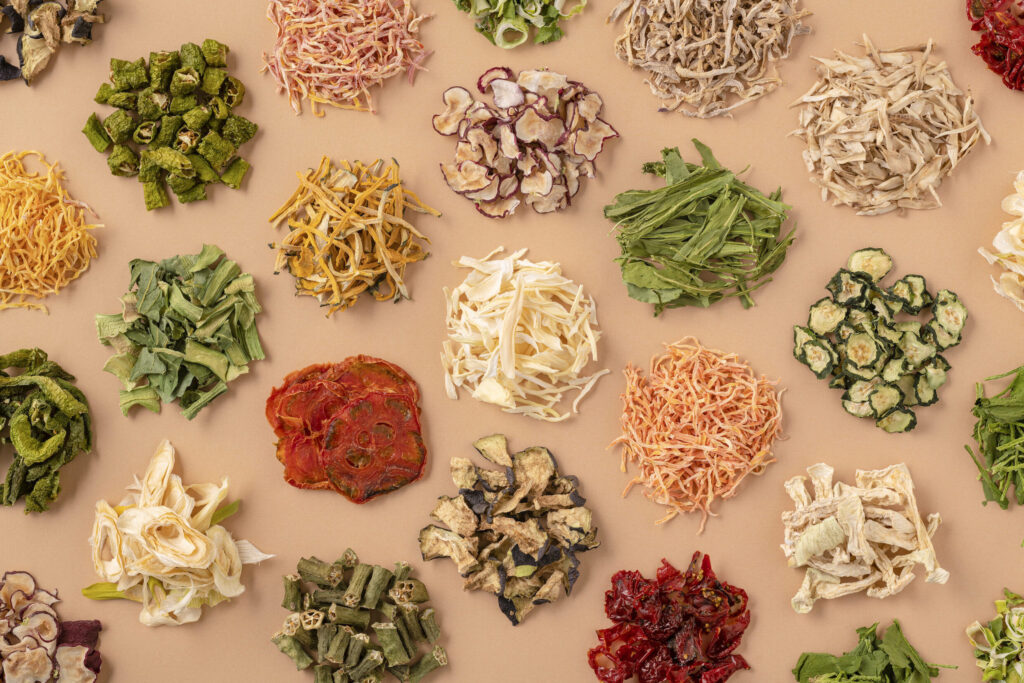
If you keep up domestic yakuzen, dried vegetables are dependable. They keep better than fresh vegetables and can be used a little at a time when needed, making them easy to work into daily life without strain.
Benefits of dried vegetables
Dried vegetables keep long, need little prep, and let you take out just the amount you want to use—those are their advantages. Powdered vegetables blend easily into dishes and suit taking in domestic ingredients casually. Drying seasonal domestic vegetables lets you use them as yakuzen ingredients regardless of the season.
Just add to soups, hot pots, and simmered dishes
Using them is simple—just add dried vegetables to soups, hot pots, or simmered dishes. As dried goods rehydrate slowly, they also transfer flavor to the broth, so they go well with soup dishes and suit making a yakuzen dish with domestic ingredients. Dried Ginger Adding just a little of a warming-in-nature ingredient like
to a soup dish makes it a dish that incorporates yakuzen thinking.
A brand that handles domestic dried vegetables OYAOYA The group's D2C brand "
" handles dried vegetables made by slowly drying Kyoto-grown vegetables at low temperature. Its uses in a yakuzen context are shared together with the yakuzen media "Yasai Yakuzen." It is one familiar option when you want to choose yakuzen ingredients with a commitment to domestic.
Points to keep in mind when choosing domestic yakuzen ingredients
When choosing domestic yakuzen ingredients, knowing a few ways of looking makes it easier to choose what suits you.
Check the growing-region labeling
When you want to choose domestic, first check the growing-region labeling. Because many yakuzen ingredients are imported, seeing whether it says "domestic" or "made in Japan," and in which region it was made, lets you choose ones whose growing region is easy to trace. For dried vegetables and dried goods, whether the raw material's growing region is labeled is also a guide to check.
How to read additive-free and organic labeling
Among shops handling yakuzen ingredients, some carry products touting additive-free or organic. Such labeling is a reference when choosing, but the labeling standards differ by product. If you have concerns, checking the raw-material and manufacturing labeling as well makes it easier to choose one that matches your own standard.
Choose to match the use
The ingredients you choose change depending on whether you'll use them in everyday cooking or enjoy them as tea. For cooking use, domestic vegetables and dried vegetables are easy to use; to enjoy as tea, black soybeans, Job's tears, and domestic herbs suit. Choosing after picturing the use makes it easier to use them up and to keep up domestic yakuzen without strain.
Putting domestic yakuzen materials to use in product development (for businesses) the explanation of yakuzen tea OEM From here on is a discussion for businesses developing food products. As health-consciousness rises and interest in domestic yakuzen ingredients spreads, product-making that makes the most of ease of tracing the growing region becomes a differentiation point. The health awareness of wanting to face one's body through daily meals pairs well with the theme of domestic yakuzen and can serve as the axis of a product concept. Using domestic dried vegetables, powders, grains, and herbs, you can develop products with yakuzen as a concept from small lots. The forms are varied, too—yakuzen tea, yakuzen dashi, yakuzen soup base, and more. Since yakuzen takes a food-product standpoint and efficacy cannot be asserted, product design can be built around domestic raw materials and seasonality as its concept. For making yakuzen tea, see the explanation of yakuzen food OEM, and for food products in general such as dashi, furikake, and powders, please also see. For where to draw the line between yakuzen and Kampo, see.
A product catalog that shows around 100 items we handle
Agriture, flexibly handling everything from small lots to large lots
- Available for purchase in small lots from 1 kg
- We handle heirloom vegetables from across Japan
- Dried fruit and herbs also supported
FOR BUSINESS
乾燥野菜を業務用でお探しですか
国産の野菜・果物を乾燥し、必要に応じて粉砕してお出ししています。扱っている品目は100種前後で、規格は 乾燥品の一覧・パウダーの一覧 に掲載しています。
少量でのご購入は、姉妹ブランドの通販サイト OYAOYA で承っています。
Frequently asked questions
Download the product catalog
We will send the materials to your email address based on the information you provide.
They can. Dried vegetables keep well and can be used casually as domestic yakuzen ingredients—just add them to soups, hot pots, or simmered dishes. The powder type blends easily into dishes and is an easy form to work into daily life.
Summary: Start yakuzen with familiar domestic ingredients
Yakuzen ingredients are not limited to imported dried goods. There are many familiar, domestically available ingredients—ginger, sansho, shiso, daikon, black soybeans, Job's tears, and more. Staples like jujube and goji berries are mainly imported, but knowing the idea of substituting domestic ingredients with similar natures lets you start domestic-centered yakuzen without strain. Yasai Yakuzen The points when choosing are to check the growing-region labeling and choose ingredients to match the use. Using domestic dried vegetables keeps well and lets you work them into everyday cooking casually. The group's yakuzen media "