
Office snack adoption guide | A comparison of pricing and selection across 8 stocking-service providers

"We want to put snacks in the office, but there are so many services that we don't know which one to choose."
We've had more consultations like this from general-affairs staff. As the shift from remote work back to the office progresses, more companies are working to enhance their office environments. Among these, "placed snacks" are drawing attention because they have a low adoption hurdle and deliver quick results for employee satisfaction.
This article compares eight major placed services on price, product range, and service content, and organizes the criteria for adoption. Note that placed services fall into three types: "snack/confectionery-centered," "light-meal/bread-based," and "salad/vegetable/deli-side (meal-replacement)." This article compares them all across the shared operating format of "placed service," but the service you should choose changes greatly depending on whether your company's need is "snacking" or "lunch replacement," so we organize them with that perspective in mind as well.
- Differences in the pricing structures and product ranges of the eight major providers
- Recommended services by company size
- The concrete flow from adoption to operation
- Expense-processing methods and tax-related points to note
- Tips for choosing snacks from a health-management perspective
TOC
What is an office snack service? Why adoption is surging
The basic mechanism of placed-snack services
An office snack service is a service in which a dedicated box or shelf is installed in the office and snacks and beverages are delivered on a regular basis. Employees can choose and eat what they like on the spot.
The mechanisms broadly divide into two.
| Type | Mechanism | Cost burden |
|---|---|---|
| Company-funded type | The company pays a monthly fee, and employees use it for free | The company bears the full cost |
| Employee-funded type (in-office convenience store) | Dedicated fixtures are installed, and employees purchase cashlessly | Employees bear the cost of their purchases |
Recently, the company-funded type is the mainstream. Because it can start from a few thousand yen per month, it is rated as a highly cost-effective measure among employee benefits.
Three reasons adoption is increasing
1. The trend of returning to the office
As more companies bring employees back to office work from pandemic-era remote work, "creating an office people want to come to" has become a management issue. Keeping snacks on hand is one easy solution.
2. Responding to health management
Because "improving the food environment" is included in the certification criteria for the Certified Health & Productivity Management Outstanding Organizations program, offering healthy snacks becomes an evaluation point. Choosing nutritionally excellent snacks such as nuts, dried fruit, and dried vegetable chips can achieve a double effect.
3. Promoting communication
The effect of a snack corner naturally sparking conversation should not be overlooked. Casual chats that cross departments arise more easily, and some companies use it as a supporting tool for team building.
Satisfaction data from adopting companies
According to a survey of companies that adopted office snacks, employee satisfaction rose by an average of 12 points. In particular, about 70% of employees responded that "their sense of belonging to the company increased." Frankly, if you get this much effect from an investment of around 10,000 yen per month, the cost performance is quite good.
A thorough comparison of eight placed-snack services
A list of each provider's price, product range, and features
Below we compared the services of the eight major providers.
| Service name | Type | Monthly fee (tax included) | Number of items | Minimum number of users | Features |
|---|---|---|---|---|---|
| Office Glico | Snack type | Free installation (employee-purchase type) | About 120 varieties | 50 or more | No. 1 in name recognition, centered on Glico products |
| snaq.me office | Snack type | From 27,500 yen | About 100 varieties | 10 or more | Strength in additive-free, natural products |
| OFFICE DE YASAI | Meal / vegetable type | Inquire | About 60 varieties | 15 or more | Centered on salads and cut fruit (refrigeration required) |
| Okashi no March | Snack type | From 3,278 yen | About 40 varieties | No limit | Low price, ideal for small companies |
| Snack Me Box | Snack type | From 11,000 yen | About 50 varieties | 5 or more | A selection of craft confectionery |
| TukTuk | Snack / light-meal type | Free installation (employee-purchase type) | About 200 varieties | 30 or more | Rich product range, payment terminal installed |
| Pan for You Office | Light-meal type (bread) | From 8,800 yen | About 30 varieties | 10 or more | A unique approach specializing in frozen bread |
| Minna no Shokudo | Meal type (deli sides) | From 16,500 yen | About 80 varieties | 20 or more | Also covers deli sides and bento |
Looking at the type column, the breakdown is five providers in the pure "snack type" and three in the "light-meal/meal type." The provider you choose changes greatly depending on whether you "want to take a breather with a snack" or "want to use it in place of lunch."
*Prices vary by plan and delivery frequency. Please check each provider's official website for the latest information.
These three providers to choose for a health-conscious approach
If you are mindful of health management, you'll want to be particular about the nutritional side of your snacks as well.
snaq.me office specializes in "additive-free snacks" that use no artificial sweeteners, synthetic coloring agents, or preservatives. Because you receive rustic sweets that feel like something you'd find at a marché, they are especially popular with health-conscious employees.
OFFICE DE YASAI is, strictly speaking, not a snack service but a "meal/vegetable-type" service centered on salads and cut fruit; because the placed operating format is shared, we introduce it as a representative service often compared under the health-conscious lens. Fresh salads, cut fruit, and deli sides are delivered chilled, so it is a type that many employees use in place of lunch. It requires a refrigerator installation space, a power source, and best-before-date management, so the operating burden is somewhat heavy.
And another option is a lineup centered on dried vegetables. Agriture Inc., a member of the Kai Group, began full-scale service in April 2026 with Office Yaoya (office greengrocer), a design in which individually packaged dried vegetables—100% domestically grown, with no sugar or additives, and low-temperature dried to concentrate umami and nutrients—can be added directly to cup noodles or miso soup. Because it upcycles out-of-spec vegetables that are misshapen and cannot reach the market, buying them from producers at a fair price, it achieves both health management and food loss reduction in a single service. It keeps for three months or more at room temperature and needs no refrigerator, making it a feature that even small offices can adopt with ease.
These three providers to choose when prioritizing cost
For companies that "want to try it on a small budget first," the following three providers are recommended.
| Service name | Monthly guideline (20-person scale) | Monthly cost per person | Features |
|---|---|---|---|
| Okashi no March | About 3,300 yen | About 165 yen | Lowest-price class, suited for small scale |
| Office Glico | 0 yen (employee-purchase type) | 0 yen (no company burden) | Can start with zero company cost |
| Snack Me Box | About 11,000 yen | About 550 yen | Mid-price range with good balance |
Office Glico involves zero cost on the company side, making it ideal for "just placing it and seeing how it goes." However, because it is a format where employees pay out of pocket, its impact as an employee benefit is somewhat thin.
Choosing a service for large companies
For companies with 100 or more employees, the following points become important.
- Support for multiple locations: whether it can be deployed to branches, not just the head office
- Payment system: whether it supports cashless payment
- Provision of usage data: whether reports on usage status are available (usable for measuring the effect of health management)
- Customizability: whether allergy accommodation and product-swap requests are possible
The three providers meeting these conditions are Office Glico, TukTuk, and OFFICE DE YASAI. TukTuk in particular handles everything from payment terminal installation to data analysis in one integrated flow and has abundant adoption results at large companies.
Learn about Office Yaoya
We have prepared materials
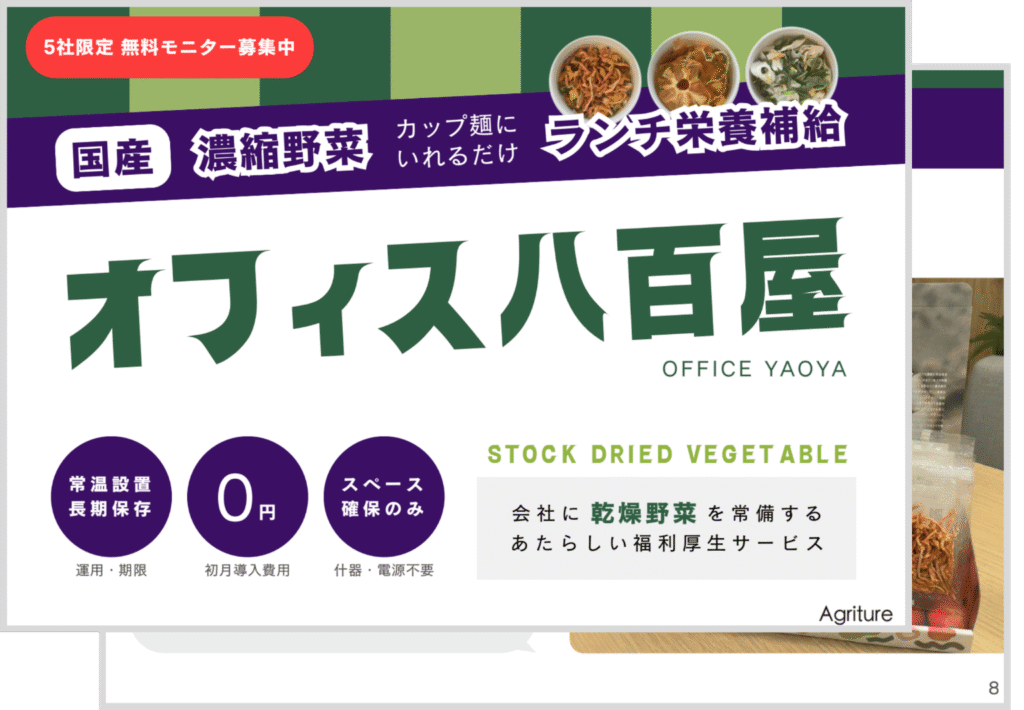
- Service details and vegetable lineup
- Pricing and plans
- How adoption and operation work
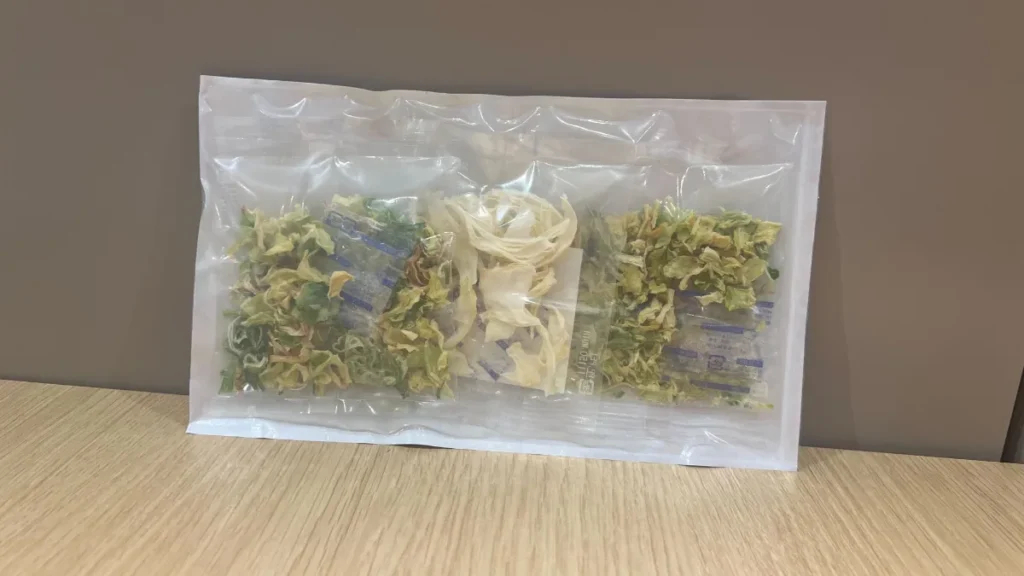
Sample sets are also available. Download the materials for details!
We offer sample sets so you can try Office Yaoya in small quantities. See the materials for details.
Concrete adoption steps and preparation
Step 1: Grasping internal needs
Before adoption, take a simple survey of employees. The items to confirm are as follows.
- Whether they want to use a snack service (intent to use)
- What kinds of snacks they'd be happy with (sweet, salty, healthy, etc.)
- Whether they have allergies
- What time slots they'd like to use it (10 a.m., 3 p.m., during overtime, etc.)
Taking the survey itself sends the message that "the company listens to employees' voices." Even if the response rate is low, showing the posture of listening has meaning.
Step 2: Comparing services and tasting
Once you've narrowed the candidates to two or three, request tasting samples. Many services offer free tasting sets.
The check points when tasting are as follows.
| Check item | Details to confirm |
|---|---|
| Taste | Have 5–10 employees taste it and collect their impressions |
| Best-before date | Whether it can be stored at room temperature and how long it keeps |
| Individual packaging | Whether it is individually packaged for hygiene |
| Nutrition labeling | Whether calories and allergy information are clearly stated |
| Delivery frequency | Once a week or twice a month—whether it fits your own pace |
Step 3: Securing an installation location and setting operating rules
The iron rule for the installation location is "a place people naturally pass by." Near the break room entrance, next to the coffee machine, or near the copier are recommended.
The minimum operating rules to decide are as follows.
- Daily usage limit (2–3 items per person is common)
- Whether taking items home is allowed (basically, in-office use only is common)
- The person in charge of restocking and its timing
- The response flow in the event of an allergy incident
Step 4: Collecting feedback after adoption
One month after adoption, conduct a simple satisfaction survey. By asking "which snacks are popular" and "what would you like improved," you can advance optimization of the service.
If you accumulate data on popular and unpopular products, you can adjust the lineup on your next order. This "record of improvement" can also be used directly to measure the effect for the Health & Productivity Management Survey.
Expense processing and tax-related points to note
Conditions for recording it as a welfare benefit expense
To process office-snack costs as a welfare benefit expense, the following conditions must be met.
| Condition | Details |
|---|---|
| All employees eligible | Do not limit it to specific departments or positions |
| A socially reasonable amount | A guideline of 3,500 yen or less per person per month |
| Consumed on-site | The premise is eating in the office rather than taking items home |
| Keeping records | Keep delivery slips and invoices, and track the number of users |
If the monthly amount per person exceeds 3,500 yen, it may be treated as "salary," so caution is needed. A service costing around 30,000 yen per month at a 20-person scale can be processed as a welfare benefit expense without problems.
Handling of consumption tax
The cost of purchasing office snacks is subject to the reduced tax rate (8%) as a food purchase. However, if the monthly service fee includes delivery charges or service fees, those portions may fall under the standard tax rate (10%). Check the itemized breakdown on the invoice.
Responding to the invoice system
Confirm that the service provider is a registered invoice-issuing business. Nearly all major office-snack services are already invoice-compliant, but confirmation is needed if you use a small-scale regional service.
An office-snack strategy considered from a health-management perspective
Breaking away from "vaguely placing sweets"
If you are mindful of health management, be particular about the contents of the snacks too. A product mix like the following is recommended.
| Category | Product example | Expected effect |
|---|---|---|
| Nuts | Almonds, walnuts, cashews | Good-quality fats, sustained concentration |
| Dried fruit | Mango, cranberry, raisins | Vitamin and mineral replenishment |
| Dried vegetable chips | Carrot, lotus root, burdock | Dietary fiber, addressing vegetable shortfall |
| High-cacao chocolate | Chocolate with 70% or more cacao | Polyphenols, a relaxing effect |
| Granola bars | Whole-grain-based bars | Filling, giving satisfaction between meals |
Agriture's dried vegetable chips are made by additive-free processing of out-of-spec vegetables sourced from Kyoto farmers. Because you feel that you are "eating vegetables," they also function as a tool for raising health awareness.
The choice of snack becomes data
Place healthy snacks and ordinary snacks side by side and record which are chosen and how often. This alone gives you data on "the trend in employees' health awareness." This data can be used to measure the effect for the Health & Productivity Management Survey and can also be used to improve the measures.
Snacks as a trigger for food education
Alongside offering snacks, distributing a monthly "snack trivia" note internally is also effective. Simply adding information like "the walnuts in this month's snack are rich in omega-3 fatty acids" naturally raises interest in food.
FAQ
Learn about Office Yaoya
We have prepared materials
- Service details and vegetable lineup
- Pricing and plans
- How adoption and operation work
Sample sets are also available. Download the materials for details!
We offer sample sets so you can try Office Yaoya in small quantities. See the materials for details.
Summary
Placed office-snack services are extremely strong as an employee-benefit measure that can start at low cost.
To reorganize the points for choosing one, they are as follows.
| Point to prioritize | Recommended service |
|---|---|
| Health-conscious (snack type) | snaq.me office, Office Yaoya (dried vegetables) |
| Meal / vegetable replacement | OFFICE DE YASAI, Minna no Shokudo |
| Low cost | Okashi no March, Office Glico |
| Rich product range | TukTuk, Office Glico |
| Support for large companies | Office Glico, TukTuk, OFFICE DE YASAI |
| Small companies | Okashi no March, Snack Me Box, Office Yaoya |
If you are mindful of health management, combining nutritionally rich snacks such as nuts, dried fruit, and dried vegetable chips also leads to a higher evaluation in the Health & Productivity Management Survey.
Start by requesting tasting samples from two or three providers and seeing how employees react. If you want to try the dried-vegetable type, Office Yaoya (office greengrocer), and for a placed-snack comparison, A thorough comparison of office placed-snack services, and for details on healthy snacks, 16 healthy snacks popular in the office—checking these together will help you find the combination that fits your company's needs perfectly.
Download the office dried vegetable materials
We will send the materials to your email address based on the information you provide.
Recommended reading
Placed staff meals, chilled vs. room-temperature | 5 differences and how to choose / Solving the office vegetable shortfall | How to choose a placed dried-vegetable service / Sustainable initiatives / Commercial dried vegetables / Product lineup / The Sustainable Food Future Agriture Aims For / Why kale has high nutritional value | Its components and health effects explained scientifically
- Food Questions in the Health and Productivity Management Survey: What to Write to Score Points
- Why the "dietary environment" influences the score in employee satisfaction surveys
Author of this article
Related articles
-
 [2026 edition] What is a meal subsidy as an employee benefit? A guide to adoption steps and a comparison of popular services
 -
[2026 edition] Meal-subsidy benefits usable at convenience stores | 3 ways to adopt them tax-free
-
[2026 edition] 6 disadvantages of placed staff meals and how to avoid them | An adoption checklist to avoid failure
-
 A Must-See for HR: 12 Measures to Raise Employee Satisfaction Through Benefits
 -
 Food Questions in the Health and Productivity Management Survey: What to Write to Score Points
 -
Summary of tax benefits for dining subsidies | Tax-exemption requirements and expense booking
-
Food Programs for Health and Productivity Management: How Much Will It Actually Cost for a Company Our Size?
-
Meal-benefit plans that even small offices of 10 or fewer people can start