Dried mugwort

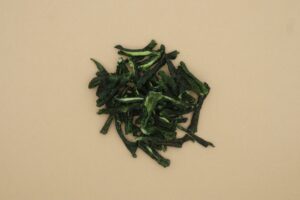
Mugwort (yomogi) is a fragrant herb long rooted in Japanese food culture, used widely in wagashi, yakuzen, and health teas. Our dried mugwort is domestically grown mugwort dried at low temperature, sealing in its deep green color and aroma. It is ideal for making products that draw on aroma and color, such as kusa-mochi and dango, bath additives, and herbal teas. Milled into powder, it can also be used as a raw material for baked goods and smoothies.
Three commitments behind our dried mugwort
Agriture's dried mugwort is thoroughly engineered for quality so it can be adopted as a commercial raw material. Here we introduce three points we consider particular strengths.
01 Made with domestic, Mie-grown mugwort
We select and process domestic mugwort, which has a strong aroma and color even among wild herbs. By carrying out primary processing right after harvest at contract growing regions centered on Mie Prefecture, we firmly retain the fresh-grass aroma and vivid green.
02 Low-temperature hot-air drying that protects color and aroma
Because drying at high temperature breaks down the chlorophyll unique to mugwort and causes fading, we use low-temperature drying with restrained temperature and airflow. The result balances a deep green color with a fresh, grassy aroma.
03 Versatility spanning wagashi, yakuzen, and body care
Processed as a clean-label raw material with no additives or glucose, it is easy to use across a wide range of OEM settings, from wagashi ingredients and health teas to yakuzen products and bath amenities.
Product catalog showing the items we handle
Flexible support from small lots to large lots
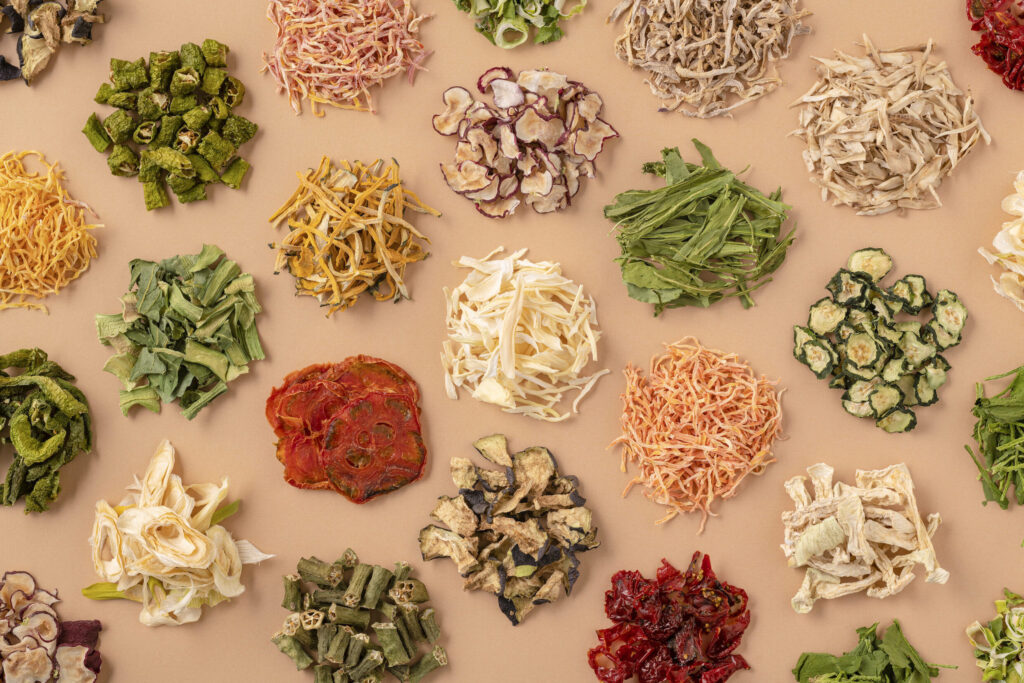
- Sold in small lots from 1 kg
- Handling heirloom vegetables from across Japan
- Dried fruits and herbs also supported
TOC
Characteristics as a commercial raw material
Here we summarize the advantages of choosing dried mugwort as an OEM raw material from six angles. Use it as a reference both for replacing existing ingredients and for developing new products.
A deep-green, visually appealing ingredient
Kneaded into kusa-mochi, dango, or doughs, its vivid color creates a look that sets products apart from competitors.
The natural aroma and bitterness of fresh grass
Because it brings a "wild-herb aroma" that is hard to achieve with synthetic flavorings, it is ideal for products with a natural appeal.
Wide-ranging applications once milled into powder
Turned into powder, it can be developed into diverse product formats such as smoothies, aojiru, baked goods, and lattes.
Plan operations around long-term storage
A 6-month best-before date at room temperature. Since short-season mugwort can be supplied year-round, inventory planning becomes easier.
Additive- and glucose-free
Because it keeps the ingredient list simple, it is easy to adopt even for natural and organic brands.
One-stop from prototype to volume production
We handle everything from small-lot prototyping (from 500g) to full production of 10kg or more. Recipe adjustments can also be carried through end to end on our own line in Kyoto.
Product specifications (commercial)
The product's basic specs are as follows. Cut specifications and packaging specs can be individually adjusted on a contract basis, so please consult us to match your OEM requirements. We have organized raw-material origin, best-before date, production method, and minimum lot so they can be checked at a glance.
Item | Details |
|---|---|
Raw material | Mugwort (domestic, Mie-grown) |
Net content | 2kg bag / 5kg box (commercial units) |
Production method | Low-temperature hot-air drying |
Best-before date | About 6 months from production |
Annual supply volume | About 10kg (varies by season) |
Processing plant | Factory in Kyoto Prefecture |
Shipping unit | 100g~ |
Minimum-lot OEM | Prototype from 1kg / full production from 10kg |
Customization support
For each OEM project, we respond flexibly to changes in cut shape, powdering, small-lot prototyping, blending, and packaging specs. In addition to the response table below, please consult us about individual adjustments to match your requirements.
Item | Available | Details |
|---|---|---|
Size change | ◎ | Milling available |
Powdering | ◎ | Fine-powder processing available |
Small-lot OEM prototyping | ◎ | Available from 500g |
Mixed materials and blends | ◎ | Blending with other raw materials available |
Packaging changes | ◎ | Both commercial and individual packaging available |
POWDER
We also offer powder products
Agriture also handles powder processing of dried mugwort. You can check pairings with other ingredients and processing examples in our vegetable powder lineup.
Variety, grower, and origin information
Agriture stabilizes quality by sourcing dried mugwort from partner farms and contract growing regions. Please refer to this as well when you want to use origin information at the product planning stage.
BRAND
Variety: We select domestic mugwort, centered on Mie-grown, based on the intensity of aroma and color.
PRODUCER
Producer: We work with growers in contract regions centered on Mie Prefecture, sending the crop on to primary processing while judging the optimal harvest timing.
REGION
Growing region: Domestic regions centered on Mie Prefecture. By targeting young leaves in mountainous areas for harvest, we secure aroma and tenderness.
CULTIVATION
Cultivation method: Gathered from wild habitats and cultivated by partner farms. We are rigorous about raw material selection.
Low-temperature drying to protect the ingredient's natural flavor
To protect the aroma, color, and umami of mugwort, Agriture uses low-temperature hot-air drying with finely controlled temperature and airflow. Our strength is retaining components easily lost in high-temperature drying, through process design tailored to the nature of the ingredient.
Because we take in the raw material at our own processing facility in Kyoto and manage the whole flow in one place—sorting, cutting, drying, and inspection—we can hold quality variation between lots to a minimum. Combining procurement from partner farmers and contracted regions, we can start the drying process while the raw material is still fresh, which ties directly to finished quality.
💡 TIPS | Drying-processing trivia
Both the aromatic compounds and the green pigment (chlorophyll) in mugwort are heat-sensitive and easily lost through blanching or high-temperature drying. That is why Agriture uses low-temperature hot-air drying with finely controlled temperature and airflow, designed to drive off only moisture while retaining color and aroma.
Commercial use cases
Because dried mugwort has ample aroma, texture, and umami on its own, a single ingredient can be developed into multi-purpose products. Here we introduce five representative use cases.
Tea and herbal-tea raw material
This is a use gaining adoption among beverage and health food makers producing tea-bag products, and among EC brands offering Japanese herb blends. With fresh mugwort, oxidation after harvest and seasonal quality variation become barriers to stable supply, but the dried product can be stored year-round at room temperature and is easier to adjust by lot. Because its gentle aroma does not overpower other ingredients, it is easy to use as a blending ingredient in yakuzen teas, wild-herb blends, and Japanese herbal teas, and can be incorporated into a brand's own original formulations.
Bath & body care raw material
This is a raw-material use aimed at OEM makers and EC brands offering body-care lines such as bath salts, bath additives, and yomogi-steam packs. Fresh mugwort is hard to source year-round due to seasonal variation and discoloration risk, and inventory management is burdensome, but the dried product allows stable storage and consistent batching at room temperature, contributing to leveling out production lots. Because it uses food-grade raw material, it can also be used for the ingredient appeal of sensitive-skin and natural brands.
Regional specialties & OEM products
It is increasingly adopted for OEM production of regional souvenirs and local sweets, and as a differentiating ingredient for health food brands. Fresh mugwort discolors quickly after harvest and is hard to supply stably outside its growing region, but dried mugwort can be stored long-term at room temperature and sourced year-round, supporting stable lot production regardless of season. Since you can select the form to suit the application, whether powder, cut, or whole, it can be used in a wide range of product designs, from mochi confections and baked goods to aojiru-type supplements and functional foods.
Commercial usage and case examples
For commercial use, we handle everything from 500g prototype lots to full production of 10kg or more. It is adopted as an OEM raw material by wagashi makers, tea makers, and health food makers, and also as a main ingredient for regional specialty brands.
At Agriture, we provide end-to-end support on our own line in Kyoto, from raw-material selection and primary processing to cutting, powdering, blending, and small-portion packaging. Because we can adjust specifications to match an OEM client's spec sheet and design recipes for launching new brands, you can entrust everything with confidence from the prototype stage through volume production and ongoing supply.
We welcome first-time inquiries and considerations of switching from existing raw materials. For sample provision, quotes, and technical questions about the production process, feel free to reach out via the inquiry form.
Related case examples and reference articles:
- What is behind the rising demand for mugwort? Market trends and the potential for use
- What are the uses of fine mugwort powder? Applications across food, beauty, and health
- A Guide to Selecting Superfood Raw Materials: Points to Master in Product Development
Product catalog showing the items we handle
Flexible support from small lots to large lots
- Sold in small lots from 1 kg
- Handling heirloom vegetables from across Japan
- Dried fruits and herbs also supported
Frequently asked questions (OEM & commercial dried mugwort)
We have compiled the questions we most often receive about OEM and commercial dried mugwort. Please use it as a reference for your decision before contracting.
Q. About what are the minimum lot and unit price?
A. Prototyping starts from 500g, and full production from 10kg as a guide. The unit price varies with processes such as cutting and powder milling, and with packaging specifications. Please request a quote via the inquiry form.
Q. When is the price / unit price determined?
A. It fluctuates each time depending on the harvest situation and market conditions. For annual contracts, the unit price at the time of contract serves as the basis; for spot transactions, we quote the price at that point.
Q. About how long are the delivery time and lead time?
A. When stock is available, about 2 weeks; for full production, 3 to 6 weeks as a guide. If additional processing such as milling or blending is involved, we will advise a separate lead time.
Q. Can you provide raw-material origin certification or origin information?
A. We can provide origin information for domestic, Mie-grown (and other domestic) material. It can be used as-is in documents submitted to your OEM clients. Please tell us the inspection items you require when you inquire.
Q. Can you handle HACCP and export requirements?
A. Our production line complies with HACCP. We can also handle export-bound projects, including preparing English-language documents and issuing hygiene certificates.
Q. What is the flow for an OEM consultation?
A. It proceeds in the flow: ① inquiry → ② interview → ③ sample provision → ④ quote and contract → ⑤ prototyping → ⑥ full production → ⑦ delivery.
Mugwort in yakuzen (for fresh mugwort)
From a yakuzen perspective, mugwort is treated as a warming wild herb and has long been enjoyed as an ingredient that warms the body.
It has taken root in Japanese life as tea, medicinal herbs, and wagashi. As a product-development angle, it also pairs well with themes such as "warming care" and "wellness for women."
💡 TIPS | Yakuzen trivia
Mugwort pairs well with warm dishes and drinks and is easy to incorporate into products themed around warming care. Conversely, when using it in cold smoothies or frozen desserts, the key is to balance it with other warming ingredients (such as ginger and cinnamon).
Agriture's dried mugwort is adopted in many OEM projects as a raw material that slots easily into "warming" product development such as yakuzen teas, warming sweets, functional foods for women, and bath amenities.
YAKUZEN
For those who want to learn more about mugwort from a yakuzen perspective
Yasai Yakuzen explains the yakuzen roles of vegetables including mugwort, along with recommended ways to eat them by constitution and season. Please also use it as a hint for product development.
Recommended reading
- What is behind the rising demand for mugwort? Market trends and the potential for use
- What are the uses of fine mugwort powder? Applications across food, beauty, and health
- A Guide to Selecting Superfood Raw Materials: Points to Master in Product Development
- Mugwort powder
Download the product catalog
We will send the materials to your email address based on the information you provide.