
Freeze-Dried Material Ranking | Popularity and How to Choose by Use

Summary of this article
We rank popular freeze-dried materials by use. From a practical standpoint, we organize six categories—strawberry / fruit / miso-soup ingredients / zenzai / vegetables and rice / meats—along with suitability by shape, recommended compositions by product category, and points to watch by material.
Freeze-drying is a drying technology seeing wider adoption in confectionery, beverages, nutritional foods, and instant foods. Unlike hot-air drying, it removes only the moisture by sublimation without heating, so the ingredient’s inherent color, aroma, and shape remain easily, and it has become standard as a material for products “rehydrated with hot water or water to eat,” such as freeze-dried strawberry, miso soup, and zenzai.
This article organizes popular freeze-dried materials by use in a ranking format, along with selective use by shape (whole / slice / dice / powder), a way of thinking about minimum lot and cost, and how to choose by outlet—confectionery and baking, beverages, nutritional foods, instant miso soup / zenzai, and Amano Foods-type products. At Agriture, we supply freeze-dried processing in small lots, centered on Kyotango-grown strawberries, in combination with partner factories. Related articles: Minimum lot/Processing cost/Commercial Freeze-Dried Strawberry。

TOC
The Basics of Freeze-Drying Technology
Freeze-drying is a drying technology that rapidly freezes an ingredient, then sublimates the moisture under vacuum. Because there’s no heating step, unlike hot-air drying or sun-drying, heat-fragile pigments, aromatics, and vitamins tend to remain, and its greatest feature is enabling long-term storage without using preservatives.
A Comparison of Drying Methods
| Drying method | Temperature range | Color and Aroma Retention | Suitable material | Processing Cost |
|---|---|---|---|---|
| Freeze-dried | Sublimation at around -40°C | ◎ Color, aroma, and even shape remain | Strawberry, zenzai, miso-soup ingredients, herbs | High |
| Low-temperature drying | 50〜60℃ | ○ Aroma and taste tend to remain | Vegetables, tomato, mushrooms | Medium |
| Hot-air drying | 70〜100℃ | △ Color dulls and aroma escapes easily | Grains, tubers, and other ingredients where color isn’t an issue | Low |
| Sun-drying | Outdoor temperature | △ Large lot variation from season and weather | Traditional-method preserved foods | Low |
Why Freeze-Drying Is Chosen
- Retention of ingredient feel: Color, aroma, and shape remain as-is, so it suits visual-appeal sweets and beverages
- Shelf stability: Water activity is extremely low, so it stores 1–2 years at room temperature without preservatives
- Weight reduction: Moisture is removed so weight drops greatly, making logistics cost easy to curb
- Instant rehydration: Rehydrates in tens of seconds to a few minutes with water or hot water. The standard processing for instant miso soup, zenzai, and soup
The Popular-Category Ranking
We’ve ranked the categories of freeze-dried materials on three criteria—the number of inquiries Agriture receives in food OEM projects, the breadth of use, and the ease of rolling out into different shapes. Rather than a simple “best-selling order,” we’ve organized it as an “order of being chosen in product development.”
No. 1: Freeze-Dried Strawberry (a Confectionery and Sweets Standard)
The most popular freeze-dried material is strawberry. Even strawberry, whose color dulls and aroma escapes with hot-air drying, can retain a vivid red color and sweet-tart aroma when freeze-dried. Its wide range of uses—as a topping for chocolate, granola, cake, tart, and confectionery/baking—underlies its solid demand.
- Whole: Decoration for cakes and gifts, creating a premium feel
- Sliced: Topping for granola, chocolate, and baked goods
- Diced (cubed): Kneading into confectionery and baking batter, ingredient for ice cream
- Powder: Coloring cream, mousse, and drinks, uniform dispersion into baked-goods batter
No. 2: Fruits Like Mango and Blueberry
mango is valued for its rich sweetness and tropical aroma, and blueberry for its high antioxidant action and vivid color. Both are heat-fragile materials whose flavor drops easily with hot-air drying, so it’s an area where freeze-drying brings great benefit.
- mango: Flavoring for smoothies, yogurt, chocolate, and sweets
- Blueberry: Health foods, cereal, granola, supplements
- Powdering: Effective for natural coloring without artificial colorings
No. 3: Miso-Soup Ingredients (Tofu, Wakame, Green Onion, Egg)
Salty instant-eat products like instant miso soup (miso balls and ingredients) and soups are the royal road of freeze-dried materials. As the very symbol of freeze-drying, it’s an area with wide outlets—home use, gifts, office employee benefits, and even emergency food.
- Miso-soup ingredients: Dried tofu, wakame, green onion, egg, vegetable mix
- Miso ball: An instant type integrating miso and ingredients. Rolled out as set sales or bagged products
- Soup: Instant products combining vegetables, mushrooms, and meats
No. 4: Zenzai Ingredients (Adzuki Beans, Shiratama, Mochi)
Zenzai has taken hold as a Japanese-sweet instant-eat product, freeze-drying adzuki beans, shiratama, and mochi separately so it can be reconstituted just by adding hot water. The standard form is bagged or sold as a set, rolled out in a gift or emergency-food context.
- Adzuki beans: A natural grain feel returns when rehydrated in water
- Shiratama, mochi: A use where “the texture returns,” unique to freeze-drying
- Set sales: Rolled out in a gift, year-end-gift, or emergency-food context
No. 5: Vegetables, Mushrooms, and Rice
Spinach,・Komatsuna, mushrooms, tomato, green onion, and the like are standard as ingredients for instant miso soup, soup, and instant noodles. Freeze-dried rice (freeze-dried gohan) is adopted as an option for emergency and camping food alongside alpha-rice. Whereas alpha-rice takes around 15 minutes to reconstitute, freeze-dried rice reconstitutes quickly, in around 3 minutes with hot water, making it easy to specialize for zōsui and okayu. Because vitamins and minerals tend to remain, adoption is also spreading in nursing-care food, baby food, and nutritional foods.
- Leafy greens: Spinach, komatsuna, mizuna. Ingredients for miso soup and soup
- Mushrooms: Shimeji, enoki, shiitake. Usable as a dashi ingredient aiming for synergy too
- Tomato: A base for pasta sauce, soup, and Western dishes
- Rice (freeze-dried rice): Zōsui, okayu, emergency food, camping food. Higher reconstitution than alpha-rice
No. 6: Meat and protein ingredients
Protein ingredients such as chicken, beef, pork, and egg are used in outdoor foods, emergency rations, sports nutrition products, and protein bars. Freeze-drying shows its value with ingredients that can't be cooked at high temperatures and where preservatives are best avoided.
- Emergency and disaster rations: just add hot water for a warm meal
- Outdoor and mountaineering food: lightweight and long-lasting
- Sports nutrition: a protein source for protein bars and recovery foods
FOR BUSINESS
乾燥野菜を業務用でお探しですか
国産の野菜・果物を乾燥し、必要に応じて粉砕してお出ししています。扱っている品目は100種前後で、規格は 乾燥品の一覧・パウダーの一覧 に掲載しています。
少量でのご購入は、姉妹ブランドの通販サイト OYAOYA で承っています。
Freeze-dried shapes and their applications
Even with the same ingredient, the freeze-dried shape changes which applications it suits. Choose based on both product appeal and ease of handling on the processing line.
Suitability by shape
| Shape | Features | Well-suited products |
|---|---|---|
| Whole | Three-dimensionality and a premium feel | Gifts, cake decoration, premium sweets |
| Sliced | Uniform thickness, easy to use as a topping | Chocolate, granola, baked goods |
| Diced (cubed) | Uniform grain size, easy to blend in | Confectionery, baking, ice cream |
| Powder | Even dispersion, coloring | Beverages, drinks, creams, supplements |
Fragility increases in the order whole > slice > dice, while fill efficiency favors dice and powder. Yield tracks the amount of shaping work involved, so cost tends to rise in the order whole > slice/dice.
Key points for choosing freeze-dried ingredients
Even once the ingredient and shape are set, the sticking points at the actual OEM ordering stage are minimum lot, yield, and processing cost. Knowing these in advance makes the timeline from planning to mass production easier to read.
Minimum lot and yield
Freeze-drying equipment gets more efficient the more raw material you load at once, so minimum lots tend to be set on the larger side. For strawberries, around 500 kg of fresh raw material is typical, and because they hold a lot of water and yield is low, the finished weight drops to roughly 5-10% of the fresh weight. For small-lot prototyping of a brand product, combining with a partner factory is the realistic route.
- Strawberries: around 500 kg fresh → roughly 30-50 kg after freeze-drying
- Vegetables: yield varies with water content and shape retention
- Detailed minimum-lot conditions are covered in Freeze-drying minimum lots.
Balancing quality and cost
Freeze-dry processing requires larger capital investment than hot-air drying, and processing costs are also higher. For that reason it tends to be adopted for products that need individual packaging, room-temperature distribution, and quick rehydration, and it shows its advantage in products that meet conditions like the following.
- High unit price, where the ingredient's color, aroma, and shape directly drive product value (premium confectionery, gifts)
- Room-temperature distribution and long-term storage are essential (emergency rations, disaster food, outdoor)
- Requires rehydration in a few minutes by adding hot water (instant miso soup, zenzai, soups)
For concrete cost market rates, see freeze-drying processing cost.
Packaging and go-to-market design
- Individual packaging (single-piece or single-bag type): single-serve and hygienic. Suited to gifts and offices
- Set sales: assortments of miso balls, zenzai, and soups that meet household and gift demand
- Commercial large bags: for confectionery and bakery factories. Quality control and fill design matter
Recommended setup by product category (shape, packaging, lot scale)
Here we map the ingredients identified in the ranking to actual product categories, with guidance on shape, packaging, and lot scale. We have compiled the combinations most often adopted in consultations at Agriture.
| Product category | Recommended Shape | Recommended Packaging | Sense of lot size |
|---|---|---|---|
| Premium confectionery and gifts | Whole / slice | Individual packaging, small-box sets | Prototype to small lot |
| For confectionery and bakery factories | Dice, powder | Commercial large bags | Medium to large lots |
| Miso soup, zenzai, soup | A combined set of all the ingredients | Individual bags, set sales | Large lot (Amano Foods type) |
| Nutritional foods and supplements | Powder | Single-serve sticks, bottles | Medium lot |
| Fruit tea and beverages | Powder, small dice | Tea bags, individual packaging | Medium to large lots |
Notes by ingredient (practical sticking points)
- Strawberry (whole): prone to breaking during transport and filling. Cushioning design and individual packaging are key
- Miso soup ingredients: inconsistent rehydration easily leads to complaints that it "won't rehydrate even with hot water"
- Powders in general: moisture absorption and clumping are the biggest weaknesses. Aluminum-laminate packaging plus silica gel is the standard
- Meat and protein ingredients: oxidation of fats and high processing cost are the challenges. Handle with oxygen absorbers and aluminum bags
- Muji-style ingredient appeal: when appealing to "irregular" and "as-is ingredients," freeze-drying's shape retention pairs well with additive-free design
We have materials available to help you understand dried processing OEM
Agriture OEM, flexibly handling everything from small lots to large lots
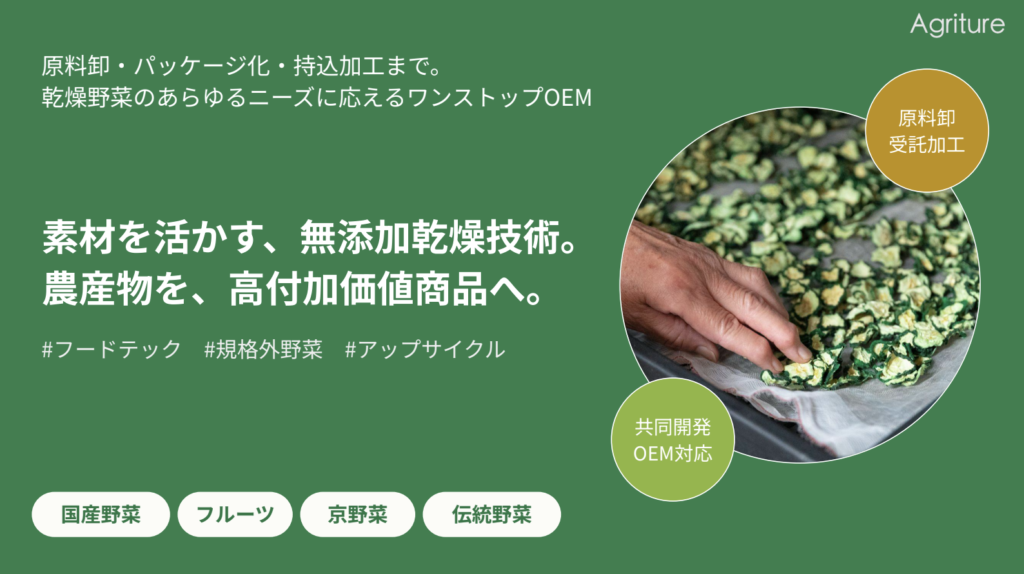
- OEM available from small lots of 10 kg
- Drying of brought-in raw materials also possible
- Support from processing to filling in one place
FOR BUSINESS
乾燥野菜を業務用でお探しですか
国産の野菜・果物を乾燥し、必要に応じて粉砕してお出ししています。扱っている品目は100種前後で、規格は 乾燥品の一覧・パウダーの一覧 に掲載しています。
少量でのご購入は、姉妹ブランドの通販サイト OYAOYA で承っています。
FAQ
What is the most popular ingredient for freeze-drying?
For confectionery and sweets, strawberry is overwhelmingly popular, followed by mango and blueberry. In the instant food field, miso soup ingredients (tofu, wakame, green onion, egg) and zenzai (adzuki beans, shiratama, mochi), along with soups, are the staples. They are widely used in Amano Foods-style instant products and Muji ingredient-focused products.
How large is the minimum lot for freeze-drying?
It depends on the ingredient and equipment, but for strawberries around 500 kg of fresh raw material is typical. Because they hold a lot of water and yield is low, the finished weight drops to roughly 5-10% (30-50 kg). Small-lot prototyping can be discussed by combining with a partner factory.
How should I choose between freeze-drying and hot-air drying?
High-value products that need to keep their color, aroma, and shape (strawberry, mango, premium confectionery, miso balls, zenzai) go to freeze-drying, while ingredients where you want to avoid dulled color and keep processing costs down (grains, tubers, vegetables before milling) tend to go to hot-air or low-temperature drying. Choose based on the final product's price range and appeal.
How do I choose the shape (whole, slice, dice, powder)?
Can I consult about freeze-dried ingredients for OEM?
Yes. Starting with Kyotango-grown strawberries, Agriture handles OEM and commercial supply of freeze-dried strawberry, mango, blueberry, miso soup ingredients, and zenzai ingredients. Small-lot prototyping can be discussed through a hybrid arrangement combined with partner factories. Food OEM no Madoguchi (Agriture) Please consult us.
Summary
The ranking of popular freeze-dried ingredients shifts significantly by application. For confectionery and sweets it's strawberry, followed by mango and blueberry; in the instant field, dried ingredients for miso soup, zenzai, and soups; and for nutritional foods, antioxidant fruits and protein ingredients are the staples. For shape, choose from four types—whole, slice, dice, and powder—the one that fits your product appeal and processing line.
Because a minimum lot of around 500 kg and processing costs constrain the design, running small-lot prototypes in combination with a partner factory is the realistic approach. For details, see Minimum lot・Processing cost・Commercial freeze-dried strawberries. For OEM consultations, Food OEM no Madoguchi (Agriture).
Download the OEM contract processing materials
We will send the materials to your email address based on the information you provide.
If you are considering product development with off-spec or your own farm's vegetables:From planning to processing, materials, package printing and novelties, you can consult us through a single point of contact. → Learn more about one-stop product development
- Freeze-Drying Minimum Lots: Small-Lot Ordering and Choosing a Manufacturer
- How to Use Fruit Powder | Substitution Design for Confectionery and Sweets
Author of this article
Related articles
-
 Original coffee marketing strategy | Ways to grow sales
 -
 ベジタリアンとは?国の規格が分けている4つの区分と食べられないもの
 -
 長ねぎと白ねぎは同じもの?ねぎの種類と呼び名を国の資料で確かめる
 -
 柚子の種類は何種類あるのか、公の資料で名前が残る系統を数えた
 -
 ゆずの時期は年に二度、青ゆずは7月から黄ゆずは10月から
 -
 ゆずの産地は高知が半分を占め、二位は徳島から愛媛に変わった
 -
 Preventing Food OEM Failures: Common Failure Cases and Countermeasures for Success
 -
 How to find a food OEM | How to efficiently find the best manufacturing partner