
Freeze-Drying Processing Costs | Price Ranges by Product and Lot

Summary of this article
We organize freeze-drying processing costs as: finished-product type at 80–500 yen per serving, and material type at 3,000–15,000 yen per kg (split by domestic/imported). It covers everything from prototyping at 30,000–150,000 yen, unit prices by lot scale, cost-reduction techniques (shape / raw material / pre-treatment / packaging), to concrete checklist items for choosing a processor.
The cost range for freeze-drying processing varies greatly with the material's moisture content, yield, lot scale, shape (whole / slice / dice / powder), and packaging spec. Finished-product types (miso soup, soup, zenzai) run 80–500 yen per serving, and material types (freeze-dried strawberries, fruit powder) run a range of 3,000–15,000 yen per finished kilogram. To avoid going over budget or compromising on quality on a first order, the key is to grasp the cost structure and market sense of prototyping and mass production.
This article organizes freeze-drying processing costs, cost trends by lot, prototype-cost guidelines, cost-reduction techniques, and checklist items for choosing a processor. Agriture handles a hybrid of small-lot prototyping and mass production, from sourcing Kyotango-grown strawberries to freeze-drying at a partner factory. Related article: Popular-material ranking/Minimum lot/Commercial freeze-dried strawberries。

TOC
The cost range for freeze-drying processing
Freeze-drying costs are made up of four elements: raw-material cost, processing cost, setup cost, and packaging cost. Because they vary greatly with material and lot scale, the market sense changes depending on whether you view it "per serving" or "per kg."
Cost range by product type (guideline)
| Product type | Per-serving market rate | Main breakdown |
|---|---|---|
| Instant miso soup | 80–200 yen | Ingredients, miso, individual packaging |
| Zenzai and Japanese sweets | 150–350 yen | Raw-material cost of azuki, shiratama, and mochi is a large share |
| Soup and risotto | 200–500 yen | Unit price rises with the variety of ingredients and seasonings |
| Block type (Western-style and Chinese-style soups) | 150-400 yen | Integrated processing of ingredients plus seasoning |
| Freeze-dried strawberries (imported, mass-produced) | 3,000–5,000 yen/kg (finished) | Premised on overseas-grown raw material and large lots |
| Freeze-dried strawberries (domestic, Kyotango and the like) | 8,000–15,000 yen/kg (finished) | Domestic raw material, premium appeal |
| Fruit powder | 5,000–15,000 yen/kg | Freeze-drying plus a grinding step is added |
The figures vary with the processor, equipment, and quality requirements, so it's premised on getting the actual quote based on a specification sheet.
The market rate for prototype costs
- Prototyping on a small machine: Around 30,000–50,000 yen (in the 10kg range, sample quality)
- Test production on a large machine: Around 50,000–150,000 yen (in the 100kg range, for sales testing)
- Number of adjustments: Because a prototype cost is incurred each time you change the formulation or size, nailing down the spec before ordering brings down total cost
- Raw material cost: Not needed if you bring it in yourself; added separately if the processor sources it
Factors behind cost differences by material
The material's moisture content and yield greatly affect the overall processing cost. A material with 90% moisture, strawberry requires around 10kg of raw material per finished kilogram, and it's not unusual for the raw-material cost to take a share larger than the processing cost.
- Materials with high moisture content (strawberry, tomato, leafy greens): yield 5–10%, requiring about 10× raw material per finished kilogram
- Materials with medium moisture content (mango, blueberry): yield 10–15%, raw material 6–10×
- Materials with low moisture / already processed (azuki, shiratama, tofu): yield 20–40%, raw material 3–5×
Cost comparison by lot
Because a freeze-drying unit's operating efficiency is determined by the input volume per batch, the per-serving and per-kg unit price moves greatly with lot scale. The smaller the lot, the more setup cost and equipment idle time ride on the unit price; the larger the mass production, the lower the unit price—that's the structure.
A sense of unit price by lot scale
The way unit price moves differs slightly between finished-product type (per-serving unit price) and material type (per finished-kg unit price). For the material type, the unit-price drop at mass production is smaller; for the finished-product type, the impact of setup cost is large, so the unit-price rise at small lots is larger.
| Lot scale | Unit-price trend for the finished-product type | Trend for the material type (per-kg unit price) | Suitable situation |
|---|---|---|---|
| Prototype (raw material 10–50kg) | Out of scope for a quote. Prototype cost is fixed | Prototype cost 30,000–150,000 yen | First prototype, before recipe finalization |
| Small lot (100–500 servings / raw material 100–300kg) | 1.5–2× the mass-production rate | 1.3–1.8× the mass-production rate | Limited sales, test marketing |
| Medium lot (1,000–5,000 servings) | Starts to ride the mass-production line | 1.1–1.3× the mass-production rate | D2C subscription sales, seasonal-limited products |
| Mass production (5,000 servings and up / raw material 500kg and up) | Unit price drops the most | Unit price drops the most | Standardization at major retail and mail-order |
Deciding between small and large lots
- from small lots: When you want to curb inventory risk, gauge market response, or run limited sales
- Large lot: When the sales plan is firm and you want to lower the unit price to secure margin
- Phased approach: Scale up in stages—prototype 10–50kg → limited sales 100–300kg → mass production 500kg and up
- Best-before date: Freeze-dried products keep 1–2 years at room temperature, but decide order volume from the combination of sales pace and inventory turnover
FOR BUSINESS
乾燥野菜のOEM・受託加工を承ります
国産の野菜・果物の乾燥、100メッシュ相当までの粉砕、10g以上の小袋充填までをお受けしています。小ロットの試作から量産までご相談ください。寄せられた相談の実例は OEM・卸のご相談 に掲載しています。
乾燥品の賞味期限は、出荷日から6ヶ月程度を目安にご案内しています。
Practical techniques to cut processing costs
Ways to lower cost without dropping quality lie in four areas: shape, raw material, lot, and packaging. Rather than blindly hammering down the unit price alone, the key is to start from the points where you can improve efficiency on a total-cost basis.
Lower the unit price through shape selection
- Whole: Yield drops and unit price rises to preserve shape. Avoid it except for gift and decorative uses
- Slice and dice: Since chips can be tolerated, yield is stable. Sufficient for confectionery and bakery uses
- Powder: Because grinding is assumed, you needn't worry about shape loss and yield is maximized. Suited to beverage, drink, and cream uses
Raw material procurement ingenuity
- Using out-of-spec / B-grade goods: Adopting material that only looks bad but has no issue with taste lowers the raw-material cost
- Bulk sourcing in season: An operation of processing in bulk at harvest time and supplying year-round curbs the raw-material unit price
- Growing-region contracts: Signing an annual contract with a farm or growing region makes you less affected by market-price fluctuations
- Shorten drying time with pre-treatment: Making the material's thickness and sugar content uniform shortens drying time (= electricity cost and machine occupancy) and lowers processing cost
Lot consolidation and packaging optimization
- Consolidated ordering of multiple varieties: Running multiple SKUs through the same equipment lowers the setup cost relatively
- Reviewing the individual-packaging spec: Simplify the multi-layer aluminum-laminate structure; review whether an oxygen absorber is needed
- Standardizing the outer packaging: Curb printing costs with off-the-shelf boxes plus label stickers, switching to original printing only at mass production
Checkpoints for choosing a manufacturer
Judge cost not by the total on the quote alone, but by the transparency of the breakdown and the conditions under which extra costs arise. Even a cheap quote can end up expensive if extra costs pile up.
Cost items to look at in a quote comparison
- Processing cost (per kg or per serving): Is the unit price by lot scale clearly stated
- Setup cost: A fixed cost per batch. The impact is greater the smaller the lot
- Raw-material cost: Varies greatly by whether you bring it in or the processor sources it
- Packaging and inspection costs: Individual packaging, lot-number printing, presence of metal detection
- Prototype cost: Can you negotiate a reduction on a mass-production premise
Items to check for quality and track record
- Status of certifications (HACCP, ISO, FSSC 22000, etc.)
- A mass-production track record with major food makers
- Raw-material handling capability (accepting brought-in material, region specification, variety specification, experience processing high-sugar or high-viscosity materials)
- Pre-treatment handling (cutting, blanching, sugar-content adjustment, etc.)
- Presence of a grinding step (whether they can handle everything through to powder processing)
- Packaging design including moisture-absorption countermeasures (aluminum laminate, oxygen absorber, silica gel)
- Reproducibility between prototype and mass-production machines (whether the prototype quality can be carried straight to mass production)
- A setup able to handle everything in stages, from small lots to mass production
Agriture's scope of support
Agriture has its own raw-material sourcing routes, such as Kyotango-grown strawberries, and handles the freeze-drying step through cooperation with a partner factory. It's a setup easy to use in the launch phase for D2C, small and midsize makers, and subscription brands.
- Raw-material sourcing: domestic raw materials such as Kyotango-grown strawberries, stably supplied on a growing-region-contract basis
- Phased scaling possible from prototype 10–50kg to mass production 500kg and up
- Quote breakdown: presents raw-material cost, processing cost, setup cost, and packaging cost separately
- A design that, in exchange for cost easily running high with domestic raw materials, makes it easy to raise the selling price through premium appeal
We have materials available to help you understand dried processing OEM
Agriture OEM, flexibly handling everything from small lots to large lots
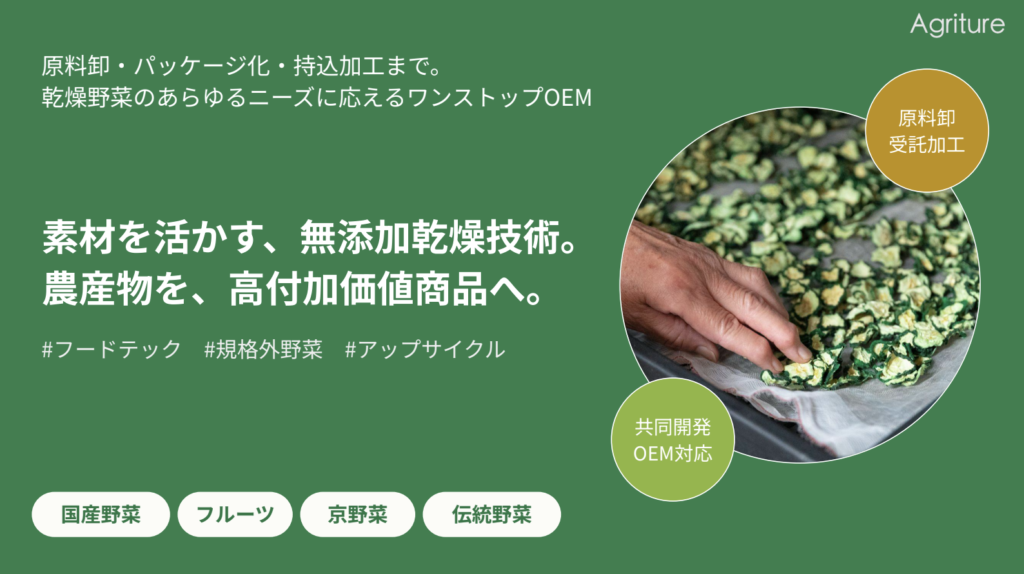
- OEM available from small lots of 10 kg
- Drying of brought-in raw materials also possible
- Support from processing to filling in one place
FOR BUSINESS
乾燥野菜のOEM・受託加工を承ります
国産の野菜・果物の乾燥、100メッシュ相当までの粉砕、10g以上の小袋充填までをお受けしています。小ロットの試作から量産までご相談ください。寄せられた相談の実例は OEM・卸のご相談 に掲載しています。
乾燥品の賞味期限は、出荷日から6ヶ月程度を目安にご案内しています。
FAQ
What's the market rate for freeze-drying processing per serving?
It varies by product type. For finished-product types, the guideline is instant miso soup 80–200 yen, zenzai and Japanese sweets 150–350 yen, and soup and risotto 200–500 yen. For material types (freeze-dried strawberries, powder), viewing them by finished per-kg unit price is the easier unit for comparison.
Why does the processing cost for strawberries get high?
Because the moisture content is about 90%—high—and the yield is a low 5–10%, around 10kg of fresh raw material is needed per finished kilogram. In some cases the raw-material cost takes a share larger than the processing cost, and the basic approach is to estimate including the cost of raw-material loss.
About how much are prototype costs?
The guideline is 30,000–50,000 yen for prototyping on a small machine (in the 10kg range) and 50,000–150,000 yen for test production on a large machine (in the 100kg range). Because a cost is incurred per adjustment, nailing down the specification sheet before ordering brings down total cost.
How much does the unit price rise if I order in a small lot?
Generally it becomes about 1.5–2× the mass-production rate. This is because setup cost and equipment idle time ride on the unit price, so a realistic design is to accept it on the premise of use in limited sales and test marketing, and lower the unit price when moving to mass production.
What's the most effective way to cut cost?
The three effective ones are "reviewing the shape (whole → slice / dice)," "using out-of-spec / B-grade raw material," and "consolidated ordering of multiple SKUs." Rather than the idea of lowering the unit price after moving to mass production, optimizing the cost structure at the spec-design stage is more effective in total.
Summary
Freeze-drying processing costs vary greatly with product type, material, lot scale, shape, and packaging. The basic ranges are: finished-product types 80–500 yen per serving; freeze-dried strawberries 3,000–5,000 yen/kg imported and mass-produced, 8,000–15,000 yen/kg domestic; and prototypes 30,000–150,000 yen. Because small lots become 1.5–2× the mass-production unit price, optimize cost through phased operation—prototype → limited sales → mass production.
Related article: Popular-material ranking・Minimum lot・Commercial freeze-dried strawberries. For cost inquiries, Food OEM no Madoguchi (Agriture).
Download the OEM contract processing materials
We will send the materials to your email address based on the information you provide.
If you are considering product development with off-spec or your own farm's vegetables:From planning to processing, materials, package printing and novelties, you can consult us through a single point of contact. → Learn more about one-stop product development
- Commercial Freeze-Dried Strawberry | How to Choose Shape and Growing Region
- Freeze-Drying Minimum Lots: Small-Lot Ordering and Choosing a Manufacturer
Author of this article
Related articles
-
 Original coffee marketing strategy | Ways to grow sales
 -
 ベジタリアンとは?国の規格が分けている4つの区分と食べられないもの
 -
 長ねぎと白ねぎは同じもの?ねぎの種類と呼び名を国の資料で確かめる
 -
 柚子の種類は何種類あるのか、公の資料で名前が残る系統を数えた
 -
 ゆずの時期は年に二度、青ゆずは7月から黄ゆずは10月から
 -
 ゆずの産地は高知が半分を占め、二位は徳島から愛媛に変わった
 -
 Preventing Food OEM Failures: Common Failure Cases and Countermeasures for Success
 -
 How to find a food OEM | How to efficiently find the best manufacturing partner